
Your wildly multifarious home!
Feed aggregator
Why is the Ogre there?
Joe's post on the Quantum Ogre raises an old question about sandbox play: when does moving an encounter around interfere with players' freedom to decide what their characters do?

Where I disagree is that players' choices matter. It doesn't matter to me whether they made an informed choice or the choice resulted from blind chance. What matters is the consequences of that choice.
Suppose there is a fork in the road. They know nothing about either path. They choose the left fork. Joe argues that if they know nothing about either path, then putting a prepared encounter, like an ogre, on either road doesn't cost them anything.
For me, the question is different.
Why is the ogre there?
To answer that, I look at how I described the setting and the campaign's current circumstances. But another factor is particularly relevant in Joe's post. Whether anything was prepared at all; thus, both roads could represent a blank slate.
Part of my Bag of Stuff consists of prepared encounters that aren't tied to a particular region or location. So how is using something from my Bag of Stuff any different from what Joe is doing by placing the ogre encounter regardless of which fork is taken?
The difference is that Joe's procedure allows the ogre to be placed on whichever road the players choose because nothing distinguished the roads beforehand. What I do instead is look at what I know about each road, make a short list of what could be there, and roll to see if the result is an ogre on the list, since the chosen road runs through some hills. Then I will use that ogre encounter in my Bag of Stuff.
I do this to discipline myself so that I always follow through on the consequences of the players' choice instead of changing the circumstances because I have something prepared that would be convenient to use. To be clear, rather than treating the "blank slate" as permission to use something I prepared, I treat it as an uncertain part of my setting that I need to resolve during the session.
That said, I like and agree with quite a bit of Joe's post.
There is a section where he had a goblin cave prepared. The goblins were causing trouble for some local halflings, but the players opted to deal with some orcs instead. As the campaign progressed, Joe adjudicated that the halflings took care of the goblins themselves.
Joethelawyer, Quantum Ogre
Another variation on this I’ve experienced as a GM is where the encounter is more than just a basic bullshit ogre on the road or goblin ambush. For example, I made up a large cave complex where a clan of goblins lived, and they were raiding the halfling lands around. The PC’s had a choice to go there, or to orc caves, or a couple more places. They went to the orc caves, kicked their asses. Through roleplaying later, the halfling village they saved said they’d take care of the goblins, thanks for the help.In my view, this represents World In Motion, an aspect of a Living World Sandbox. That is, as players make their choices and act accordingly, the other inhabitants aren't standing still but making decisions themselves. In this case, to finally deal with those pesky goblins once and for all.
As for the prep, it went back into his Bag of Stuff and was repurposed later with different inhabitants and circumstances, which is exactly what the Bag of Stuff is for.
The goblin caves went unused. It would be a bullshit move as a GM to have the PC’s encounter the goblin caves in the next encounter. But there’s nothing wrong with using it in the future. I reskinned it a bit, added a two-headed troll, and used it as an encounter with a different group. I could have used it with the same group once enough time had passed, and it was in a different place.
If you are interested in my ideas behind my Living World Sandbox. I have a blog post below summarizing what that type of sandbox campaign entails.
And I collected all my posts on Sandbox Campaigns on this page.
Categories: Tabletop Gaming Blogs
Doctor Who: A New Era Begins in 2028
The Doctor Who tender process moves forward, with the BBC sharing details of the brief for the 2028 relaunch
After months of anxiety among fans, a path for the future of Doctor Who is emerging as the BBC officially begins the tender process. As Blogtor reported at the time, they originally announced their plans back in June. They’ve now completed putting together the tender document, which officially invites production companies to submit their bids for making the show.
This new development isn’t really much of a surprise. While fans with longer memories may recall the early 1990s when vague platitudes about ‘exploring options’ for the show’s future were cover for a lack of will to bring it back at all, that was never going to be the case today. The tender process is now standard across the whole of the BBC. For example, Casualty and Strictly Come Dancing are also among the flagship programs to go through it. Certainly, the BBC would never have jeopardised their future relationships with other production companies, by leading them to invest money in early plans to bid for a tender that was never coming.
The cancelling of the 2026 Christmas Special may have seemed alarming. In reality, it was effectively to allow the tender process to kick off now. And, therefore, to get Doctor Who back on screens full time as soon as possible.
The new production team will be announced in March, immediately starting work on new specials and episodes for 2028/2029
The timeline the tender document lays out is as expected too, based on how long it took other shows to go through the process. Doctor Who’s new team will be announced in March 2027. They’ll immediately be working to having the show back on screens in the financial year 2028/2029. That’s a faster turnaround than the two previous times the show’s production effectively started from scratch. Work on both 2005’s Series One and 2022’s 60th Anniversary specials began two years in advance. However, the nature of the tender process itself means that the winning bidders will already have laid substantial groundwork ahead of March 2027.
By then, prospective producers will have broad plot outlines of their ideal season. This include possible episodes, and character guides for their new Doctor, companions, and any supporting cast. While not an absolute requirement, the winners will likely also have lead actors and writers already ‘attached’ to their plans. (‘Attached’ being the vague state where typically discussions have confirmed an actor’s interest in a role, and their position as the producers’ first choice, without them being officially under contract.)
Similarly, the winning bid will also have proposals in place for a production base, studio, and so on. It’s highly likely to also include details of how they’re sourcing crew, what FX houses are on standby to provide visuals and more. All in all, the winners will hit the ground running as soon as they receive the green light.
Doctor Who filming has become a regular sight on the streets of Cardiff since 2004 (c) BBC Studios Doctor Who will remain a production supporting the UK industry in the regions, but a move from Wales isn’t entirely ruled out

One of the detailed requirements in the document is that Doctor Who should remain a regional production. The BBC have a clear preference for it remaining in Wales, but are open to the possibility of using it as a hub for investment and industry growth in other regions.
Another detail worth noting is that the initial contract is for one season, and associated specials, with an option for the BBC to renew for one more. Further seasons after that will see the contracts renegotiated. It’s worth bearing in mind that the multi-season renewals given to Doctor Who over the years have always been the exception to the rule. So while fans might have welcomed the security of a longer deal, this is the treatment most shows get.
A number of production companies and potential showrunners have already expressed interest in bidding for Doctor Who. However, the tender requirements seem to rule two of them out immediately. Applicants must have experience of British television, having produced at least one television show in the UK that lasted at least three seasons, with seasons of at least six episodes each. Although prominent figures in international genre movies and television, neither Dean Devlin’s Electric Entertainment (The Librarians, Leverage) or J Michael Straczynski’s Studio JMS (Sense8) have that track record in the UK.
The two eligible production companies to go public with their ambitions so far are BBC Studios and World Productions
The two remaining companies to go public with an interest are BBC Studios and World Productions.
BBC Studios’ experience of making shows for the BBC goes without saying, and their presence in the process is basically a guarantee that Doctor Who will continue regardless of the other submissions. World is a British company perhaps currently most famous for their collaborations with Jed Medcurio, creator of Line of Duty, one of the BBC’s biggest rating hits of the past decade. With over 35 years of experience, they’ve been responsible for series like 90s vampire thriller Ultraviolet, which launched Idris Elba’s career, political dramedy Party Animals, which launched Matt Smith’s, political thriller Bodyguard, and international murder mystery Vigil.
World also very much tick the box for regional productions. Notably, they’re currently filming a seventh season of Line of Duty in its regular production home of Northern Ireland. At this stage Belfast is as familiar as Cardiff with being transformed into English cities (though if it does become home to Doctor Who, Blogtor expects the odd Translink bus to sneak into the background.) They’ve also produced three seasons of Vigil in Scotland, with the most recent run transforming the University of Stirling campus into an Arctic research base.
SNL’s George Fouracres is likely just the first of many names to be linked to the role in the media over the coming months For obvious reasons, production companies vying the the job are unlikely to share their plans until the decision is final

However, there’s no reason to think other production companies haven’t simply been working quietly away on their pitches less publicly. Blogtor Who will keep you updated as we hear more, but it’s actually possible the final winning tender next March will be a total surprise.
Indeed, fans should be aware that during this delicate phase, competitors will want to keep details of their plans under wraps. So nobody should be too alarmed by long periods of radio silence on Doctor Who between now and March. On the other hand, of course, some bidders may try and build momentum and public enthusiasm for their big by discreetly leaking things like which actors they’ve been talking to. Even if they don’t, the British tabloids will likely leap on every possible connection, so brace yourself for some wild speculation in the coming months. Recent talk of Saturday Night Live’s George Fouracres is almost certainly just the beginning of a rumour mill that will spin freely from the sublime to the ridiculous.
The new era represents the biggest reinvention of the show since 2005, but some elements will remain firmly the same
What can we say the new era of Doctor Who will be like, based on the tender document? Well it will involve a season of episodes and at least one special, to be broadcast sometime between April 2028 and March 2029. There’s nothing more specific about timing than that, but it wouldn’t be surprising if the new era launches with a 2028 Christmas Special before a full season in early Spring 2029. There’s a strong implication that there must be at least six episodes in the season, but that doesn’t mean contenders won’t pitch for a longer run. The BBC are open to pitches for both runs of individual, standalone episodes or one serialised story across the season.
There will be the Doctor and at least one, possibly more, companions. As in the past few decades, the companion will be the “access point for audiences.” This doesn’t mean that they have to be a human from contemporary Earth, but it seems likely we’ll still have to wait for the next robot dog, alien, or astrophysicist from the future. Another way the next generation of companion will keep to recent precedent is in being definitely a co-lead of the show. They will be “distinctive, authentic characters in their own right, whose lives, relationships, ambitions, and personal journeys enrich the series”
The TARDIS is returning, with a mission to be “relevant, surprising,brave, and inspiring” (c) BBC Studios The new version of the show will feature a mix of high concept science fiction, emotion, and behind the sofa scares for a family audience

The new Doctor Who will strike a balance between keeping the familiar concept and tone, and not just being more of the same. There’s disappointment for anyone hoping for a shift to a more ‘adult’ show, and the new era will still target a broad family audience. Individual stories will continue, too, to focus on human emotion amid the alien invasions, and celebrate traditional Doctor Who values like intelligence and compassion.
In places the tender invitation still sounds striking similar to Russell T Davies’ own proposal document back in 2003. The new description reads:
“Stories should balance high concept science fiction with strong emotional narratives, ensuring that spectacle is always grounded in character and human experience. Episodes should transport audiences to extraordinary times and places, ranging from historical settings to distant futures, alien worlds, and contemporary Earth. Successful pitches will deliver ‘back of the sofa’ scares, jeopardy and tension, whilst remaining suitable for a broad family audience. Doctor Who embraces themes that celebrate curiosity, courage, intelligence, and compassion, themes that interrogate the human condition.”
Against that, pitches are also “an exciting opportunity to innovate and surprise,” while offering “a new perspective that ensures Doctor Who remains relevant, surprising, brave and inspiring for both long-standing fans and new audiences.”
In short, the BBC want a mix of horror, character drama, high concept science fiction, and inspiring values comparable to that of the Davies, Moffat, and Chibnall eras. But they invite would be showrunners to deliver that in a new way the BBC themselves would never have thought of.
The process will move quickly, with the deadline for submissions on the 2nd of October, and more detailed proposals to be in by the 23rd
The next milestone in the rebirth of Doctor Who will be at 2pm on Friday the 2nd of October, a mere two weeks from now. That’s the deadline for any interested parties to submit their tender applications. A week later, on Friday the 9th of October, the BBC will notify all those who’ve met its eligibility requirements. Those candidates will then have just another two weeks to prepare their initial proposal of their vision for the show, with a deadline of 2pm the 23rd of October. (You can see why Blogtor Who suggested companies probably already started developing their ideas back in June, if not before).
That’s when the fun really begins as applicants begin working up their season plans in detail across November and December, ahead of parallel production meetings with the BBC in January, and a final decision on the winning bid in March.
Again, even as these milestones pass behind closed doors, expect very little information to reach the public domain. However, Blogtor Who will make sure to keep you up to date with all the news about this bold new future for Doctor Who, as we hear it.
In the meantime, you can read the invitation, and the entire tender document, for yourselves at the official BBC site here.
The post Doctor Who: A New Era Begins in 2028 appeared first on Blogtor Who.
Categories: Doctor Who Feeds
The Unleashing of St. Nimuanne
Lixu
Lixuni Gaming
OSE
Levels 1-6 (ha!)

Lixuni Gaming
OSE
Levels 1-6 (ha!)
Centuries ago, a mortal Myrenean queen named Nimuanne used forbidden rites at a sacred menhir field to transcend death, splitting her essence into three fragments upon her final death: Body, Mind, and Spirit. Grave robbers broke open the funerary urn containing these fragments, plunging the region into a desperate crisis.
This 79 page adventure presents four or five dungeons with ten to twenty locations each, plus a few small towns in a small region that is having some troubles. Its abstracted text seems out of place given the page count, with a lack of anything specific going on in the adventure.
Ok, so, I got some things to say. And this adventure probably doesn’t deserve to be the one I go off on. It’s not a disaster.
But, also, this sentence appears in the adventure: “That independence became its undoing: no walls, no militia, no warning before its own monks were the first to fall when the Mind Stone took root beneath them, spreading house to house until the entire town turned in what may have been a single night.” I have a blind spot when it comes to spotting AI. But, the triple negative is a a hallmark of AI. I’m not even going to mention the end of that sentence, just focusing on the triple negative. It stands out like a sore thumb. And it’s listed as human created with no AI. I’m no “AI is the bogeyman and everywhere!” kind of person, but this sticks out.
I think, though, what stood out the mot for me in this adventure was the page count vs the dungeon content. I’m not sure how to frame this so people will understand. The dungeons here are relatively small, ten to twenty rooms. The room descriptions are rather minimal, a sentence or two. “Cell 3. A single unlabeled potion of climbing, tucked behind a loose stone, easy to miss without a search.” Or, for a longer room “Storeroom. Broken crates, moldering sacks, the smell of old grain gone to rot. 2 Shambling Husks stir. Loot: a locked strongbox (30gp), and a scroll of protection from undead, wax seal still faintly intact.” Even that is pretty light. And there’s nothing wrong with that. But, that also means that the dungeon keys fit on a page or maybe a little more, for a ten room dungeon. And there are only, I don’t know, four or so dungeons in this? That’s only a small number of pages. But this is an eight page adventure. I have no idea, honestly, no idea, what those pages are being used for. Stat blocks at the end, tables at the end, maps, I guess. It’s just so offputting. To see a large page count and then see the size of the dungeons and the minimal room descriptions.
Because the rest of the content, those in between pages, are not exactly stellar. The local lord is having a dream about three locations. Go check em out and defeat the evil one. I know, I know, i’m hyperbolic, but this is almost the extent of what you get to help launch the adventure. Go ahead and get the party moving based on that. Because that’s about all you’re getting. Oh, there’s a fuck ton of explaining and backstory and so on, but I think thats being confused for gaeable content. The actually hooks in, the specificity, is not there at all. This is supposed to be a sandbox like thing. Do the three in any order and then end up at the final dungeon. But its all so very loose. Maybe, I mean abstracted. “Hey, there’s a ransacked village with some pod people in it. You need the party to en up at the local monastery.” Again, hyperbolic, but not by much. But, then, also, augment that with a whole lot of backstory that isn’t really relevant to the game at the table.
The emphasis here is on the wrong things. You can, as Stonhell demonstrated, get away with some minimal keying. But you do this by adding context and specificity around the general situation in the area. There are things going on, the place is alive, as noted in the general notes for the level/area. This allows for a rather shorter dungeon key entry. But, importantly, we cannot mistake historical background for “current situation.” Or even, the current situation for “this shit will impact game play.” If it’s not impacting game play then it’s just padding. A line or two od padding, thrown in here or there, might be fine. You can’t lose sight of the goal: supporting the game at the table. In looking at a page long NPC description, does it matter that dude grew up an orphan? Almost certainly not.
This misses the mark with nearly everything. Yes, it does have some interconnected dungeons that are coherent enough to run. But any specificity, in town, in the hook, in the wilderness, outside the dungeon, inside the dungeon, is essentially absent. Anything that could tie things together well and help the DM create the feelings of immersion that a ten session adventure would rely upon is not present.
Also, it’s mostly stabbin.
There is supposed to be a whole pod person thing going on in one area that can bleed over in to others. None of that comes through well. The interconnections and theming between the sites, doesn’t come across. And, finally, the last dungeon has three separate version, only one of which will be used. This would seem to be a waste.
It’s just weird, in the way it abstracted the content and yet is STILL quite lengthy.
This is $10 at DriveThru. The preview is fifteen pages. You’ll get some general overview, and none of the dungeons. That overview is, honesty, the most information you’re going to get about the hook and linking things together.
https://www.drivethrurpg.com/en/product/580488/the-unleashing-of-st-nimuanne?1892600
Categories: Tabletop Gaming Blogs
Video of the Day – Doctor Who: Highlights of Series 6, 2026
The post Video of the Day – Doctor Who: Highlights of Series 6, 2026 appeared first on Blogtor Who.
Categories: Doctor Who Feeds
Let's Do the GRIDSHOCK Again!

Paul Vermeren's game of futuristic, super-powered resistance fighters on the run is back in a new edition! The standalone game GRIDSHOCK ZERO, powered appropriately enough by Free League's Year Zero Engine is being crowdfunded now on Gamefound.

I've talked about my appreciation for GRIDSHOCK before. Paul has a familiar-but-fresh vision not really like anything else out there and he's assembled artists for this version (Simon Roy, Giannis Milonogiannis, and the returning Steven de Waele) to really give a great visual style.
I may even get a chance to pitch some adventure scenarios for it, so back it and stay tuned!
Categories: Comic Book Blogs, Tabletop Gaming Blogs
Video of the Day – BARK and Josh Horowitz, 2026
The post Video of the Day – BARK and Josh Horowitz, 2026 appeared first on Blogtor Who.
Categories: Doctor Who Feeds
REVIEW: Doctor Who: The Kaleidoscope
The Kaleidoscope is Jo Martin’s stunning debut novel, with the actor’s deep understanding of the Fugitive Doctor creating a compelling tale of memory and identity
Circuit Breaker is Doctor Who’s third epic cross-media event, following 2020’s Time Lord Victorious and 2023’s Doom’s Day. It was already head and shoulders above those efforts, but new full length novel The Kaleidoscope establishes it as one of the most compelling and significant Doctor Who stories of recent years. In many ways it calls to mind the old New Adventures credo. Like them it tells a story too deep and too broad for television. Time Lord Victorious’ concept of the Tenth Doctor going off the rails was enticing on the surface. But it could never really take that idea very far. Meanwhile, Doom’s Day asked for a lot of in investment in a brand new character. Both contained some great stories, but Circuit Breaker really shines in taking advantage of the Fugitive Doctor’s mystery and rougher edges.
Circuit Breaker is already the strongest of these events so far, and the new novel gives it true heart
The actual plot throughline of this arc has been looser than ever. All summer the Doctor’s been on a reverse scavenger hunt – returning items to their proper place in space and time. But that’s been the perfect way to give more breathing room to the storyline’s emotional core. The Kaleidoscope brings this to the forefront. Its novel format allows more access than ever to the Fugitive Doctor’s thoughts and feelings. Traditionally, few Doctor Who novels are told in the first person from the Doctor’s perspective, in order to help preserve their sense of unknowable mystery. But this Doctor is a mystery to herself, and more closed off than most to sharing with others. In addition, she’s an incarnation we barely spent any time with on screen, so she benefit from this chance to know her better.
The Kaleidoscope’s greatest asset in this is Jo Martin herself. The actor takes up the challenge of exploring her own character’s interior life with thoughtful precision and deep emotional intelligence. While this is her debut novel, Martin has written for stage and screen before and the result stands apart from other recent celebrity Doctor Who novels. It’s telling perhaps that the acknowledgements don’t suggest an established co-author. Instead, there’s merely thank to MG Harris and Steve Cole for editing and for providing details of Doctor Who lore. Meanwhile, the author’s notes make it clear that Martin has thought deeply about her version of the Time Lord. Far more than just tough and ruthless, this is the Doctor about as vulnerable and uncertain as we’ve ever seen them.
The Fugitive Doctor gains more depth and shades, as Jo Martin grants us a view behind the gruff exterior
The Fugitive Doctor series over at Big Finish tries its best to keep to Chris Chibnall’s suggestion of a vague placement for this incarnation. However, Martin herself obviously feels entitled to her own strong ideas about that. The result is the most satisfying and emotionally impactful story for her yet. It reframes the tale told in The Timeless Children, from one of a Division agent mind-wiped at retirement, to something more like Marvel’s Winter Soldier. A weapon to be reset and rebooted whenever, inevitably, she rebels again and again against their cruelty and cowardice.
This element skillfully unfolds from the Doctor’s initial boasting of her ‘Great Reserve’ – a Sherlockian mind palace of information and experience she doesn’t remember acquiring – to growing concern about why she doesn’t remember it. Why does she keep encountering people she’s never met but who definitely know her face? And why does she have such an instinctive affection for a second rate backwater planet like Earth anyway? These questions bring her from confidence through self-doubt, to ultimately a new determination to reclaim her own life.
In its closing chapters, The Kaleidoscope similarly redefines one of the most important relationships in the whole of Doctor Who. In doing so it also provides a compelling and heartbreaking new understanding of just why, as Amy Pond observed, the one thing the Doctor can’t do is leave a crying child.
Their quest takes the Doctor and Martha from London to modern Jamaica to a Jamaican space colony in the distant future, infused with Martin’s clear love for the island
All this character development for the Fugitive fits beautifully with the details of her and Martha’s latest mission. The supposed ‘kaleidoscope’ itself is actually an alien device for grounding memory at both at a cultural and personal level, designed to ensure a society never loses touch with its history. Appropriately, the main villains here to stop our heroes unlocking its secrets are the Silence. After all, another way to stop the Doctor ever speaking their name is to make sure they can’t remember it…
The Doctor’s personal journey and mission intersect in Jamaica. In the future, an isolationist colony world tries to hold a nostalgic notion of Old Earth Jamaica in amber forever. In the present, the Doctor and Martha travel to the real Jamaica and encounter a woman claiming to the Time Lord’s mother. Throughout both, Jo Martin’s love for her own parents’ homeland shines through. The novel is full of fond observations about the island’s people, language, and unique character. It’s this, as much as the author’s closeness to the role she played on television, that gives Kaleidoscope a sense of deep authenticity.
All the chapters in Circuit Breaker stand alone as well as being part of the wider arc, but if you only pick up one it should be The Kaleidoscope
The science behind the kaleidoscope may be questionable even by Doctor Who standards. Clues about a particular character, presumably to pay off in Circuit Breaker’s finale, may be laid on so thickly you could hang wallpaper with them. But this is a blisteringly good Doctor Who novel. It’s also an astonishing debut novel in its own right, if one likely to be overlooked by critics due to its TV tie-in nature.
Big Finish provide the climax of Circuit Breaker with next week’s Full Circuit. Yet The Kaleidoscope will likely prove to be its real heart. Even if you only pick up one entry in this year’s event, make it this one.
Doctor Who: The Kaleidoscope. Cover by Lee Binding (c) Penguin Books Doctor Who: The Kaleidoscope

When memories lie, the truth can be fatal.
In the aftermath of an improbable mission, the Fugitive Doctor and Martha realise that something is interfering with their minds. Something that doesn’t want to be found.
Their investigation leads to a curious artefact in the British Museum: an apparently medieval toy known as the Kaleidoscope. But the object refuses to stay in one place, one time – or one identity. And when the Doctor is repeatedly mistaken for someone she’s never met, fragments of unfamiliar memories begin to surface.
Across the Earth, a hidden pattern emerges; evidence of a secret that someone has gone to extraordinary lengths to conceal. As ancient enemies close in and innocent lives are put at risk, the Doctor learns the hard way that some truths were buried for a reason…
The Kaleidoscope is out now, and you can buy your copy at all good bookshops or at the links here.
The post REVIEW: Doctor Who: The Kaleidoscope appeared first on Blogtor Who.
Categories: Doctor Who Feeds
Video of the Day – Doctor Who: Circuit Breaker, 2026
The post Video of the Day – Doctor Who: Circuit Breaker, 2026 appeared first on Blogtor Who.
Categories: Doctor Who Feeds
Crochet and Catch Up with Moogly - September 16, 2026
If you're lucky, the temps are finally starting to drop a bit - and the yarn is beckoning! Join me for another Crochet and Catch Up with Moogly as we chat about new patterns, upcoming events, fall projects, and maybe even a few sneak peeks. I'll be answering your questions live, too! You'll find links to […]
The post Crochet and Catch Up with Moogly - September 16, 2026 appeared first on moogly. Please visit www.mooglyblog.com for this post.
0
Categories: Crochet Life
Announcing 2000 AD: A Visual History
Fifty years after it exploded onto shelves and revolutionised comics forever, the visual story of how 2000 AD has evolved is to be told in a special book. 2000 AD:…
Categories: Comic Book Blogs
Marvel Comics Staff Face a Difficult Choice as New York Operation Moves to California
Marvel Comics employees are facing a major career and personal decision as the company prepares to relocate its New York-based comics operation to Burbank, California. Marvel, the iconic publisher that…
Categories: Comic Book Blogs
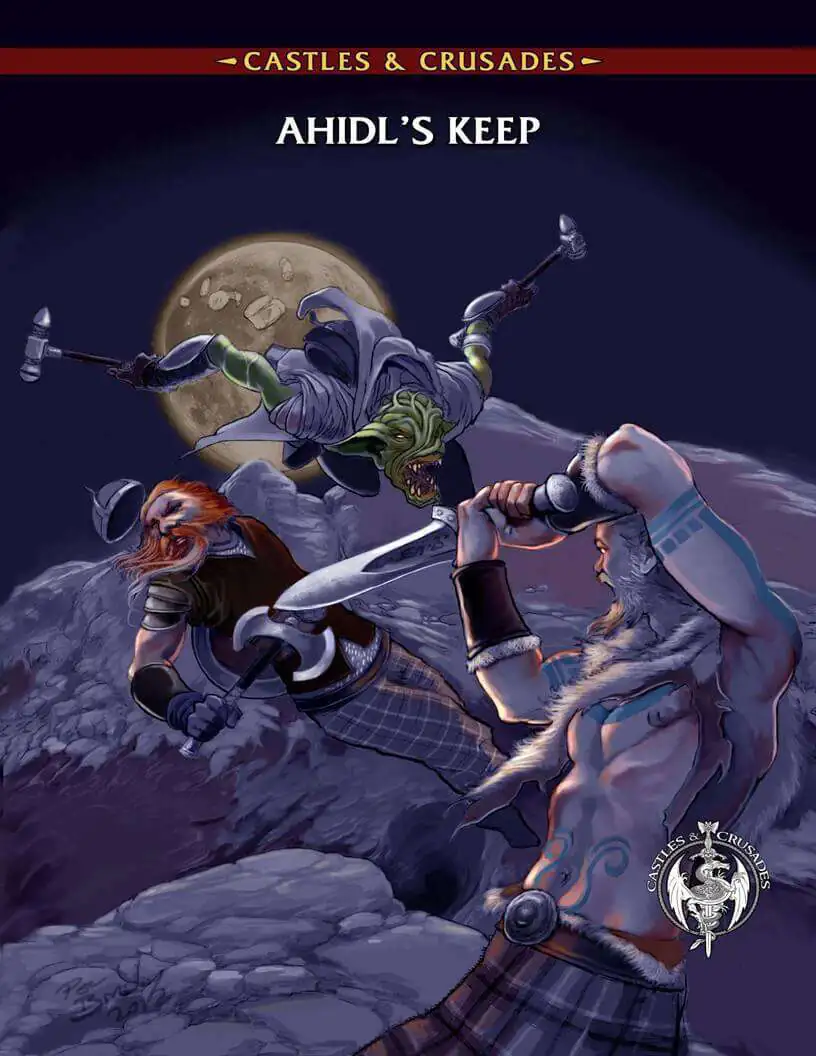
Ahidl’s Keep
By Jeremy Farkas
Troll Lord Games
Castles & Crusades
Level ... 3?
Troll Lord Games
Castles & Crusades
Level ... 3?
Dare you cross the vast desert and seek out the great red mesa where the near-mythical mine is rumored to lie? Dare you plunge the darksome depths of the labyrinth and wrest fortune and glory from its yawning chasm? Dare you seek out the legendary hammer Earthrender, which bestows lordship upon any dwarf who holds it aloft? Dare you discover the fate of the great wyrm Morglax the Bold, who brought her great host of bandits and monsters up from the south to snuff out Lord Ahidl-Mor and his kin?
This eighteen page adventure uses about fourteen pages to describe a thee levels dwarf “orcs in a hole” with about 35 rooms. Stuffed with humanoids, it uses a conversational style to present a lot of things to stab.
I’m not sure what to say here. You know all of those adventures that have a bunch of humanoids in a dungeon with some kind of backstory? This is one of those. In this case the humanoids are kobolds, goblins, orcs and bugmeans. Along with the required vermin, an abomination or two, and a young dragon at the end. And in this case the dungeon is a three level Lonely Mountain, with thew dwarves pushed out by orcs and a dragon and the old dwarf king leaving a clue where the entrance was, up to and including a secret entrance on a ledge. The required “broken dwarf elevator” is present.
Look, I don’t have anything positive to say. I guess I’ve got some negative things to point out. But, overall, there’s just not a lot here. This was a tourney module and then they added some content to try and expand it. I’m going to ignore the expanded content, a village and preamble adventure. I don’t think they really add anything interesting and are just padded out. If you just want to, I don’t know, enter a few rooms and kill a few things then I’ve got some great news for you about this adventure. It even has a few environmental things and light puzzels to solve! You gotta find the yellow control crystal to make the elevator work again! Uh. That didn’t come across well. If you want to stab things then you can, and there a few things to break up the stabbin.
Look, I know people like to stab. It is not lost on me that Chainmail exists. Chainmail, 3e, 3.5, 4e, the whole range, devoted to stabbin.I like to stab also. I like to stab as a means to an end. B/X is my favorite edition because of the balance there between stabbin as a means to an end rather than a tactical minis simulation. Ultimately I’m looking for something with a decent exploratory vibe, some roleplaying, and other interactivity in addition to the stabbin. And it has to be something a little more interesting than “find the gold key to open the gold lock.” And the adventure here is not altogether great in areas other than things to stab.
I’m also more than a little irked by many aspects of the C&C house style. Is any one thing terrible? No. Does it all annoy me? Yes. Like, no level range anywhere. I guess you just rush out and dump money at the new C&C adventure rather than looking for a specific adventure for a specific level range? Man, stick a fucking level range on it somewhere.
And the read-aloud here. You know the drill, fancy fonts with long italics make things hard t read. But, further, the read-aloud is all mixed up. We’ve got the famous second person stuff, with lots of “As you draw nearer, you clearly see …” writing, which should never be used. But, then, the bold/italics shifts. While read-aloud is in bolded italics so it DM text! Or, maybe its also read-aloud? It will just suddenly have what is obviously DM only information in the same bolded/italics. Huh? What’s the point then?
And then it’s padded ALL the fuck out. The house style loves to pad, but then the adventure does also. Creature stat blocks are long with phrasing like “Their primary attributes are physical. Their special abilities are dark vision and light sensitivity. In battle they use military forks that deal 1d8 damage, or short swords that deal 1d6 damage” As I get older the sublime majesty of the ready ref sheets becomes more and more apparent. No? You don’t agree? How about a very conversational tone in the writing, which forces you to wade through mountains of padding when locating information? “If for some reason the PCs feel compelled to loot Ahidl’s grave, “ Oh come on. What’s the point there?
And then in other places the information is absurdly out of order. AFTER a room description we get this little note “When the PCs get within 10 feet of the chamber prior, they must cross a steel tripwire just 6 inches off the ground.” That should, I think we can all agree, come BEFORE the room so the DM notices it before the party gets to the room. “Knock has no effect” ah, jesus man. It’s a low level adventure. Let the wizard use his fucking knock spell. It’s one less sleep he’ll have memorized, which is the entire point of utility spells. I can bypass this ther kind of challenge if I give up nuking a room of monsters. What’s wrong with that? Sounds like the D&D circle of life to me.
I’m looking at room 33 right now, titled Dragon Bones. There’s a paragraph of bolded italics read-aloud. Then there are five paragraphs of DM text that follow. There is nothing in those those five paragraphs related to the room, in play. The past sentence is “Searching the room will yield no secrets or great treasures.” It’s all backstory. A quarter page, or more? For one room?
I can excuse a lot of things as I’m Not In To That Style Of Play. But I can recognize how someone else might be. But, all of that text, for nothing? Wasted effort? Aimed at readers? Distracting from the purpose of the designer AND the purpose of a DM? Nope.
This is $7 at DriveThru. The preview is about a dozen pages, which includes a sizable number of rooms as well as some preamble text. More than enough to see what you’re getting yourself in to.
https://www.drivethrurpg.com/en/product/579756/castles-crusades-ahidl-s-keep?1892600
Categories: Tabletop Gaming Blogs
Wednesday Comics: DC, December 1985 (week 3)
I'm reading DC Comics' output from January 1980 (cover date) to the end of Crisis! This week, I read the comics on sale on September 19, 1985.
Warlord #100: Warlord hits 100 issues and Grell provides the cover. I reviewed it here.
Batman and the Outsiders #27: Barr and Davis have Halo getting a new, short, and very 80s haircut. Meanwhile, Sapphire and Rex are on their honeymoon, and Rex is kidnapped by men who appear to pull his soul or consciousness into a palm-sized sphere. Katana's co-worker Emily Briggs pays her a visit at the Wayne Foundation, but as she's leaving, she's kidnapped by thugs. Batman and the Outsiders think the gangster, Morgan Jones, is responsible, but it turns out not to be the case. The thugs that kidnapped Emily were mind-controlled. Elsewhere, Emily's strange captor with glowing eyes tells her she will be queen of the world.
Blue Devil #19: Mishkin/Cohn and Kupperberg/Maygar give this issue prominently featuring Kid Devil a retro feel with several short stories alternating protagonists between Kid Devil and Blue Devil. The Blue Devil ones call him "Kid Devil's Pal." The joke wears thin pretty quickly, unfortunately. There's a segment with the Trickster manipulating both Captain Cold and Kid Devil in an attempt to one-up his Roguish rival. My favorite is probably the one where Kid Devil and his pen pal Robin realize they both fought the same bicoastal villain who relies on public air travel to get back and forth. The Blue Devil sequences deal with him bouncing around some alternate realities before getting home.
Green Lantern #194: This is another Crisis crossover by Englehart and Staton. Guy is transported to Oa and as he meets with the Guardians, we get his backstory as well as Krona's history. Hal had followed part way, but then he was deposited on Oa, not in the Guardians' sanctum. He heads off to the Guardians' citadel, finding that since Oa itself has absorbed energy he is able to fly, but there are also monsters released by loss of the Power Battery's energy.
Meanwhile, Katma Tui is fighting natural disasters on Earth, but her ring suddenly shuts off. John Stewart is in the 19th Century fighting Shadow Demons with Cyborg, Jonah Hex, Bat Lash and Scalphunter, and his ring shuts off, as well.
Infinity, Inc. #20: The Thomases and McFarlane/Montano/DeZuniga formally introduce the two new heroes they've been telegraphing were on the way for the past few issues, and they both have pretty bad costumes. After the wedding of Green Lantern and the Harlequin, Harbinger appears to take the JSA and Infinity, Inc. to the Monitor's satellite. Rick Tyler, left behind, has already decided to become the new Hourman. He heads to South Carolina (hitchhiking) to check on Beth Chapel, who lost her sight in the daytime but now, like Dr. Mid-Nite, can see in the dark. After she and the new Hourman are attacked by the Anti-Monitor's shadow-demons, she decides to her adopt her own superhero identity, designs a costume and becomes "Dr. Midnight." The Chapel family home is hit by a cannonball, so Dr. Midnight and Hourman are immediately thrown into action.
New Teen Titans #15: Arella tracks Raven to a Louisiana leper colony that has been holding her captive, but both are abducted and the lepers killed by Mother Mayhem and the Church of Blood.
Meanwhile, the Titans in space arrive at Tamarran, and discover what Captain Karras hasn't been telling them: the royal family expects Kory to wed to end the civil war, and the person she must wed is the heir of Kalapatt, Karras. Apparently, none of them know that Blackfire is on Tamarran fomenting unrest.
Sgt. Rock #407: Two stories this issue with three shorter, humor pieces. In the main story, Kanigher and Catan have Easy get a new kid (a shiny "new penny"), but after the first engagement the kid is shellshocked into near catatonia. The lieutenant (who never sees the kid's face. This is important!) demands Rock take the kid to the MPs and wants him court martialed for cowardice. On the way to find MPs in a warzone, the new penny finds his courage and saves Rock by firing an artillery piece at the cost of his own life. When the lieutenant arrives, he finds not only that he was wrong about the kid, but the kid is his own son, just 16, who lied about his age to enlist.
The second story involves pie laced with rat poison being fed to German soldiers, saving two captured G.I.s. The interesting thing here is that it was written, drawn, and colored by Scott Madsen, and so far as I can tell, it's his only comics credit anywhere.
Saga of Swamp Thing #43: Hippie naturalist and sometime drug dealer Chester, happens to pick up one of the tubers that dropped from the Swamp Thing. Examining it, he cuts it into 3 parts. One eventually goes to a woman dying of cancer, who experiences psychedelic visions of her oneness with the Earth and cycles of life, and dies free of pain and at peace. Another is stolen by a bully and dealer who has a bad trip wherein he relives the horrific events of the Swamp Thing's life before he's hit by a car. Chester, hearing these stories, decides the plant must reveal a person's true morality. He considers taking the last bit himself, but them decides against it.
Who's Who #9: We are in "G-H" now. Newer characters Gypsy and Halo show up, courtesy of Patton and Aparo. Harbinger is here by Perez, but her first appearance is wrong. She doesn't even appear in in New Teen Titans (1980) #21. We get the Hawks of two Earths with Hawkgirl (Earth-Two) being drawn by Steve Rude. McFarlane provides the art for Infinity, Inc. antagonists, Helix. With the debut of Hourman II this month, both Rex and Rick Tyler appear here, with art by Murphy Anderson and Denys Cowan, respectively. The newly married Harlequin is here by Nodell/Giordano. There's also the Haunted Tank by regular penciler Sam Glanzman.

Warlord #100: Warlord hits 100 issues and Grell provides the cover. I reviewed it here.

Batman and the Outsiders #27: Barr and Davis have Halo getting a new, short, and very 80s haircut. Meanwhile, Sapphire and Rex are on their honeymoon, and Rex is kidnapped by men who appear to pull his soul or consciousness into a palm-sized sphere. Katana's co-worker Emily Briggs pays her a visit at the Wayne Foundation, but as she's leaving, she's kidnapped by thugs. Batman and the Outsiders think the gangster, Morgan Jones, is responsible, but it turns out not to be the case. The thugs that kidnapped Emily were mind-controlled. Elsewhere, Emily's strange captor with glowing eyes tells her she will be queen of the world.

Blue Devil #19: Mishkin/Cohn and Kupperberg/Maygar give this issue prominently featuring Kid Devil a retro feel with several short stories alternating protagonists between Kid Devil and Blue Devil. The Blue Devil ones call him "Kid Devil's Pal." The joke wears thin pretty quickly, unfortunately. There's a segment with the Trickster manipulating both Captain Cold and Kid Devil in an attempt to one-up his Roguish rival. My favorite is probably the one where Kid Devil and his pen pal Robin realize they both fought the same bicoastal villain who relies on public air travel to get back and forth. The Blue Devil sequences deal with him bouncing around some alternate realities before getting home.

Green Lantern #194: This is another Crisis crossover by Englehart and Staton. Guy is transported to Oa and as he meets with the Guardians, we get his backstory as well as Krona's history. Hal had followed part way, but then he was deposited on Oa, not in the Guardians' sanctum. He heads off to the Guardians' citadel, finding that since Oa itself has absorbed energy he is able to fly, but there are also monsters released by loss of the Power Battery's energy.
Meanwhile, Katma Tui is fighting natural disasters on Earth, but her ring suddenly shuts off. John Stewart is in the 19th Century fighting Shadow Demons with Cyborg, Jonah Hex, Bat Lash and Scalphunter, and his ring shuts off, as well.

Infinity, Inc. #20: The Thomases and McFarlane/Montano/DeZuniga formally introduce the two new heroes they've been telegraphing were on the way for the past few issues, and they both have pretty bad costumes. After the wedding of Green Lantern and the Harlequin, Harbinger appears to take the JSA and Infinity, Inc. to the Monitor's satellite. Rick Tyler, left behind, has already decided to become the new Hourman. He heads to South Carolina (hitchhiking) to check on Beth Chapel, who lost her sight in the daytime but now, like Dr. Mid-Nite, can see in the dark. After she and the new Hourman are attacked by the Anti-Monitor's shadow-demons, she decides to her adopt her own superhero identity, designs a costume and becomes "Dr. Midnight." The Chapel family home is hit by a cannonball, so Dr. Midnight and Hourman are immediately thrown into action.

New Teen Titans #15: Arella tracks Raven to a Louisiana leper colony that has been holding her captive, but both are abducted and the lepers killed by Mother Mayhem and the Church of Blood.
Meanwhile, the Titans in space arrive at Tamarran, and discover what Captain Karras hasn't been telling them: the royal family expects Kory to wed to end the civil war, and the person she must wed is the heir of Kalapatt, Karras. Apparently, none of them know that Blackfire is on Tamarran fomenting unrest.

Sgt. Rock #407: Two stories this issue with three shorter, humor pieces. In the main story, Kanigher and Catan have Easy get a new kid (a shiny "new penny"), but after the first engagement the kid is shellshocked into near catatonia. The lieutenant (who never sees the kid's face. This is important!) demands Rock take the kid to the MPs and wants him court martialed for cowardice. On the way to find MPs in a warzone, the new penny finds his courage and saves Rock by firing an artillery piece at the cost of his own life. When the lieutenant arrives, he finds not only that he was wrong about the kid, but the kid is his own son, just 16, who lied about his age to enlist.
The second story involves pie laced with rat poison being fed to German soldiers, saving two captured G.I.s. The interesting thing here is that it was written, drawn, and colored by Scott Madsen, and so far as I can tell, it's his only comics credit anywhere.

Saga of Swamp Thing #43: Hippie naturalist and sometime drug dealer Chester, happens to pick up one of the tubers that dropped from the Swamp Thing. Examining it, he cuts it into 3 parts. One eventually goes to a woman dying of cancer, who experiences psychedelic visions of her oneness with the Earth and cycles of life, and dies free of pain and at peace. Another is stolen by a bully and dealer who has a bad trip wherein he relives the horrific events of the Swamp Thing's life before he's hit by a car. Chester, hearing these stories, decides the plant must reveal a person's true morality. He considers taking the last bit himself, but them decides against it.

Who's Who #9: We are in "G-H" now. Newer characters Gypsy and Halo show up, courtesy of Patton and Aparo. Harbinger is here by Perez, but her first appearance is wrong. She doesn't even appear in in New Teen Titans (1980) #21. We get the Hawks of two Earths with Hawkgirl (Earth-Two) being drawn by Steve Rude. McFarlane provides the art for Infinity, Inc. antagonists, Helix. With the debut of Hourman II this month, both Rex and Rick Tyler appear here, with art by Murphy Anderson and Denys Cowan, respectively. The newly married Harlequin is here by Nodell/Giordano. There's also the Haunted Tank by regular penciler Sam Glanzman.
Categories: Comic Book Blogs, Tabletop Gaming Blogs
Video of the Day – Saturday Night Takeaway, 2026
The post Video of the Day – Saturday Night Takeaway, 2026 appeared first on Blogtor Who.
Categories: Doctor Who Feeds
‘Tis the Season for Terror! EC Comics’ Haunting Holiday Tradition Returns in SHIVER SUSPENSTORIES 3 #1
You Better Watch Out! For the Third Year Running, EC and Oni Press Present 56 Pages of Head-Lopping Holiday Horror Courtesy of John Arcudi, Sarah Gailey, Ryan Kelly, David Lapham…
Categories: Comic Book Blogs
MAVERICK’S HIT YOUNG ADULT GRAPHIC NOVEL “NAVIGATING WITH YOU” RETURNS WITH VOL. 2 THIS NOVEMBER
FOR IMMEDIATE RELEASE: SEP. 15, 2026 (MIAMI, FL) — Mad Cave Studios’ young adult graphic novel imprint, Maverick, presents the highly anticipated sequel to Navigating With You, with Volume 2…
Categories: Comic Book Blogs
OSR Adventure Fodder - d100 random encounter table designed for a high-octane 1930s pulp adventure, optimized for Amazing Adventures (using SIEGE Engine / d20 OSR math)
Here is a d100 random encounter table designed for a high-octane 1930s pulp adventure, optimized for Amazing Adventures (using SIEGE Engine / d20 OSR math) while drawing on the tropes, villains, and modules of the Pulps. This post picks up from OSR Campaign Slab - Amazing Adventures Rpg - Weird War II CampaignPulp Adventure Wilderness & Remote Front-Line Encounters (d100)SIEGE Needleshttp://www.blogger.com/profile/11243274667834930867noreply@blogger.com0
Categories: Tabletop Gaming Blogs
First Look: Elita Prime’s Fight for Cybertron in Transformers #37
Elita Prime Story Starts New Arc in the Eisner Award-Winning Series This October! LOS ANGELES 09/15/2026 — Today Skybound and Image Comics, in collaboration with Hasbro, a leading games, IP and toy company, shared a…
Categories: Comic Book Blogs
FANHOME ANNOUNCES THE SPIDER-MAN MASTERPIECE COLLECTION
The best of Spider-Man in a one-of-a-kind full-color collection of hardcover graphic novels New York, NY – Fanhome, the leading producer of subscription-based collections announces the launch of the Spider-Man…
Categories: Comic Book Blogs
Pages
