
Your wildly multifarious home!
Tabletop Gaming Feeds
A d100 Encounter Table Tailored For classic B/X Dungeons & Dragons (and compatible Old School Renaissance systems).
Here is a d100 encounter table tailored for classic B/X Dungeons & Dragons (and compatible Old School Renaissance systems).Yes I totally stole this photo from Wayne's Books from here. To keep this highly functional for a standard B/X campaign, the table is structured around the classic dungeon tier logic: Levels 1 to 3. It balances standard low-level fantasy staples with faction Needleshttp://www.blogger.com/profile/11243274667834930867noreply@blogger.com0
Categories: Tabletop Gaming Blogs
Meditations on the classic In Search of the Unknown (Module B1, written by Mike Carr in 1978) module Adapted To OSR Rpg systems especially The Adventurer, Conqueror, King Second Edition - Part Four
In ACKS II, Level 2 of Quasqueton transitions from a military fortification to a hostile subterranean wilderness. Wandering encounters here are not just combatants—they are environmental pressures that test the party’s resource management (light, rations, sanity) in a damp, enclosed ecosystem. This post picks right up from Meditations on the classic In Search of the Unknown (Needleshttp://www.blogger.com/profile/11243274667834930867noreply@blogger.com0
Categories: Tabletop Gaming Blogs
Quick Thought on DTRPG

You see, I do all this stuff for fun, not for a living. I admire and respect my friends and cohorts who make a living at it. I do not.
I also never look at my DTRPG earnings. I'm terrible. I even neglect comments so that I see questions asked a year later. I'm terrible.
Anyway, I did run some quick numbers just out of curiosity. I predicted that the Black Pudding Heavy Helping books would be the ones that sold the most, and it's true. By a country mile. But I was pleasantly surprised that GOZR came in second to them. I had this feeling that while GOZR was the most labor intensive thing I'd ever done, it was a big fat super unknown. And it is... in the grand scheme who the hell knows about GOZR?
In terms of pure downloads, the Black Pudding zines are far and away the highest (5,678 "sold" for BP 1, for example). But they are also free (pay what you want), so that makes sense.
All told, if I had to live off what I'm earning on DTRPG, me and my family would have died a decade ago. But I kinda knew that already. I'm just stoked when anyone buys a copy of anything I do. I appreciate it! You help me keep going.
Categories: Tabletop Gaming Blogs
Rabbits & Rangers Ten Years Later
In August 2016 I published Rabbits & Rangers. That's ten years ago! Time flies.
I thought I'd look back on the book since I haven't touched it in many years.

First, I went with a traditional digest format, which is nice. The POD print book is compact, cool. Good job, me.
Layout was done by Matt Hildebrand and I have to hand it to Matt... this thing still looks cool to me. Thanks Matt!
Speaking of thanks, flipping through it this morning I didn't spot any errors. Oh I'm sure there are some that slipped through, but Andy Solberg lent his meticulous editorial eyes to this thing and I'm forever in his debt. Thanks Andy!
The Monday Doomslakers RPG group played this game. I ran an adventure called Sheep on the Borderlands... get it? So thanks to them for enduring it. We started gaming in 2014 and, with a few changes in membership, we're still going strong today (currently playing Boot Hill 3e!).
Ok, so anyway... here are some things about the book I had forgotten that I believe are quite good.
1. Size differential table. I kept it simple. Sizes are small, medium, and large. You get +1 or -1 based on where you fall on that scale compared to your opponent in a fight. Small vs. small +0, small vs. med the small guy gets +1. Small vs. large, small fry gets +2. I think that's elegant and simple.
2. Natures. Inspired by the exaggerated personalities of old cartoons, you pick or roll for a Nature. If you're a Bully, then you act like a Bully. If you're Rascally then you're always one step ahead. And so forth. I think this reinforces the cartoon inspirations, but isn't too intrusive.
3. Death options. This has become something of a theme in my games. GOZR certainly has this. In R&R, you get to decide if your character dies at zero HP or not. The choice comes with cost, of course. If you die, you get a benefit to your next PC. If you live, you're knocked down a few levels until you earn 1,000 XP. I'm not sure why I did it that way, honestly. If I wrote this today I'd just say you're knocked out for a few rounds and get back up with 1 HP. But that was 10 years ago and I was firmly entrenched in OSR thinking... the idea of letting a PC live after the dice called for death?? Preposterous!
4. HD limits and XP mods. I put a lot of thought into this book. Looking at it now, I see hundreds of files of revisions and ideas. I spent a long, long time on this bastard. The tone and logic had to work. So it mattered to me that a mouse Fighter and a moose Fighter would have the same HD and stuff. It doesn't make sense. So I put limits on them. The mouse has a d4 HD limit, even as a Fighter. But they get a beefy +20% XP bonus. I also applied ability score modifiers quite liberally, but with balance. The mouse, for example, gets +3 to Dex but -3 to Str. They also get +1 to Cha (cute mice!) and a bump to AC for being small and quick. All animals get similar considerations for their size, speed, and traditional characteristics.
5. 21 new spells, 18 new magic items, 14 new creatures*. Notes and advice about armor and weapons that work for the vast array of animal shapes. Like... you find some plate mail in a dungeon. You're a polar bear and your companion is a bat. What are the odds this armor fits either of you? Well, unless the LL already knows the answer, you roll 1d6 to see what size it is. Then maybe you roll a percentile to see if it's specialty. Maybe you'll get lucky and find a rare All-Fitting Armor, which is described in the book.
Some of my favorite little bits:
StoatThe first level spell Ahkme's Catalog. The mage sends gold and a request by way of a magic bird to the laboratories of the geniuses at Ahkme. Within the hour, the bird returns with a package delivery containing an item that may help in their situation. You roll on a table to see if the thing explodes in your face or works like a charm. There's also a magic ring of Ahkme you can find.
Spells that target certain types, such as Down to Earth, a spell that grounds avian creatures.
The cute little animal portraits! I did one for each of the 50 animal types and I adore them, even if I drew them. I'm not above loving my own work. And it's so rare that I adore my own work from so long ago.
I'm waxing nostalgic now, but I have a hankering to run this again. What's more... there exists an expanded edition that started as a sequel. I did all the work of adding 50 more animals, some new spells, etc. I just didn't finish the work. It's something I'd like to do... but I would have to put myself back into a full on Labyrinth Lord mode and beg Matt to do an updated layout for the expanded edition. It would be worth it, though. Hopefully I would hold firm and keep to the classic LL format... complete with descending AC.
But there's also the strong possibility I'd want to change the whole thing to mesh with Black Pudding Play Book... and that would be awesome too.
The PDF is free to download.
*Fun fact: the zard makes its first appearance here! I ported them over to GOZR later and I don't even know if I remembered they came from this book originally.
Categories: Tabletop Gaming Blogs
An Interview with Julio: A Puerto Rican Game Designer
As I mentioned last week, the community that has grown around Puerto Rico Role Players is wonderful. This series of interviews has allowed me to connect with creators from Puerto Rico who channel their imagination into games, art, and other endeavors related to TTRPGs, fantasy, and beyond—from artists publishing their own books to aspiring designers building their own role-playing systems.
I’ve had the pleasure of knowing Julio for a few years through the Puerto Rico Role Players group, our Geeknic events, and social media. He first told me about the game he’s developing a few months ago, we caught up about it at the latest Geeknic, and he’s been sharing some of his progress in the Tabletop Game Designers Puerto Rico group.
He was kind enough to answer my questions and participate in this interview!
Introduce yourself! Who are you, and what are you creating?
My name is Julio, and I specialize in Worldbuilding.
How would you describe your art or creative work?
Well, I try to be as descriptive as possible, so I would say it’s highly detailed.
How did you discover TTRPGs (tabletop or pen-and-paper role-playing games)?
In high school, some friends invited me to play Dungeons & Dragons. I really liked the game’s concept and saw its creative potential. Unfortunately, the DM got tired of it and killed us all with an Ancient Wyrm that left the city looking like a lake of lava.
Are you playing actively? What are you playing right now?
At the moment, I’m not playing anything. I want to focus on my personal and professional goals, but as soon as I have the time, I would like to play my own TTRPG.
What is the next thing you want to play?
I would like to play my own game, but I’d definitely get back into D&D—it has always been my favorite.
What projects do you have available, and what are you working on right now?
I am creating my new TTRPG world called “RE//in Eden-01”, which is what I am dedicating myself to at the moment.
It is a mysterious world where the player lacks a physical body, as they are a digitized soul in a crystal container. However, that crystal can be installed in a synthetic body tailored to the character’s needs (representing different character classes).
The player can have more than one body to use, depending on what they need to do. Bodies are created in two ways: Cybernetic or Biological. The player can create a cybernetic body with a human appearance or a fully robotic humanoid. They can also choose to create a “chimera,” where they can make anything from a demi-human to a tentacled aberration.
The world is in danger of being consumed by different factions seeking to gain control, exploit resources, and enslave and strip the inhabitants. The player is “isekai’d” into this world after their death because their soul was copied by an ancient system of unknown origin that saw potential in them. Will the players help restore the world, or will they use their power to eliminate the competition for domination?
Art by Julio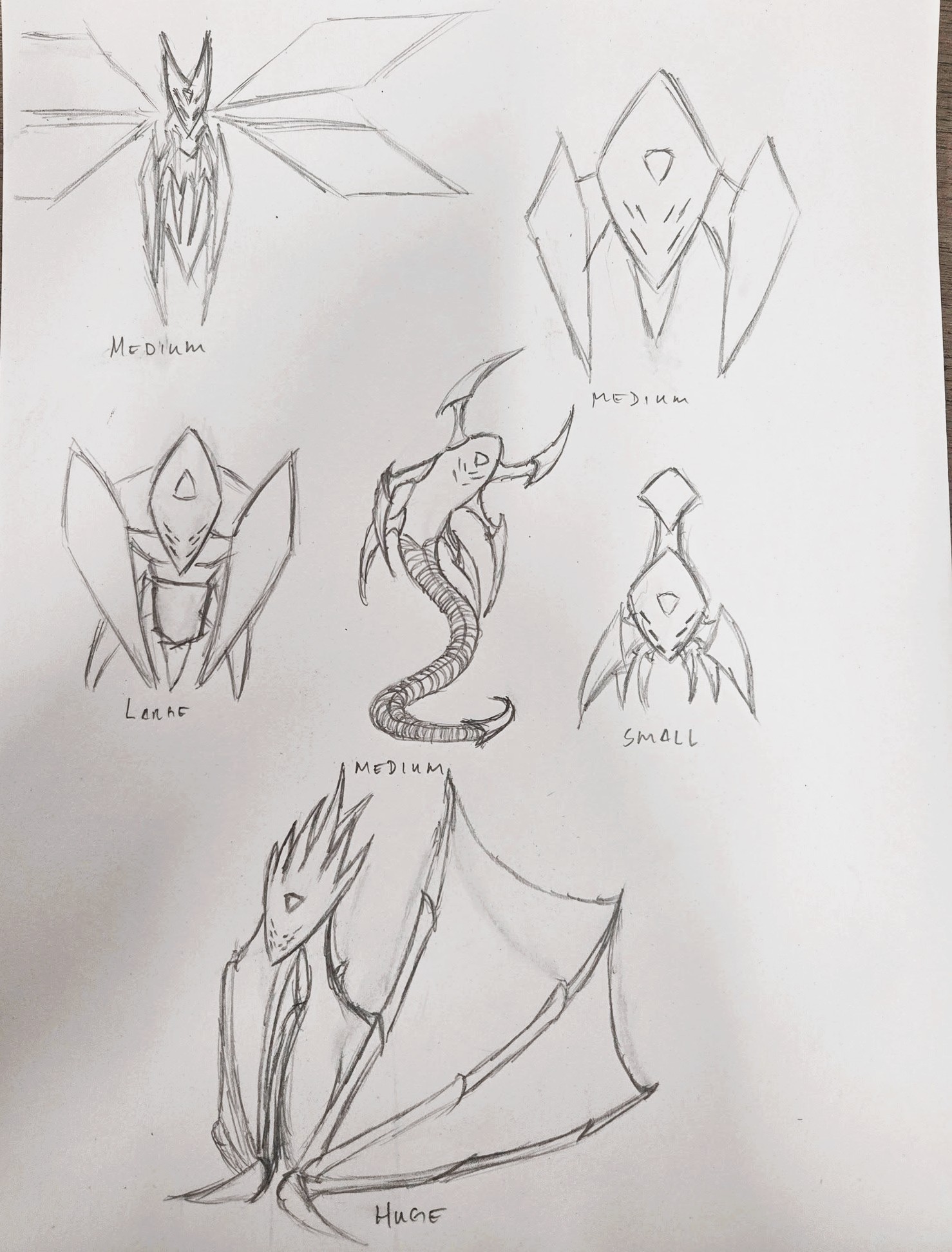
Where can people find your projects?
I still have a lot to write, but I plan to set up a public access site soon so people can check it out.
Any final comments?
I hope you all like it once it’s ready!
Julio, thank you very much for your time. I wish you much success in your work, and I’ll be sure to share any news about the game here on the blog and across my socials as it develops!
Categories: Tabletop Gaming Blogs
A Series of D100 Sword & Sorcery Table for Profane & Terrible Lovecraftian entities Encounters Tables For Castles & Crusades Rpg
Here is a d100 random encounter and lore table tailored for a high-lethality Sword & Sorcery campaign. In classic pulp style, these entities aren't just blocks of hit points; they are reality-warping terrors that twist the landscape, corrupt the mind, and demand heavy logistics or clever tactical thinking to survive. This blog post picks right up from D100 Sword & Sorcery Needleshttp://www.blogger.com/profile/11243274667834930867noreply@blogger.com0
Categories: Tabletop Gaming Blogs
The Lost Tomb of Kazcuk Mot the Undying
By Greg Gawron
Advanced Fantasy Games
OSRIC
Levels 2-4
Advanced Fantasy Games
OSRIC
Levels 2-4
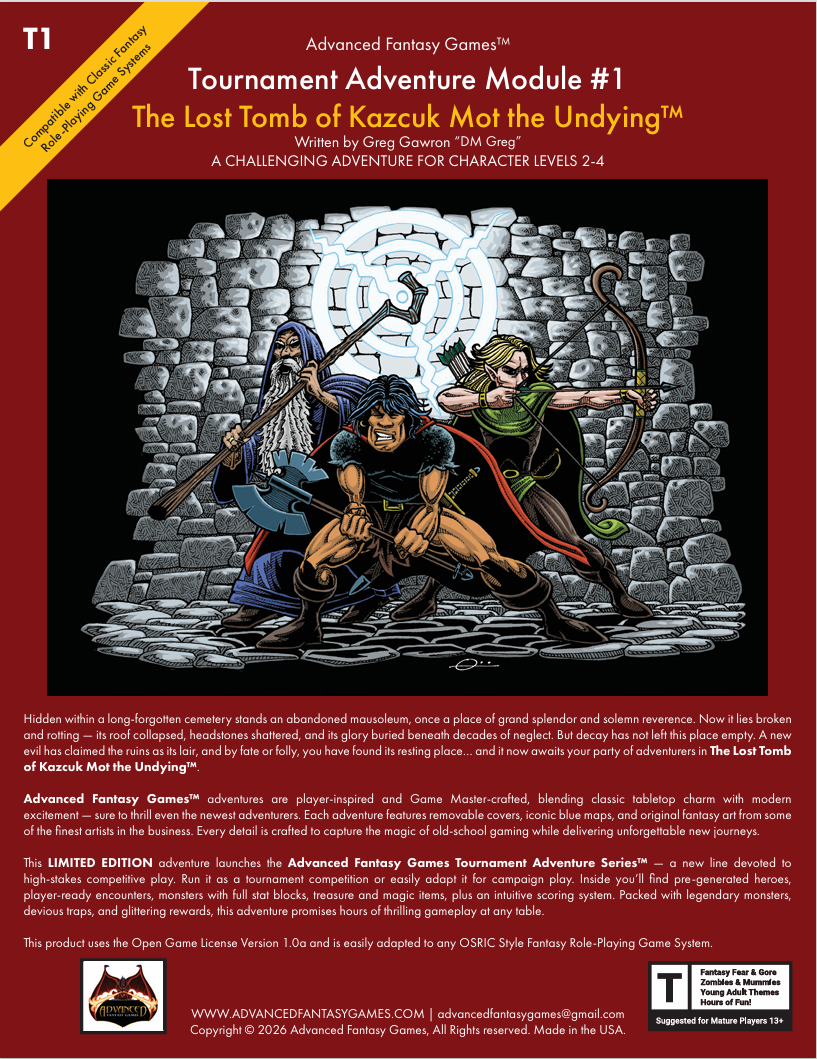
Hidden within a long-forgotten cemetery stands an abandoned mausoleum, once a place of grand splendor and solemn reverence. Now it lies broken and rotting — its roof collapsed, headstones shattered, and its glory buried beneath decades of neglect. But decay has not left this place empty. A new evil has claimed the ruin as its lair, and by fate or folly, you have found its resting place… and it now awaits your party of adventurers in The Lost Tomb of Kazcuk Mot the Undying.
This 28 page adventure presents a small tomb with fourteen rooms that is primarily aimed at tournament play. There is a certain, physicality? to it that I find interesting, however, it’s a bad tournament adventure, with mucho read-aloud and padded out DM text with rather simplistic challenges.
It’s not every day you see someone thanking both Finch AND Taormino in the same breathe, like the credits page to this one does. I assume he went to a con and they both said some kind of Gandhi shit to inspire him to publish? I hope that’s the case. I don’t know, Taormina cranks his shit piles out so maybe it was publishing tips? Anyway, this is a tournament adventure. Tournament adventures need a few things special going on so you can judge them similarly, fairly, amongst different tables. I think that’s all bullshit and it’s like comparing a Rothko to a Picasso. “You get a prize!” Fuck that shit.
And, therein, is the issue, at least with regards to the tournament aspect to this. Let us consider two different scoring systems for a dungeon. In the first, I give you one point for each room you enter. In the second I roll a d6 for every room you enter and if it comes up a ‘1’ then I give you a point. IE: what are we measuring? The ability to penetrate the dungeon by any means possible or are we measuring how lucky the dice are for the party? Further, we must be up front with the players on what we are measuring. SHould they be tearing the place apart looking for treasure, or defeating monsters, or “winning” the plot, or trying to roll as high as they can on their dice? This adventure, of course, does not disclose the scoring to the party other than to say you get a point for accomplishments and lose a point for mishaps. And then it does things like “if you search the room then roll a d6. If you roll a 1 then the party finds a pearl necklace. They get a point.” I seem to recall that some tourney adventures went so far as to have die rolls prepared for the DM in order to make things as fair as possible across tables. Rothko does not approve. So, as a tournament adventure I think this fails to do a decent job with the scoring. The answer is not more prepared die roll and less randomness, but a different axis of scoring, I think.
Ok, so, the adventure intro also says we can use this as a stand-along adventure. How was the play Mrs Lincoln? Not as bad as one might think, given the murder of the president.
I’m not happy with the adventure, or the interactivity as a whole, but there is a certain physicality to the interactivity that I think works well. One of the entry rooms has a door under a sarcophagus that flips up. There’s a grate in the floor to go down. There’s a portcullis to lift. There’s a decent amount of this kind of physical interactivity in the adventure. Or, maybe, environmental? Whatever. There are other classic elements as well, such as yellow mold, the old water monster in a pool of water thing, and so on. They don’t feel tired in this, but I’m also open to this being because the amount of text that surrounds them. Interactivity, beyond that physicality, is generally limited to stabbing. And, even that is a bit iffy. The wanderers are bats, rats, and centipedes and they show up a decent amount. One wonders at the boredom of it all.
Otherwise, the adventure has some of the long standing usual problems with the untrained. The read-aloud can be quite long. And, of course, players don’t listen to long read aloud. It’s not a new thing. You’re boring them with read-aloud. Keep it short. It’s the designers job to figure out how. Further, the read-aloud over-reveals the rooms contents. You want the read-aloud to hint at things for the players to have their characters follow up on, not to just expo dump every little detail. at the party. You want the back and forth.
EVerything here is padded out. Every read-aloud ends with “WHAT DO YOU DO” and then immediately we get a “DM NOTES” heading. Yeah, got it man. It’s not read-aloud so it’s DM notes. Yeah, got it, the read-aloud is over so now the party and do things. The first trap takes like three paragraphs to describe, and it’s a simple stair foot pit. Ok, so, I take it back. Four paragraphs. This is a quarter of a page. For a simple trap. It’s not complex. It’s just padded out. The wanderer text is padded out. “Inside the mausoleum the characters will find ample space to move about and it may appear to be a safe place to rest and take shelter. It is not.” Jesus man, that did nothing for the adventure. It is just worthless text. You didn’t actually say anything. All you’re doing is adding words to the adventure. And these filler words and paragraphs get in the way of the ACTUAL meaningful text that the DM needs to locate in order to run it at the table. The DM needs to be able to quickly scan the text, and right now they have to dig through shit like that in order to get to the stuff that matters.
It’s just relentless. The editor is the designer, which is either magnificent, if the designer knows what the fuck they are doing, or a disaster is they do not. The designer was not born with some a priori knowledge of how to write an adventure and do layout and what makes it fun and so on. Ideally, an editor, a decent one anyway, can help with some of that. YOU DO NOT KNOW WHAT YOU ARE DOING. You might be a decent DM. You are probably an ok guy But YOU DO NOT KNOW WHAT YOU ARE DOING. Seek help. Seek an editor. Learn what makes an adventure a good adventure and also an easy to run adventure.
This is $20 at DriveThru. I think that’s because it was kickstarted. I’m going to, rather generously for me, NOT say this is a fucking cash grab, even though the first thing published was kickstarted at $20. That advice above? Learning what makes a good adventure, getting an editor, etc? You can ignore that. You can go down the path of filthy lucre. Just crank shit out on kickstarter the most efficiently possible and build your market.
https://www.drivethrurpg.com/en/product/562629/the-lost-tomb-of-kazcuk-mot-the-undying-osric?1892600
Categories: Tabletop Gaming Blogs
Adapting B2 keep on the Borderland By Gary Gygax be adapted Into The Victorious Rpg and Wretched Epoque role-playing game
Yes, absolutely. In fact, B2: The Keep on the Borderlands aligns surprisingly well with the mechanics of the Wretched system. Because the Wretched system (including Wretched Époque) is built on an OSR (Old School Renaissance) d20 foundation heavily inspired by classic B/X D&D, the core math, monster stats, and dungeon-crawling loops require almost zero heavy mechanical conversion. This Needleshttp://www.blogger.com/profile/11243274667834930867noreply@blogger.com0
Categories: Tabletop Gaming Blogs
The villainous Gemini from Thundarr the Barbarian For Sword of Cepheus 2nd Edition
Bringing the 80s Saturday-morning post-apocalyptic swagger of Thundarr the Barbarian into the gritty, OSR-style mechanics of Sword of Cepheus 2nd Edition is an awesome cross-genre mix.Gemini is the ultimate Thundarr antagonist: an evil, ancient-tech-wielding cyborg sorcerer with a literal split-personality. His head rotates 180° beneath his visor to switch between a short-tempered, Needleshttp://www.blogger.com/profile/11243274667834930867noreply@blogger.com0
Categories: Tabletop Gaming Blogs
[Parsulan] The Durendine Heads
Photo by Paul Glazzard

The head of Vorlas is on display in the Revolutionary Museum in Kingshead, shielded from the ravages of time by magic so that it may be a near-permanent reminder of the revolution's resolve. One of the last of the great Wizard-Kings, Vorlas's rule was particularly despotic and draconian, but his security forces and even inhuman soldiers transformed by magic proved unequal to the defense of his kingdom during the Demon War and even less effective in dealing with the crises of displacement of people and food shortages that followed.
Vorlas was dragged to central square of Kingsforge, his capital, by the rebel army and beheaded by a new apparatus designed for that purpose, the machine now called "The Nemesis." The city was renamed in commemoration of this event and the head has resided there since.
There is another, newer head in Kingshead. That one is made from steel, thaumatite, manastone, and more than a little spellcraft. The dwarven theorists and magitechnologists behind its creation convinced the Council for Progress, a conclave formed of the various business groups that have become the true rulers of the Durendine Confederation, that the magitech mind could run the nation more efficiently than any mortal, anticipating problems before they arose, and maximizing their profits. So far, the head remains a work in progress, but the Council is still captivated by the possibilities.
The dwarves who built it have an even grander vision. While they promise their device will far exceed the computational and planning capabilities of mortals, they hope for it to one day to be greater than either god or titan, at least in the sense that it would be free of their passions and weaknesses.
Categories: Comic Book Blogs, Tabletop Gaming Blogs
Survive This!! Vigilante City & New Flesh Rpg = Survive This New Flesh City Campaign Part II
Blending the transgressive, Cronenbergian biopunk of New Flesh (The Red Room) with the gritty, 90s-cartoon-inspired sandbox of SURVIVE THIS!! Vigilante City (Bloat Games) yields a highly distinct tabletop experience. It transforms a street-level superhero aesthetic into a dark, visceral "splatterpunk-noir" setting. This blog post picks up right from Survive This!! Vigilante City & Needleshttp://www.blogger.com/profile/11243274667834930867noreply@blogger.com0
Categories: Tabletop Gaming Blogs
BGG Gen Con Preview is LIVE
This is one of the best ways to plan for Gen Con!
The BGG Gen Con Preview is live!Coming to Gen Con? BGG creates a “Gen Con Preview” list of all the hot new releases. You can check out the full list here, or just the Allplay titles here.Even if you aren’t going, the Preview is a great place to see what’s coming out so that you can add games to your wishlist from home. We have 21 New Games since last Gen Con, so go check it out!
As you browse, we’d love for you to give the Allplay games a thumbs up (by clicking the thumb to the left of each game’s image). This lets us know what you’re excited for and helps other gamers know what to look out for!See The Allplay TitlesSee The Full Gen Con PreviewComing To Gen Con: “It might well be one of the most exciting games you’ve ever played. It is superb. It is awesome.”
-Shut Up & Sit DownContainer – One of the greatest economic games of all time. Build factories, produce containers, set prices, negotiate with your rivals, and sail across the sea to trade. Obviously, buy low, sell high. But, can you make it happen?See The Gen Con Preview
“Every time you think you’ve seen what this box can do, it opens up your mind again.” – Lincoln Hoppe | The Game BardMountain Goats: Legacy – The goats are back! Roll and combine dice to race up the mountain. Get to the top to score, but don’t get knocked off! As your story progresses, you’ll unlock special ability and face tougher challenges. The mountain itself might even transform beneath your hooves.See The Gen Con Preview“It’s got a really satisfying puzzle. Every time I play this, the first thing I want to do after seeing my score is to try again and get a better score… but it never feels overbearing. It always retains that cozy vibe” – Ezeekat Enchanted Ivy– Our very first dedicated solo game! Expand your inn, place guests based on their preferences, and connect the magical ivy to have the perfect stay. See The Gen Con Preview“Absolutely fantastic game! Very simple concept with a real fun twist that always causes uproars and hysterics.”
– BGG User ItcantstormJibber Jabble – A cooperative, word-association party game. Players spells one letter each. The catch? They aren’t allowed to discuss what your clue they’re trying to spell. The first time you have a perfect clue in mind, but the person next to you says a letter you weren’t expecting at all… well, that’s Jibber Jabble.See The Gen Con Preview “Phantom Ink has gone down brilliantly every time I’ve played it, and it may even replace our other similar games… Teaching the game takes a matter of minutes and it plays well with a wide range of player counts and ages”
– PROFDECUBE, Zatu GamesPhantom Ink – Commune with your clue-givers to decipher a secret word before the other team! Answers from beyond the grave are public, but the questions are private. If you’re on the same wavelength as your spirit, stop the answer mid-spelling.See The Gen Con Preview Manipulate the meme market in real time in Stonk Market. Run the best television network in The Networks: Primetime. Frantically yell breakfast items at your teammates in French Toast.
You know that we always come to Gen Con with a truckload of new titles. We can’t wait for you to try them!See The Gen Con PreviewLet’s all play.
Categories: Tabletop Gaming Blogs
Integrating Adventurer Conqueror King System II (ACKS II) with the legendary, chaotic, and maximum-gonzo DNA of Dave Hargrave’s Arduin Grimoires - ACKS II Domain Level Play Part II
Integrating Dave Hargrave's Arduin (a chaotic, techno-magical, multi-genre playground) with ACKS II (Adventurer Conqueror King System II, a hyper-detailed, mathematically airtight simulation of medieval demographics and domain management) creates a fascinating campaign style. While ACKS II assumes a relatively grounded world where human kingdoms use strict economics to manage standard Needleshttp://www.blogger.com/profile/11243274667834930867noreply@blogger.com0
Categories: Tabletop Gaming Blogs
Southwardens is on Backerkit
The monsters keep getting bigger, and we’re running out of time…
Soothwardens by Navaar Seik-Jackson is in its final 48 hours on BackerKit! Back now You are receiving this email because you signed up, made a purchase, or have been part of a crowdfunding fulfillment campaign. What is Soothwardens? Navaar Seik-Jackson brings his renowned love of larger-than-life fights and his fascination with the unique connections that bind both communities and individuals together to Soothwardens: 200+ pages of rich, vibrant non-Eurocentric fantasy worldbuilding and deep-layered mechanics around tracking, learning about, and battling the mysterious colossal monsters who keep forcing their way into the realm.
Protect against colossal monsters In Soothwardens, you play as one of the many gifted protectors of reality. Traversing Nyobekeer, a world split apart and reshaped into a ring-like continent by mages long past, you will encounter the many peoples and creatures of the land. Like you, monsters on a separate plane of existence roam, looking for cracks in reality to break through. When these Breakers find their way in, it is your job to hunt them down alongside your partner. Together you will protect, together you will fight, because what you do cannot be done alone.
Rely on skill, connections, and resources, not luck
Soothwardens is a Luckless game, meaning there are no dice, no cards, and no random outcomes. Using two resource tracks, you will investigate, hunt, and fight Breakers. Throughout every aspect of play, Wardens will also deal with the Link to their partner(s), explore the world, and help communities along the way. Explore the strange magic connecting you to each other and the realmWardens operate through an intense and intimate magick called a Link. This connection allows for two things that a Warden needs. One: it is a tether to reality, allowing them to return safely while fighting in the Break. Two: it allows the Linked Wardens to sense how the other is faring in their fight. They feel their pain, they sense their emotions, and they use this Link to heal and care for each other. Wardens are each other’s spear and shield. A confidant for the words they’ll never say. A union, and one no Warden would wish to have ripped from them in the midst of a fight against the Breakers.
Brought to life with a powerhouse teamAdditional story writing by award-winning horror and TTRPG creator Josephine Kim. The bold and colorful afrofantasy art of Barbados-based illustrator Joshua Clarke. The evocative set design inspired the architecture and textile renderings of LA illustrator Zakiya Goggins.
Soothwardens by Navaar Seik-Jackson is in its final 48 hours on BackerKit! Back now You are receiving this email because you signed up, made a purchase, or have been part of a crowdfunding fulfillment campaign. What is Soothwardens? Navaar Seik-Jackson brings his renowned love of larger-than-life fights and his fascination with the unique connections that bind both communities and individuals together to Soothwardens: 200+ pages of rich, vibrant non-Eurocentric fantasy worldbuilding and deep-layered mechanics around tracking, learning about, and battling the mysterious colossal monsters who keep forcing their way into the realm.
Protect against colossal monsters In Soothwardens, you play as one of the many gifted protectors of reality. Traversing Nyobekeer, a world split apart and reshaped into a ring-like continent by mages long past, you will encounter the many peoples and creatures of the land. Like you, monsters on a separate plane of existence roam, looking for cracks in reality to break through. When these Breakers find their way in, it is your job to hunt them down alongside your partner. Together you will protect, together you will fight, because what you do cannot be done alone.
Rely on skill, connections, and resources, not luck
Soothwardens is a Luckless game, meaning there are no dice, no cards, and no random outcomes. Using two resource tracks, you will investigate, hunt, and fight Breakers. Throughout every aspect of play, Wardens will also deal with the Link to their partner(s), explore the world, and help communities along the way. Explore the strange magic connecting you to each other and the realmWardens operate through an intense and intimate magick called a Link. This connection allows for two things that a Warden needs. One: it is a tether to reality, allowing them to return safely while fighting in the Break. Two: it allows the Linked Wardens to sense how the other is faring in their fight. They feel their pain, they sense their emotions, and they use this Link to heal and care for each other. Wardens are each other’s spear and shield. A confidant for the words they’ll never say. A union, and one no Warden would wish to have ripped from them in the midst of a fight against the Breakers.
Brought to life with a powerhouse teamAdditional story writing by award-winning horror and TTRPG creator Josephine Kim. The bold and colorful afrofantasy art of Barbados-based illustrator Joshua Clarke. The evocative set design inspired the architecture and textile renderings of LA illustrator Zakiya Goggins.
Categories: Tabletop Gaming Blogs
GURPS From Steve Jackson Games Now on Backerkit
PLEDGING OPEN: GURPS Ring of Fire Steve Jackson Games
Pledging has begun for a new GURPS book on BackerKit
AUSTIN, TX 6/10/2026 – The year is 2000, and the residents of the quaint and quiet town of
Grantville, West Virginia, are in for the surprise of their lives. On what they assumed would be a
normal day, the town was suddenly surrounded by a mysterious, otherworldly ring of fire that
transported everyone to 1630s Germany and the Thirty Years’ War. The residents survived –
and changed the world.
GURPS Ring of Fire, created with Baen Books, is based on the collaborative Ring of Fire
series initially penned by Eric Flint. The largest alt-history setting ever created, it encompasses
hundreds of books, anthologies, and magazines. GURPS Ring of Fire draws on these sources
to create a thrilling TTRPG experience featuring contributions from a number of writers of the
series – Griffin Barber, Charles E. Gannon, Walter H. Hunt, and Robert E. Waters. William H.
Stoddard, a fan-favorite award-winning GURPS author, edited and adapted the Ring of Fire
series to be compatible with GURPS Fourth Edition, while Larry Elmore created the cover art.
The timeline runs from 1632-1637 and includes descriptions for nine famous organizations and
dozens of notable individuals. Character-creation rules will help players to explore this new
frontier of unlimited possibilities. A system is in place for reinventing or copying uptime gear, and
players will find notes on weapons, vehicles, and key equipment. The book is visually enhanced
with maps of important regions, not only in Grantville, but also beyond.
The BackerKit campaign for GURPS Ring of Fire is now open for pledging. GURPS Ring of
Fire requires GURPS Basic Set to play, and players who do not have a copy or wish to upgrade
can secure their copy of the upcoming GURPS Basic Set, Fourth Edition Revised book in the
campaign, but it will also be available late this summer on Warehouse 23.
About Steve Jackson Games: Based in Austin, Texas, Steve Jackson Games has published
games, game books, and magazines since 1980. Its catalog of hits includes Munchkin, Zombie
Dice, Car Wars, the GURPS roleplaying system, Ogre, Illuminati, and more. Munchkin, Ogre,
and Illuminati also have digital versions on Steam and other platforms, bringing tabletop
classics to a new generation of fans. In 2025, SJ Games welcomed Possum Creek as an
imprint. Possum Creek has created the award-winning Wanderhome, Yazeba’s Bed &
Breakfast, and the upcoming Seven-Part Pact.
Categories: Tabletop Gaming Blogs
[BLOG] News on the March! Episode XV.
This post continues the series of brief play reports I have been posting on Discord. This does not cover every single session (sometimes, recon and setup is what happens), but it covers our ongoing games.
They Also Visited the Iudex
18/02/2026 THISIUM
News from the doomed city of Thisium! A small group of adventurers hatched a plan to kidnap the city’s most powerful nobleman, Mornalt Tamburello, and deliver him to his sister, Lucia, the bringer of the Doom Beneath the City. At this time, Mornalt was throwing a grand garden party and masquerade, just the night after his last rival, Gordisio Pamfile was mysteriously assassinated. The company spent the day in preparation. The stealthy characters secured an escape route from the palace gardens from an abandoned apartment, while Giacomo went and bought costumes. More than that, he ordered an extra set from an expensive tailor, to closely resemble the crow costume Mornalt had bought. At night, with Giacomo leading the company as a balrog, followed by a cuckoo, a dryad, a skunk, and a rabbit (Septimus only wearing his chameleon armour), they entered the lamplit gardens of Villa Tamburello. The city’s nobility and hedonists were engaged in decadent partying centred on a stage offering risque and blasphemous comedy, while others snuck off on twisting paths for amorous trysts and intrigue. Aufidia started looking if any masked assassins were to be found, and spotted a masked person dressed in form-fitting black, stalking into the garden. Septimus followed in his camouflage, and saw that the person was a woman, looking down a round pit leading to the thermal pool below, and smiling. Following in her tracks, she was seen to converse with a man wearing a vulture costume. Septimus and Eriberto Barrella followed the vulture-man into the palace banquet. They found him in the kitchen ordering a large quantity of the finest wines for the underground revellers for his personal care. As he was leaving, they ambushed him in the torchlit corridor and dragged him into a side-room. The man proved to be Puccio Malatesta, a minor noble and gadfly they had met before, and he was found to be in the possession of a pouch of powdered poison.
In interrogation, Puccio spilled the beans rather than be exposed publicly. He acted on behalf of the dark-clad lady, Iacynthe Tamburello, Mornalt’s wife, with whom he was madly in love with, but did not know her reasons for wanting the partygoers poisoned. The hapless fellow was left tied up in a cupboard, while Eriberto took on his buzzard costume. Heading out to the garden, Giacomo found his love, the maiden Hestia Tamburello, who, being disgusted with the assembled guests, had only agreed to come down to the fête to dance with him. In doing so, she could pinpoint her father, Mornalt, a dark bird of prey standing aside in the company of four loosely dressed ladies wearing mice costumes. He approached, and invited him for a garden walk to reveal a deadly danger – where the head of the house was slept and black-bagged. A random, charmed partygoer was given the copy of his costume to serve as the impromptu master of Villa Tamburello for the night, which the fellow gladly accepted. Carrying the sleeping malefactor to the Pickled Carp, they donned adventuring gear and descended deep into the Underworld with their unconscious baggage. At last, deep beneath the city, they entered the mighty volcanic cavern spanned by a dark basalt bridge above roaring fires. Lucia Tamburello was there, and Mornalt, who had instigated her murder with poisoned words among the city’s mobs, was given over to her. Mornalt tried fleeing, and as Lucia advanced on him, fell over the bridge into the fiery depths. With this, Lucia agreed to forgive the city, her revenge satisfied, and departed this world. Thus passed the Doom from Beneath the City, the second of the four.
The company chose to return to the surface, but their adventure was not yet over. They took a wrong turn in the passages, and were well and truly lost. They encountered a group of adventuring barbarians, who were impressed by Giacomo’s fire sword, a group of sackcloth-robed undead, who were turned, and four minotards, who were blasted by Aufidia’s fireball. Their way finally led to a great columned hall decorated with inky drapes, and furnished with bare wooden benches. A group of skeletal lictors in the garments of the old Empire and the helmets of Legion III demanded their purpose in petitioning the Iudex, the Judge of the Underworld. They said they brought a case, and, in keeping with the court’s rules, had brought petitioners’ masks to ensure the court’s impartiality, as well as a donation to pay the court costs. The Iudex received them on his bench, a dark-cloaked, masked figure. The Judge confirmed that the Doom From Beneath the City – brought on by Mornalt’s act of fratricide, – and the Doom From the Forests – brought on by the city’s godlessness, and failure to perform their annual sacrifices to honour the gods, had been made right and lifted. Two more remained. As the Iudex explained the cases, the Doom From the Seas was caused by the breaking of divine commandments not to build on certain sacred islands, and would be punished by a flood of poisonous gasses from the volcano on the Isle of the Black Dogs. As for the Doom From the Mountains, its cause was Thisium’s treachery to break the bonds of love between the knight Sir Rapax and the forest fairy Niabex, whose split caused the downfall of their tiny mountain kingdom. For this reason were the invincible orc armies allowed to march on the city. Hearing the Judge’s words, the company returned to the surface, to plan their actions against the remaining dooms. At this time, the city had 18 days left.

19/02/2026 KASSADIA
News from the fallen empire of Kassadia! Returning from a deadly but lucrative adventure, the Lion Pack delivered the healing herbs to Senator Porfirio Holden, who gratefully offered to instruct Martus the Opiate in the magical arts, and to owe them a favour in the future. Selling off their loot at the jewellers and trying to buy pearls for identify, they learned that all in town were bought up by Messer Barcello Cadorna for an expensive dress for his daughter, Gundelinda. First contemplating burglary, they remembered the name of Guetto the Leech, an underworld figure who was supposedly able to get „anything” in town. Inquiring at Renaldo’s delight, the proprietor’s eyes darkened, and he warned them Guetto was an assassin, a blackguard, and a dangerous man to deal with. At their dinner, they were also approached by Septimus Regulus, a cheerful old gnome, who sought travelling companions to take a trip to scenic Wailing Lake, located among Sormadium’s mountains, and known for its picturesque cypresses and antique grave obelisks. The next day, they decided to visit Penitents’ Plaza, where Guetto owned a restaurant/brothel. Jovial Faustulus went on horseback befitting a great lord, drawing impressed and fearful looks (rumours in town took him for a pirate captain travelling incognito). The plaza was a small round place, its sides lined with cages serving as Sormadium’s jail, a scenic view from the brothel’s upper balcony. It turned out Guetto was a prisoner himself for now, after insulting Messer Verenzio Altieri, the lord of Fiolaga. They discussed the matter of the pearls, and he agreed to try his best by evening. Returning after sundown, Guetto was now indoors, enjoying dinner in his establishment next to a company of his own jailers. He had the pearls, and in his upstairs office, bought the party’s supplies of refined purple poppies, also offering exclusive poisons for sale.
Declining this offer, they left satisfied, although not before Faustulus bumped into Charming Valentino Viselli, a haughty young rake who was just about to challenge him right there and then. For now, it did not come to blows, and they retired to Renaldo’s Delight. Fearing Valentino’s assassins, they set a watch, but what came instead was a cat-burglar descending from the rooftop on their balcony. Publius Varro, on watch, fired his crossbow and missed, upon which the thief retreated, the affair resolved reasonably amicably between two professionals.
The following day was heavy with late autumn rains, but Septimus Regulus was enthusiastic about the trip. They mounted horses, and – after scaring off a band of mercenaries trying to rob them on the bad side of town – headed for the mountains. In dark rainfall, they followed the old imperial road, then a mountain trail from the Monastery of Kurlakum of the Seven Misfortunes. Beyond a pass, at dusk, they found Wailing Lake with its sinister grave obelisks and gloomy cypresses. Entering the neglected graveyard, shadows rose from the burial mounds, which were mostly turned, and a few killed. Septimus Regulus loved the atmosphere, and went skinny-dipping. It was dark, and they feared more undead were about, so they urged the gnome to be done with it and leave while they could. In constant rain, they retreated a little to set up camp. Alas, the shadows followed them, and it was only Jovial Faustulus’ alertness which saved them from a nasty surprise. They quickly mounted their horses and rode off in the darkness... getting lost in the mountains. Below a rocky ledge, they heard the woosh of large wings, and 11 griffins descended on them to feast on their horses and themselves! Martus the Opiate threw his fireball, catching four and scattering the rest. In blind panic, they fled on horseback, cold and soaked by rain, among the dark peaks of Sormadium.

22/02/2026 KASSADIA
News from the fallen Empire of Kassadia! I, Valerius Artorius, messenger of the God Apelles; and my companions, Cymbrix the Druid, Ilvar Goron the Grave-Robber, Bartavir the Fighter, Gaunt Gerald the Illusionist, and Petronius the Fighter, gathered at the call of Collino the Vulture, who had a lucrative tip for us. He wanted us to venture into the Cisterns of Death, and retrieve a set of building plans from the tomb of its architect, Gaius Licinius Profundus – in particular, a map of the podesta’s palace. I had adventured in the area before: on the outskirts of Cassidum, still within the old walls, but within the modern city, among the ruins of the old empire now used for pasture and orchards.
We set out with five hired men and an empty purse, until we found the broken aqueduct which led to the site we were seeking. What were once splendid baths were only outer walls now, with hovels and shacks built among them, and ruled by Old Bertoni, a local crime boss whose son I and my companions slew an adventure earlier. Thus, we persuaded a local urchin to lead us in safely; and he mentioned an old trapdoor in his mother’s cottage which dropped into the depths. Sneaking into the ruins, we descended by rope into a vast, lightless columned hall. Dark, brackish water was found 80’ below, shallow enough to wade in. Orienting ourselves, we saw a tall tower rising to the ceiling to our NW, stairs climbing around it to double gates. We checked this first, and behind, discovered an abandoned shrine to Cloacina, Goddess of Sewers. A tangle of skeletons in rotted togas were prodded and slain in battle. Here, alas, we lost my spearman, Vinicio, whom I accidentally shot in his back (he had 1 Hp, and I did the same in damage), and I myself almost died. The shrine had metal rungs behind the statue leading to another trapdoor, from beyond which we heard heavy footsteps. Instead, we made a sacrifice to Cloacina in Vinicio’s memory, and were rewarded with her favour.
We returned down into the cistern. On its southern side, frescoes depicted the bathhouse’s construction, and we found a secret door next to the depiction of Gaius Profundus. Stairs led up to a chamber with three walled arches and three secret buttons. Only one was hollow, however, and this proved the correct way into a splendid hall. We were in an under-temple of Gladuor, God of Aqueducts, with golden treasures heaped on his altar, a side-treasury with locked chests, and further ways out. Nearby, we found the body of a thief clutching a sack, and he came back as a spectre whom Petronius slew single-handedly, winning a sack’s worth of small jewellery. We now turned to plunder the treasury, whose chests were laden with coinage, gems, and more jewels. We took as much as we could carry, happy to return outside. However, as we would depart the temple, the statue of the god spoke, and we were crushed by the weights of invisible pillars, killing Gaunt Gerard, Baldo the Porter, Roderigo the Porter, and August the Legionary. We survivors dragged out the treasure chests, and took them to the shrine of Cloacina, making another sacrifice of the coins we could take no further. Alas, trying to climb out, we were greeted by Old Bertoni and his men, who demanded our treasures for letting us leave. Cymbrix hid in a mostly empty chest, while some of us snuck off for the shrine exit. The druid could make terrible havoc upstairs by conjuring thick fog, and using a heat metal spell on Bertoni, who ended up grilled in his banded mail as his men fled. Those left down fared less well, as we were attacked by ghasts, and poor Bartavir was dragged off as we fled. Three of us made our way out, finding ourselves in Bertoni’s gaudy hut, and taking his treasures for our own. Alas, the vagrants’ settlement burned due to Bertoni’s heated armour, and its inhabitants fled to the four winds as we returned to the city to sell off our loot, rest, and prepare for a return trip.
Now better outfitted, we headed back. The entrances had been sealed and guarded on the podesta’s orders, and Captain Barduccio Blackeagle saw through our ruse to present ourselves as official exorcists. However, he smiled as he did, and allowed us in for a cut to „the Podesta” (widely known as “Signor 10%”). We descended, and now headed east. Stairs lead up to a long balcony above the cistern, and more splendid rooms. In one with two fonts (one offering water making us get recognised as undead, and another detected as poison). Behind a secret door, we found the survivor of another expedition sponsored by Collino the Vulture, the thief Giordano. We headed east, into a large underground forum, and down some stairs into a room with a gold-covered fountain and a statue of a maiden with her cat. The latter proved a mimic, and was slain (revealing a treasure-pit); the fountain’s golden sheen yellow mould, which fortunately killed none of us. Westwards and even further down, we found a dressing room with curiously intact togas, and – after checking for cloakers – we donned them, remembering Giordano’s words about getting attacked by patricians’ spirits for dressing as a plebeian. We found the patricians fairly close, in a steam bath, and could converse with them as equals, learning some more of the dungeon. Following their leads, we pressed on; encountering the ghost of a poet, a dead member of Giordano’s expedition, and another who was alive, just about to be drained of blood by six deranged „vampiric” cultists. These we slew, and headed back to the exit, satisfied with our take. We paid off the captain (concealing some smaller gems and jewellery), and headed back from the field of ruins to the centre of Cassidum.

23/02/2026 THISIUM
News from the doomed city of Thisium! A reconnaissance party set out towards the northern mountains to spy on the orcs, and learn of the fate of the knight Sir Rapax and the faerie Niabex, separated by Thisian intrigue. But first – following a treasure map, they halted in Mouseshire, and took sledgehammers to a secret chamber in the crumbling old belltower, gaining 12,000 gp in old Imperial coinage. ¼ was given over to the Majordomo to use in the war effort, while the rest was to be transported to Thisium. The company rode north, reaching the mountain pass above the fortress of Castrum Rapax by dusk. They observed the orcish forces carefully, taking stock of the castle’s strength and weaknesses. They also noted a hidden trail descending from the pass, and seemingly going around the castle. This piqued their curiosity, and next dawn, Amedeo, Poucas Trancas, and Don Arduino Spezzaferro made a three-man detour. The route led above a deep ravine next to the castle walls. The two thieves descended by rope, spotting a mighty wooden gate under a rock overhang. An enormous and very ugly troll was slumbering next to it with a massive mace, and a large wooden sign read in bad lettering: „NO PRIVAET ENTRIE!” Noting this way in, they returned to the rest of the party. Travelling north along a desolate seacoast, and returning to the mountain-cradled valley where the castle stood, they rode up to a saddle on the valley’s western side. This was a garden long gone wild. Statues of courtiers stood in the tall grass in dated finery, with expressions of sadness and sorrow. There was nothing else here, and no person like Niabex was found. Now they travelled back south along the peninsula’s western coast, reaching the swamps by dusk. They were surrounded by a group of bedraggled men, who turned out to be escapees from the orcish mines producing iron for Castrum Rapax’s forges – some 150 slaves, many of them halflings, under the yoke of 80 orcs and Troglont, one of the orc lords.
The next day, they escorted the escapees back to Mouseshire. They stopped at a clearing south of a lone mountain peak, where, in the middle of nowhere, stood the statue of the Philanthropus, Thisium’s mysterious and much-hated benefactor. The statue kept its secrets, and they marched on, arriving in the evening, where 22 men of the 40 immediately signed up as recruits to fight the orcs. The next day, they explored the northern areas of the Forest of Verrilli. First they found a garden where the spirits of nymphs were taunting the statue of a particularly sinister-looking satyr. Its gaze was terrifying, but Amedeo stood his ground, which the figure seemed to like. He could tell of Niabex, whom he named a trollop (and more foul things) for leaving the faerie court and marrying a human – as the satyr added gleefully, things ended badly for her, and she died of a broken heart after Sir Rapax cheated on her. They rode on, finding a different garden with the statues of animals, a votive column with a mysterious inscription, and the bodies of people turned into flowering earth on marble benches. The road continued, leading to the ruins of a small barbaric village on the edge of the woods, destroyed in some old battle. The sole standing structure was a crumbling garanary, where wild wheat grew on piles of earth. Bregor stepped in to search for treasure, and did not watch out for two giant crab spiders, which injected him with deadly poison. In the fight, the campaign’s unluckiest Fighting-Man was hit twice by his own company’s slingers firing into meelee, suffering organ failure, and finally dying of spider venom. Some coins were recovered, however, from buried clay pots under the pile of rotted grain. Some more exploration in the forest found a sinister-looking dead area, but the hour was late, and they needed to ride back to Thisium, so this place they skipped, riding across the land to reach the gates at night. At this time, the city had 16 days left...

02/03/2026 THISIUM
News from the doomed city of Thisium! The Comely Lass sailed out from port to explore the Isle of the Black Dogs. However, before making landfall, the company took a look at the smaller island to its south, and decided to explore it more thoroughly. The place was covered in thick jungles not found in this clime. They followed a river to one of the cliffs rising from the wilderness when they found themselves greeted by 6 lizardmen – unexpectedly friendly, and asking the assistance of mighty heroes! In broken speech, the lizards explained they were being regularly preyed on by two „flying demi-gods”, which the company soon guessed to be the two black dragons they have known to lair in this part of the isles. They followed the warriors to their primitive village, located among crumbling ruins. Consulting with the chief, they agreed to help out, and decided on setting a trap. With the lizards’ aid, they headed for the island’s central group of cliffs, where rose „the Hand”, a plateau ringed by stone outcroppings. They ordered their allies to build a great beacon, and smoke much of their rotting meat supplies to draw in the beasts. The women and young fashioned large nets from lianas, and they also prepared a big pot of glue wrapped up in the juiciest strips of meat. The lizards were ordered to dance around the fire, while they hid themselves in an ambush among the stones. After nightfall, the dragons came, swooping down on the campsite, and blasting the lizardmen with their breath. Many were killed, and the battle was on! Arrows and javelins just bounced off of the beasts’ hardened scales, and both nets missed. The lizardman warriors were decimated and ran for shelter, along with the chief. The battle was the company’s to win or lose! Lemmy the heavy footman charged, and died heroically in a dragon’s jaws. The other dragon was (very luckily) entrapped in a web, and brought down.
The other met the charging attackers with a stream of acid, and Quayin Torchbearer, the southern prince seeking his inheritance, as well as Opiter Torchbearer (both named for light-casting magic swords), died, while Racha Ducka barely survived with 2 Hp. It was finally Maglor the Elf who saved the day, snatching the cowardly chieftain’s magic spear with a spectral hand [my SVoZ version], and attacked the dragon, killing it with a critical hit. The battle was won! The lizardmen saw what was well and truly a miracle, and from now on, the characters were considered demi-gods, or at least divine messengers. A great feast commenced on the clifftop, and one brave lizardman, Hisss, endeavoured to join the group. In the morning, before parting, the lizards brought their treasures to gift their liberators; gold, a few gems, potions, and the magic spear. Now it was time to plunder the dragon lair! They sailed for the neighbouring island, a place of mangrove swamps and water channels leading to a dark lake in the centre. A cave mouth opened to a network of foetid passages with deep pools of brackish water. Strange, eerie string music came from the depths. This would have been a nasty place for a dragon fight, but they were already dead. Thus, the entrance trap and the giant frogs lurking in the passages were no match for the adventurers. In the depths of the lair, they found the source of the music: an old, chained man playing a golden harp on a massive pile of treasure. He introduced himself as Nicanor Philocrates, who was imprisoned here by the evil wizard Prospero, known to dwell deep beneath Thisium. Liberating Nikanor (who joined the company), they could now load the dragon hoard on their ship – 30,000 gp, a wealth of 46 gems, and a cache of magic items, including a staff of healing! Thus they sailed back to Thisium. At this time, the city had 17 days left...

12/03/2026 KASSADIA
News from the fallen empire of Kassadia! Separated from his companions in the mountains of Sormadium, and fleeing from Death Griffon Doom, Martus the Opiate finally found a campfire in the wilderness – it was not his previous party, but Aristeo Guarini, Arden Oakbark, and their follower Albred the Grey, just as lost in the wilds as they were. They spent the night in the storm, and on the next rainy late Autumn day, followed a valley westwards. Travelling through untamed wilderness, they finally found an overgrown stone path leading to the town of Sambuci, and Villa Bonnacorsi. They received hospitality from the landlord, Quirino Bonnacorsi, as well as his son Alvaro and daughter Mercede, telling of their adventure in Ucria, where they destroyed the drug plantation and found the body of the slain Paolo Viglione. True to his word, Quirino gave them his heirloom magical seal, and they spent a nice evening dining and drinking wine. Then, disaster struck. There was a crash of splintering glass from Mercede’s room, and arrived just in time to see her abducted by four gargoyles – no doubt the minions of her obstinate suitor, the sculptor and impoverished nobleman Edoardo Memmoli!
Edoardo lived on the isle of Fiolaga to the south of Sormadium, and the next morning, they sailed out on the Lydia, the family’s pleasure ship. Alvaro brought his arms, and four guards: Ugo, Clodoveo, Asterio and Adalfredo. They reached the shores of Fiolaga by mid-afternoon with fortunate winds. Deciding not to land next to Villa Memmoli, they instead found a little bay close by... and a recently landed ship! A mountain trail led up to a rock formation resembling a hand with broken-off fingers, and a scene of horror. 20 axe-wielding cultists in rag-masks, 4 bodyguards, and a cowled figure had just finished sacrificing four goats, a youth, a maiden, and a chest of treasure to Titus Malformatus, the evil god whose cultists the Lion Pack had already fought previously! The cult leader called on the god for help, but as the cultists rushed forward to slay the interlopers, Martus threw his fireball, scoring a lucky 28 Hp on 5d6, killing the leader, his bodyguards, and half the cultists. The rest were killed without mercy, and Alvaro Bonnacorsi proved his skill with the blade.
Looting the bodies, they continued to Villa Memmoli, reaching the estate’s crumbling walls by a moonless night. They entered through a gap, near a glass-topped greenhouse. Westwards, they saw a very large statue and an obelisk crowned by a recently lit flame, but decided to move towards the dark villa. The overgrown grounds held statues: the first, a guardsman, issued a cryptic warning, while a stone dog rushed them before turning into an armoured knight who slew Clodoveo with a single strike, before being himself dispatched by the vengeful Alvaro. They crept closer. They found a small back entrance, and after confirming the building was dark and silent, entered. Avoiding an open central courtyard, they entered the main hall, dusty and cobwebbed, with ragged tapestries and strange statues... the statues animated! A troll, a faceless man, and a demon marched on them, striking Aristeo before they could flee, but did not pursue outside. Choosing the villa’s eastern side, they now approached a terrace overgrown with vines which, contrary to their expectation, did not attack. The body of an adventurer rested before a door, badly burned. As it was inspected, there was the sound of wings, and 4 gargoyles descended from the rooftops, avoiding Martus the Opiate’s web spell. The horrid creatures fell on the party and slew Albred the Grey, while taking little damage from the party, which lacked magic weapons in its current composition save for Arden’s slave in stone spell. They fled the house, sustaining wounds from the pursuing gargoyles, and seeing more of them circling above the sagging roof. They contemplated their plans, lost in the moonless night.

15/03/2026 FOMALHAUT
News from Fomalhaut! Lost in the massive city of Diomira, the company chose to hit up Eldoxos, an old acquaintance, and one of the merchants/smugglers operating out of the Plaza of the Gloomy Wells, dealing in goods and foodstuff from the outside world. The plaza was also one of the places in Diomira where the faceless statue had its head missing, and only the rim remained of the dark metal mirror on the facade next to it. Eldoxos was not in his store, and as they were informed by his protégé, Polemon, who was specialised in outside liquors and narcotics, he has moved up in society thanks to their previous visit. They hit him up in the House of Broken Locks, a warehouse complex to the SE, guarding the entrance to the monorail station, and thereby controlling Diomira’s illicit trade. Eldoxos was happy to see them – he had greatly expanded business after his predecessor, Boss Twand, met an „unfortunate accident” at the characters’ hand – but grew a bit concerned when he was told of the Uttermost Masters, and their plans which would disrupt his lucrative smuggling operation. The men had been seen twice in the city: once emerging from a nearby cistern shaft, and once lurking near the Spiralling Temple, a sealed building north of Diomira’s central plazas. He also told them of the great stone face they had seen in a back alley – he had once followed one of the „False Men”, the brainwashed servants of the powers ruling Diomira, and heard him receiving spoken instructions from the visage.
They enjoyed an evening of fine food and drink, and early next morning, set out for the Spiralling Temple. Off the main plaza, at the foot of the octagonal spire of the Radiant Pyramid, they were approached by an elegant young woman, Alkithoë. She came at the behest of Eldoxos, her lover, to bring news that he had seen something interesting at a nearby location. While the others were conversing with her, Bocephus furtively cast true seeing to check her out. There was something very wrong with Alkithoë, a gaping piece of emptiness in her personality, and a strange tic around the eyes; and Bocephus saw that she was deadly with the concealed dagger and mini-crossbow she was carrying. They told her they would follow her suggestions, then quickly went the exact opposite way towards the temple.
The great front doors, bearing a massive disk embossed with a spiral, were sealed, and dark mirrors were mounted on the front facade. But the side had open windows, and as the area was deserted this early, they quickly climbed inside with ropes. The abandoned interior was a massive columned space with suspended glass prisms, openings to side-chambers, and a great stone face. As they advanced, the face spoke one word: „KILL!” The prisms started to rotate, hypnotising Lilith, Ion, and Itestra. With clanging steps, six mechanical men bearing battleaxes came from the side-chambers. A fight ensued, in which the city’s crossbow-wielding assassins also made an appearance through the windows on the other side, but a judicious application of spells and violence defeated them. The place was empty, but narrow spiral stairs led down. They descended into a chamber of strange, defunct machines (Pausanias identifying them as devices for complex calculations and decision-making), and found a cabinet with a spare energy cartridge and a handful of healing dermal patches. From the south came sounds, belonging to 17 of the shaggy, brutish Underdwellers, with murderous intent. They fought bitterly, but Bocephus’s wand of paralysation proved useful, and they were killed off. To the south, they came to a small monorail terminal with a crashed vehicle, a massive gong (which the Underdwellers were too stubborn to ring), and a passage from which came an even rumbling. They chose to follow the westwards monorail passage instead, through the crashed metal gates.
The tunnel brought them to a station, and a SW passage, through which they entered a familiar place: a massive circular hall, with a tall towering structure standing in the middle of deep shaft. Bridges connected from the outer rim to the central building. Remembering how they had run into formidable opponents here the last time, and knowing they did not have a way to get in yet, they withdrew. The next objective was to find an alternate exit. They followed the monorail tunnel a long way NW, finding a station, and stairs up. Stepping out through a secret door, they saw daylight, and emerged in verdant gardens on the edge of the city, with Diomira’s people engaged in picnics and enjoyment at various spots. An inscription running along the small structure they came from read: : : KEEP US SAFE : : KEEP US NOURISHED : : KEEP US VALUED : : It was still early in the day, but they knew Eldoxos must be in danger, as the city’s masters must have known of their contact if they used Alkithoë’s lure like that. They followed side-streets back to the warehouse, but even so, they ran into a group of people looking at them suspiciously. „It is them!”, screamed a colourfully dressed man, and the mob grew into a size of 40. Pausanias colour spayed five of them, upon which they got cold feet. „Someone’s got to doooo something!”, whined the man, but didn’t dare to mess with a group of well-armed killers. They quickly got lost in the alleyways, and made their way back to Eldoxos. The news of the discovery were bad, and the master of the smugglers was in danger. They suggested he should skip town through the monorail system, and gave him a few identifiers to let him meet Tyraxus Tharg, the wizard-tyrant of Glourm, and establish even stronger trade deals with the outside world. Their next aim was to find a special mirror, somewhere in the city, which contained a passcode of sorts to the underground tower... and courtesy of Eldoxos, they now had a few leads to follow!

18/03/2026 THISIUM
News from the doomed city of Thisium! On Day 81, the Comely Lass sailed out to sea, carrying the heads of two black dragons. They headed for the island ruled by a terrible demon who had long ago ordered them to slay these creatures – and now that the deed was done, they went to claim their reward. They landed near a ruined, archaic village, whose inhabitants had gone feral, but were overawed by the adventurers’ display of power. They climbed massive old stairs to the plateau, then even further up to the island’s peak where stood a massive marble dome. Inside, in a wild garden, the winged demon awaited. Giacomo offered the heads, and the demon agreed to let them to pick as much as they could carry of its treasure – a magical axe, a potion and a scroll, and about a tenth of its 100,000 sp. Afterwards, it ordered them to leave him to contemplate the dooms of men, which were sure to come!
Returning to ship, they sailed north, finding a mostly sunken island where suntanning mermaids lounged on the rocks remaining above water, above beautiful coral forests. Hiss dived down to take a sample, then they approached the beauties, ears plugged for most and Giacomo tied to the ship’s mast. The beauties were cheerful and inviting, remarking that the dooms were not so bad – after all, the city of Wiorak had already sunk, yet there was life after that too! When Giacomo asked them of the corals, they noted some of them were horribly poisonous. This was a good time to take their farewell without bothering the underwater formations.
Now they headed for the Isle of the Black Dogs. Sailing along its northern coast, they discovered the entrance of a sea cave among the cliffs, wide enough for a small ship. The sounds of revelry and music came from beyond a bend, and after some recon by Hisss, they sailed inside, into a large limestone cavern occupied by a lake. Dining tables stood on the shore laden with food, drink, and precious silverware, but the dining guests were not to be seen. Introductions were made, and the apparitions – who turned out to be invisible fairy-folk – turned out to be welcoming hosts. Giacomo challenged one of them, Fern to a dance-off and lost his wager, but won the fairies’ admiration (the 18 CHA helped). The fairies thought the doom a minor and insignificant issue but told them the cavern below the wizard’s tower on the island was the lair of what they figured was a red dragon. As they much disliked Pantomorphus, the master of the tower, they agreed to a future prank if the company came up with a good plan. They parted on amicable terms, and as it was getting late, spent a night on their ship.
The next day, they investigated the island’s northern tip, spotting the ruins of a primitive village, and finding three half-submerged colossi in the sea. Further in the forests, they also discovered a massive stone gate next to an altar of burning fire. Something gleamed in the flames, but it reeked of being a trap, and they decided not to risk it. They headed to the ruined village on the northern slopes of the broken volcano, finding it long deserted. However, somewhat further, they discovered something more interesting: a narrow, barely visible trail heading for the steep cliffs below the inaccessible mountain plateau, and a treacherous way leading up. They climbed up in single file, and emerged on the top, a grassy land of small glades and a bronze-age village. Large herds of sheep grazed on the grass. Assuming danger, Kaeso scouted ahead, camouflaged in his chameleon armour. The shepherd he spotted was a girl-child of thirteen, and the village was populated solely by women, many well-armed. A crude idol of an owl decorated with golden plates stood in the middle of the settlement. He returned to the group, and they chose to announce themselves. The shepherd girl gave a cry and fled. Out of the village came a host of 60 women with bows and spears. Belloza the Archer was picked as the company’s spokeswoman as the only female member. In an archaic dialect, the amazons demanded their purpose, obviously displeased by their arrival. They were faithful followers of the gods, and of the Wise Owl, their messenger, who had come to them in ages past. They outright refused to help unless the adventurers would bring news of their lost leader Thisbe, who had gone missing while hunting with her precious armaments, and a light-casting magic sword.
This was familiar, as the party owned two such weapons, one of which was found on this very island in a clearing with some bones, the prey of a spotted smilodon. Thus, they left, and decided to return the remains to the amazons along with the sword. They descended from the plateau, and investigated its other end. Here they discovered a very well-hidden little bay, and a splendid longship with golden sails bearing the mark of an owl, as well as a golden figurehead depicting a mermaid. Deciding to leave it be for now, they headed back to their own vessel, and rounded the island to find the clearing with Thisbe’s remains. Three owlbears were fought and killed in the isle’s forests, but the bones were found, and after resting on the ship again, they made their way back to the plateau again. The amazons were now slightly more friendly. What they could offer as help was to suggest that the company find Kadorto, another messenger of the gods, who was known to carry messages from mortals to their presence, and had once had a fondness for the island of the sorceress Daphne di Leonti. They outright refused an alliance against the red dragon, proving once again that in SVoZ, women roll their WIS on 3d6, not 2d6 like men.
Unfortunately, men do truly roll it on 2d6. For the adventurers, overcome by greed, decided to steal the amazons’ enchanted ship on their way back, and doing so, sleep overcame them. They awakened in the morning, but what day? Trying his beard, Giacomo thought it was longer than it had been. With these doubts, they sailed back to Thisium, and arrived on the noon of Day 86, having slept three whole days. While they were out, the orcish armies had advanced across the Thisian plateau, slowly encircling the doomed city. A rain of blood had fallen the preceding day, and the previous night, some 1/20 of the citizens had been turned into lycanthropes, massacring many innocents before they could be cut down at great cost. At this time, the city had 11 days left...

21/03/2026 FOMALHAUT
News from Fomalhaut! The company continued exploring the massive city of Diomira to find the special mirror containing the code glyph to the underground tower. The first one they heard of was close to their present location, in an alleyway off of the main avenues. A large statue stood there, its face replaced with a mirror, and the inscription „THE MYSTERY OF MAN” chiselled on the plinth. A group of fancily-dressed poets admired their own reflections on the surface. Ion gazed inside, and was fascinated by himself, having to be dragged away by the others. They decided to try their next known option. They moved through the massive crowds, which seemed to be on edge this day. NW of the main plaza, in a run-down area with a lake, they ran into a mob gathered below one of the city’s omnipresent black mirrors. A young woman called out: „It is them from the outer darkness! They who bring want and the spirit of strife!” They ran back into the maze of streets as the mob gave pursuit, but ran into another mob coming from another direction, closing in. They escaped to a side-street, and found themselves in a plaza surrounded with old houses and a lake. They found refuge in a house, waiting for the murderous crowds to disperse. They decided to check one of their three sites, the Radiant Pyramid, but the way was blocked by surging masses of thousands. The colourfully dressed citizens gathered before the Spiralling Temple, on the edge of a nervous breakdown, weeping and shouting in a weird collective ritual. After some thinking, they made a wide detour to the north, through less populated areas, until they arrived at the base of the pyramid.
The eight-sided structure rose to 90’ with multiple balconies near the top, and a purple-robed figure standing on one. Entering from the base, they found themselves in a mirror maze with private rooms occupied by people enjoying drugs, gossip, or amorous pursuits. Murat expertly navigated the maze, finding a secret door near the middle. There were steep stairs, and a 10’×10’ room with buttons on its metal walls that did not work no matter which button they tried. They climbed, emerging in a comfortable suite near the top. Pleuron, the master of they pyramid and a contact of Eldoxos and the Handymen, was friendly in receiving them, although behaving a bit oddly as if coming down from his own drugs.
They decided to go with the open strategy and explain it all about there being some great danger to the city, now working from an underground tower, a cabal of evil infiltrators from the outside! Pleuron was surprised by the revelations (he only knew of the Cannibalistic Human Underdwellers prowling the underground areas), but agreed to assist them. He didn’t have the magic mirror, but suggested Akrasios, who ran an atelier for avantgarde art close by, had recently acquired one that was said to be special. He also mentioned a previous encounter with a mirror which created a hostile duplicate of whoever looked inside it several years before, but didn’t know what had happened to it. They took their leave from their helpful host, and walked over to the atelier, a white marble building in the side of the eastern cliffs. The guards admitted them at once when they told they were from Eldoxos, and, passing through a collection of modern art, entered Akrasios’s suite on the top. A group of scantily dressed, tipsy ladies were enjoying drinks and drugs in the company of price cats (no doubt imported from the outer world, as there were none others in Diomira). Akrasios was in a side-room, and was quite taken aback when the mirror was brought up, claiming he didn’t have any such thing. As the adventurers’ interrogation grew more insistent („You are not in trouble, but...”), he started to panic, insisting on his innocence and appearing more and more guilty, offering to show his safe to demonstrate there was no mirror in there in a growing panic. That’s when things went sideways.
A barrage of crossbow bolts came from behind them, and an invisible spellcaster covered their room in sticky white webs, trapping them all. The voice was familiar – Pleuron, the man on top of the pyramid! It was a desperate struggle at first. Akrasios’s doxies fled in panic, and the atelier’s master was in complete shock. Through superhuman effort, Kleombrotos freed himself enough to chug a potion of giant strength, allowing him to escape the webs. Pleuron cast more spells, remaining invisible. „You shall not prevail over the City-Machine!”, he spoke evenly, as his assassins attacked in an oddly mechanical fashion. Finally, as Kleombrotos fended off the men, Ion could set the webs on fire, and let them escape with some burns. The assassins were cut down, Pleuron remaining invisible for a while. On his person, they found a poisoned dagger, bracers, some edible cubes and colourful candy, as well as half a pouch of dust of disappearance. Akrasios was still shocked at the assassination attempt, as he had known Pleuron, but he noted he had started behaving oddly in the recent months. He helped the company as he could in saving his city, providing them with a rare vial of imported potion of spider climbing.
They returned to the top suite of the Radiant Pyramid, liberating Pleuron’s spellbooks, valuables, and a round mirror similar to, but also different from the dark disks on the streets of Diomira. They returned through the now dark and deserted streets to their apartment hideout – now luckily meeting nobody – and having Bocephus, who was immune to mind-control, gaze into the mirror. He did so, and he saw flashing patterns, geometric forms, and finally, a complicated and intricate glyph which sunk into his mind as an exact memory. The way to the underground tower lie open, but the masters of the city were aware of their presence, and had taken steps to destroy them. The game was on!

11/04/2026 FOMALHAUT
News from Fomalhaut! Having found the mirror with the weird glyph displayed therein, the company decided to strike the underground tower immediately. They followed through the dark, deserted streets of Diomira, passing by a handful of corpses beaten to death recently. At the entrance to the Eternal Gardens, they found a young man looking over the bridge, contemplating a leap, but Lilith talked him out of it. They proceeded to the „doorless” marble pavilion, and entered through the secret entrance. Following a side-passage, they heard approaching Underdwellers, and drew back, while the bestial men were also reluctant to engage. Following the monorail tunnel, they made their way to the great circular hall of the underground tower. A dark abyss opened before them, the central metal cylinder connected to the surrounding ledge with metal bridges. On its northern side, they discovered double gates with no opening mechanism but a round mirror to the side. Bocephus recalled the glyph from Pleuron’s mirror; and as he did so, the mirror by the entrance also flashed with its pattern. The door hissed open, and from a dusty corridor came a barrage of crossbow bolts – they were awaited! The green-cloaked, oddly mechanically moving False Men were defeated, each falling without hesitation to defend the tower. Beyond the entrance hall, they found a chamber with a small rock garden, lit from above by dull grey ceiling panels, and surrounded with colourful benches. All was dusty and abandoned. In a nearby passage was a metal door. Opening it up revealed a ransacked room with badly damaged panelling, and a half-collapsed ceiling exposing intricate pipework. Disregarding marks of corrosion on the panels, Lilith stepped in, and two ochre jellies dropped on her from the pipes. These gelatinous horrors were only divided up by weapons, but eventually, fire proved useful, although wounds were also sustained.
A side-room proved to be a former storeroom, most of its crates emptied of all contents, but one still bolted shut. For now, they just pushed it into the portable hole for later opening. They continued exploring a side-corridor. Rhythmic, heavy metal footsteps came from ahead. Bocephus crept forward invisibly, looking into a dimly lit, marble-covered hallway decked with large mirrors displaying odd landscapes. A massive metal guardian covered in riveted yellow plates lumbered along, much like a sentry. As they were discussing how to ambush it, it heard the conversation, and came at them, firing off its laser, and then pummelling with its fists. It was brought down, Bocephus using his ring of the ram* well. Prying off the destroyed automaton’s chest plate, they extracted an intact energy cartridge.
They now returned to the rock garden. Kleombrotos, who has been increasingly fascinated by this strange location, dug through the mineral samples to find something good. He did find the sharp-edged rock sample containing deadly poison, made his saving throw, and wrapped up the deadly rock in a piece of cloth, satisfied. As they were wounded [and a player had to leave early], they decided to return to their apartment before going deeper. Back in the city, the metal crate brought along in the portable hole was opened up with a knockspell. The container offered up a good amount of valuables: electrum sheets, gold coils for an unknown purpose, two large industrial diamonds – a total value of some 30 thousand altogether – and a mysterious bakelite box stamped with the inscription „HYPERVORTEX”. „I am feeling a lot better about those ochre jellies!”, said Lilith.

23/03/2026 THISIUM
News from the doomed city of Thisium! A large company rode out of Thisium to destroy the orcs’ military operations in the Northern Wilderness. Messengers were sent out previously to Mouseshire, the Imperator, and the military school of Ramondo Montefeltro to mobilise their forces for a campaign, and make a landing on the western shores of the mountainous peninsula. The adventurers themselves followed wilderness roads: there were signs of large-scale orc troop movements all around the Thisian Plateau, and they encountered a smaller force of 30, blasting them with a fireball. At the gateway of the mountain valley where rose Castrum Rapax, they found a small glade with the overgrown statue of a stone knight, identified by an inscription: „A GALLANT KNIGHT WAS SIR RAPAX / AND A WOOD NYMPH EVER-FAIR NIABEX / THEIR CASTLE’S WITNESS TO THEIR LOVE / AND TO THEIR SPLIT STONES WORDLESS”. There was a recently used campsite nearby, and on a hunch, Aufidia Corvina looked around to see if there were any tracks to pick up. They led to a nearby stone, and underneath, they discovered a rich cache of recently hidden treasures! Happy with their discovery, they rode along the eastern seacoast, and climbed up the hidden path to the pass above Castrum Rapax.
After establishing camp, they descended the mountain trail, surprising and killing a group of orc special forces. Next to the castle, they entered the ravine leading to the side-gate they had found previously, guarded by Hellafinet the troll. Clotilde advanced, using her potion of giant control, to no success. Hellafinet was thus slain in combat and his remains torched. The gate was wizard-locked, but Maglor dispelled the magic with his wand, and a knockspell threw it open. They entered an abandoned old cellar, overgrown with moss. At the end, an ancient old tuatara lizard stirred, chained to the wall. Failing to succumb to poisoned food, it, too, was killed in combat. At the end of the cellar, spiral stairs ascended upwards. A door led to a throne room, where sat a mummified king wearing a golden crown. He spoke, introducing himself as Strozza Bragadin, offering his boon if they defeated his hated rival, Cipriano Barbani. For now, they gave a non-committal answer, and quickly filed out.
Up the stairs, they found a secret door. It led to a prison cell whose only occupants were petrified courtiers wearing antiquated attires. Beyond bars, a torture chamber was lit by flames, a minotaur torturer preparing a glowing iron for his work. They killed him, and freed the prisoners in the other cell: a badly wounded legionary named Varanthus, and a merchant named Iblogan. As they were too weak, they were pointed to the exit and told to wait there. The captives’ cell hid a secret exit behind a loose stone block, with a crawlway leading to a small grotto. The statue of a hunched jester studied his own features in a silver mirror. Narvi removed the mirror, animating Arlecchino the Clown, who attacked him in a crying, laughing fury. The horrifying entity was put down and his gemstone tears collected. Beyond the grotto, a vertical cavern shaft dropped into darkness. They climbed up with ropes, eventually emerging in a dusty secret corridor. This led to the more regularly used passages. The first chamber was a council room, where five tromes were defeated, and a magic shield they were talking over taken. A set of stairs led to a kitchen operated by ogre cooks and several orcs, but they left this one alone. Now orcs were coming down the stairs, and using the cover of darkness, they made their exit from the dungeons. Varanthus was there, with Iblogan’s bloody corpse: the merchant, a spy from Arak Brannia, had tried to assassinate the young legionary, but failed in his treacherous work! With their new ally, they returned to the mountain pass to develop new plans. At this time, the city had 14 days left...

15/04/2026 THISIUM
News from the doomed city of Thisium! The day after a successful recon expedition, the time came for an assault on Castrum Rapax. Varanthus the legionary, freshly rescued from the dungeons, was chosen to deliver a message to the assembled forces on the other side of the valley. Varanthus swigged a potion of polymorphisation, transformed into a majestic imperial eagle, and flew off. The adventurers descended towards the castle to wreak havoc, and open the gates from the inside. In the forest on the mountain slopes, however, they heard flapping wings, and a manticore attacked from the air. The beast killed Toecutter the bowman and Ozzy the light foot with its tail spikes. Maglor cast darkness 15’ radius on the company to provide cover; the beast came down, and was cut down as it charged into the darkness.
They continued to the castle, and the lower side-entrance in the ravine. With Hellafinet gone, a small group of orcs served as a guard, and were quickly dispatched. They entered the underground passages, fighting a giant tuatara, then climbed upstairs. A secret door led to another set of spiral stairs, and a cellar well stocked with foodstuffs, as well as animated frescoes depicting a harvest. The supplies, it seems, were mainly from the island republic of Arak Brannia. Going higher up, they heard snoring from a side-room, opened it, and killed a sleeping goblin. This was another storeroom, filled with casks of lamp oil, again with Arak Brannia’s seal. Poucas quickly rigged a simple trap so opening the door from the outside would combust the whole place, then they headed up. The stairs emerged in the castle’s gatehouse. The outer gates were partially open, guarded on the outside by a group of orcs, while stairs led up to a locked iron door to the bastion, where the orc archers were in wait. As the adventurers were discussing their options, five from the outside guard came in. They were slept, but not soon enough to prevent an alarm.
Orcs started pouring in through the front gates, and more came from the tower. Orders were being shouted and horns blown. A vicious melee developed in the wide gatehouse corridor. Maglor read a scroll of monster summoning III, and at once, two shriekers appeared, hooting loudly. Now even the orcs drinking in a nearby dining room heard the commotion, and came up from the back, followed by 7 tromes from deeper in the dungeons. Some of the orcs ran upstairs to bring further reinforcements. As the orcs came down from the bastion, Aufidia cast pyrotechnics inside their stairwell, flooding it with smoke. The characters in the gatehouse fought valiantly, holding back the orcish foe. Aufidia’s fireball blew up the orcs advancing from behind, but this was only temporary relief. From beyond them came a great orc in plate mail, with two ogre bodyguards, announcing himself as Troglont, one of the orc lords leading the campaign against Thisium! He was upon the back guard, destroying Maglor’s animated spear. Aufidia threw another fireball from her wand. Dead were the orcs and tromes, dead was Dio the light foot, and dead was Septimus (Fighter 3), Aufidia’s faithful companion! Troglont, wounded but strong, went for Aufidia, swinging his magic longsword. Aufidia stood her ground, swung her staff, and with a critical hit and 10 Hp damage, killed the surprised orc lord in one stroke! The remaining orcs ran where they could, and those in the bastion kept dead quiet not to be noticed. They killed off the remaining shrieker, picked up what they could, and marched out of the castle gates. Gargoyles dove down from the parapets, but were killed. Through the drawbridge, they headed to the wilderness to meet their army on the valley road, led by the Imperator, Sir Egmont Mouseburg, and Ramondo Montefeltro. They were hailed as victors by the assembled host, and started to plan their next stratagem against the orcish foe. At this time, the city had 13 days left...
Categories: Tabletop Gaming Blogs
Wednesday Comics: DC, September 1985 (week 2)
I'm reading DC Comics' output from January 1980 (cover date) to Crisis! This week, I'm looking at comics that were published on June 13, 1985.
Legion of Super-Heroes #14: Levitz and Lightle/Mahlstedt have the Legion auditioning new members. After a routine call for testing purposes turns into an encounter with Ontiir of the Dark Circle, another candidate appears in the form of the diminutive alien, Quislet. As the Legionnaires gather to make their decision, Saturn Girl comes in and requests they give consideration to a mysterious masked candidate she vouches for: Sensor Girl. In the end, Polar Boy, Tellus, Quislet, Magnetic Kid, and Sensor Girl become Legionnaires.
Batman #387: Moench and Mandrake conclude the Black Mask arc. I had this issue and the one before as a kid, but not the part in Detective. It's interesting how the story is crafted so that you really don't need that other issue for the most part to make sense of things. Here, Bruce Wayne announces a masquerade party to lay a trap for Black Mask. Black Mask knows it's a trap and knows Bruce and the police know he know's it, but his analysis of Bruce's psychology is fault as he doesn't know the wealthy playboy is Batman, so he comes. He and his goons fail to kill Bruce, of course, and Robin tracks them to their lair. Batman and Robin fight through the False Face Society to get to Black Mask who has gone just a bit crazier and is burning everything left of his life as Roman Sionis. Batman is barely able to get the villain out of the fire in time, and not before the black pigment from the coffinwood mask is seared onto his face. Black Mask ends up in jail, repeating the word "Janus" to himself. Circe leaves her mask with a guard to give to Sionis, and disappears into the night.
This was a good arc, one of the best of Moench's run, I think.
Amethyst #9: Cohn and Colon/Kessel reveal secrets of Gemworld's creation as an impish creature called the Dream Weaver visits Amy Winston on Earth and takes her on a dream voyage to Gemworld's past. The creature's version of events is that Citrina made a pact with the Ancient Ones allowing the creation of Gemworld, but only as long as she was alive. When she died, the Ancient Ones got to consume the magic generated in the world. In this version, Citrina broke the deal and now Amethyst must honor it. Amethyst thinks she knows the truth, though. The Ancient Ones (through Dark Opal and others) have worked behind the scenes to end Citrina's life early so they can collect. Amethyst vows to stop them, but she will have to physical return to Gemworld to do it.
Arak Son of Thunder #48: The Thomases/Loifficiers and Infantino/DeZuniga have Arak and Valda contend with the warrior woman Mu-Lan, who's a lot fiercer than her Disney counterpart. When they hold their own, Mu-Lan says it was only a test. She takes them to meet her grandfather who reveals the dragon of Canton is no dragon at all. Later, at a dinner, after Haakon tries to drug Arak, but is thwarted by Brunello, the grandfather reveals the dragon is a creature summoned by a sorceress. Arak and Valda are sure that sorceress is Angelica.
Flash #349: This issue shows that Bates and Infantino/McLaughlin have a few twists left, at least. After being found guilty, Flash basically just gives up and asks they take him to jail. Soon, though, he's visited by Nathan Newbury, who this issue reminds me we first met back in issue 338, so Bates has had this laid out for a while. Newbury is from the future and came back in time to observe Flash's trial because the death of Reverse Flash before he was ever born is something of a temporal anomaly. He reveals that Flash, according to the hsitory record was acquited, so his conviction points to further disruption. He also tells how Reverse Flash came out of the timestream to ensure Flash's conviction when Newbury had thought he ensured Flash's acquittal.
Meanwhile, the Reverse Flash appears to have captured all the Rogues. It's that group that manages to work out how all this is possible. Someone is involved that has access to greater technology than the Reverse Flash (or Newbury) is doing this: Abra Kadabra.
G.I. Combat #279: Kanigher and Glanzman give is two Haunted Tank stories, though one is more a vignette. The cover story, Stuart's Raiders are tasked with assaulting a cache of stolen gold and recovering it so that it can be used to fund an insurgency in Germany. Faced with gold bars worth $30,000 each, the crew are tempted to take one, but Jeb keeps them in line. It's a good thing too, because a portion of the bars are booby-trapped. As luck would have it, another group of Germans tries to take the gold back and winds up catching the brunt of the explosion.
In the other story, the Raiders go swimming and wind up having to deal with an ambush while they're in the water.
Kana is back courtesy of Kanigher and Cruz, and this time is "transcendental meditation" takes him into a Mad Max-ian future where he helps the civilized Survivors fight against the hostile Wasters. Finally, there's a Mercenaries story by Kanigher/Catan where the three are hired to help an opposition leader return safely to a Latin American country for an election. An assassin disguised as a flight attendant almost ends his life, but the Mercenaries are there to save the day.
Omega Men #30: Klein and McManus bring this arc to a close. Artin/Primus reveals the answer to one of the Psion's Four Questions. It's an answer the Psions have discovered more than once before but their ego hasn't allowed them to accept and so they have forgotten it. The Psions were uplifted from reptiles by experiments of the species that would be the Guardians of the Universe. Learning the technology these ancients left behind, the Psions "improved" themselves, then went out seeking their creators. When they found them, the Guardians were disappointed in their creations and exiled them to the Vega system until they learned something more than soulless science. While the Psions are reeling from these revelations, the Omegans escape and help some of the inhabitants in their experimental domain do likewise. The robots who have now gained sentience vow to take care of the rest.
Red Tornado #3: The Construct has taken over the world. What few superheroes are left take their last stand and the free human population is down to a scattered few in hiding. It's all very Invasion of the Body Snatchers. Meanwhile, Red Tornado is out on a mountain in Wyoming being aloof from humanity. Sulking really. Kathy who is one of the last free humans finds him. At first Tornado rebuffs her, but she offers that the very fact he can question his humanity means that he has it. He's convinced by this argument and reconnects with his human side, deciding to save humanity.
Star Trek #18: Kupperberg is writer on this issue with Sutton/Villagrain still on art. We get a Scotty solo story. He visits an old from who is commander of Starbase 7. When an assault by armed men appears to be only related to theft of the station's new shipment of paper towels, Scotty and a cadet wind up investigating. They discover a plot by a cabal of Starfleet officers (including Scotty's friend) to manufacture and sell a dangerous drug of abuse. Interesting, this is exactly the sort of story element (a Starfleet officer selling drugs) than Roddenberry objected to in Ellison's original City on the Edge of Forever script.
Super Powers #1: Series Two of the Super Powers toys have hit shelves, so we get another out-of-continuity (in fact, from this issue, it's unclear if it's in continuity with the first limited) limited series. This time, Kirby does the penciling himself with Theakston on inks and Kupperberg scripting. Due to the revolt depicted in Hunger Dogs, Darkseid flees from Apokolips. He uses his last boom tube and so constructs a new star gate once he's in his secret base. Darkseid plans to conquer Earth using the Seeds of Doom. The Justice League stands in his way, and this issue is mostly about Martian Manhunter and Aquaman going up against his plans.
Superman #411: The cover proclaims this "a very special issue" and the title of the story by Maggin and Swan/Anderson nods to at least one way that's true. This is "The Last Earth-Prime Story." On Earth-One, former science fiction agent and editor Julie Schwartz is a homeless in the Bowery on his 70th birthday. After attempting suicide by jumping off a building, but being rescued by Superman, he is kidnapped by a forgettable super-villain, Olaf. Perry White's concern for his old friend leads to Superman looking for him and rescuing him from Olaf. The ordeal has been too much though, and Schwartz is dying. He has Superman transport him to Earth-Prime where they arrive at an office birthday party for that universe's Julie Schwartz, editor at DC Comics. Bringing two versions of the same person together as one is dying apparently causes them to merge into one. Schwartz and Superman have a brief conversation alluding to Crisis and the end of multiple worlds, then Superman says goodbye. Back on Earth-One, Clark Kent adds a bust of Julie to his apartment next to the bust of Mort Weisinger.
New Teen Titans Annual #1: Wolfman and Hannigan/DeCarlo present a backdoor pilot for a Vanguard series. The Vanguard is a group of space-themed alien super-heroes. We meet them in the reveal of a previously untold adventure of the Titans when Raven and Terra were still with them. The Titans intervene when the Vanguard appear to chase and apprehend Superman on Earth, but the truth is that Superman is a robot created by Brainiac who has captured the real Superman and is using him to power a planet-scorching weapon. The Titans help (well, mostly just watch) the Vanguard rescue the Man of Steel, and the combined power of the group defeats Brainiac--for now.
Apparently, the comics reading public wasn't all that keen on the Vanguard, because they have only appeared in-story one other time in the DCU (and even then, basically in a cameo).

Legion of Super-Heroes #14: Levitz and Lightle/Mahlstedt have the Legion auditioning new members. After a routine call for testing purposes turns into an encounter with Ontiir of the Dark Circle, another candidate appears in the form of the diminutive alien, Quislet. As the Legionnaires gather to make their decision, Saturn Girl comes in and requests they give consideration to a mysterious masked candidate she vouches for: Sensor Girl. In the end, Polar Boy, Tellus, Quislet, Magnetic Kid, and Sensor Girl become Legionnaires.
.jpg)
Batman #387: Moench and Mandrake conclude the Black Mask arc. I had this issue and the one before as a kid, but not the part in Detective. It's interesting how the story is crafted so that you really don't need that other issue for the most part to make sense of things. Here, Bruce Wayne announces a masquerade party to lay a trap for Black Mask. Black Mask knows it's a trap and knows Bruce and the police know he know's it, but his analysis of Bruce's psychology is fault as he doesn't know the wealthy playboy is Batman, so he comes. He and his goons fail to kill Bruce, of course, and Robin tracks them to their lair. Batman and Robin fight through the False Face Society to get to Black Mask who has gone just a bit crazier and is burning everything left of his life as Roman Sionis. Batman is barely able to get the villain out of the fire in time, and not before the black pigment from the coffinwood mask is seared onto his face. Black Mask ends up in jail, repeating the word "Janus" to himself. Circe leaves her mask with a guard to give to Sionis, and disappears into the night.
This was a good arc, one of the best of Moench's run, I think.

Amethyst #9: Cohn and Colon/Kessel reveal secrets of Gemworld's creation as an impish creature called the Dream Weaver visits Amy Winston on Earth and takes her on a dream voyage to Gemworld's past. The creature's version of events is that Citrina made a pact with the Ancient Ones allowing the creation of Gemworld, but only as long as she was alive. When she died, the Ancient Ones got to consume the magic generated in the world. In this version, Citrina broke the deal and now Amethyst must honor it. Amethyst thinks she knows the truth, though. The Ancient Ones (through Dark Opal and others) have worked behind the scenes to end Citrina's life early so they can collect. Amethyst vows to stop them, but she will have to physical return to Gemworld to do it.

Arak Son of Thunder #48: The Thomases/Loifficiers and Infantino/DeZuniga have Arak and Valda contend with the warrior woman Mu-Lan, who's a lot fiercer than her Disney counterpart. When they hold their own, Mu-Lan says it was only a test. She takes them to meet her grandfather who reveals the dragon of Canton is no dragon at all. Later, at a dinner, after Haakon tries to drug Arak, but is thwarted by Brunello, the grandfather reveals the dragon is a creature summoned by a sorceress. Arak and Valda are sure that sorceress is Angelica.

Flash #349: This issue shows that Bates and Infantino/McLaughlin have a few twists left, at least. After being found guilty, Flash basically just gives up and asks they take him to jail. Soon, though, he's visited by Nathan Newbury, who this issue reminds me we first met back in issue 338, so Bates has had this laid out for a while. Newbury is from the future and came back in time to observe Flash's trial because the death of Reverse Flash before he was ever born is something of a temporal anomaly. He reveals that Flash, according to the hsitory record was acquited, so his conviction points to further disruption. He also tells how Reverse Flash came out of the timestream to ensure Flash's conviction when Newbury had thought he ensured Flash's acquittal.
Meanwhile, the Reverse Flash appears to have captured all the Rogues. It's that group that manages to work out how all this is possible. Someone is involved that has access to greater technology than the Reverse Flash (or Newbury) is doing this: Abra Kadabra.

G.I. Combat #279: Kanigher and Glanzman give is two Haunted Tank stories, though one is more a vignette. The cover story, Stuart's Raiders are tasked with assaulting a cache of stolen gold and recovering it so that it can be used to fund an insurgency in Germany. Faced with gold bars worth $30,000 each, the crew are tempted to take one, but Jeb keeps them in line. It's a good thing too, because a portion of the bars are booby-trapped. As luck would have it, another group of Germans tries to take the gold back and winds up catching the brunt of the explosion.
In the other story, the Raiders go swimming and wind up having to deal with an ambush while they're in the water.
Kana is back courtesy of Kanigher and Cruz, and this time is "transcendental meditation" takes him into a Mad Max-ian future where he helps the civilized Survivors fight against the hostile Wasters. Finally, there's a Mercenaries story by Kanigher/Catan where the three are hired to help an opposition leader return safely to a Latin American country for an election. An assassin disguised as a flight attendant almost ends his life, but the Mercenaries are there to save the day.

Omega Men #30: Klein and McManus bring this arc to a close. Artin/Primus reveals the answer to one of the Psion's Four Questions. It's an answer the Psions have discovered more than once before but their ego hasn't allowed them to accept and so they have forgotten it. The Psions were uplifted from reptiles by experiments of the species that would be the Guardians of the Universe. Learning the technology these ancients left behind, the Psions "improved" themselves, then went out seeking their creators. When they found them, the Guardians were disappointed in their creations and exiled them to the Vega system until they learned something more than soulless science. While the Psions are reeling from these revelations, the Omegans escape and help some of the inhabitants in their experimental domain do likewise. The robots who have now gained sentience vow to take care of the rest.

Red Tornado #3: The Construct has taken over the world. What few superheroes are left take their last stand and the free human population is down to a scattered few in hiding. It's all very Invasion of the Body Snatchers. Meanwhile, Red Tornado is out on a mountain in Wyoming being aloof from humanity. Sulking really. Kathy who is one of the last free humans finds him. At first Tornado rebuffs her, but she offers that the very fact he can question his humanity means that he has it. He's convinced by this argument and reconnects with his human side, deciding to save humanity.

Star Trek #18: Kupperberg is writer on this issue with Sutton/Villagrain still on art. We get a Scotty solo story. He visits an old from who is commander of Starbase 7. When an assault by armed men appears to be only related to theft of the station's new shipment of paper towels, Scotty and a cadet wind up investigating. They discover a plot by a cabal of Starfleet officers (including Scotty's friend) to manufacture and sell a dangerous drug of abuse. Interesting, this is exactly the sort of story element (a Starfleet officer selling drugs) than Roddenberry objected to in Ellison's original City on the Edge of Forever script.

Super Powers #1: Series Two of the Super Powers toys have hit shelves, so we get another out-of-continuity (in fact, from this issue, it's unclear if it's in continuity with the first limited) limited series. This time, Kirby does the penciling himself with Theakston on inks and Kupperberg scripting. Due to the revolt depicted in Hunger Dogs, Darkseid flees from Apokolips. He uses his last boom tube and so constructs a new star gate once he's in his secret base. Darkseid plans to conquer Earth using the Seeds of Doom. The Justice League stands in his way, and this issue is mostly about Martian Manhunter and Aquaman going up against his plans.

Superman #411: The cover proclaims this "a very special issue" and the title of the story by Maggin and Swan/Anderson nods to at least one way that's true. This is "The Last Earth-Prime Story." On Earth-One, former science fiction agent and editor Julie Schwartz is a homeless in the Bowery on his 70th birthday. After attempting suicide by jumping off a building, but being rescued by Superman, he is kidnapped by a forgettable super-villain, Olaf. Perry White's concern for his old friend leads to Superman looking for him and rescuing him from Olaf. The ordeal has been too much though, and Schwartz is dying. He has Superman transport him to Earth-Prime where they arrive at an office birthday party for that universe's Julie Schwartz, editor at DC Comics. Bringing two versions of the same person together as one is dying apparently causes them to merge into one. Schwartz and Superman have a brief conversation alluding to Crisis and the end of multiple worlds, then Superman says goodbye. Back on Earth-One, Clark Kent adds a bust of Julie to his apartment next to the bust of Mort Weisinger.

New Teen Titans Annual #1: Wolfman and Hannigan/DeCarlo present a backdoor pilot for a Vanguard series. The Vanguard is a group of space-themed alien super-heroes. We meet them in the reveal of a previously untold adventure of the Titans when Raven and Terra were still with them. The Titans intervene when the Vanguard appear to chase and apprehend Superman on Earth, but the truth is that Superman is a robot created by Brainiac who has captured the real Superman and is using him to power a planet-scorching weapon. The Titans help (well, mostly just watch) the Vanguard rescue the Man of Steel, and the combined power of the group defeats Brainiac--for now.
Apparently, the comics reading public wasn't all that keen on the Vanguard, because they have only appeared in-story one other time in the DCU (and even then, basically in a cameo).
Categories: Comic Book Blogs, Tabletop Gaming Blogs
House of the Lost Shepherd
By Ben Gibson
Coldlight Press
5e/Pathfinder/OSE
Levels 4-6
Coldlight Press
5e/Pathfinder/OSE
Levels 4-6
What’s going on in Morpheus’ villa? We’ve not heard anything from them for weeks, outside of the weeping, and the screams, and deep below, some kind of roaring…
This ten page adventure uses a couple of pages to describe a two level villa with about forty rooms in it. Overly terse, it leans hard toward the Vampire Queen style of writing, or perhaps Tegal, than a modern take.
I think I’m missing something here. This is in the OSR section on DriveThru. It’s listed for Pathfinder, 5e, OSE. The cover says “Written for 5e” on it. There’s one set of stat blocks on the back page that seems an awful lot like 5e. Is the assertion here that 5e/Pathfinder/OSE are enough alike that you can just run with it? I don’t know. I guess? Something feels wrong here.
This is a two level “villa crawl.” Some dude hasn’t been heard from and you go in to find him/loot the place/whatever. Blah blah blah, there’s monsters that drain your mental stats to represent ”draining emotions.” The mechanics are simple, you recover a point a day once the big monster is dead and if you reach zero you turn in a monster. Thusly you’ve got former residents and servants now drained of emotions and monsterized and of course the usual assortment of cultists and others looking to cash in one way or another.
Before I hit the encounters let’s talk map. It fucking SUUUUUUCKs. It’s hand drawn on … beige graph paper? The pencil weight vs the weight of the graph paper lines is too similar. You can’t tell where a wall is and where a door is. Level two, the underground, is better, but level one is all “classic gygax” map with thin walls and everything on top of each other. It’s gotta be legible man, that’s always rule number one. Handdrawn can work, but there’s gotta be enough contract that you can tell what is going on.
The encounter writing style here is terse. VERY terse. Like, twenty entries to a page terse. “Outer Patio – Both doors wedged shut. Gives a numb feeling, cold.” It just feels odd to me. Like, it’s a ten page adventure and two and a half are devoted to the room keys. That’s just odd. It FEELS like there is some artificial constraint going on here here. Like “facing pages” or something else that Gibson is trying to do that is just NOT translating AT ALL. In another place we get the room description of “Smells of rot, corpse of a slave who trapped both doors
in here wearing a lucky band (one-use, reroll failed mental save)” That’s the entirety of the entry, so I’m not quoting things out of context. (And, I don’t see anything in the intro/other keys which this could play off of.) The corpse could use an extra word. The traps two more words. It’s just sparse to the point of almost being barren. “Passing between these glyph-etched columns drains all emotion during the walk (mental damage).” I get it. I get what he’s going for. Kind of. I’d prefer this just be a little longer with a few more adjectives. I think I can make a case, also, for it being ambiguous in its effect. There ARE rules for draining emotion present in the intro. “Several traps, effects, and spells inflict mental damage, dealing 1 point of damage to a random stat (1d3 for INT, WIS, or CHA) “ So, if we take that, then … the door traps are, what, these magic emotional traps? I didn’t really get that vibe from the servant body thing. And, for the glyph pillars I’m kind of stuck on the word “all”, as in “all emotion.” Does it mean all? As in this is a death trap? Maybe I’ll chill with that at level six. Or, is it referring to one point?
And then there’s the Big Bad, The Below. The stat block is just a stat block. There’s no real description anywhere, just a reference to a spirit of earth and darkness in the intro.
I don’t want to read too much in to the intent, but it FEELS like this is an experiment to write for 5e/Pathfinder/OSE in a way that makes an adventure possible for all three. And then combine that with this kind of very terse style. Theoretically I think both of these are possible. Nothing REQUIRES a mile long state block for Pathfinder. And it’s all D&D based, after all, so with a little work I think you could do the ruleset thing. Similarly, I think you can get away with those very terse descriptions. I mean, fuck me, Stonehell is the king of this shit, but it leveraged a few pages of context for it’s terse keys. I’m also chill with some abstracted away mechanics, which saves TONS of space. “Poison needle trap-1d6” works for me. But it has to be done in a way that keeps that the enables the evocative. You have to WORK those keys, hard (and possible the layout) to stuff in enough vibe to not have this be a half step more than Vampire Queen. A few more descriptive words. Building a vibe in key after key that kind of leverage each other to create something greater than the individual entries.
If that was going to happen here, if that was the intent, then the keys needed more work. I get that a kind of “basic outline” is a different kind of structure, but I just don’t see that as being as successful in running a game.
This is $5 at DriveThru. The preview is five pages and shows the level one map and keys and intro. Good preview.
https://www.drivethrurpg.com/en/product/567820/house-of-the-lost-shepherd?1892600
Categories: Tabletop Gaming Blogs
Building The Red Planet Empire - Mixing Warriors of the Red Planet (WotRP) with the Domain-level Architecture of ACKS II Rpg
Marrying the Sword and Planet flavor of Warriors of the Red Planet (WotRP) with the heavy simulationist, domain-level architecture of ACKS II creates an incredible sandbox. You get the pulpy, high-adventure energy of Barsoom combined with the rigorous economic, logistical, and empire-building mechanics that make ACKS II legendary.Because both systems are built on top of the classic B/X D&Needleshttp://www.blogger.com/profile/11243274667834930867noreply@blogger.com0
Categories: Tabletop Gaming Blogs
Meditations on the classic In Search of the Unknown (Module B1, written by Mike Carr in 1978) module Adapted To OSR Rpg systems especially The Adventurer, Conqueror, King Second Edition - Part III
This skirmish event occurs in Room 19 (The Room of Pools), a large, central No-Man's-Land chamber that acts as a structural bottleneck between the West and East wings of Quasqueton. This blog post picks right from Meditations on the classic In Search of the Unknown (Module B1, written by Mike Carr in 1978) module Adapted To OSR Rpg systems especially The Adventurer, Conqueror, King Needleshttp://www.blogger.com/profile/11243274667834930867noreply@blogger.com0
Categories: Tabletop Gaming Blogs
Pages
