
Your wildly multifarious home!
Tabletop Gaming Feeds
Adapting North West of Earth By C.L. Moore - Orbital Decay (MicroRed version) From The Red Room & The New Flesh Rpg - Sci Fi Adventure Locations D100 Old School Solar System Random Graves, Tombs, & Dungeon Table
In the classic planetary romance tradition of C.L. Moore and Leigh Brackett, the Solar System is littered with the bones of forgotten civilizations. These ancient burial sites, sealed vaults, and subterranean ruins hold immense power, cosmic terror, and unimaginable wealth for bold rogues and spacers.Below is a d100 Random Graves, Tombs, & Dungeon Generator Table tailored for old-schoolNeedleshttp://www.blogger.com/profile/11243274667834930867noreply@blogger.com0
Categories: Tabletop Gaming Blogs
RPG a Day 2026 – Day 23: Fortune
Welcome to Day 23 of #RPGaDay2026. As I explained in my Day 0 post, I’ll be creating NPCs based on the day’s prompts and the week and day modifiers presented in the infographic below. Check out that post for further details.
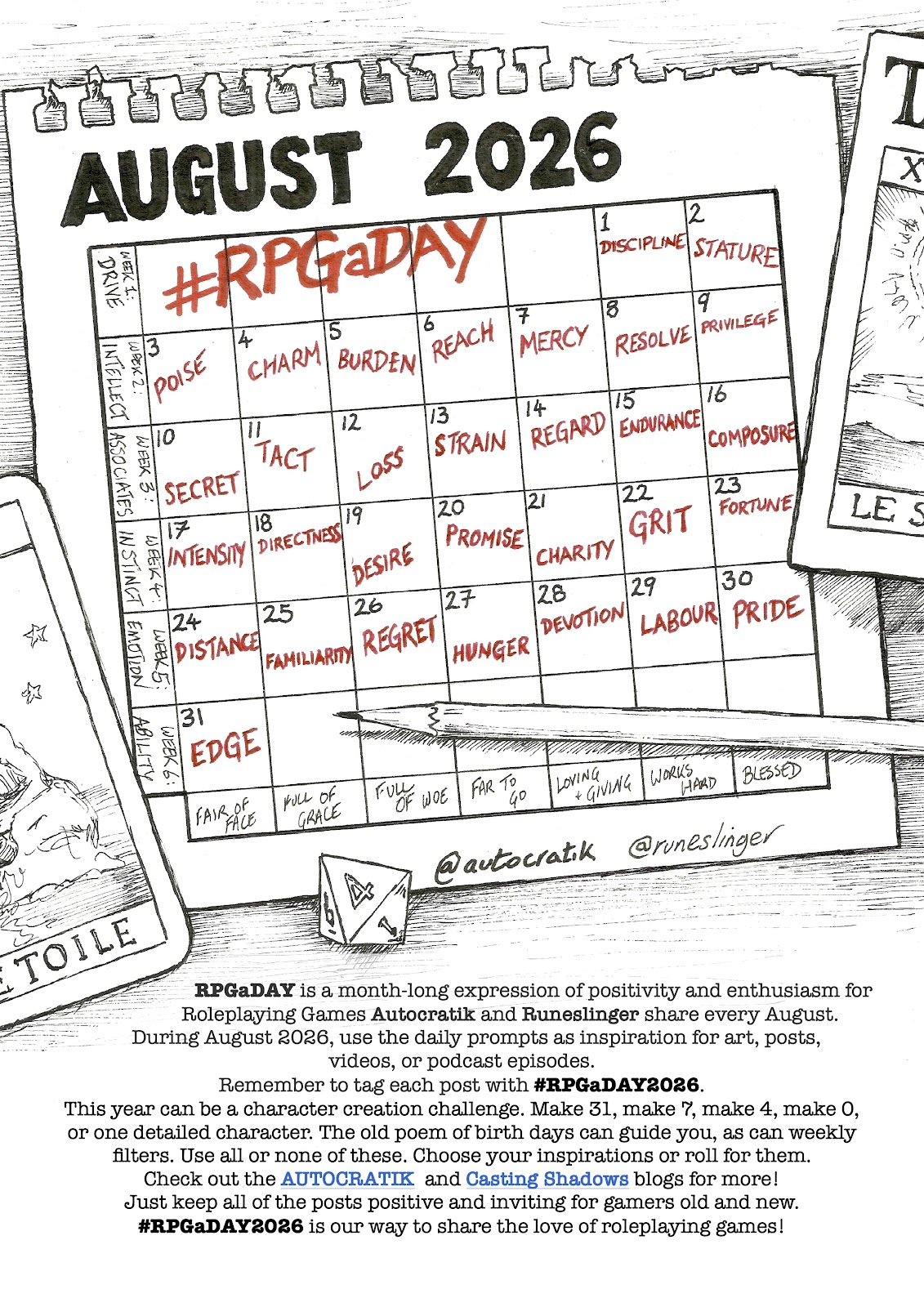
Today’s combination: Fortune (Prompt) + Instinct (Weekly Modifier) + Blesses (Weekly Modifier) + Post-Apocalyptic (Genre)
Here is today’s NPC.
Malahki (Fantasy Name Generators used: Futuristic name generator and Scientific device name generator)
Malahki is the proprietor of a gambling den in a crossroad settlement. His establishment, The Blessed Fortune, is a wooden two-story building with a sign bearing its name in large, gaudy letters. Jugglers, fire-eaters, and exotic mutants perform outside, inviting passersby to come in and try their luck.
Malahki was once a scavenger, surviving by rummaging through the ruins of the past out in the wastes. Stories tell of how he found a powerful artifact from before the fall and used the riches it brought him to start his enterprise. The owner of The Blessed Fortune not only runs card and dice games but also hosts pit fights and animal races. He loans money to his den’s patrons, as well as to merchants and traders in town. Everyone knows Malahki has a sharp instinct for business and games.
What only a few trusted associates know is that the relic Malahki found was the Harmonic Twister—a box of dull metal with dials and controls that shift locations across its surface every time it is used. Only Malahki understands how it works. To those he trusts, he explains that the Harmonic Twister whispers to him.
The artifact controls luck and probability, warping reality to produce outcomes that benefit Malahki. Simple, small adjustments, like ending a client’s lucky streak, have little visible effect on the world; perhaps someone’s eye color shifts, or they suddenly have a new name that everyone seamlessly accepts. Larger adjustments, like causing the failure of a debtor’s plans or eliminating a rival, impact the world in major ways, profoundly changing the people around him or even rearranging buildings across town. Regardless, thus far, only Malahki notices these shifts in reality, and most work to his benefit.
Thus far.
Thanks for reading; I am looking forward to your RPG a Day 2026 post, comments, and conversation. If you want further information about #RPGaDay2026, be sure to check out Autocratik’s blog.
A Spanish version of this post is available at the Desde la Fosa Facebook page.
See you all tomorrow!
Categories: Tabletop Gaming Blogs
[ZINE] Echoes From Fomalhaut #15: The Gardening Issue (NOW AVAILABLE!), US Shipping Options

I am pleased to announce the publication of the fifteenth issue of my fanzine, Echoes From Fomalhaut. This is a 64-page zine dedicated to adventures and GM-friendly campaign materials for OSRIC and other old-school systems. The cover art was provided by Graphite Prime, and the interiors by Ferenc Fabian, Cameron Hawkey, Jason Blasso, and the Dead Victorians. The current issue features a larger wilderness scenario, a port town, two smaller articles, and plenty of gardening advice! The following materials are included:
The Hanging Gardens of Pasquino Babilonio (levels 4–6, 32 keyed areas), a large wilderness scenario set in a mysterious hanging garden left behind from the late days of the Empire. A masterwork of garden design, this place is more than it seems, and hides a long-lost secret which reveals Pasquino Babilonio’s true design.
Pellagris, Port of Plenty (35 keyed areas). A pleasant coastal town on the borders of fair Frabotia, Pellagris has survived centuries of turmoil without much destruction. An orderly mafia town and noble resort, it is a fine place to rest and plan new adventures – but there is enough local intrigue to keep a group occupied or send them on far-flung adventures.
Significant Ships: A collection of 20 ships to be encountered in port, or on the high seas.
The Garden of Punches (levels 2–4, 9+18 keyed areas), a fighting school which has taken over an abandoned village. What conflict lurks among the school’s pugilists? What is the secret of the old lighthouse? And what can we learn about gardening in this place? Find out HERE!
The Illustrious Index of Incline: A catalogue of Echoes #01 to #15, also available here.
Two foldout map sheets with player and GM maps.
* * *
The print version of the zine is available from my Bigcartel store; the PDF edition will be published through DriveThruRPG with a few months’ delay. As always, customers who buy the print edition will receive the PDF version free of charge.
US Shipping Options
Freedom is Coming!
(But Freedom Ain't Free)I am happy to report that US shipping is once again
available through my storefront. I am less happy to report that these shipping
options are not yet a return to the normal shipping possibilities that were
available previously. What we have for now are substandard solutions and
workarounds.

Option #01 – Postal Shipping: Currently, due to the elimination of postal De Minimis exceptions last August, commercial mail, which was a cheap and reliable shipping option, is not yet available, and after a year, it is doubtful if it will be. I can currently ship to the US through commercial EMS packages. These start at a high threshold at the equivalent of $75. They scale up well, so a very large box containing most of my books is not much more expensive than one containing a single zine. Therefore, all US orders will ship for $75. I will make up the difference as a form of discount, but I cannot charge less. This is not a good way to order a single zine (for that, I may recommend Option #02), but it may make sense for a larger batch. On the upside, EMS packages ship fast, usually arriving within a week of postal dispatch.
I will keep investigating alternate shipping options; unfortunately, those I have found on the Hungarian market have not been better than the Post.
Option #02 – Ordering Through Dark Future PDX: As a shipping alternative, I can recommend checking out Dark Future PDX, where this product will be available in a few weeks. Dark Future are a small store, so they may not have everything in my catalogue all the time, but they restock regularly, and they have amassed a good reputation. They will also be carrying the forthcoming Gamemaster’s Guidelines Beyond Fomalhaut. Orders through Dark Future are also eligible for free PDFs.
The Perfidious Port of Pellagris

Categories: Tabletop Gaming Blogs
RPG a Day 2026 – Day 22: Grit
Welcome to Day 22 of #RPGaDay2026. As I explained in my Day 0 post, I’ll be creating NPCs based on the day’s prompts and the week and day modifiers presented in the infographic below. Check out that post for further details.
Today’s combination: Grit (Prompt) + Instinct (Weekly Modifier) + Works Hard (Weekly Modifier) + Pulp and Two-Fisted Adventure (Genre)
Here is today’s NPC.
Ernest “Ernie” Chase (Fantasy Name Generator used for the name: 20th century English name generator)
Ernie is a twelve-year-old newsboy whose father died in the war. After his mother disappeared, he and his young sister were left to live with their grandfather. The old man is often drunk, so Ernie works hard to keep himself and his sister fed despite life’s hardships.
Short and scrawny for his age, Ernie has learned to trust his instincts to survive the city’s dangers. While he lacks a formal education, he possesses a sharp mind. He reads better than he writes, but above all, he prides himself on never forgetting a face or a name. His sheer grit keeps him alive on the streets.
Because newsboys are a ubiquitous sight, and most adults pay little attention to children anyway, Ernie is perfectly positioned to see and hear what people try to keep hidden. He has cultivated a network of clients who pay him to keep an eye out for specific targets, listen in on conversations, and report on the comings and goings across the city. Policemen, smugglers, and gumshoes alike all know to slip Ernie a coin for a vital piece of information.
Thanks for reading; I am looking forward to your RPG a Day 2026 post, comments, and conversation. If you want further information about #RPGaDay2026, be sure to check out Autocratik’s blog.
A Spanish version of this post is available at the Desde la Fosa Facebook page.
See you all tomorrow!
Categories: Tabletop Gaming Blogs
OSR Adventure Fodder - A D100 Random Sword & Sorcery Lovecraftian Encounter Table for Castles & Crusades rpg
To run a Lovecraftian Sword & Sorcery adventure in Castles & Crusades, lean heavily into cosmic dread, decaying sorcery, alien geometry, and sanity-draining horrors. Use the D100 Random Encounter Table below to stock wilderness travels, subterranean crawls, or city ruins with eldritch threats.D100 Sword & Sorcery Lovecraftian Encounter Tabled100Encounter Description01–04The Needleshttp://www.blogger.com/profile/11243274667834930867noreply@blogger.com0
Categories: Tabletop Gaming Blogs
Appendix G (for Greyhawk)
Art by Gary Gianni. Check out all those polearms!
While my Greyhawk series of posts are all just sort of pseudo-encyclopedia entry sort of stuff, they are informed by a certain conception of Greyhawk, at least. I thought it was worth taking a post to outline the works that inform the way I'm presenting and interpreting what I read in the 1980 folio, and other "primary sources."
Anderson, Poul. The Broken Sword — Fantasy in a historical setting with some science fictional rationalization.
Buehlman, Christopher. Between Two Fires, The Blacktongue Thief — The first is a horror/fantasy novel in a Medieval setting, full of horrific monsters and historic detail. The latter is a secondary world fantasy in a world with interesting cultural detail and humor.
DeCamp, L. Sprague. The Reluctant King — Humorous fantasy with good worldbuilding. I've opined before about the relationship between De Camp and Gygax.
Chabon, Michael. Gentlemen of the Road — A historical adventuring duo, highlighting some less discussed areas of history like the Khazar Khaganate.Howard, Robert E. Conan series, various historical adventure stories. — Pulpy historic adventure or pseudo-historic adventure, with a sweep of history element. "The Hyborian Age" essay seems to have been a strong influence on Greyhawk's presentation.
Jókai, Mór. Told by the Death's Head — Picaresque adventure.
Leiber, Fritz. Fafhrd & Gray Mouser stories — Picaresque-inspired fantasy with the archetypal fantasy city and active gods.
Potocki, Jan. Manuscript Found in the Saragossa — Stories within stories that mix Gothic, picaresque, and a bit of secret history.
Smith, Clark Ashton. Averoigne stories — Pulpy pseudohistorical fantasy with a lot of atmosphere, humor.
Art by Marie & John Severin
The nonfiction is perhaps less definitive, but it has provided some inspiration to me in the course of the posts I've written so far.
Nonfiction:Armstrong, Dorsey. Powerful Women of the Medieval World (Great Courses) — Vignettes on the lives of some figures of the Middle Ages.Bale, Anthony. A Travel Guide to the Middle Ages — A fairly light, but informative series of examines of the stories of various travelers in the Middle Ages.Devereaux, Bret. "Practical Polytheism," blog series — A great read on how real polytheism worked.Gies, Francis and Gies, Joseph. Life in a Medieval City — Street level (literally) view of life in the city of Troyes in 1250 CE.Haywood, John. Historical Atlas of the Medieval World — Just the one I happened to have at home.Hoffman-Becking, Dirk. History of the Germans (Podcast) — I particularly found this inspiring regarding the Great Kingdom.Muesse, Mark W. Great World Religions: Hindusim (Great Courses) — useful inspiration for the thinking about the religions of Oerth.Various. Osprey Publishing military books — mostly for the pictures of armors and armor of various cultures/eras.

While my Greyhawk series of posts are all just sort of pseudo-encyclopedia entry sort of stuff, they are informed by a certain conception of Greyhawk, at least. I thought it was worth taking a post to outline the works that inform the way I'm presenting and interpreting what I read in the 1980 folio, and other "primary sources."
As I mentioned, initially thinking of Greyhawk as a more firmly Medieval place was the impetus for this series, but as these things tend to do, my approach has drifted some with time. While my view remains more realistically Medieval elements are nice to bring in, I also don't want to lose site of the Gygaxian Implied Setting Recipe, because at the end of the day, a Greyhawk that feels like Greyhawk (if more rationalized) is more interesting to me than a straight pseudo-history.
Fiction:Anderson, Poul. The Broken Sword — Fantasy in a historical setting with some science fictional rationalization.
Buehlman, Christopher. Between Two Fires, The Blacktongue Thief — The first is a horror/fantasy novel in a Medieval setting, full of horrific monsters and historic detail. The latter is a secondary world fantasy in a world with interesting cultural detail and humor.
DeCamp, L. Sprague. The Reluctant King — Humorous fantasy with good worldbuilding. I've opined before about the relationship between De Camp and Gygax.
Chabon, Michael. Gentlemen of the Road — A historical adventuring duo, highlighting some less discussed areas of history like the Khazar Khaganate.Howard, Robert E. Conan series, various historical adventure stories. — Pulpy historic adventure or pseudo-historic adventure, with a sweep of history element. "The Hyborian Age" essay seems to have been a strong influence on Greyhawk's presentation.
Jókai, Mór. Told by the Death's Head — Picaresque adventure.
Leiber, Fritz. Fafhrd & Gray Mouser stories — Picaresque-inspired fantasy with the archetypal fantasy city and active gods.
Potocki, Jan. Manuscript Found in the Saragossa — Stories within stories that mix Gothic, picaresque, and a bit of secret history.
Smith, Clark Ashton. Averoigne stories — Pulpy pseudohistorical fantasy with a lot of atmosphere, humor.
Art by Marie & John Severin

The nonfiction is perhaps less definitive, but it has provided some inspiration to me in the course of the posts I've written so far.
Nonfiction:Armstrong, Dorsey. Powerful Women of the Medieval World (Great Courses) — Vignettes on the lives of some figures of the Middle Ages.Bale, Anthony. A Travel Guide to the Middle Ages — A fairly light, but informative series of examines of the stories of various travelers in the Middle Ages.Devereaux, Bret. "Practical Polytheism," blog series — A great read on how real polytheism worked.Gies, Francis and Gies, Joseph. Life in a Medieval City — Street level (literally) view of life in the city of Troyes in 1250 CE.Haywood, John. Historical Atlas of the Medieval World — Just the one I happened to have at home.Hoffman-Becking, Dirk. History of the Germans (Podcast) — I particularly found this inspiring regarding the Great Kingdom.Muesse, Mark W. Great World Religions: Hindusim (Great Courses) — useful inspiration for the thinking about the religions of Oerth.Various. Osprey Publishing military books — mostly for the pictures of armors and armor of various cultures/eras.
Categories: Comic Book Blogs, Tabletop Gaming Blogs
RPG a Day 2026 – Day 21: Charity
Welcome to Day 21 of #RPGaDay2026. As I explained in my Day 0 post, I’ll be creating NPCs based on the day’s prompts and the week and day modifiers presented in the infographic below. Check out that post for further details.
Today’s combination: Charity (Prompt) + Instinct (Weekly Modifier) + Loving & Giving (Weekly Modifier) + Science Fiction and Space Opera (Genre)
Here is today’s NPC.
Rector Augun Colrin (Fantasy Name Generators used: Honorific generator, Futuristic name generator, and Space colony/station name generator)
Rector Colrin is one of the Deputy Directors of the Galactic Charity Bureau (GCB), overseeing the Loving & Giving Program in the Epitome System. His responsibilities encompass government support for housing, health, sustenance, and offspring support. The GCB was originally named the Galactic Citizen Services Bureau and was conceived to maintain the well-being and quality of life of a growing galactic population, ensuring everyone benefited from the achievements of a multi-planet governing body. However, after the commerce sector reorganized the galactic government, the Bureau’s mission was drastically reconceived.
At the onset of this galactic reorganization, Augun Colrin was a mid-level commercial bureaucrat—ambitious but lacking in power and influence. He did possess a keen political instinct. He knew that in the vast new bureaucracy, true power would not rest with generals or governors, but with those who controlled the populace’s purse strings.
As populations across the galaxy were taxed to support the GCB, benefits were systematically curtailed. The Bureau’s programs were weaponized to dictate where people could live, provide subpar health services and food, and reassign children to priority off-planet labor. Effectively, the citizens of the galaxy were turned into indentured servants feeding the machinery of galactic business.
Rector Augun Colrin has grown rich, powerful, and complacent in his role—a position he has held for centuries thanks to anti-aging serums and gene-modification treatments. He knows that while others rule Epitome in name, he truly controls the people of the System. But he is concerned. The ferment of revolt has taken hold among fringe elements of society, who scheme, plot, and attack the authorities. While others in the administration violently oppose the insurrection, Colrin follows his instincts and plans to flush them out by restricting access to food, water, and essential services. His brand of loving charity will pull the weeds by their roots and save his stilted, sterile garden.
Thanks for reading; I am looking forward to your RPG a Day 2026 post, comments, and conversation. If you want further information about #RPGaDay2026, be sure to check out Autocratik’s blog.
A Spanish version of this post is available at the Desde la Fosa Facebook page.
See you all tomorrow!
Categories: Tabletop Gaming Blogs
OSR Supernatural Menace - Pennywise the Dancing Clown (IT) For The Sword of Cepheus 2nd Edition Rpg & The Cepheus Engine Rpg
Categories: Tabletop Gaming Blogs
Session One: Arrival in Daggerford
As I previously mentioned, Cairn arrives at the end of spring, so we’ll make things easy and say it’s the first day of summer. It’s about 60 miles from Stonehold (where Cairn is from) to Daggerford, but that’s assuming a straight line. I would think that the primary road would head west from Stonehold to the river, and then follow the river north, crossing at some point to get to Daggerford. I would assume there are several villages and small keeps along the river where the caravan would stop to barter for a day or two - probably stopped ten times, so two days of rest and one day of travel would be thirty days since he left Stonehold. Paid a silver a day for guard duty would put him at the 3 gold he has in pocket, so that all lines up.
I’m going to say that Daggerford is a walled town of about 100 buildings and about 1,200 people. The people are exceedingly superstitious and gossipy. Daggerford was a small fishing village until 70 years ago when the survivors of Trasik arrived, and the village blossomed into a town virtually overnight. The majority of structures are less than 70 years old, but the roughly two dozen older structures stand out in contrast with the newer buildings.
I had actually written up a bit of information on Daggerford already, so I made a few minor edits to that, but it gives me a foundation to work from.
The first stop is the tavern. Cairn will spend 1 gold there to get some food and drink, and to see if he can get some information about Trasik (at a minimum) and his uncle (if he gets really lucky).
What is up with Trasik? I guess the first thing to determine is who lived there, and then what happened to it that it’s in ruins…
Was it humans? Likely. 8. Yes.
Was the purpose of the city mining? Possible. 6. Yes.
Copper mines? 7. No.
Iron? 9. No.
Salt? 3. Yes.
The Salt Mines of Trasik. Has a nice ring to it.
What happened?
Dragon Attack? 9. No.
Humanoid Siege? 11. No.
Evil Awakened? 10. No.
Combined event? 3. Yes.
So, the mines started to tap out of salt, deeper excavations opened a portal to the Vale of Eternal Winters, allowing wintry beasts to come through and ravage the town, sending the survivors fleeing. It was rumored that the more powerful salt guilds of the town had amassed great wealth that was lost or left behind, and may still be in these ruins. The town is now enveloped in an unending winter.
Let’s see how much of this Cairn learns. It’s a Mind check (yuck). He gets +1 edge from the gold he spent. I roll a 10 and an 8. Success! He basically learns everything I’ve written above. It is unlikely he also is able to get information about his uncle; I roll a natural 1!
Well then. It turns out that his uncle had made the Blind Basilisk his base of operations, and had reserved a room there permanently (paying 1,000 gold to reserve it ‘for 99 years’). He had made a half dozen successful forays to the ruins until two years ago when he stopped returning. The innkeeper allows him to use the room (since he has provided sufficient evidence that he is the nephew - and he assumes that the uncle is dead at this point).
I’m going to say that the room has a level 2 treasure left therein… I roll terribly, but still decide there must be at least one instance of treasure. There are three things in the chest: 14 gold, a key, and a journal that is written entirely in the dwarven tongue. I have him trade in his light hammer (gets 1 gold) and buy a medium hammer 4 (8 gold), leaving him with 9 gold. It is likely (if not very likely) that the key is to a chest that the uncle has hidden (containing his actual wealth), and this money was just pocket change he left here. If Cairn trades in his leather armor (getting 2.5 gold), he has enough to buy a ringmail shirt (leaving him with 1 gold and 5 silver). He does all this.
Cairn Torvinson of Clan Thunderforge, Jovial Dwarf Myrmidon 1
Armor 2; Hits 12; Move 60’; Hammer (5) and Shield (2)
Might 4; Mind 1; Reflex 1
Brawler; Fortitude; Two Weapons; Warrior
Ringmail Armor 2; Shield; War Hammer 4; 1 gold, 5 silver
He attacks at +2 with melee weapons, and deals +1 damage. He attacks with both hammer and shield each round. The shield grants +1 edge to armor checks.
The Journal…
I’m going to roll D12 to see how much awesome stuff is in the journal. On a 1, it is mostly personal entries about how he’s feeling, general “I destroyed three skeletons today” entries, and reflections on food or the people of Daggerford. With a 12, there are detailed maps of the ruined town, notes about caverns under the town he has explored, and with a natural 12 details on where he has hidden the chest.
Dang. I roll a natural 12. Alright then!
He learns that Toren had buried the chest at the back of a cave on the opposite side of the river, about a mile upstream. He has a drawing of what the cave looks like. The journal implies that the key is for the chest.
Toren had found a gap in the north wall of Trasik, and used this to venture in and out of the ruins.
He had a lair in Trasik - he found a house with a hidden cellar, and used the cellar as a place to rest and recover. He had taken extra measures to hide the cellar entrance, and in the several months the journal covers, he had made dozens of forays into the town.
His most recent entries were about the ‘frozen portal’, and how he had discovered a way past it. His final entry suggests he was attempting to get through the portal.
Categories: Comic Book Blogs, Tabletop Gaming Blogs
RPG a Day 2026 – Day 20: Promise
Welcome to Day 20 of #RPGaDay2026. As I explained in my Day 0 post, I’ll be creating NPCs based on the day’s prompts and the week and day modifiers presented in the infographic below. Check out that post for further details.
Today’s combination: Promise (Prompt) + Instinct (Weekly Modifier) + Far to Go (Weekly Modifier) + Horror (Genre)
Here is today’s NPC.
Lydia Politoti, Esq. (Fantasy Name Generator used for the name: Greek name generator)
In a world where myths and unimaginable horrors are real and lurk in the shadows, those who discover these secrets are often overwhelmed and left at the mercy of powers they don’t understand. Facing the unknown can be daunting, and even if you manage to confront the terrors, making sure a being of inconceivable power keeps its word not to destroy you in your sleep may seem hopeless. If you need help, call the AMT Law Firm and ask for Lydia Politoti, Esq.
Lydia’s specialties are the dealings and bindings of the secret world hidden behind the veil of normality. She is known for her keen legal instinct and her encyclopedic knowledge of how promises and binding words serve as a powerful currency—and a vital deterrent—against creatures whose power might rend mortals and reality itself.
She will mediate a truce, secure protection, or negotiate a promise of safe passage, binding all parties to the arrangement regardless of the imbalance of power between them. She can be patient, even forgiving, with an inexperienced mortal who has stumbled into a reality they were not ready to face. However, she makes certain that any shadow power that violates the Horkos-clause of a contract faces the significant influence and wrath of the AMT Law Firm.
Lydia was beautiful in her youth, but today she wears far too much makeup. The combination of excessive cosmetic work, obvious hair extensions, an outdated pantsuit, gaudy jewelry, a counterfeit handbag, chain-smoking, and a strange gait in high heels gives her a comical air. This appearance doesn’t quite fit her deep, commanding voice and unbreakable self-assurance.
She always meets clients in a bar or restaurant; the law firm’s actual location is never clear. Clients can find her in many cities across the world, but when asked to take a break and stay a while, she always declines, because she has far to go.
Thanks for reading; I am looking forward to your RPG a Day 2026 post, comments, and conversation. If you want further information about #RPGaDay2026, be sure to check out Autocratik’s blog.
A Spanish version of this post is available at the Desde la Fosa Facebook page.
See you all tomorrow!
Categories: Tabletop Gaming Blogs
OSR Review & Commentary - Clement Sector Careers: The Engineer By Michael Johnson For The Clement Sector Rpg & Cepheus Engine Rpg
Clement Sector Careers: The Engineer is a specialized character supplement by Independence Games designed for the Cepheus Engine RPG.Unlike standard sci-fi character creation options where an "Engineer" implies a starship mechanic wrenching on hyperdrives in an engine room, this supplement shifts the focus entirely to the architects, Needleshttp://www.blogger.com/profile/11243274667834930867noreply@blogger.com0
Categories: Tabletop Gaming Blogs
Development of the Majestic Fantasy RPG, Part 1
I just shipped off the draft for my Scourge of the Demon Wolf, 2nd edition, to my editor, and I am resuming work on my next major project, the full version of the Majestic Fantasy RPG.
For those who don't know, I started publishing on my own by releasing Supplement VI: The Majestic Wilderlands. Not only was it a setting overview of my Majestic Wilderlands, but it was also a supplement adding classes and other rules to Swords & Wizardry, Core Rules circa 2009.
Since then, I've used it in various campaigns, and by the mid-2010s, it had become a complete system in its own right. Still compatible with Swords & Wizardry.
I realized many of you already have a favorite edition or clone, and that more of you opt to run your campaign using a kitbash of your favorite subsystems. While the Majestic Fantasy RPG is a complete RPG in its own right, I also designed it so that it is easy to pull apart so you can use as much or as little of it as you want in your own campaign. To help with this, the text will feature numerous Rob's Notes that explain why certain sections work the way they do.
I created a basic overview for my players, which you can download here.
https://www.batintheattic.com/downloads/MW%20Majestic%20Fantasy%20Basic%20RPG%20Rev%2010.pdf
Later in 2020, I expanded it, had it edited, and released it as the basic rules here.
https://www.drivethrurpg.com/en/product/337515/the-majestic-fantasy-rpg-basic-rules
Now I am working on the full version as a sandbox RPG supporting my Majestic Fantasy Realms, Living World Sandbox Campaigns, and medieval fantasy settings. If you have questions or want to discuss something, the best place is the development log thread I maintain on the RPG Pub. https://www.rpgpub.com/threads/the-majestic-fantasy-rpg-draft.12932/
The system will be presented as four digest books, split so each is a useful reference in its own right.
The Manual of the Three Adventuring ArtsA player's handbook for the Majestic Fantasy RPG
The Domesday Codex
A manual of characters for the Majestic Fantasy RPG.
The Legendarium of the Fantastic
A manual of monsters for the Majestic Fantasy RPG.
The Tome of the Mundane, Strange, and Arcane
A guide for running campaigns using the Majestic Fantasy RPG, along with various subsystems like Merchant Adventures, and material like Magic Items and Treasures.
Optional
Libram of Spells
(print only, the PDF will be included in the files for the Manual of the Three Adventuring Arts)
Rob's Note: Several people suggested offering a print version of just the spells. The spells will also be included in the Manual of the Three Adventuring Arts.
Categories: Tabletop Gaming Blogs
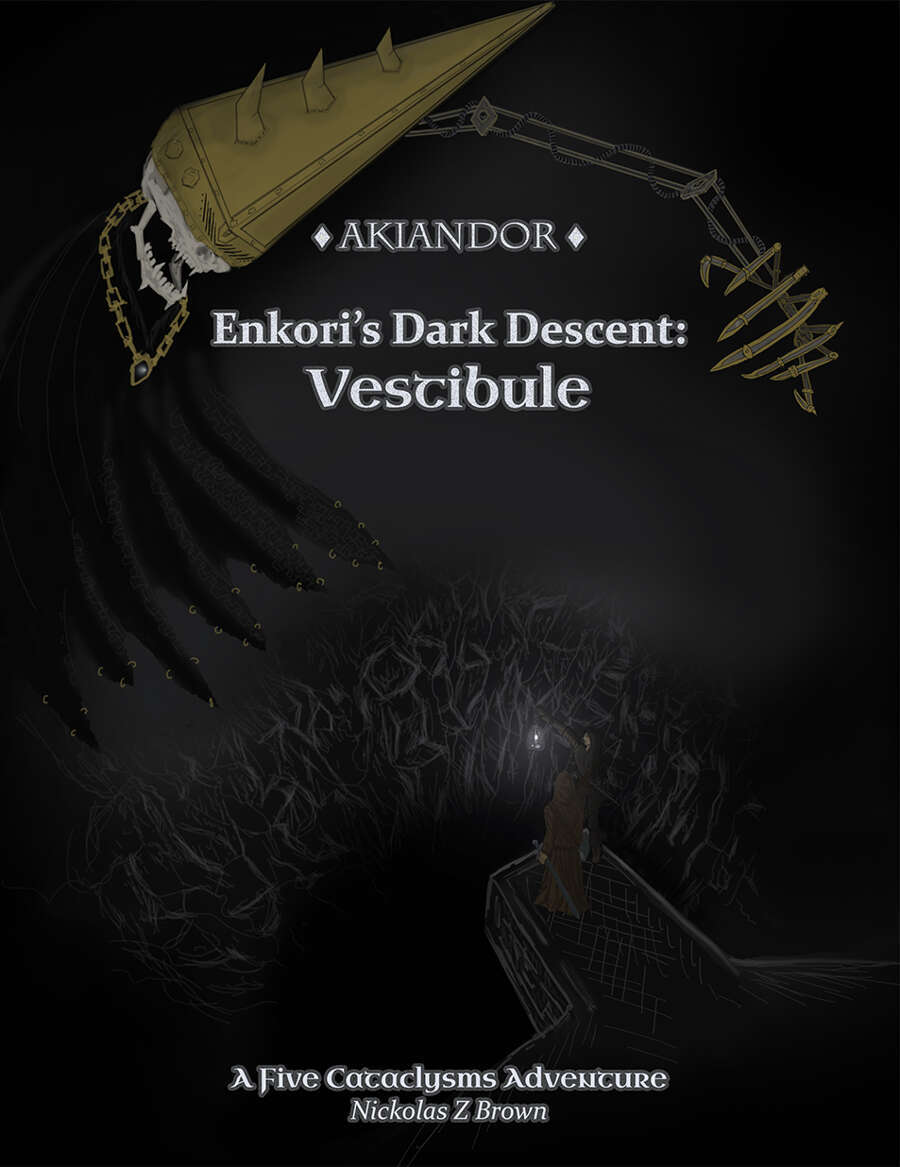
Enkori’s Dark Descent – Vestibule
By Nickolas Zachary Brown
Five Cataclysms
Five Cataclysms
Level 1
Five Cataclysms
Five Cataclysms
Level 1
Souls trespassing into the rogue plane of Akiandor are captured and trapped here, doomed to be tormented by the dark denizens of this place, their souls slowly whittled down to fuel distant engines of preposterous design. This dark and terrible place is full of necromantic monsters built to instill terror, and vicious mechanical traps wrought to imbue fear in every step. Flesh will be torn. Limbs will be severed. Lives will come to a brutal end again and again, only to be cruelly revived by the light of Tirazen, locked in an eternal loop until the day their soul is so tattered from repeat sunderings that their quivering essence joins the chorus of mournful wailing in the chasm of souls.
This 72 page adventure presents a single dungeon level with about 120 rooms in a touch dungeon with lots of challenges, varied and interesting. Imaginative and creative, as is usual with Five Cataclysms, it’s also more than a little askew with a strong funhouse vibe that never turns in to farce.
This is a classic Tower of Gygax dungeon. You’re on another plane, and each time you tie in the dungeon you get brought back to life in the lobby area, perhaps with a little signal degradation, so to speak. You’ve met a black blog in the lobby who has a key to level two, but it’s only giving it to you if you bring it The MacGuffin, somewhere on level one. This is the absolute barest of pretexts for a dungeon designer to be a “starter dungeon for a group of master-level players.“
Ok, sure. And that differs from White Plume how? And thusly we come to everyone’s relationship with funhouse dungeons and/or how much pretext we need to adventure. How much verisimilitude do you need to get going? Is that even a designers job? Isn’t it YOUR job, the players, to find a reason to adventure? Fuck if I know the meaning of life, but we’ll take my attitudes towards it as the norm for players and dms and run with it while examining adventures.
And thusly, how much pretext do I need? How much funhouse can be in the funhouse? How much should the map be an exploratory map and how much is it allowed to be a pointcrawl map? This is not a zany dungeon. I’m not even sure it’s fair to call this a funhouse dungeon. There is not the meta or snark that, say, Tomb of Tog had. I think, maybe, it’s more classic dungeon encounters, over and over again. Maybe an analogy would be Dragon’s Lair?
The individual encounters here are pretty damn nice. There’s a degree of real life to them. Not just verisimilitude but something both simpler and more complex than that. I’m remembering one of the rooms, let me go find it. Ok, so, it’s a tenfoot wide hallway, forty feet long, door on both sides. The door opens only slightly, revealing charred and dented crates just beyond the door. There’s a fucking heavy crate in front of the door. And/or a hallway full of them. This is nuts. I can’t tell you how many times this has happened to me in real life. Well, ok, maybe not the dented and charred part (IE: pay the fuck attention to the trap that was just telegraphed to you Excellent work there!) But the whole “a fucking spatula has gotten out of place and now I can’t open the fucking utensil fucking drawer.” It’s so simple. It’s so immensely relatable.
And it feels like that’s what this adventure, and most stuff by Brown, does. Over and over and over again. There is this ability to create a relatable situation, as if the situation was imagined first, by someone who has never played D&D or heard about it, and then it’s put in the adventure and maybe a mechanic or two attached. Imagination without the influence of the weight of Tolkien and all of that fantasy literature and media since then that has standardized it. I would normally refer to this as “the OD&D way”, but I think it’s a little different here. “Barbed Pillar Atop a multi-tiered pillar is a scepter that radiates magical power. However, the pillar is covered in sharp iron spikes and barbs, many of these strung up with strings & chain with little brass bells suspended upon them. The pillar itself rests on a platform surrounded by the dark streams of liquid. “ This is not a full on 4e set piece, but it is a Special, I think, if we were looking at this from a dungeon population table.
I frequently draw analogies to the Tower of Gygax for some funhouses. It is, I think, because of the ratio of specials to other rooms. When the ratio gets too high then you’re trending to funhouse. There is some kind of middle ground where we find Dungeon of the Bear and other entries like it.
I like almost every encounter in this. They are unusual, varied, many are relatable. I am envious of Browns ability to come sup with these and hit time and time again. And it’s not just the encounters. When it comes to monsters we’ve got “A ramshackle blob of corpses stitched and bolted together, bound with chains and hooks and cords. Stands 8’ tall and roughly 6’ wide, hobbles on 3 stumps of rotten flesh. As it shambles, the clanking of its chains resonate down the halls.” Well, there you go! Great description! But,also, hey, it’s an abomination. How about something more mundane? “A humanoid skeleton whose hands have been replaced with rusted meathooks, or similar. Curiously, they smell like, really bad.” Well, yes, duh, of course! Rusted metal claw hooks for hands. That hits in the imagery department and it hits HARD! Why didn’t you think of that? I guess I’m just a 4e DM and don’t deserve love since I have no creativity at all.
Formatting is good enough, terse and easy enough to follow. Writing is quite evocative, even with a more than a few second person thrown in. Map is decent, large, lots of loops, lots of features. Blah blah blah
I am fascinated by this. Or, perhaps, the question raises. While I admire the raw creativity here and think Brown is one of the best, there is something else going on that I can’t get ahold of. I suddenly realize my own mortality: the line of pretext. Every room a special? Ok. Not much of a setup, or, one that doesn’t make sense? So what. How grounded does an adventure have to be for you to buy in to it? And, if you don’t buy in to it then is it then that arch-heretic: an activity? Damn you Nickolas Zachary Brown! Damn you all to hell!
Meh. Encounters are great. Imagery and creativity is great. I love it them to death. I must also condemn thee to Regerts. Maybe it’s a zones issue?
This is $9 at DriveThru. The preview is eleven pages. You get to see about seven rooms at the end and all the intro. You’re going to have to make a determination from that, and you should be able to.
https://www.drivethrurpg.com/en/product/574403/enkori-s-dark-descent-vestibule?1892600
(Actually, I do know the meaning of life, so, you know,)
Categories: Tabletop Gaming Blogs
Wednesday Comics: DC, November 1985 (week 4)
I'm reading DC Comics' output from January 1980 (cover date) to the end of Crisis! This week, I read the comics on sale on August 22, 1985.
Detective Comics #556: Moench and Colan/Smith continue their story from this month's Batman. It's very much set under the red skies of the Crisis, but it's not labelled as a crossover. We find out, as Night Slayer keeps murdering them, that the False Face Society leftovers hadn't actually been working with Nocturna yet--but as of this issue, she takes command.
Robin tries to tell her how he feels and lean on her for support, but Nocturna is preoccupied with what's happening to the night skies. However, when Batman tracks her down after an encounter with Night Slayer, she makes time for a kiss. Meanwhile, Bullock reveals to Commissioner Gordon his theory that the current Robin isn't the original (something Gordon had noticed as well) but is actually Nocturna's son!
In the Green Arrow backup, we get back to the story by Cavalieri and Moore that had been left dangling. Ollie agrees to help Onyx battle Lars, a renegade monk at the monastery where Ollie himself once trained, who has killed the Exalted Master and taken over. Ollie recalls a run in he had with Lars when they were both students, where the guy confided that he sought a "wisdom key" that would unlock the power of an ancient book. As soon as Green Arrow and Onyx arrive at the monastery, they are confronted by Lars's goons.
All-Star Squadron #51: A Crisis crossover, but that bit only amounts to a cameo, really. The Thomases and Clark/Jones/Coletta have the passing of Harbinger and Firebrand give Mr. Mind a way to find Earth--or at least an Earth. That leads to the events of this issue, where Hourman and Dr. Fate arrive at the JSA brownstone to find most of their team members missing and Hawkgirl a captive of a group of former JSA-member villains banded together as the Monster Society of Evil. This group is the brainchild of Mr. Mind, who came to Earth to meet his hero Charlie McCarthy only to find out he was just a puppet. He then decided to meet his other heroes the JSA, and when he could find them, he decided to be a super-villain.
Hourman, Dr. Fate, Hawkgirl, and late arriver Sandy battle the likes of Oom the Mighty, Ramulus, Mr. Who and Nyola. Unfortunately, they're going to need more help to defeat them. Elsewhere, Liberty Belle and Johnny Quick have apparently fallen through the reverse of the portal Mr. Mind came through and find themselves facing Captain Marvel.
Nathaniel Dusk II #2: MacGregor and Colan pick up just at last issues cliffhanger. Dusk survives the falling unicorn statue, but the gunman who shot at Cranston gets away. As Dusk continues his job of trying to keep Cranston out of trouble, he gets the idea that the older man knows who is trying to kill him and is playing some dangerous game. Amanda's stepfather leans on Dusk to drop the case, and her husband takes him flying. He gets another piece of the puzzle when he finds out Cranston borrowed a camera from Amanda and that he visited her new family on the one day he slipped Dusk's surveillance.
Before he can put any of this together, a drive-by with a tommy gun seems to take Cranston's life. This leads to one of those (for me) jarring aspects of the story, where it moves from conventional detective story to 80s action. Dusk pursues the shooter. The getaway car gets wrecked, and the shooter takes a bus. The issue ends with Dusk on top of the bus as the shooter blows holes in the roof trying to ventilate the detective, too.
Omega Men Annual #2: Klein and host of artists (including McManus, Colon, Smith, Giffen, and O'Neil) give us Primus's backstory, the events leading up to his marriage to Kalista and the founding of the Omega Men, his apparent death in the Spider Guild war, and how he came to be bonded with Artin. When she has heard the whole story Kalista accepts that this being is indeed her husband (at least in part) and the two reconcile. This issue pretty much closes the gap between the previous run and the time jump when Klein took over.
V #10: After all the setup and schemes last issue, it resolves pretty quickly. The mayor reveals herself to our heroes as one of the Visitors but tells them she is actually a triple agent and on their side. She gives them a device that can extend the New York winter, keeping the red dust active and at least postponing a renewed invasion. They're overheard, though, and the mayor is captured, interrogated, and executed. Still, the resistance has the device. Big, bad Walter sent to kill Donovan, gets in a fight with him, but before things resolve he's killed by friendly fire from an overzealous Visitor fighter. The device works, spring is forestalled, and our heroes return to L.A., presumably assuming the nascent New York resistance they were starting up can take care of itself.
World's Finest #321: Cavalieri and Delbo pit our heroes against the Atom villain, Chronos. Coerced by the mysterious Powerbroker, Chronos uses time travel in a plot to destroy Batman. After sending Superman off chasing bombs in the timestream, Chronos forces Batman to journey to the past and watch his parents get murdered--or save them and alter history. Batman resists the temptation to save his parents, using the experience of again reliving their deaths to strengthen his crimefighting resolve, and he's rescued by Superman. Chronos, in a desperate attempt to evade capture, uses his time machine to become one with the timestream.

Detective Comics #556: Moench and Colan/Smith continue their story from this month's Batman. It's very much set under the red skies of the Crisis, but it's not labelled as a crossover. We find out, as Night Slayer keeps murdering them, that the False Face Society leftovers hadn't actually been working with Nocturna yet--but as of this issue, she takes command.
Robin tries to tell her how he feels and lean on her for support, but Nocturna is preoccupied with what's happening to the night skies. However, when Batman tracks her down after an encounter with Night Slayer, she makes time for a kiss. Meanwhile, Bullock reveals to Commissioner Gordon his theory that the current Robin isn't the original (something Gordon had noticed as well) but is actually Nocturna's son!
In the Green Arrow backup, we get back to the story by Cavalieri and Moore that had been left dangling. Ollie agrees to help Onyx battle Lars, a renegade monk at the monastery where Ollie himself once trained, who has killed the Exalted Master and taken over. Ollie recalls a run in he had with Lars when they were both students, where the guy confided that he sought a "wisdom key" that would unlock the power of an ancient book. As soon as Green Arrow and Onyx arrive at the monastery, they are confronted by Lars's goons.

All-Star Squadron #51: A Crisis crossover, but that bit only amounts to a cameo, really. The Thomases and Clark/Jones/Coletta have the passing of Harbinger and Firebrand give Mr. Mind a way to find Earth--or at least an Earth. That leads to the events of this issue, where Hourman and Dr. Fate arrive at the JSA brownstone to find most of their team members missing and Hawkgirl a captive of a group of former JSA-member villains banded together as the Monster Society of Evil. This group is the brainchild of Mr. Mind, who came to Earth to meet his hero Charlie McCarthy only to find out he was just a puppet. He then decided to meet his other heroes the JSA, and when he could find them, he decided to be a super-villain.
Hourman, Dr. Fate, Hawkgirl, and late arriver Sandy battle the likes of Oom the Mighty, Ramulus, Mr. Who and Nyola. Unfortunately, they're going to need more help to defeat them. Elsewhere, Liberty Belle and Johnny Quick have apparently fallen through the reverse of the portal Mr. Mind came through and find themselves facing Captain Marvel.

Nathaniel Dusk II #2: MacGregor and Colan pick up just at last issues cliffhanger. Dusk survives the falling unicorn statue, but the gunman who shot at Cranston gets away. As Dusk continues his job of trying to keep Cranston out of trouble, he gets the idea that the older man knows who is trying to kill him and is playing some dangerous game. Amanda's stepfather leans on Dusk to drop the case, and her husband takes him flying. He gets another piece of the puzzle when he finds out Cranston borrowed a camera from Amanda and that he visited her new family on the one day he slipped Dusk's surveillance.
Before he can put any of this together, a drive-by with a tommy gun seems to take Cranston's life. This leads to one of those (for me) jarring aspects of the story, where it moves from conventional detective story to 80s action. Dusk pursues the shooter. The getaway car gets wrecked, and the shooter takes a bus. The issue ends with Dusk on top of the bus as the shooter blows holes in the roof trying to ventilate the detective, too.

Omega Men Annual #2: Klein and host of artists (including McManus, Colon, Smith, Giffen, and O'Neil) give us Primus's backstory, the events leading up to his marriage to Kalista and the founding of the Omega Men, his apparent death in the Spider Guild war, and how he came to be bonded with Artin. When she has heard the whole story Kalista accepts that this being is indeed her husband (at least in part) and the two reconcile. This issue pretty much closes the gap between the previous run and the time jump when Klein took over.

V #10: After all the setup and schemes last issue, it resolves pretty quickly. The mayor reveals herself to our heroes as one of the Visitors but tells them she is actually a triple agent and on their side. She gives them a device that can extend the New York winter, keeping the red dust active and at least postponing a renewed invasion. They're overheard, though, and the mayor is captured, interrogated, and executed. Still, the resistance has the device. Big, bad Walter sent to kill Donovan, gets in a fight with him, but before things resolve he's killed by friendly fire from an overzealous Visitor fighter. The device works, spring is forestalled, and our heroes return to L.A., presumably assuming the nascent New York resistance they were starting up can take care of itself.

World's Finest #321: Cavalieri and Delbo pit our heroes against the Atom villain, Chronos. Coerced by the mysterious Powerbroker, Chronos uses time travel in a plot to destroy Batman. After sending Superman off chasing bombs in the timestream, Chronos forces Batman to journey to the past and watch his parents get murdered--or save them and alter history. Batman resists the temptation to save his parents, using the experience of again reliving their deaths to strengthen his crimefighting resolve, and he's rescued by Superman. Chronos, in a desperate attempt to evade capture, uses his time machine to become one with the timestream.

Categories: Comic Book Blogs, Tabletop Gaming Blogs
RPG a Day 2026 – Day 19: Desire
Welcome to Day 19 of #RPGaDay2026. As I explained in my Day 0 post, I’ll be creating NPCs based on the day’s prompts and the week and day modifiers presented in the infographic below. Check out that post for further details.
Today’s combination: Desire (Prompt) + Instinct (Weekly Modifier) + Full of Woe (Weekly Modifier) + Fantasy (Genre)
Here is today’s NPC.
Dinis “Whispering Din” Silveira (Fantasy Name Generators used for the name: Portuguese name generator and Bandit name generator)
Whispering Din is a big fish in a small pond. As the local crime lord of an insignificant trading town, he runs rackets and extorts merchants, traders, and beggars alike, while the small local thieves’ guild pays him tribute. Although the bandits on the nearby roads owe formal allegiance to no one, more than one bandit leader is safely in his pocket. Very little illicit business happens in these parts without his knowledge.
In turn, however, Whispering Din owes allegiance and coin to bigger bosses: the Shadow Barons and Counts in the neighboring cities. The Guild of Weights and Measures holds a dark secret over him that keeps him from meddling in their affairs, and he owes heavy debts to the corrupt captains whose ships waylay vessels and sell captives at the southern oasis ports. It is a precarious balancing act, but Din has always possessed a sharp instinct for handling shifting allegiances and navigating the criminal underworld.
Yet, Whispering Din is deeply unhappy. Above all else, he desires respectability and peace—two things that have eluded him his entire life. His ambitions have always guided him, tempered only by his survival instincts, from his early years as a young cutpurse to his dangerous days raiding tombs. Physically, he is a wiry, weaselly man with a thin mustache and thinning, slicked-back hair. He always wears a scarf and speaks with deliberate purpose, though his voice never rises above a harsh whisper.
The scarf hides the ragged scars on his neck, left behind when the claw of a lich ripped open his throat. Dinis and his former companions managed to destroy the undead sorcerer, but not before the creature cursed them to a life full of woes. It is a curse of endless sorrow, ensuring their dreams will never be fulfilled and that every victory will inevitably turn to defeat. Thus, Whispering Din toils ceaselessly, chasing unachievable goals while desperately searching for a way to break the magic that binds him.
Thanks for reading; I am looking forward to your RPG a Day 2026 post, comments, and conversation. If you want further information about #RPGaDay2026, be sure to check out Autocratik’s blog.
A Spanish version of this post is available at the Desde la Fosa Facebook page.
See you all tomorrow!
Categories: Tabletop Gaming Blogs
[NEWS] Gamemaster’s Guidelines: Announcement and Preview
Worlds of High Adventure
(Non-Final Mockup Using Cameron Hawkey's Cover Art)
“Heavy is the head that wears the crown! In role-playing games, the position of the gamemaster carries the most responsibility, as it is a formidable task to entertain and challenge an entire group of players from session to session while preserving the game’s continuing appeal and mystery. Fortunately, the tricks and techniques required for gamemastering are easily learned with a little practice, and perfected through continuous play. All it takes is a lively imagination, sound judgement, and a pinch of ambition.
This volume provides guidance and time-tested techniques emphasizing the practical side of gamemastering to assist in fulfilling these ambitions. Building on the philosophy of classic adventure gaming, and focusing on player agency, gamemaster creativity, and fast, open gameplay, it offers comprehensive guidance for running old-school games, and designing adventures, campaigns, and game worlds. The book provides not only advice, but also a rich toolset to help both during preparation and at the table: procedures of play to facilitate a smooth game experience, a broad selection of monsters and magic items, as well as a large set of random generation tables to inspire gamemastering creativity.”
After all kinds of delays that took a year and then some, I am happy to announce the forthcoming release of my book, Gamemaster’s Guidelines Beyond Fomalhaut. This is going to be a large, comprehensive guidebook focused on providing practical advice on designing and running old-school adventures and campaigns, from basic philosophy to tested design methods and a whole lot of supplemental material (including optional rules, monsters, treasure, and random generation tables). You may have seen some of the book’s contents on this blog in less polished form; this volume has a lot of that, but most of it would qualify as new for the international reader.
The book will be a 292-page, illustrated hardcover retailing for $60. We are currently at the point where final proofreading is coming in, the cover design is being finalised (what you see above is my sorry mockup superimposed on Cameron Hawkey’s outstanding cover art), and we are gearing up for printing and binding. It is expected that copies will be available in mid-October, and if things go well, as a debut release at Cauldron Con 2026.
Antique Mysteries and Dark Magic
What it isIn modern old-school gaming, despite a generous supply of solid materials, there is a conspicuous absence of reference books to help people learn gamemastering from the ground up, or pick up additional techniques beyond the basic level. There is solid guidance out there, but an accessible, detailed how-to is mostly missing. The main game systems in circulation are rather laconic on this matter, focusing on rules and “stuff” rather than guidance in their GM sections. The reasons for this are partly historical: when this thing started in the 2000s, the people involved were assumed to be old hands who knew the AD&D DMG and the B/X rulebooks inside out, and didn’t really need more than what those works and some forum discussion couldn’t provide. Over 20 years later, this is no longer the case – there is a lot of information out there, but much of it is disorganised or tucked away on obscure sites; likewise, as old-school gaming lost its focus, a lot of its assumed knowledge base became muddled and uncertain. OSRIC 3 is an excellent game aid where explaining the rules are concerned, but it is not a book focused on telling you how to be a GM, or how to improve your skills.
Gamemaster’s Guidelines, whose first version was released in 2008 as the GM’s booklet for my old-school RPG, Sword and Magic, seeks to fill this gap. It is intended to supplement your ruleset of choice (OSRIC by default, but easily applicable for other old-school systems), and focus on the practical side of gamemastering – the nuts and bolts of running a game, creating various types of adventures, managing a larger campaign, and designing fantastic settings. It gives readers the basic and advanced techniques, as well as a complex view of how the pieces fit together, and how to make it your own (which is the natural and really fun part of it). It follows the philosophy of Classic Adventure Gaming with its focus on campaign-level play and high player agency, and the Judges Guild tradition of sandbox campaigns and sword & sorcery-flavoured adventure gaming with a hint of weirdness. It is not exhaustive, but it is intended to provide a full picture.
As all good things, it is also something with a personal stamp – not entirely the D&D of Gary Gygax and Bob Bledsaw, although indebted to both and standing on these giants’ shoulders. It is what we have made of it over years of play. Therefore, the book also presents optional rules that have stood the test of time in our campaigns, discussions on world design the way we have enjoyed them, and creatures and magic items that came from these games too, along with a bunch of random tables which served me and my friends in numerous campaigns. Ultimately, your game is yours, and it is up to you where you take it. This is where we did.
"A-ha! I knew it had a section on
summoning the Colour Invisible to Man!"
What’s in itGamemaster’s Guidelines is organised into nine chapters as follows:
I. Guiding principles: A primer for CAG-style play, thoughts on sword & sorcery as a distinct style of fantasy, and sources of inspiration (calling it “Chapter I” is a bit less mysterious than “Appendix N”, but we will live).
II. Gamemastering: This chapter offers an introduction to basic and advanced GMing techniques. It discusses “invisible” issues such as effective descriptions, questions of time management at the table, improvisation, and so on. It offers advice on common problems cropping up in a game, as well as different game styles and how individual player preferences can impact the campaign. It considers issues of simulation and verisimilitude (along with their limits), how to run NPCs, and matters of game balance and the level of challenges. Finally, it offers simple, robust tools for harnessing randomness for creativity.
"Now was that Blade Venom, Type III, or Purple Worm Extract?"
III. Optional rules: The chapter is a collection of rules drawn from our games. These are fairly small, modular rules that can be adopted piecemeal into your own game. The section adds simple combat options including abstract positioning and pursuit rules, and a simple mass combat system (with naval and siege options). It offers options for experience and magic, including notes discussing the interpretation and extension of common spells, the role of divinations and illusions (both prominent in our campaigns), as well as magic item creation. Survival rules, poisons, disease, and a bunch of traps round out the chapter.
IV. Adventures and campaigns: The book’s largest section, encompassing the adventure styles you can find in classic adventure gaming. It offers a general discussion on open—ended scenario design and player agency. It offers guidance and procedures for location-based adventures including dungeons, wilderness exploration (with a variety of approaches from journeys to point-crawls and hex-crawls, and procedures which interface with them), and cities. In all cases, it focuses on what is gameable, and how to focus design work on actual play. It also delves into the conundrum of situation-based adventures, which tend to have an often justifiable bad rep in old-school circles, and discusses how they can be used well in our paradigm. The chapter closes with an in-depth discussion on constructing and running larger-scale campaigns, and how to do so without being overwhelmed. This section thus discusses issues like the information economy, why you need STRICT TIME RECORDS, and bottom-up sandbox design.
V. Fantastic worlds: This chapter delves into creating game-friendly settings, the implications of fantastic societies, with a discussion of level demographics, civilisation vs. wilderness, the role of magic in a fantastic society, the dreaded magic shop issue (something the book supports), and so on. A larger section deals with religion, and how characters can sacrifice to, defeat, and perhaps become gods. A shorter section rounds out the chapter with a discussion of variant fantasy settings, from prehistoric milieus to the weirder end of the post-apocalypse.
VI. Taxes & death: This is a slightly more complex rules module offering basic domain management guidelines. It comes with procedures for taxation, regional development, construction, and army upkeep. It is not a “deep” system (as they say, “ACKS already does that”), but it is one which can be run in a reasonably pain-free way if your players happen to become the lords of a small city-state or satrapy.
The Floating Fungus is Introduced
to a Company of AdventurersVII. Monsters: Again, one of the book’s larger chapter. It offers a large section of 255 monsters, about half familiar, and half new. Some of the new monsters have appeared in my zines and modules; others are bound to be new to anyone who did not play in all my campaigns, and I don’t think any of you have. The chapter duplicates some entries from OSRIC and Monsters of Myth (so there are stats here for orcs, mothmeres and gelatinous cubes, although it takes liberties with common monsters like ghosts or dragons, and introduces variants for others).
The reason for this duplication (which I ruminated over a lot during development) is to offer a complete on-hand resource, but particularly because the book also includes a very large, complex set of random encounter tables which use this particular monster selection. In the proud tradition of AD&D’s Appendix C, it includes tables for wilderness encounters for various climates and terrain types, as well as ruins, seas, cities, and the Underworld (as in the kind of massive megadungeons which stretch deep downwards into the depths of the earth). We have played the hell out of these tables over some 20 years (and they have developed gradually), and this together forms the “implied setting” of the campaign.
The chapter also includes a large section of typical NPC stats for human encounters, a fun one-page section for generating adventurer parties (which I am incredibly happy with), and notes on monster customisation.
VIII. Treasure: As the name implies, this is a whole bunch of magic items, again mixing old and new, and rounded out by a bunch of random tables. These items are usually on the lower and middle part of the power scale, with an emphasis on “tricky” items with odd powers and interesting drawbacks – even some cursed items which can be fun and useful! There is a lot here, from the sword of lions (which rusts in the hands of a cowardly user, but is restored in the hands of the bold) to the figurines of the lesser lords (tribal fetishes offering their own idiosyncratic advice) and the pendulum of graves (which divines a grave’s contents when swung above it). Of course, this book would not be an EMDT production without a selection of technological devices, so those are here, with rules for laser pistols, but also the weirder edge of sinister future technologies such as reversal, a horrible serum inducing rapid reverse evolution, and the doctrinator, a device implanted in the skull to compel correct behaviour. The chapter includes its own treasure generation system, and tables for jewellery and exotic goods.
What is Over here?IX. The omniscient oracle: The book’s final chapter is a selection of random inspiration tables, all of them thoroughly tested. There are tables for adventure locations (e.g. “Desolate Crypt of the Damned City”), dungeons (both subsections like “the Hiding Place of the Gloomy Horror” and individual rooms like “the Grandiose Garden”), and wilderness sites (such as “the Scintillating Ravine” and “the Hidden Grove”).
Tables are offered for exotic ruins (such as a ruined step-pyramid once used as a garden, and now as a refuge), islands (such as an island with a lake and several streams, covered by strange mists, and hiding plantations and lost statues, as well as a garrison), and weird civilisations (such as a depopulating, militaristic society striving to achieve a bucolic utopia, plagued by mysterious disappearances and ruled by a cadre of philosophers).
Tables for curiosities include some usable to stock places like laboratories or temples (e.g. with drapes, an orb, and braziers), some to generate archaeological rubbish (going from broken pottery to the wreckage of great machines), and some to discern the functions of magical things (e.g. a benevolent oracle), or random teleporters and gateways (e.g. to a similar, but subtly different reality).
There is a table of 100 curses (including the Curse of the Fire-Worshippers, which draws the character towards all manners of fire, and compels their worship), carousing complications (e.g. gaining an influential, but very temporary friend), and downtime events for missing characters (e.g. being challenged to a duel, or finding a trail to a treasure).
How it can be orderedThere are simple answers and, regrettably, complicated answers.
Outside the US, the book will just be available from my Bigcartel store, as well as partnered stores. If you are in the EU, there is a small but non-zero chance that the EU has effectively destroyed its single market and all small, independent webshops therein with a retarded environmental regulation a few days ago. If this is the case, and the regulation gets enforced instead of withdrawn, then EMDT is a dead company walking, and so are most small RPG publishers in Europe, along with all other small creators selling custom jewellery, art prints, or handmade baby clothes. I sincerely hope it is not enforced. It is some insane shit, the kind that defines modern Europoor politics, and makes you wish for the return of the Habsburgs.
No! Don't Do It!
There Will Be Ways to Buy the Book!Inside the US, things are a bit more complicated. As you might be aware, the US introduced postal tariffs on foreign countries late last August, which, as a side-effect, basically eliminated commercial mail from Europe in a way that has not been restored in the one year since. My working assumption is that it is gone for good. Commercial packages became available again earlier this year, but the only affordable shipping option in this category is EMS, which has a lower threshold of $75. I will be opening up my store to US orders with the publication of Echoes From Fomalhaut #15 in late August, but it will be a flat $75 whether you buy this book, you buy one zine, or you buy every damn thing I have for sale. (I’ll cover the difference if it is higher – EMS scales up decently well, and arrives quickly). That’s not great, but what can you do.
Furthermore, the book will be available from Dark Future PDX in Portland, OR. They are a small, friendly old-school game store who have accumulated a good rep, and I am happy to note that they carry my stuff. So buy with confidence – if you buy from them, you are eligible for free PDFs as always. There may be other distribution partners too in the future.
If you come to Cauldron Con, I may have advance copies available through the organisers. See you there!Preview – Dungeon adventuresFinally, after all this long talk, here is a 12-page preview of Chapter IV’s section on dungeon adventures, discussing mapping, encounters, and gamemastering procedures. Enjoy!
Gamemaster’s Guidelines Beyond Fomalhaut – PREVIEW (11 MB PDF)
"I ain't afraid of no Level V encounter table!"

(Non-Final Mockup Using Cameron Hawkey's Cover Art)
“Heavy is the head that wears the crown! In role-playing games, the position of the gamemaster carries the most responsibility, as it is a formidable task to entertain and challenge an entire group of players from session to session while preserving the game’s continuing appeal and mystery. Fortunately, the tricks and techniques required for gamemastering are easily learned with a little practice, and perfected through continuous play. All it takes is a lively imagination, sound judgement, and a pinch of ambition.
This volume provides guidance and time-tested techniques emphasizing the practical side of gamemastering to assist in fulfilling these ambitions. Building on the philosophy of classic adventure gaming, and focusing on player agency, gamemaster creativity, and fast, open gameplay, it offers comprehensive guidance for running old-school games, and designing adventures, campaigns, and game worlds. The book provides not only advice, but also a rich toolset to help both during preparation and at the table: procedures of play to facilitate a smooth game experience, a broad selection of monsters and magic items, as well as a large set of random generation tables to inspire gamemastering creativity.”
After all kinds of delays that took a year and then some, I am happy to announce the forthcoming release of my book, Gamemaster’s Guidelines Beyond Fomalhaut. This is going to be a large, comprehensive guidebook focused on providing practical advice on designing and running old-school adventures and campaigns, from basic philosophy to tested design methods and a whole lot of supplemental material (including optional rules, monsters, treasure, and random generation tables). You may have seen some of the book’s contents on this blog in less polished form; this volume has a lot of that, but most of it would qualify as new for the international reader.
The book will be a 292-page, illustrated hardcover retailing for $60. We are currently at the point where final proofreading is coming in, the cover design is being finalised (what you see above is my sorry mockup superimposed on Cameron Hawkey’s outstanding cover art), and we are gearing up for printing and binding. It is expected that copies will be available in mid-October, and if things go well, as a debut release at Cauldron Con 2026.
Antique Mysteries and Dark Magic

What it isIn modern old-school gaming, despite a generous supply of solid materials, there is a conspicuous absence of reference books to help people learn gamemastering from the ground up, or pick up additional techniques beyond the basic level. There is solid guidance out there, but an accessible, detailed how-to is mostly missing. The main game systems in circulation are rather laconic on this matter, focusing on rules and “stuff” rather than guidance in their GM sections. The reasons for this are partly historical: when this thing started in the 2000s, the people involved were assumed to be old hands who knew the AD&D DMG and the B/X rulebooks inside out, and didn’t really need more than what those works and some forum discussion couldn’t provide. Over 20 years later, this is no longer the case – there is a lot of information out there, but much of it is disorganised or tucked away on obscure sites; likewise, as old-school gaming lost its focus, a lot of its assumed knowledge base became muddled and uncertain. OSRIC 3 is an excellent game aid where explaining the rules are concerned, but it is not a book focused on telling you how to be a GM, or how to improve your skills.
Gamemaster’s Guidelines, whose first version was released in 2008 as the GM’s booklet for my old-school RPG, Sword and Magic, seeks to fill this gap. It is intended to supplement your ruleset of choice (OSRIC by default, but easily applicable for other old-school systems), and focus on the practical side of gamemastering – the nuts and bolts of running a game, creating various types of adventures, managing a larger campaign, and designing fantastic settings. It gives readers the basic and advanced techniques, as well as a complex view of how the pieces fit together, and how to make it your own (which is the natural and really fun part of it). It follows the philosophy of Classic Adventure Gaming with its focus on campaign-level play and high player agency, and the Judges Guild tradition of sandbox campaigns and sword & sorcery-flavoured adventure gaming with a hint of weirdness. It is not exhaustive, but it is intended to provide a full picture.
As all good things, it is also something with a personal stamp – not entirely the D&D of Gary Gygax and Bob Bledsaw, although indebted to both and standing on these giants’ shoulders. It is what we have made of it over years of play. Therefore, the book also presents optional rules that have stood the test of time in our campaigns, discussions on world design the way we have enjoyed them, and creatures and magic items that came from these games too, along with a bunch of random tables which served me and my friends in numerous campaigns. Ultimately, your game is yours, and it is up to you where you take it. This is where we did.
"A-ha! I knew it had a section on

summoning the Colour Invisible to Man!"
What’s in itGamemaster’s Guidelines is organised into nine chapters as follows:
I. Guiding principles: A primer for CAG-style play, thoughts on sword & sorcery as a distinct style of fantasy, and sources of inspiration (calling it “Chapter I” is a bit less mysterious than “Appendix N”, but we will live).
II. Gamemastering: This chapter offers an introduction to basic and advanced GMing techniques. It discusses “invisible” issues such as effective descriptions, questions of time management at the table, improvisation, and so on. It offers advice on common problems cropping up in a game, as well as different game styles and how individual player preferences can impact the campaign. It considers issues of simulation and verisimilitude (along with their limits), how to run NPCs, and matters of game balance and the level of challenges. Finally, it offers simple, robust tools for harnessing randomness for creativity.
"Now was that Blade Venom, Type III, or Purple Worm Extract?"

III. Optional rules: The chapter is a collection of rules drawn from our games. These are fairly small, modular rules that can be adopted piecemeal into your own game. The section adds simple combat options including abstract positioning and pursuit rules, and a simple mass combat system (with naval and siege options). It offers options for experience and magic, including notes discussing the interpretation and extension of common spells, the role of divinations and illusions (both prominent in our campaigns), as well as magic item creation. Survival rules, poisons, disease, and a bunch of traps round out the chapter.
IV. Adventures and campaigns: The book’s largest section, encompassing the adventure styles you can find in classic adventure gaming. It offers a general discussion on open—ended scenario design and player agency. It offers guidance and procedures for location-based adventures including dungeons, wilderness exploration (with a variety of approaches from journeys to point-crawls and hex-crawls, and procedures which interface with them), and cities. In all cases, it focuses on what is gameable, and how to focus design work on actual play. It also delves into the conundrum of situation-based adventures, which tend to have an often justifiable bad rep in old-school circles, and discusses how they can be used well in our paradigm. The chapter closes with an in-depth discussion on constructing and running larger-scale campaigns, and how to do so without being overwhelmed. This section thus discusses issues like the information economy, why you need STRICT TIME RECORDS, and bottom-up sandbox design.
V. Fantastic worlds: This chapter delves into creating game-friendly settings, the implications of fantastic societies, with a discussion of level demographics, civilisation vs. wilderness, the role of magic in a fantastic society, the dreaded magic shop issue (something the book supports), and so on. A larger section deals with religion, and how characters can sacrifice to, defeat, and perhaps become gods. A shorter section rounds out the chapter with a discussion of variant fantasy settings, from prehistoric milieus to the weirder end of the post-apocalypse.
VI. Taxes & death: This is a slightly more complex rules module offering basic domain management guidelines. It comes with procedures for taxation, regional development, construction, and army upkeep. It is not a “deep” system (as they say, “ACKS already does that”), but it is one which can be run in a reasonably pain-free way if your players happen to become the lords of a small city-state or satrapy.
The Floating Fungus is Introduced

to a Company of AdventurersVII. Monsters: Again, one of the book’s larger chapter. It offers a large section of 255 monsters, about half familiar, and half new. Some of the new monsters have appeared in my zines and modules; others are bound to be new to anyone who did not play in all my campaigns, and I don’t think any of you have. The chapter duplicates some entries from OSRIC and Monsters of Myth (so there are stats here for orcs, mothmeres and gelatinous cubes, although it takes liberties with common monsters like ghosts or dragons, and introduces variants for others).
The reason for this duplication (which I ruminated over a lot during development) is to offer a complete on-hand resource, but particularly because the book also includes a very large, complex set of random encounter tables which use this particular monster selection. In the proud tradition of AD&D’s Appendix C, it includes tables for wilderness encounters for various climates and terrain types, as well as ruins, seas, cities, and the Underworld (as in the kind of massive megadungeons which stretch deep downwards into the depths of the earth). We have played the hell out of these tables over some 20 years (and they have developed gradually), and this together forms the “implied setting” of the campaign.
The chapter also includes a large section of typical NPC stats for human encounters, a fun one-page section for generating adventurer parties (which I am incredibly happy with), and notes on monster customisation.
VIII. Treasure: As the name implies, this is a whole bunch of magic items, again mixing old and new, and rounded out by a bunch of random tables. These items are usually on the lower and middle part of the power scale, with an emphasis on “tricky” items with odd powers and interesting drawbacks – even some cursed items which can be fun and useful! There is a lot here, from the sword of lions (which rusts in the hands of a cowardly user, but is restored in the hands of the bold) to the figurines of the lesser lords (tribal fetishes offering their own idiosyncratic advice) and the pendulum of graves (which divines a grave’s contents when swung above it). Of course, this book would not be an EMDT production without a selection of technological devices, so those are here, with rules for laser pistols, but also the weirder edge of sinister future technologies such as reversal, a horrible serum inducing rapid reverse evolution, and the doctrinator, a device implanted in the skull to compel correct behaviour. The chapter includes its own treasure generation system, and tables for jewellery and exotic goods.
What is Over here?IX. The omniscient oracle: The book’s final chapter is a selection of random inspiration tables, all of them thoroughly tested. There are tables for adventure locations (e.g. “Desolate Crypt of the Damned City”), dungeons (both subsections like “the Hiding Place of the Gloomy Horror” and individual rooms like “the Grandiose Garden”), and wilderness sites (such as “the Scintillating Ravine” and “the Hidden Grove”).

Tables are offered for exotic ruins (such as a ruined step-pyramid once used as a garden, and now as a refuge), islands (such as an island with a lake and several streams, covered by strange mists, and hiding plantations and lost statues, as well as a garrison), and weird civilisations (such as a depopulating, militaristic society striving to achieve a bucolic utopia, plagued by mysterious disappearances and ruled by a cadre of philosophers).
Tables for curiosities include some usable to stock places like laboratories or temples (e.g. with drapes, an orb, and braziers), some to generate archaeological rubbish (going from broken pottery to the wreckage of great machines), and some to discern the functions of magical things (e.g. a benevolent oracle), or random teleporters and gateways (e.g. to a similar, but subtly different reality).
There is a table of 100 curses (including the Curse of the Fire-Worshippers, which draws the character towards all manners of fire, and compels their worship), carousing complications (e.g. gaining an influential, but very temporary friend), and downtime events for missing characters (e.g. being challenged to a duel, or finding a trail to a treasure).
How it can be orderedThere are simple answers and, regrettably, complicated answers.
Outside the US, the book will just be available from my Bigcartel store, as well as partnered stores. If you are in the EU, there is a small but non-zero chance that the EU has effectively destroyed its single market and all small, independent webshops therein with a retarded environmental regulation a few days ago. If this is the case, and the regulation gets enforced instead of withdrawn, then EMDT is a dead company walking, and so are most small RPG publishers in Europe, along with all other small creators selling custom jewellery, art prints, or handmade baby clothes. I sincerely hope it is not enforced. It is some insane shit, the kind that defines modern Europoor politics, and makes you wish for the return of the Habsburgs.
No! Don't Do It!

There Will Be Ways to Buy the Book!Inside the US, things are a bit more complicated. As you might be aware, the US introduced postal tariffs on foreign countries late last August, which, as a side-effect, basically eliminated commercial mail from Europe in a way that has not been restored in the one year since. My working assumption is that it is gone for good. Commercial packages became available again earlier this year, but the only affordable shipping option in this category is EMS, which has a lower threshold of $75. I will be opening up my store to US orders with the publication of Echoes From Fomalhaut #15 in late August, but it will be a flat $75 whether you buy this book, you buy one zine, or you buy every damn thing I have for sale. (I’ll cover the difference if it is higher – EMS scales up decently well, and arrives quickly). That’s not great, but what can you do.
Furthermore, the book will be available from Dark Future PDX in Portland, OR. They are a small, friendly old-school game store who have accumulated a good rep, and I am happy to note that they carry my stuff. So buy with confidence – if you buy from them, you are eligible for free PDFs as always. There may be other distribution partners too in the future.
If you come to Cauldron Con, I may have advance copies available through the organisers. See you there!Preview – Dungeon adventuresFinally, after all this long talk, here is a 12-page preview of Chapter IV’s section on dungeon adventures, discussing mapping, encounters, and gamemastering procedures. Enjoy!
Gamemaster’s Guidelines Beyond Fomalhaut – PREVIEW (11 MB PDF)
"I ain't afraid of no Level V encounter table!"

Categories: Tabletop Gaming Blogs
Adapting North West of Earth By C.L. Moore - Orbital Decay (MicroRed version) From The Red Room & The New Flesh Rpg - a detailed room-by-room map layout and hazard guide for a derelict orbital station hosting a Shambleau infestation.
ORBITAL STATION: LEKTRA-09 (DEEP-SPACE BIO-RESEARCH & RECREATION HUB)Lektra-09 is a decaying, medium-class orbital habitat slipping out of a stable Lagrange point. The environmental controls are failing, coating everything in hot, humid moisture, crimson bio-gel, and suffocating neon haze. The station operates on low auxiliary power, creating severe visibility limits and fluctuating Needleshttp://www.blogger.com/profile/11243274667834930867noreply@blogger.com0
Categories: Tabletop Gaming Blogs
RPG a Day 2026 – Day 18: Directness
Welcome to Day 18 of #RPGaDay2026. As I explained in my Day 0 post, I’ll be creating NPCs based on the day’s prompts and the week and day modifiers presented in the infographic below. Check out that post for further details.
Today’s combination: Directness (Prompt) + Instinct (Weekly Modifier) + Full of Grace (Weekly Modifier) + Cyberpunk (Genre)
Here is today’s NPC.
Omen (Fantasy Name Generator used for the name: Cyberpunk (nick)name generator)
Omen’s reputation as a jacker who can slice through any corporate security node is almost as legendary as her lack of tact. She calls it directness; those who deal with her call it rudeness. She only began taking contracts a few years ago, but her reputation quickly grew as she completed increasingly daring jobs. She never goes on physical runs and is rarely seen out in the city, but when you need a system cracked, “Omen is your gal.” Or so she constantly reminds everyone.
She will point out the flaws in your plans, your lack of forethought, or your poor choice in cybernetics with little regard for social norms or your feelings. However, she rarely fails at a job. She chalks her success up to unfailing instincts and the blessing of whatever higher power might be listening. Omen is quick to tell you that she’s “just that good, and being full of grace never hurts!”
With clients she doesn’t know or trust, she communicates exclusively via encrypted messages. When her instincts give the green light, and you’ve earned her trust—not an easy feat—Omen might welcome you to her “sanctum sanctorum,” a heavily secured ops center where she practices her digital sorcery.
Omen has scrubbed her real identity from all digital records and answers to no other name. Her base of operations is protected by a heavily chromed bodyguard she affectionately calls “her brother,” though they obviously share no actual relation. The place is rigged with state-of-the-art neural computers and servers, its walls covered in religious imagery and paraphernalia from dozens of faiths. As she puts it, “One or more of these has to be blessing me at any given point.”
Thanks for reading; I am looking forward to your RPG a Day 2026 post, comments, and conversation. If you want further information about #RPGaDay2026, be sure to check out Autocratik’s blog.
A Spanish version of this post is available at the Desde la Fosa Facebook page.
See you all tomorrow!
Categories: Tabletop Gaming Blogs
OSR Commentary - Running T1-4: The Temple of Elemental Evil (AD&D 1E) by Gary Gygax With Frank Mentzer using Adventurer Conqueror King System II (ACKS II) Rpg
Running T1-4: The Temple of Elemental Evil (AD&D 1E) using Adventurer Conqueror King System II (ACKS II) creates an extraordinary sandbox campaign. ACKS II excels at domain building, mercenary armies, economic mechanics, and granular dungeon crawling—making it a perfect fit for Hommlet, Nulb, and the massive mega-dungeon beneath the Temple.
Categories: Tabletop Gaming Blogs
Tomb of Tog
By Arman Bohn
Distropilis Goods
OSE
Levels 1-3
Distropilis Goods
OSE
Levels 1-3
A town, overrun with rabbits and on the brink of starvation, offers its only clue to the source of its suffering: a book known as the Tome of Tog. Locals claim the titular mage has been a nuisance for years. The pages of the book have been torn out, save for a map that leads the party on a winding, hallucinogenic path through a dense wood to the TOMB OF TOG.
This 24 page adventure presents eleven rooms in a wizards Challenge Dungeon. With Grimtoothian machinations the party faces snarky challenges with no rewards. As challenges go they are ok, but I loathe the subgenre and the suspension of pretext so much that it’s hard to say much nice about this.
Yeah, so, arrogant wizard makes a challenge dungeon. You defeat all eight rooms, one for each school of magic. You then face the ninth school of magic. Your reward is a map to another Tog dungeon. That’s the ONLY reward. Good luck leveling. So, this is one of those “have an experience” hippy mork borg dungeon “activities” instead of a D&D adventure. If you’re in to this kind of shit, then, yeah you. I’m not. I want to play a game. A game in a campaign. And I’m using the words game and campaign very explicitly. I acknowledge, though, that a significant number of people DO engage in RPG’s as an activity. So, if you are a l000ser, is this adventure for you?
Yeah, I mean, probably. There’s no real pretext here for adventure other than “the wizard did it”, which is the lame ass meme. [And, as a rant, I would like to mention something here. “What happens when someone is gifted with a wellspring of power but is completely incompetent?” That’s not a fucking wizard. That’s one of those fuckwits who are born with power or make a pact with an entity to get power. Some kind of power fantasy YA novel bullshit crap where you’re A Special Flower. Wizards wrest knowledge from the universe through hard work. Also, wizard is my favorite of the three classes …]
Ok, so, interactivity. You gotta go through each of the nine rooms. They each have some kind of challenge devised by the wizard. The challenges are going to be framed with a certain wryness. So, in the clearest example, to get in to the dungeon you have to answer a couple of riddles. The riddler begins with “ Here, we celebrate the glory of Tog the Inexorable, Tog the Impossible, Tog the Immutable, Tog the Intangible. Who is the greatest wizard of all?” The answer, of course, is Tog. That’s funny. Ok, humor is subjective and _I_ find it funny. There’s a bit of a wink from the designer in this. It never quite falls in to being a joke adventure, which are all shitty as fuck. It instead remains in the realm of those early adventures like Dungeon of the Bear and Grimtooth. Not in a deathtrap way, or punny way, but with a kind of hint toward both.
The first room, “Illusion” is a good example. When you go in you are immediately turned invisible (and, of fucking course, the fucking door slams shut behind you. Fucking challenge dungeon bullshit.) Bound to the room is a VISIBLE stalker. Who is depressed. “Unable to see its victims, the creature has suffered countless humiliating encounters. It now uses small talk as both a form of therapy and a method to pinpoint the location of intruders.” It’s taken the normal encounter and kind of turned it ninety degrees, yes? Is it s a gimmick? Absolutely. But, it’s a challenge dungeon.
The rest of the encounters replicate this kind of obtuse encounter type. Things are more than a bit askew in here. In terms of a challenge dungeon it is certainly in the realm, if we squint hard enough, of Tower of Gygax. The dungeon throws the players off balance in various ways, with a little (snark?) mixed in. I am MUCH more down for this type of challenge dungeon than a simple series of skill checks and combats. There is an air of Grimtooth room traps about the place. Not really traps, but in the setup of the rooms. And this includes a couple of meta things, like “Each player must secretly write down a single word describing their character’s current emotional state, without discussing it with the other players, and pass it to the GM.” Which then builds an Emotions Golem in the room. I always raise my eyebrows at the emo stuff, but this is a decent implementation of it.
Formatting is meh. The background of the pages are a beige parchment color with the text being light grey and the font something with some flourishes and varying stroke weight. This combines to make things harder than it should be to read the thing, but it’s not impossible. When some words show up in italics it’s a pain though, given this combination. There tends to be a little read-aloud section offset in a darker grey, and then a longish section of DM text that explains the room, with several very short paragraphs following that expand on things. It does an ok job, a little subpar, and is on the edge of being a pain but not quite there, especially given the obtuse nature of the rooms.
So it’s a challenge dungeon, maybe most similar to White Plume with just a little meta and snark thrown in. Maybe “the California Style” will be recognizable, and never really goes full on jokey or too meta. I’m allergic to all challenge dungeons, but if I were looking for one for a one shot sort of thing as an activity this one WOULD come to mind, chiefly because of the askew nature of the challenges.
This is $8 at DriveThru. The preview is eight spread pages (the PDF is spreads also. ARG!) so you get about thirteen pages of content, enough to show a large portion of the dungeon. A brief perusal will show the Grimtooth Rooms as diagrams, and the PDF is more than apt in showing you what to expect, so good preview.
https://www.drivethrurpg.com/en/product/573505/tomb-of-tog?1892600
Categories: Tabletop Gaming Blogs
Pages
