
Your wildly multifarious home!
Tabletop Gaming Feeds
Weird Revisited: Kung Fu Dark Sun
As when I wrote this post in 2019, I've been watching some wuxia film lately, and then there was the announcement of a new edition of Dark Sun, so it seemed a good time to revisit this idea...
art by Eric Belisle
Still on a wuxia kick and thinking about the arid lands of Northern China, it occurs to me that Dark Sun might be an interesting mashup with kung fu action. It is true that the default 80s barbarian film meets Mad Max aesthetic of Dark Sun doesn’t scream Crouching Tiger or Hidden Dragon, but that aside, I think it’s actually not a bad fit. Let me run the list:

Still on a wuxia kick and thinking about the arid lands of Northern China, it occurs to me that Dark Sun might be an interesting mashup with kung fu action. It is true that the default 80s barbarian film meets Mad Max aesthetic of Dark Sun doesn’t scream Crouching Tiger or Hidden Dragon, but that aside, I think it’s actually not a bad fit. Let me run the list:
- The downgrading of weaponry due to the scarcity of metal in the setting leaves space for bare-handed martial arts.
- The Elemental clerics thing can easily spun in a wuxia direction (as seen in Avatar: The Last Airbender).
- The "fighting oppression" angle of Dark Sun dovetails nicely with with the "fighting corrupt authority" aspect of some wuxia.

- There are Thri-Kreen who are praying mantis people, essentially, who would be natural practitioners of praying mantis kung fu.
- Athasian Dragons aren't common monsters but beings of immense power, like the Chinese conception of the creature (though Athas's is certainly not benevolent).

Categories: Comic Book Blogs, Tabletop Gaming Blogs
OSR Sword & Sorcery Adventure Fodder - d100 Random Serpent People & Treasure Table tailored for the Serpent Tower fully compatible with Castles & Crusades (and most classic OSR systems)
Here is a themed d100 treasure table for the Serpent Tower, blending ancient serpent-cult relics, ophidian oddities, venomous alchemy, and classic Castles & Crusades treasure. This entry picks from OSR Sword & Sorcery Adventure Fodder - d100 Treasure Table tailored for the Tower of the Serpent Horde, fully compatible with Castles & Crusades (and most classic OSR systems)TheNeedleshttp://www.blogger.com/profile/11243274667834930867noreply@blogger.com0
Categories: Tabletop Gaming Blogs
RPG a Day 2026 – Day 7: Mercy
Welcome to Day 7 of #RPGaDay2026. As I explained in my Day 0 post, I’ll be creating NPCs based on the day’s prompts and the week and day modifiers presented in the infographic below. Check out that post for further details.
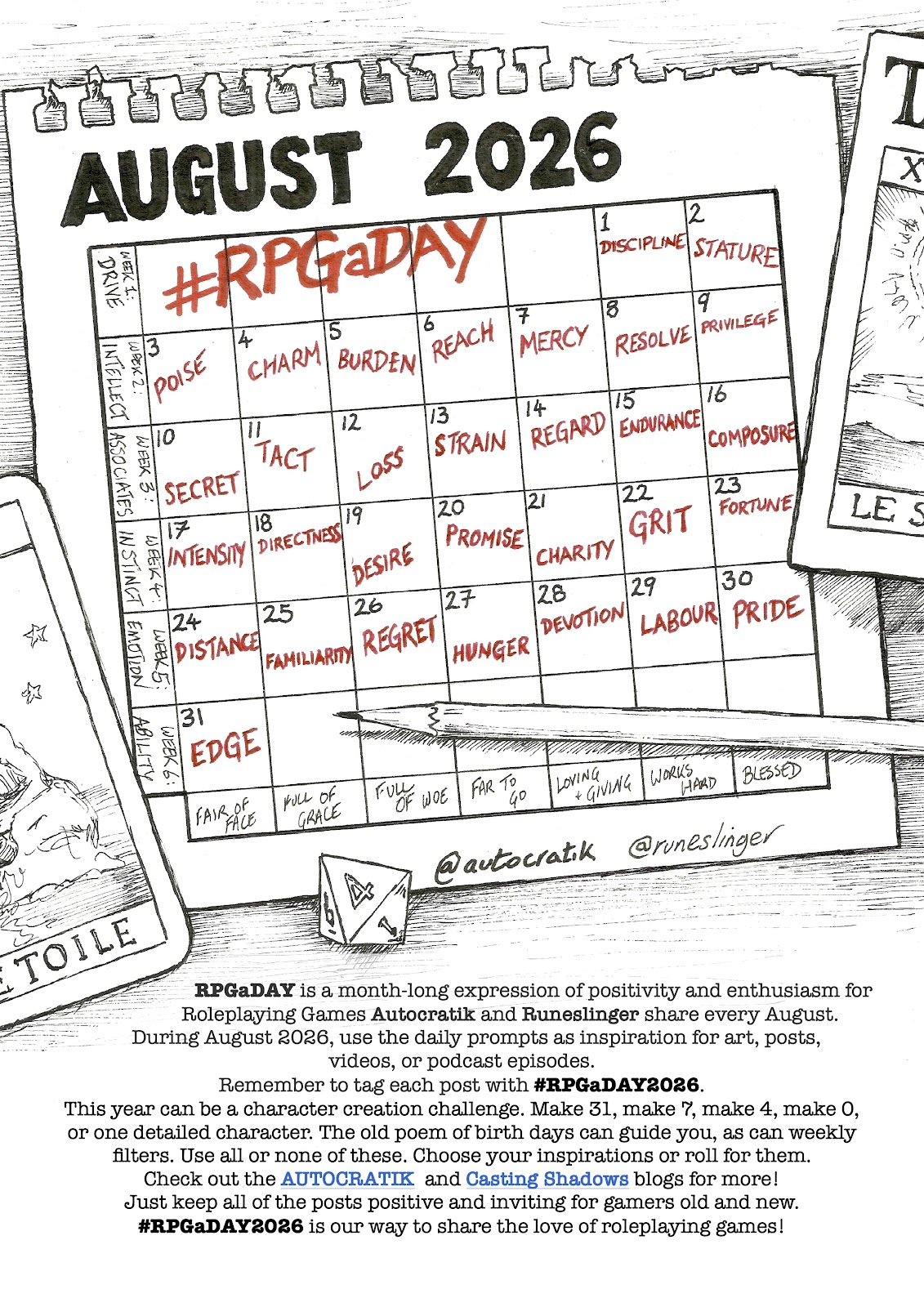
Today’s combination: Mercy (Prompt) + Intellect (Weekly Modifier) + Loving and Giving (Weekly Modifier) + Western (Genre)
Here is today’s NPC.
Sister Laila Casad (Fantasy Name Generator used for the name: Old West name generator)
Sister Laila joined the Sisters of Sienna after her husband, Mad Dog Casad, was hanged for his crimes by a Marshal in the territories. Seeking penance for his eternal soul—and perhaps her own—she joined the nuns, dedicating herself to protecting the defenseless and educating the young.
While she lacked formal religious training, she possessed a sharp intellect and knew how to survive. These skills helped keep her and the other sisters safe during their mission to build an orphanage where children could be taught the mercy of the Lord. Laila took her vows not long after the Sienna Orphanage was finished.
She proved to be a fast learner, letting go of past anger and old grudges to fully embrace the Sisters of Sienna’s mission of loving and giving unto others. She has since grown into a position of leadership at the frontier orphanage: teaching the children, guiding her fellow sisters, and protecting her home against bandits or anyone else who means them harm.
The Sienna Orphanage always offers hospitality to weary travelers in exchange for a small donation. Sister Laila keeps an open ear for rumors regarding travelers and ne’er-do-wells in the nearby territories, and she is always willing to share what she knows with friendly visitors. However, she won’t hesitate to pull a gun from under her habit and remind anyone with ill intent that she is still the widow of Mad Dog Casad.
Thanks for reading; I am looking forward to your RPG a Day 2026 post, comments, and conversation. If you want further information about #RPGaDay2026, be sure to check out Autocratik’s blog.
A Spanish version of this post is available at the Desde la Fosa Facebook page.
Categories: Tabletop Gaming Blogs
RPG a Day 2026 – Day 6: Reach
Welcome to Day 6 of #RPGaDay2026. As I explained in my Day 0 post, I’ll be creating NPCs based on the day’s prompts and the week and day modifiers presented in the infographic below. Check out that post for further details.
Today’s combination: Reach (Prompt) + Intellect (Weekly Modifier) + Far to Go (Weekly Modifier) + Space Opera (Genre)
Here is today’s NPC… well, a sort-of NPC: an intelligent space opera artifact MacGuffin. I hope you find it useful.
Skull of Wisdom (Fantasy Name Generator used for the name: Artifact name generator)
The Skull of Wisdom was discovered by the first species to reach beyond their home world. The obsidian-colored skull of an unknown entity is oblong, polished, and crossed by reddish cracks. It lacks a lower jaw and does not belong to any species known to travel the stars.
Whatever its origin, the skull whispers to its owner in their sleep, regaling them with tales of past victories and achievements. Although these visions can be confusing at first, the Skull of Wisdom ultimately advises its owner on their most pressing matters. No one can tell if it possesses a single intellect or the collected wisdom of its many previous owners, but it can reach through the ages to find the exact parable or knowledge the current owner requires.
However, the Skull of Wisdom has a profound effect on its proprietor. While it offers counsel in their dreams, it also fosters an intense sense of wanderlust and ambition. It drives them to seek out discovery or conquest, constantly convincing them that their destiny remains incomplete and that they still have far to go.
Conquerors and explorers have sought and claimed the Skull of Wisdom throughout the ages, and it has guided them to forge galactic empires and plumb the unknown regions of space. Some seek to own it, while others wish to destroy it, but the voice of the Skull of Wisdom is always present, waiting for the next audacious being to hold it in their hands.
Thanks for reading; I am looking forward to your RPG a Day 2026 post, comments, and conversation. If you want further information about #RPGaDay2026, be sure to check out Autocratik’s blog.
A Spanish version of this post is available at the Desde la Fosa Facebook page.
See you all tomorrow!
Categories: Tabletop Gaming Blogs
OSR Campaign Setting - Leigh Brackett Solar System Campaign Framework For OSR Rpg Systems
The Leigh Brackett Solar System—often termed the classic "Planetary Romance" setting—blends hard-boiled noir, colonial exploitation, decadent alien antiquities, and melancholic space opera. Unlike the sweeping galactic empires of hard sci-fi, Brackett’s Solar System is a gritty, frontier-driven setting of trade companies, lawless outposts, dying alien races, and ancient cosmic mysteries Needleshttp://www.blogger.com/profile/11243274667834930867noreply@blogger.com0
Categories: Tabletop Gaming Blogs
1E DMG: The Ultimate Dungeon Creator

9 nearly full pages of old-school mega-mega-mega-dungeon.
All created using the random tables on pages 170-172 of the AD&D 1st Edition Dungeon Masters Guide by Gary Gygax, published in 1979.
Why? Because drawing dungeons from just the scratch of my imagination has become kinda boring.
I marked my entry point in the center of a page and simply went with whatever happened. It was linear at first, but it soon expanded; side passages upon side passages, straight, diagonal, parallel, intersections -- 4-ways, Xs, Ys, Ts, all leading to chambers and rooms of all shapes and sizes (it's implied but never explicitly stated that rooms have doors and chambers do not). These tables are designed to go on and on and on; there are occasional dead-ends, but if you don't consciously stop it, it probably will not stop (25% of periodic-checks introduce side passages and 50% of side passages introduce multiple side passages).
I wanted every passage to take you deeper down the rabbit-hole, so no looping was allowed until deeply forward for every path. Every new corridor goes underneath any room or passage it crosses, but eventually loops do occur, plenty of them. At times, it's like solving a puzzle; decisions have to made, to connect or not connect? Sometimes I beg for a dead-end and sometimes I have no choice but to place one and sometimes a loop is allowed. This place is wild. I get lost just looking at it. If players were mapping it, they'd fuck up quickly, just as they would if it were a real place.
This process also reinforces the notion of space; not every room will be occupied (could/should still be interesting though) and there are many long, twisting corridors. Noise wouldn't travel here very well, not clearly. Certainly you might hear echoes and clangs and screams, but they would haunt like distant nightmares. It's easy to see adventurers snooping about, even fighting, without disturbing much of anything at all. What about the goblins in the next room? With Gygax's system, chances are, there are no goblins in the next room.
Eventually I came to the edge of the first page, all four edges, and thought, what the hell, let's keep going, and before long, it became clear that it would bleed over onto at least 9 pages. I configured entry points to align with Act III if I insanely go in that direction. Who am I kidding...

Some thoughts...
Wandering Monsters are built in. That's right, on the main d20 "Periodic Check Table" a roll of 20 results in a wandering monster, not a check, an actual random monster right then and there. So, I put an X on the map, always in a corridor. Sometimes they occur in bunches. So, what if wandering monsters were always handled this way, and, is that a repeated occurrence or just a one time thing? Just thinking out loud; one time occurrence is obvious to me, unless something (a glyph?) is spawning creatures.

Stairs... come up plenty of times, but there's no way I'm doing levels below this monstrosity. So, I simply put stairs in the corridor -- almost always going down. Combined with the fact that new passages go under already drawn ones, the farther out you go, the deeper underground you are. It's shaped like an underground hill. This could be how danger (dungeon levels) is measured. Center page -- dungeon levels 1 and 2; 8 pages surrounding the center page -- dungeon levels 3 and 4; 16 pages surrounding that -- dungeon levels 5 and 6, etc. So danger equals distance from the center as opposed to levels straight down.

Tricks/Traps come up as often as stairs and such; all in corridors. I've never been a fan of hallway traps because they're punitive and make the game an unfun slog. The players have no defense other than to check every 10' of the place. So whatever these turn out to be, there must be clues.
.jpg)
Special passageways... Rivers, caverns, chasms, streams, all come up periodically, but I've avoided all so far. I have a certain look in mind -- the cellar of Castle Dracula, complete with arched columns, vaulted ceilings, and at times, unfinished floors. I may add subterranean canals at some point, but I'll be damned if I taint this place with caverns.

After a few weeks, all 9 pages are nearly complete (much more complete than the pic I posted above) and it has a shit-ton of passages bleeding off in every possible direction. This implies a larger ring of 16 new pages for a total of 25. I would love to keep going until all natural dead-ends are met, but this could become comically large. So, is it now just a work of art? A curiosity? The odds of it stopping on its own are astronomically low. I wonder, what is the largest dungeon ever made using these tables? This is probably unknowable.
And then you must stock it!

Your mind would never imagine what these tables create.
Gary Gygax was a genius.
Categories: Tabletop Gaming Blogs
Wednesday Comics: DC, November 1985 (week 2)
I'm reading DC Comics' output from January 1980 (cover date) to the end of Crisis! This week, I'm looking at comics that were published on July 11, 1985.
Arak Son of Thunder #50: We arrive at the long ago announced final issue of the series as Arak and friends part ways from their more recent allies from the Middle East, and head ever eastward on a Chinese ship. Machinations of the Serpent see them barely making it to Japan, where they are attacked by the Ezo people under the command of an oni. Arak drives off the demon, sending the Ezo running too, and putting Arak and friends in the good graces of the local lord. The relationship sours, however, when Arak refuses to exterminate to Ezo for him. As Arak leaves, he frees an Ezo prisoner, who leads the group to his village. The Ezo aren't on the demon's side at all, but under his thumb. They want to escape to another island, free from the Japanese and the demon. Arak and friends slay the oni and get the lord to agree to giving safe passage to the Ezo.
Arak and Maligigi reveal that they have seen in visions that Charlemagne has now been made Emperor of the Romans. Valda realizes she must return to her king. Arak and Satyricus set out in a smaller boat to the Americas, but Maligigi is sure he and Valda will see them again.
This is the end of their story, though. Aside from some cameos, Arak and friends haven't appeared in the post-Crisis DCU. At 50 issues, Arak had the second longest run of any Sword & Sorcery character not based on a Robert E. Howard property in American comics.
Amethyst #11: Nice cover here by Cullins and Tanghal. Cohn and Colon/Kesel have Topaz and Turquoise reveal their love to Amethyst. Feeling betrayed, Amethyst decides to quit Gemworld to just live as Amy Winston on Earth. Gemworld isn't out of danger, though. Odd crystal formations are emerging, and one in the form of a serpent recruits Sardonyx for some evil scheme.
Things aren't so great on Earth, either. Amy's friend Rita is now Carnelian's accomplice in luring her father to his home to be a sacrifice for some dark ritual using the power of Dark Opal's broach. Meanwhile, in the Winston household's domestic drama, it seems like Herb's dissatisfaction with married life with an adopted kid who's also the savior of a fantasy world may be heading to an affair with one of his students from Hudson University.
Arion, Lord of Atlantis Special #1: The promised final issue of the series became a special instead. Kupperberg and Duursema seem like they're stuffing in every potential plot element they had thought of in this one issue. Atlantis is attacked by sub-men, alien invaders arrive, and jackal-headed S'net launches another assault. All of these forces manipulated and abetted by the evil god, Chaon. It's a lot for one issue, and it crowds out any significant focus on the characters, except that we do get to see Mara in her new relationship with the musician who also has an unusual ability: the power to manifest wings.
In the end, the alien invasion is turned back after the revelation that they had their origins in expeditions from Atlantis millennia ago. Their ship is driven into the sun by one of their leaders sympathetic to the Atlantean cause so they won't be returning. S'Net is lost in space, and the sub-men have allied with the Atlanteans against their common foes.
In Arion's fight with Chaon, though, the demon unleashes a blast sends seismic shudders through the land. Arion banishes Chaon, but Atlantis is doomed. Arion, Chian, Wyynde, and many Atlantean refugees escape in ships, but their great city is no more. This is also the last appearance of Arion and his supporting cast in the pre-Crisis universe. Arion will show up in the post-Crisis world, mostly as a background element, though he will get another series in 1992 where he takes up residence in modern day New York.
Batman #389: Thanks to the Crisis (and Moench and Mandrake) there are red skies over Gotham. That's got Bruce thinking about his love life. He goes to the gym where Vicki is always working out to end things for good, but she thinks he's trying to win her back and storms off. Catwoman is back in town, tracking down the person killing wayward members of the False Face Society, and Batman meets with her to let her down easy, too. This attempt goes a bit better, but she declines to give up her vigilantism. Meanwhile, Jason is feeling the lack of a mother, so when a disappearance Bullock is working suggests Nocturna is back in town, he goes to the observatory to find her. Apparently, she's the one leading the False Face Society. Though no one knows it, Night Slayer is the one killing the Society members, with Nocturna is final goal.
G.I. Combat #280: In the first Haunted Tank story by Kanigher and Glanzman, Stuart's Raiders draw cards to see who will go on a solo suicide mission to destroy the secret hangar for Germany's new jets, but even after Jeb "wins," his men won't let him go it alone. The second is a solo Rick story where he's attending a carnival with a woman when the Germans attack. Rick takes a shot from the top of a roller coaster to take out a fighter pilot.
In the Mercenaries story by Kanigher and Catan, the trio steals back a convoy of food relief for the Ethiopian famine from a hijacker chief, Nakamti.
The two nonserial stories are both by Kanigher. The first, with art by Cruz, has an American G.I. and former championship skier besting the Chinese and an avalanche to complete his mission. The second has art by Catan as his about a paratrooper unlucky enough to get his chute caught on the wing of a German fighter plane, but lucky enough to make it out alive.
Justice League of America Annual #3: Mishkin and Hoberg/Gustovich give us the ending of the pre-Crisis Red Tornado. It seems to me impossible to square the early events depicted here with the version of them in COIE #8 (though Wikipedia makes an effort). Here, Red is conscious and alone at the JLA station as he uses equipment there to test his powers, seeking to find out what the Anti-Monitor's cryptic comments meant about their being more to him. This leads to him exploding and sending the damaged station falling on to the Earth. The disaster is responded to by the new Justice League and several of the old members including Firestorm, Green Arrow, and Black Canary.
Meanwhile, unusual weather patterns are starting up, and members of the JLA discover it isn't due to the Crisis but an experimental weather manipulation station that has mysteriously gone out of control. Red Tornado's lady friend, Kathy, is contact by Red through a TV set and other electronic devices. He asks her to meet him at the golden gate bridge.
It turns out Red Tornado has survived, he's again in the form of the living tornado, the Tornado Champion. Now viewing himself as a force of nature, he looks with a new-found horror at the ecological devastation humanity had wreaked on Earth. He decides to destroy civilization and battles the heroes to do just that. Finally, Kathy gets through to him, and he leaves the Earth to go elsewhere in the universe.
Legion of Super-Heroes #16: Levitz and Lightle/Smith still have Brainiac 5 moping over the death of Supergirl. If "moping" seems a dismissive description of grief over the death of a loved one, well, that's weirdly exactly how the narrative treats it. Brainiac is drawn to look like a sad sack, and a lot of other characters question why he's so upset when her death had occurred a long time ago and was a matter of the historical record. It seems the opposite of what you would want to do in a story, particularly when Crisis spent so much time trying to make her death impactful. I assume Levitz was trying to drive home that this is the future, and the past had been written, but that only draws attention to the fact that it clearly isn't, and it also seems to contradict the idea of Crisis as a sort of meta-temporal occurrence. Otherwise, to everyone but poor Anthro, maybe, the Crisis is to some extent "in the past."
Interestingly, the DCU fandom wiki argues Brainiac 5 is glum about the 1000 anniversary of Supergirl's Pre-Crisis death. It points out her death is not mysterious in this story--unlike a number of other Crisis-related events --and further notes Crisis isn't mentioned in this issue, nor does it carry a Crisis banner. Given, however, we saw Brainiac 5 grieving Supergirl in COIE #8, I'm not persuaded, but it is interesting.
Beyond, that a lot of Legionnaires attend the baptism of Graym, Lighting Lad's and Saturn Girl's infant. The new members also go on their first solo case to take down some bombers, which proves more complicated and mysterious than anticipated.
Omega Men #32: Klein and guest artist Spiegle do a fill-in issue where Felicity returns to Karna and finds work as a bar dancer, only to lose that job due to the lack of titillation in her dance. She meets a scarred face human named Mung who helps her get more work and gives her some dance pointers. In the background of all this, the cops are hunting for a serial killer who they believe to be a "regressor," a Karnan who can turn into a big cat like Tigorr. The story seems to signal that Mung is the killer, and he certainly tries to kill Felicity after revealing himself to be the bounty hunter Bedlam we saw previously. Felicity manages to best him and the cops take him away. Still, the issue ends with some ambiguity: Was Mung the killer? The only other possibility is that Felicity is secretly a regressor, but I'm not sure what Klein intended.
Star Trek #20: Laurie Sutton scripts with Tom Sutton and Villagran on art for this Sulu solo story. Sulu attends a family wedding where a clan cousin he was romantically involved with in his youth is marrying a son of a rival clan in the un-Trekian giant robot business. It turns out the young man hasn't given up the feud, it ends as these things must: Sulu and the guy fight, each piloting a giant robot.
Super Powers #3: Kupperberg and Kirby/Theakston send Wonder Woman, Green Lantern, and Dr. Fate to Easter Island, probably so Kirby can again illustrate the Maoi, which he has done more than once before. Like in those stories the statues turn out to be aliens, but the primary menace here is Kirby's redesigned Mantis. The grateful Easter Islanders erect busts of the heroes, but unfortunately Green Lantern feels they have to be destroyed, which could be construed as "destroying evidence."
Superman #413: Bates and Swan/Williamson get to the end of the this "Clark Kent--Fired!" storyline. Luthor, already having Supes doubting his sanity, moves to his endgame. It comes at a particularly bad time, too, because Clark has been invited to a dinner, unaware that it's a big to-do in his honor put in by his friends and colleagues. Luthor's devices convince Superman that the Earth is dematerializing around him. Lex plans to trap him in this simulated reality of defeat forever, but his super-hearing (I guess) picks up all his friends and co-workers mentioning Clark Kent. Their calls focus him on the real world, allowing him to pull out of Lex's machine. As he fights with the villain, though, Lex is pulled away by some force. From Crisis, we know that's Brainiac, but it's mysterious here.
Superman attends the dinner and gives Clark's regrets but clears his good name by saying his previous reporting was all part of a plan to catch Luthor.

Arak Son of Thunder #50: We arrive at the long ago announced final issue of the series as Arak and friends part ways from their more recent allies from the Middle East, and head ever eastward on a Chinese ship. Machinations of the Serpent see them barely making it to Japan, where they are attacked by the Ezo people under the command of an oni. Arak drives off the demon, sending the Ezo running too, and putting Arak and friends in the good graces of the local lord. The relationship sours, however, when Arak refuses to exterminate to Ezo for him. As Arak leaves, he frees an Ezo prisoner, who leads the group to his village. The Ezo aren't on the demon's side at all, but under his thumb. They want to escape to another island, free from the Japanese and the demon. Arak and friends slay the oni and get the lord to agree to giving safe passage to the Ezo.
Arak and Maligigi reveal that they have seen in visions that Charlemagne has now been made Emperor of the Romans. Valda realizes she must return to her king. Arak and Satyricus set out in a smaller boat to the Americas, but Maligigi is sure he and Valda will see them again.
This is the end of their story, though. Aside from some cameos, Arak and friends haven't appeared in the post-Crisis DCU. At 50 issues, Arak had the second longest run of any Sword & Sorcery character not based on a Robert E. Howard property in American comics.

Amethyst #11: Nice cover here by Cullins and Tanghal. Cohn and Colon/Kesel have Topaz and Turquoise reveal their love to Amethyst. Feeling betrayed, Amethyst decides to quit Gemworld to just live as Amy Winston on Earth. Gemworld isn't out of danger, though. Odd crystal formations are emerging, and one in the form of a serpent recruits Sardonyx for some evil scheme.
Things aren't so great on Earth, either. Amy's friend Rita is now Carnelian's accomplice in luring her father to his home to be a sacrifice for some dark ritual using the power of Dark Opal's broach. Meanwhile, in the Winston household's domestic drama, it seems like Herb's dissatisfaction with married life with an adopted kid who's also the savior of a fantasy world may be heading to an affair with one of his students from Hudson University.

Arion, Lord of Atlantis Special #1: The promised final issue of the series became a special instead. Kupperberg and Duursema seem like they're stuffing in every potential plot element they had thought of in this one issue. Atlantis is attacked by sub-men, alien invaders arrive, and jackal-headed S'net launches another assault. All of these forces manipulated and abetted by the evil god, Chaon. It's a lot for one issue, and it crowds out any significant focus on the characters, except that we do get to see Mara in her new relationship with the musician who also has an unusual ability: the power to manifest wings.
In the end, the alien invasion is turned back after the revelation that they had their origins in expeditions from Atlantis millennia ago. Their ship is driven into the sun by one of their leaders sympathetic to the Atlantean cause so they won't be returning. S'Net is lost in space, and the sub-men have allied with the Atlanteans against their common foes.
In Arion's fight with Chaon, though, the demon unleashes a blast sends seismic shudders through the land. Arion banishes Chaon, but Atlantis is doomed. Arion, Chian, Wyynde, and many Atlantean refugees escape in ships, but their great city is no more. This is also the last appearance of Arion and his supporting cast in the pre-Crisis universe. Arion will show up in the post-Crisis world, mostly as a background element, though he will get another series in 1992 where he takes up residence in modern day New York.

Batman #389: Thanks to the Crisis (and Moench and Mandrake) there are red skies over Gotham. That's got Bruce thinking about his love life. He goes to the gym where Vicki is always working out to end things for good, but she thinks he's trying to win her back and storms off. Catwoman is back in town, tracking down the person killing wayward members of the False Face Society, and Batman meets with her to let her down easy, too. This attempt goes a bit better, but she declines to give up her vigilantism. Meanwhile, Jason is feeling the lack of a mother, so when a disappearance Bullock is working suggests Nocturna is back in town, he goes to the observatory to find her. Apparently, she's the one leading the False Face Society. Though no one knows it, Night Slayer is the one killing the Society members, with Nocturna is final goal.

G.I. Combat #280: In the first Haunted Tank story by Kanigher and Glanzman, Stuart's Raiders draw cards to see who will go on a solo suicide mission to destroy the secret hangar for Germany's new jets, but even after Jeb "wins," his men won't let him go it alone. The second is a solo Rick story where he's attending a carnival with a woman when the Germans attack. Rick takes a shot from the top of a roller coaster to take out a fighter pilot.
In the Mercenaries story by Kanigher and Catan, the trio steals back a convoy of food relief for the Ethiopian famine from a hijacker chief, Nakamti.
The two nonserial stories are both by Kanigher. The first, with art by Cruz, has an American G.I. and former championship skier besting the Chinese and an avalanche to complete his mission. The second has art by Catan as his about a paratrooper unlucky enough to get his chute caught on the wing of a German fighter plane, but lucky enough to make it out alive.

Justice League of America Annual #3: Mishkin and Hoberg/Gustovich give us the ending of the pre-Crisis Red Tornado. It seems to me impossible to square the early events depicted here with the version of them in COIE #8 (though Wikipedia makes an effort). Here, Red is conscious and alone at the JLA station as he uses equipment there to test his powers, seeking to find out what the Anti-Monitor's cryptic comments meant about their being more to him. This leads to him exploding and sending the damaged station falling on to the Earth. The disaster is responded to by the new Justice League and several of the old members including Firestorm, Green Arrow, and Black Canary.
Meanwhile, unusual weather patterns are starting up, and members of the JLA discover it isn't due to the Crisis but an experimental weather manipulation station that has mysteriously gone out of control. Red Tornado's lady friend, Kathy, is contact by Red through a TV set and other electronic devices. He asks her to meet him at the golden gate bridge.
It turns out Red Tornado has survived, he's again in the form of the living tornado, the Tornado Champion. Now viewing himself as a force of nature, he looks with a new-found horror at the ecological devastation humanity had wreaked on Earth. He decides to destroy civilization and battles the heroes to do just that. Finally, Kathy gets through to him, and he leaves the Earth to go elsewhere in the universe.

Legion of Super-Heroes #16: Levitz and Lightle/Smith still have Brainiac 5 moping over the death of Supergirl. If "moping" seems a dismissive description of grief over the death of a loved one, well, that's weirdly exactly how the narrative treats it. Brainiac is drawn to look like a sad sack, and a lot of other characters question why he's so upset when her death had occurred a long time ago and was a matter of the historical record. It seems the opposite of what you would want to do in a story, particularly when Crisis spent so much time trying to make her death impactful. I assume Levitz was trying to drive home that this is the future, and the past had been written, but that only draws attention to the fact that it clearly isn't, and it also seems to contradict the idea of Crisis as a sort of meta-temporal occurrence. Otherwise, to everyone but poor Anthro, maybe, the Crisis is to some extent "in the past."
Interestingly, the DCU fandom wiki argues Brainiac 5 is glum about the 1000 anniversary of Supergirl's Pre-Crisis death. It points out her death is not mysterious in this story--unlike a number of other Crisis-related events --and further notes Crisis isn't mentioned in this issue, nor does it carry a Crisis banner. Given, however, we saw Brainiac 5 grieving Supergirl in COIE #8, I'm not persuaded, but it is interesting.
Beyond, that a lot of Legionnaires attend the baptism of Graym, Lighting Lad's and Saturn Girl's infant. The new members also go on their first solo case to take down some bombers, which proves more complicated and mysterious than anticipated.

Omega Men #32: Klein and guest artist Spiegle do a fill-in issue where Felicity returns to Karna and finds work as a bar dancer, only to lose that job due to the lack of titillation in her dance. She meets a scarred face human named Mung who helps her get more work and gives her some dance pointers. In the background of all this, the cops are hunting for a serial killer who they believe to be a "regressor," a Karnan who can turn into a big cat like Tigorr. The story seems to signal that Mung is the killer, and he certainly tries to kill Felicity after revealing himself to be the bounty hunter Bedlam we saw previously. Felicity manages to best him and the cops take him away. Still, the issue ends with some ambiguity: Was Mung the killer? The only other possibility is that Felicity is secretly a regressor, but I'm not sure what Klein intended.

Star Trek #20: Laurie Sutton scripts with Tom Sutton and Villagran on art for this Sulu solo story. Sulu attends a family wedding where a clan cousin he was romantically involved with in his youth is marrying a son of a rival clan in the un-Trekian giant robot business. It turns out the young man hasn't given up the feud, it ends as these things must: Sulu and the guy fight, each piloting a giant robot.

Super Powers #3: Kupperberg and Kirby/Theakston send Wonder Woman, Green Lantern, and Dr. Fate to Easter Island, probably so Kirby can again illustrate the Maoi, which he has done more than once before. Like in those stories the statues turn out to be aliens, but the primary menace here is Kirby's redesigned Mantis. The grateful Easter Islanders erect busts of the heroes, but unfortunately Green Lantern feels they have to be destroyed, which could be construed as "destroying evidence."

Superman #413: Bates and Swan/Williamson get to the end of the this "Clark Kent--Fired!" storyline. Luthor, already having Supes doubting his sanity, moves to his endgame. It comes at a particularly bad time, too, because Clark has been invited to a dinner, unaware that it's a big to-do in his honor put in by his friends and colleagues. Luthor's devices convince Superman that the Earth is dematerializing around him. Lex plans to trap him in this simulated reality of defeat forever, but his super-hearing (I guess) picks up all his friends and co-workers mentioning Clark Kent. Their calls focus him on the real world, allowing him to pull out of Lex's machine. As he fights with the villain, though, Lex is pulled away by some force. From Crisis, we know that's Brainiac, but it's mysterious here.
Superman attends the dinner and gives Clark's regrets but clears his good name by saying his previous reporting was all part of a plan to catch Luthor.
Categories: Comic Book Blogs, Tabletop Gaming Blogs
RPG a Day 2026 – Day 5: Burden
Welcome to Day 5 of #RPGaDay2026. As I explained in my Day 0 post, I’ll be creating NPCs based on the day’s prompts and the week and day modifiers presented in the infographic below. Check out that post for further details.
Today’s combination: Burden (Prompt) + Intellect (Weekly Modifier) + Full of Woe (Weekly Modifier) + Fantasy (Genre)
Here is today’s NPC.
Inafarihm the Taciturn (Fantasy Name Generator used for the name: Wizard name generator)
It is said that when you need to find out the secret name of a baleful creature from the depths, or the formula to break a slumber caused by a fairy’s tears, there is no wiser or more intelligent sage to consult than Master Inafarihm. He is also known as Inafarihm the Taciturn, though never to his face.
The massive, balding man with a square jaw has a frame that must have once been imposing, but has grown rotund and sluggish in old age. His expression is locked in a perpetual scowl. His heavy eyelids hood clear blue eyes that appear far younger than the deep lines on his face would suggest. His huge, calloused hands seem ill-fitted for a sage’s work, and he relies on one of his many attendants to do most of the writing for his voluminous correspondence.
Those few who remember his youth confirm that this man once went by another name, and that the original Inafarihm was his companion, a wizard of some renown. The two traveled to far-away lands in search of treasure and adventure, but only one returned—a broken man, full of woe and regret, who retired to the wizard’s tower, never to sally forth again.
Despite his isolation, tales of his intellect brought adventurers and other sages to consult him, and his reputation grew. Quiet, reserved, and often surly, he can still be coaxed to answer a query or research a formula for the correct price or the right vintage. With good wine and enough time, one may earn the Master’s trust and learn the terrible truth: the burden of a wizard’s mind living on inside the body of the man who was once his friend, retaining his vast knowledge, but completely lacking the power to use magic.
Thanks for reading; I am looking forward to your RPG a Day 2026 post, comments, and conversation. If you want further information about #RPGaDay2026, be sure to check out Autocratik’s blog.
A Spanish version of this post is available at the Desde la Fosa Facebook page.
See you all tomorrow!
Categories: Tabletop Gaming Blogs
Integrating Adventurer Conqueror King System II (ACKS II) with the legendary, chaotic, and maximum-gonzo DNA of Dave Hargrave’s Arduin Grimoires- d100 treasures & relics table from the Arduin rpg
In Dave Hargrave’s Arduin Grimoire series (Volumes I–III and The Arduin Adventure), random treasure generation subverts standard fantasy tropes. Hargrave mixed high fantasy with sci-fi, cosmic horror, and weird fiction. This blog post picks right up from Integrating Adventurer Conqueror King System II (ACKS II) with the legendary, chaotic, and maximum-gonzo DNA of Dave Hargrave's Needleshttp://www.blogger.com/profile/11243274667834930867noreply@blogger.com0
Categories: Tabletop Gaming Blogs
RPG a Day 2026 – Day 4: Charm
Welcome to Day 4 of #RPGaDay2026. As I explained in my Day 0 post, I’ll be creating NPCs based on the day’s prompts and the week and day modifiers presented in the infographic below. Check out that post for further details.
Today’s combination: Charm (Prompt) + Intellect (Weekly Modifier) + Full of Grace (Weekly Modifier) + Horror (Genre)
Here is today’s NPC.
Mamaachik “Manny” Sihui Cuya (Name source: Fantasy Name Generator – Quechua name generator)
Mamaachik Sihui Cuya never uses his birth name these days. He goes by Manny. Originally from Peru, he admits to having once been a paqos, a type of priest, in his home in the Andes. But he hasn’t been one in a long time. At least that’s what he claims.
An amicable and charming old man with a penchant for fancy suits, Manny runs a local car service which employs a few other immigrants, and owes various vehicles, including a limousine, that he often drives. He is glib and can strike up a conversation with anyone. He seems to know a bit of trivia on almost any subject, and many passengers are awed by his incredible intellect.
But what he seems to know most about, but is often reluctant to talk about, is the dangers that lurk in the shadows where men do not dare look, of the invisible dangers of this world and beyond, of the ancient secret masters of reality.
If pressed, he admits to having confronted some dangers others might not have survived, but insists he only managed to do so by the grace of the balance and wisdom of the universe.
However, when people confront the unknown, and their concept of reality is frayed, someone may pass them a dog-eared business card for a car service and tell them to ask for Manny; he might be able to guide them out of this mess.
Thanks for reading; I am looking forward to your RPG a Day 2026 post, comments, and conversation. If you want further information about #RPGaDay2026, be sure to check out Autocratik’s blog.
A Spanish version of this post is available at the Desde la Fosa Facebook page.
See you all tomorrow!
Categories: Tabletop Gaming Blogs
Adapting North West of Earth By C.L. Moore - Orbital Decay (MicroRed version) From The Red Room & The New Flesh Rpg - D100 Random Solar System encounter table based on North West of Earth By C.L. Moore
C.L. Moore’s Northwest of Earth collection—featuring her iconic space-faring rogue Northwest Smith—blends planetary romance, cosmic horror, dark decadence, and raygun pulp. In Moore’s 1930s Solar System, Mars is a dry wasteland of ancient dead gods, Venus is a sultry jungle ringed with sinister matriarchal fortresses, and Jupiter’s moons hide ethereal siren-entities. This picks rightNeedleshttp://www.blogger.com/profile/11243274667834930867noreply@blogger.com0
Categories: Tabletop Gaming Blogs
The Apocalypse Now
Art by Jeff Easley
A lot has been written about the "Myth of the Frontier" underpinnings of D&D, and the games perhaps greater homology to Westerns than traditional fantasy in many ways. Interestingly, despite that clear element of the game's core assumptions, when we look at published D&D settings, we don't really see a frontier and expansion setup.

A lot has been written about the "Myth of the Frontier" underpinnings of D&D, and the games perhaps greater homology to Westerns than traditional fantasy in many ways. Interestingly, despite that clear element of the game's core assumptions, when we look at published D&D settings, we don't really see a frontier and expansion setup.
The implied setting of D&D, as a number of writers have pointed out, can also be said to be post-apocalyptic. That often conjures images of science fantasy writers from Appendix N, but of applies to in the literal sense if not the generic sense to the Hyborian Age of Conan and the 3rd Age of Middle Earth. Materially greater and in some ways more advanced civilizations must precede the current one for there to be so much wealth and magic to be looted in old ruins.
A post-apocalyptic setting allows the frontier to be closer at hand, and indeed really sort of obscures it even being a frontier, as no discernable border but instead the distance between "civilized points." Connecting these dots seems more reclamation than expansion.
That works, but in D&D settings like Greyhawk, Krynn, and the Forgotten Realms, the apocalypse is remote enough so that the current civilization doesn't seem post-apocalyptic, at least no more than the High Middle Ages seems to us recovering from the fall of Rome.
Yet, Greyhawk, for all its map full of named regions, heraldry, and rulers with elaborate titles, is really empty. Some of this exists to facilitate the desired game play, sure, but that's the Doylist explanation. I like the more Watsonian explanations of humanoid and demihuman groups that are not adequately censused coupled with events that have led to a decline in population.

As Chris Kutalik and other commentors suggested in his blog series of years ago, I think Greyhawk is best analogized not to some science fantasy post-apocalypse but to historical eras like the "Dark Ages" (or early Middle Ages) after the collapse of Rome, or the plague, famine and war riven period of the Crisis of the Late Middle Ages.
In many ways, I think, Greyhawk reads better as a setting where the apocalypse (or at least an apocalypse) is not the remote past but happening now or relatively recently. This isn't so much a total destruction kind of apocalypse but a "civilization is dealt a blow" sort of one. This allows for the breadth and complexity of social structures described in Greyhawk, but also for the population numbers and available real estate for enterprising adventures to carve out something for themselves.
It's "points of light" to use the modern descriptor, but not (like so many of those settings) a rather static period, but one where there are still roving bands of invaders (humanoids, monsters, or armies of other human nations) and isolated communities that must either grow larger and more resilient or be wiped out. I should add, There's no one way the communities have approach this problem to survive. Orcs settling down to live in some sort of peace is potentially just as possible as driving them out and killing them.
I think this sort of implied framing could be fun to lean into. D&D settings need more Random Calamitous Event Tables and societies in flux (like we see in some epic fantasy like A Song of Ice and Fire). Christopher Buehlman's historical horror novel Between Two Fires and his fantasy series beginning with the Blacktongue Thief where human civilization is still dealing with the fallout from a disastrous (and still simmering) war with goblinkind are great inspirations, as well.
Categories: Comic Book Blogs, Tabletop Gaming Blogs
OSR Sword & Sorcery Random Encounters - d100 Wilderness Random Encounter Table tailored specifically for a Sword & Sorcery campaign using Castles & Crusades.
Here is a d100 Wilderness Random Encounter Table tailored specifically for a Sword & Sorcery campaign using Castles & Crusades. This blog post picks right up from OSR Sword & Sorcery Adventure Fodder - d100 Treasure Table tailored for the Tower of the Serpent Horde, fully compatible with Castles & Crusades (and most classic OSR systems)In true Sword & Sorcery Needleshttp://www.blogger.com/profile/11243274667834930867noreply@blogger.com0
Categories: Tabletop Gaming Blogs
RPG a Day 2026 – Day 3: Poise
Welcome to Day 3 of #RPGaDay2026. As I explained in my Day 0 post, I’ll be creating NPCs based on the day’s prompts and the week and day modifiers presented in the infographic below. Check out that post for further details.
Today’s combination: Poise (Prompt) + Intellect (Weekly Modifier) + Fair of Face (Weekly Modifier) + Cyberpunk (Genre)
Here is today’s NPC.
Alecia “Nova” Seins (Fantasy Name Generator used for the name: Cyberpunk (nick)name generator)
There are endless rumors about Nova’s origins, but they all contradict each other. Whoever she was before breaking into the city’s entertainment scene is practically unverifiable. Only her birth name, Alecia Seins, and the fact that she was born in the broken-down rural wastes of the interior could be gleaned from a leaked detention bulletin once shared on the Net. While her history has been scrubbed extensively, those two facts remain.
She originally represented small-time acts for corporate interests but soon branched off as an independent producer, making a name for herself in unsanctioned taverns and underground dance halls. In these dangerous circles—often controlled by the Yakuza—she held her own. Always unfazed and projecting absolute poise, her sharp intellect and quick wits kept her safe. She quickly built a network of contacts throughout the city’s unofficial circles, turning the information she gathered into her primary currency.
Today, Nova still represents some of the most famous non-corporate up-and-comers, holding court at her eponymous dance hall. There, she highlights the cream of the underground crop, some of whom have even managed to cross over and become corp-stars. She is known just as much for her cunning as her looks. While her true age is a closely guarded secret, she appears far younger than she should; she is undeniably fair of face, though her beauty is heavily augmented by surgical enhancements, some of which are rumored to be far deadlier than mere cosmetic upgrades.
Renowned for her unmatched business intellect, Nova now serves as a premier information broker, go-between, and trusted contact across the neon-lit underworld.
Thanks for reading; I am looking forward to your RPG a Day 2026 post, comments, and conversation. If you want further information about #RPGaDay2026, be sure to check out Autocratik’s blog.
A Spanish version of this post is available at the Desde la Fosa Facebook page.
See you all tomorrow!
Categories: Tabletop Gaming Blogs
Adapting North West of Earth By C.L. Moore - Orbital Decay (MicroRed version) From The Red Room & The New Flesh Rpg - Expanding The Campaign
In Decaying Orbit—the atmospheric sci-fi horror tabletop RPG focused on exploring a doomed orbital facility and uncovering lost memories—The Red Room serves as one of the station’s most ominous, high-tension focal points. This blog post picks right up North West of Earth By C.L. Moore - Orbital Decay (MicroRed version) From The Red Room & The New Flesh Rpg - Expanding The Needleshttp://www.blogger.com/profile/11243274667834930867noreply@blogger.com0
Categories: Tabletop Gaming Blogs
RPG a Day 2026 – Day 2: Stature
Welcome to Day 2 of #RPGaDay2026. As I explained in my Day 0 post, I’ll be creating NPCs based on the day’s prompts and the week and day modifiers presented in the infographic below. Check out that post for further details.
Today’s combination: Stature (Prompt) + Drive (Weekly Modifier) + Blessed (Weekly Modifier) + Pulp & Two-Fisted Adventure (Genre)
Here is today’s NPC.
Nathaniel Morrow (Fantasy Name Generator used for the name: 20th-century English name generator)
Nathaniel Morrow was a young, renowned pilot for the Morrow Traveling Airshow. His daring abilities and his drive to be the best made him known far and wide, cementing his reputation as the preeminent aviator on the circuit. His remarkable stature among other, far older pilots was exactly why Doctor Lars Peukert reached out to him to test-fly the experimental Peukert X-71 Hyper Plane.
Boarding the aircraft at Dr. Peukert’s secret facility in Seattle, Nathaniel intended to cross the Pacific in record time. Unfortunately, the doctor’s team lost contact with him shortly after takeoff. As the silence stretched on, he was widely presumed lost at sea.
Against all odds, Nathaniel unexpectedly touched down at Pearl Harbor, shattering the speed record. The military dismissed his wild tales of where he had been, convinced the young pilot was simply blessed—surviving in such a badly damaged aircraft was nothing short of a miracle. Yet, upon returning to Dr. Peukert, Nathaniel recounted the full truth: during his flight, he had passed through a strange storm cloud and entered a wondrous, uncharted world. He had spent weeks surviving in that lost land before finally escaping back to his own reality.
Thus began Nathaniel and Dr. Peukert’s relentless drive to find the lost land beyond the storm.
Thanks for reading; I am looking forward to your RPG a Day 2026 post, comments, and conversation. If you want further information about #RPGaDay2026, be sure to check out Autocratik’s blog.
A Spanish version of this post is available at the Desde la Fosa Facebook page.
See you all tomorrow!
Categories: Tabletop Gaming Blogs
Building The Red Planet Empire - Mixing Warriors of the Red Planet (WotRP) with the Domain-level Architecture of ACKS II Rpg - A d100 Green Martian Warriors and Raiders table
Green Martians (Tharks, Warhoons, and independent hordes) are the terror of the dry sea beds. Standing 10 to 12 feet tall with four arms, tusks, and an innately warlike culture, their encounters should range from lone honor-bound duelists to terrifying clan migrations capable of leveling a city-state. This entry picks right up from Building The Red Planet Empire - Mixing Warriors of Needleshttp://www.blogger.com/profile/11243274667834930867noreply@blogger.com0
Categories: Tabletop Gaming Blogs
Lair of the Swamp Beast
By Peter Jewicz
Mellow Golem Games
"OSR"
Level 5?
Mellow Golem Games
"OSR"
Level 5?
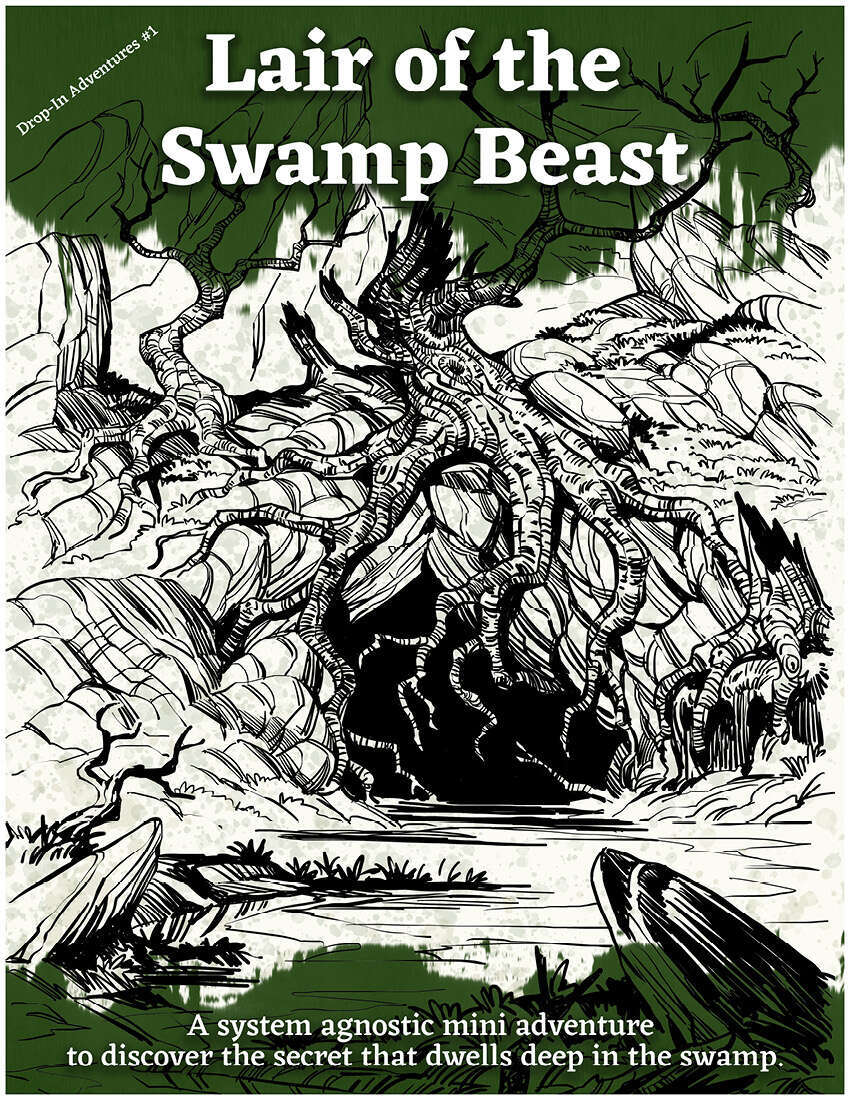
This twelve page adventure uses about three pages to describe four rooms in a hag lair. It sufferers from the generic/universal curse and relies on tables for a substantial portion of the adventure. Abstracted content with little specificity to help bring it alive.
The legend of the beast is persistent in these parts, a terrible force that dwells deep in the swamp and strikes fear into the hearts of those who live nearby. Little do they know, the beast is but a pawn, for something far more sinister lurks within the bowls of the swamp.
Ah, the generic/universal adventure. They seldom fail to not disappoint, even when statted for “OSR”, as this one is. There is something about them that makes a designer seemingly fearful of providing anything concrete to it. The designer wanted an adventure in which the party shows up to a village on the edge of a swamp. Fearful and superstitious locals. Talk of The Beast, everywhere, the cause of all ills. And then a journey through a swamp, full of dread, before finally arriving at the beasts lair, only to find out Muhahahahaha! The beast is the pet of a swamp hag!
Instead, we get little of that.
Adventure writing can be hard. As a designer you have to get out of your head what you are imagining and get that down on paper so that when someone reads it they can get close to what you intended. We get what the designer wanted here because they out right tell us “To get the full effect for this mini-adventure, make sure to play up the townsfolk’s fear of the beast.” That is, in principle, great! You want a town that seems immersive to that point. The adventure designer needs to help bring that about. This doesn’t do that. The village is quite minimal, just one line or so about the town being on stilts and moldy. That’s fine, but, what isn’t fine is the lack of the The Best present in their ramblings. Or any rambling at all. We might look to the rumors table, but all we get is abstracted information like “1 The swamp has been especially active lately.” or that the swamp spirits are angry. There’s nothing much here at all about The Beast. I love that it’s called The Beast, but there’s nothing more. None of its misdeeds or lame calves or anything. The designer needs to bring an adventure alive through specificity for things like this. Yes, the DMs job is to run with it and expand on it but you have to give them SOMETHING to work with.
Then we get to the swamp. This also is abstracted away. Just roll on a page full of random tables. “3 A large depression that collects rainwater.” or a smell that “A salty taste, similar to being near an ocean.” That’s what you have to work with here; it’s totally abstracted away. There IS an encounter table, or single line entries or so, and it does show some decent things in it. “A series of stick figures are attached to the trees. Until they are destroyed, those traversing this area of the swamp walk in circles always arriving back at the figures.” That’s creepy as all fuck. And it deserves more than a line on a d12 encounter table. The swamp needed to be fixed encounters, or a pointcrawl or something, with the entries worked to bring them to life.
The lair, proper, is four rooms. You get The Beast room, a Catoblepas, and then a potion room. In the potion room you get told EXPLICITLY how to make a potion, by a journal, that gets you through a bramble corridor. Then you hit, surprise, Lareth the Beautiful! Err a swamp hag. No hints of a hag up to this point at all. It’s all wasted.
Make the town afraid. Make the swamp a real area and bring life to the best of the encounters on the table. Hint at creepy things to foreshadow the hag.
Tables ruin adventures. Yes, old school uses tables and randomness, but not to create the entire adventure from.
This is $2 at DriveThru. The preview is four pages. You get to see the “village” and the “swamp”, or at least the dressing for it. The preview should have shown a bit more of the adventure, a lair page, for example.
https://www.drivethrurpg.com/en/product/571424/lair-of-the-swamp-beast?1892600
Categories: Tabletop Gaming Blogs
RPG a Day 2026 – Day 1: Discipline
Welcome to Day 1 of #RPGaDay2026. As I explained in my Day 0 post, I’ll be creating NPCs based on the day’s prompts and the week and day modifiers presented in the infographic below. Check out that post for further details.
Today’s combination: Discipline (Prompt) + Drive (Weekly Modifier) + Works Hard (Weekly Modifier) + Fantasy (Genre)
Here is today’s NPC.
Antonia One Eye (Fantasy Name Generator used for the name: Bandits)
Antonia was born into poverty in Karral, a major metropolis in the southern trade routes, where the imperial ways meet the Thunsen River. Living as an urchin and pickpocket in the bustling streets, she lost her left eye, leaving a terrible scar, after stealing from a powerful crime lord, the heir of the elder Thief Lord.
Banished from the city by the Beggar Master, Antonia was forced to survive among the outlaw bands in the hills outside the city. Despite the hardships and cruelties she faced, Antonia was driven by a thirst for vindication and revenge, quickly rising to leadership among the brigands.
Other bands would raid caravans, spend their coin wantonly, and engage in internecine infighting. Antonia’s crew was disciplined, recruiting the most skillful warriors and cunning spotters. They carried out the most daring heist with the greatest rewards.
Antonia One Eye became known as Queen of the Bandit Hills.
The One Eye’s crew carried out the daring attack that captured the new Thief Prince, ransomed him to The Brotherhood of Shadows for a fortune, and the head of the old Beggar Master.
Known for her tenacity and diligence, none of her crew were ever found despite the Thief Prince hunt and bounties. Rumors insist Antonia sails a pleasure barge down the canals of the delta of exotic and ancient Nefatara.
Thanks for reading; I am looking forward to your RPG a Day 2026 post, comments, and conversation. If you want further information about #RPGaDay2026, be sure to check out Autocratik’s blog.
A Spanish version of this post is available at the Desde la Fosa Facebook page.
See you all tomorrow!
Categories: Tabletop Gaming Blogs
OSR Sword & Sorcery Adventure Fodder - d100 Treasure Table tailored for the Tower of the Serpent Horde, fully compatible with Castles & Crusades (and most classic OSR systems)
Here is a full d100 Treasure Table tailored for the Tower of the Serpent Horde, fully compatible with Castles & Crusades (and most classic OSR systems). This post picks right up from A d100 Abomination and Undead Sword & Sorcery Random Encounter Table for Castles & Crusades rpgIn true Sword & Sorcery fashion, the hoard favors ancient relics, dark alchemical compounds, Needleshttp://www.blogger.com/profile/11243274667834930867noreply@blogger.com0
Categories: Tabletop Gaming Blogs
Pages
