
Your wildly multifarious home!
Ten Foot Pole


I bought these adventure and review them so you don't have to.
Updated: 1 month 2 weeks ago
Bugbears in the Mountains
By Fabricio Garcia
Kobold King
OSR
Level 3
Kobold King
OSR
Level 3
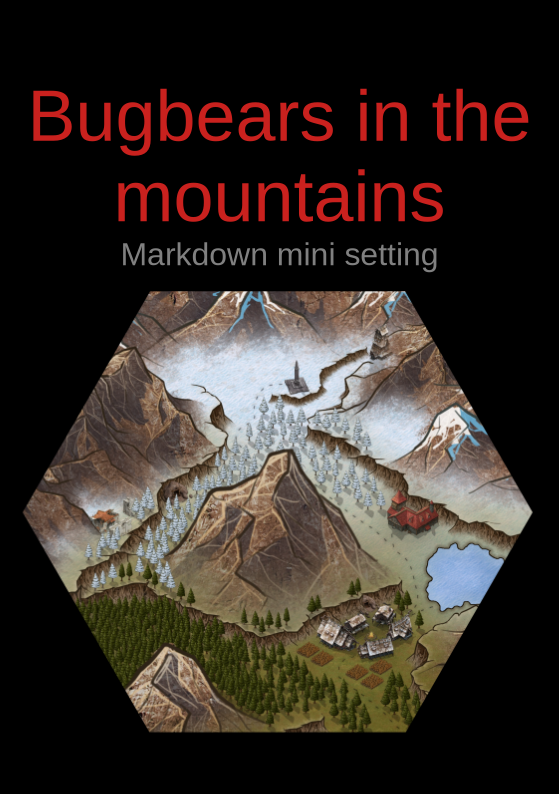
Bugbears are attacking the dwarfs on their way up the mountain to make offerings to their god. A group of elf scholars came to the region to study the presence of bugbears in such remote region and they are stopping the dwarfs in their attacks against the bugbears. Furious with the lack of offerings and prayers. The dwarven god is eminent to turn away from the region and allowing monsters to roam free. The PC’s can seek the god absolution on the dwarfs instead or even make them leave the region and help the bugbears in taking the region and put their gods in power of Altuvia.
(This is a PDF but there is an Obsidian markup file. Again, I tried to install obsidian and get it going to view it the way it was meant to be viewed, got it installed, but again couldn’t figure out how to view/work with the markup file)
This sixty page adventure describes … I don’t really know what it describes. A political situation? A couple of dungeons surrounding a political situation? It’s all just general ideas, with few specifics, and almost certainly worth no time. And yet, I find the premise intriguing in a weirdly real-life cynical way.
The marketing blurb is essentially correct. Some dwarves were driven above ground by oozes attacking their mines. They have no ore. They are trying to get ore from their cousins but the elf lands are in the way and “Now the dwarfs wait for the complicated and unhurried elf politics allows the ore transport.” Noice! And, now, some bugbears have moved in to the region. Their attacks are preventing the dwarves from getting to their temple to honor their goddess. This WILL eventually cause her to abandon them and then the bugbear god will move in to set up shop, which is the EXPLICIT plan of the bugbears. IE: preventing the dwarves from worshipping their goddess so she’ll abandon them and their dude can take up the mantle of the region. But, now, also, with the bugbears showing up, some elf researchers have shown up and have a manor home in the wilderness where they’ve set up base. They want to study the bugbear migrations, which they find unusual, and are preventing the dwarves from attacking the bugbears. If we think of the eves as having superior technology/gods/magic/armies, then the position of the dwarves becomes quite interesting. Piss off the local elves and maybe influence the larger political “ore from our cousins” thing? Are there local dwarves acting as guides to the elves, or, maybe, nearby halflings that trade with the dwarves but also sell their services to the elves? The analog of an asymmetric power relationship, and the consequences to all parties, it quite interesting. The elves WILL, through their good natured scholastic meddling, cause the dwarves to be wiped out and the bugbears to take over the region. Do they care? Will they be wiped out also? This is all fucking magnificent. The comparisons to real life are obvious.
And almost nothing of substance is in the adventure. Some of what I described is present in the adventure. Some of it is shit I inferred, like dwarf collaborators or halflings, or other linkages. But, also, beyond a simple overview, essentially matching in context and length what I described, there is nothing of any of this present in the adventure. The individuals, the timeline, everything else, none of it really is related to the overall situation described. Yes, the bugbears want to kill and maybe an elf , described, wants to study shit. But these kind of grand machinations, or even minor machinations, are just not present in the adventure. At best you’ll get an NPC description who has a quest like “I want some elven wine.”
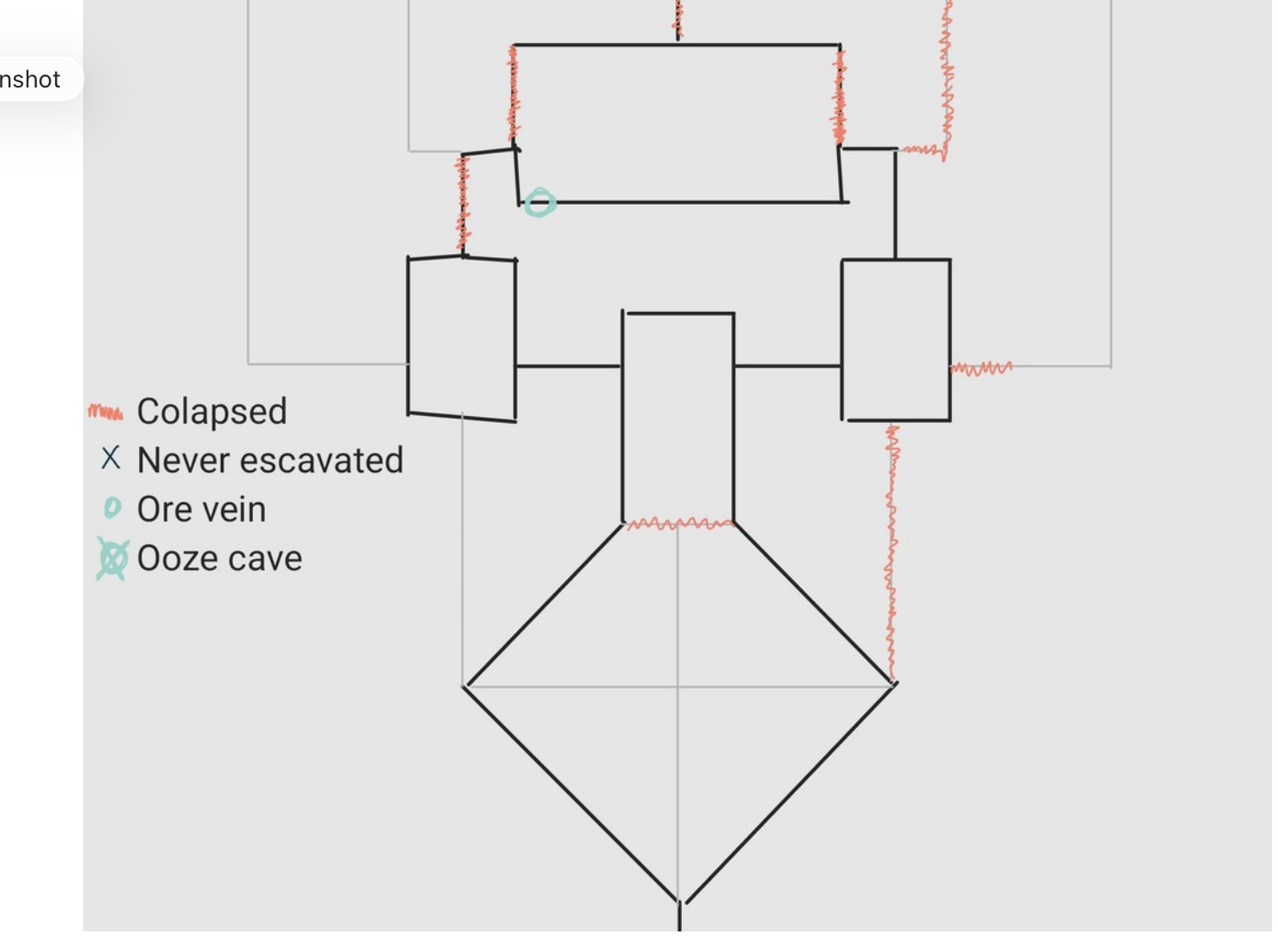
For it being sixty pages there is remarkably little specific to point to. The dwarf mines have a map, but no key, just instructions to roll on random tables. But, even then, I’m not sure I can make heads or tails of the map. Are the rectangles rooms? Or are those just hallways that meet up? What are the grey lines? And then the map of a ruined manor is not keyed, with just things like “Bedroom 1 : The room to the left of the corridor” Creature amounts and mundane treasures, including potions and scrolls are just not present, explicitly so, fitting in to some “for use with any system” statement. I can’t fathom ever doing this in an adventure.
This is SO open ended, SO non-specific that it amounts to just the overall situation description, some NPC descriptions that don’t tie in very well, and site descriptions that are almost as vague and non-specific as you can possibly have and still call it a site description. You’re going to have to wing, and add to and expand everything. I get it, we do some of that when running a game. But there is SO little direction here, so little that is specific, that this amounts to very little more than napkin notes and ideas of what could be going on in various places with various people. In sixty pages. I think I’m done with Kobold King.
This is $2 at DriveThru. There is no preview.
Categories: Tabletop Gaming Blogs
The Hills have SCREAMS
By Dinko "Salty Nick" Galeti?
Salty Nick's Tavern
Generic/Universal/D&D
Levels 5-6
Salty Nick's Tavern
Generic/Universal/D&D
Levels 5-6
Strange phenomena plague the land: saltwater rain, shared dreams of a tide covering the land, shallow puddles reflecting deep, strange oceans. Some people have even fallen into puddles and disappeared entirely. The epicenter of the phenomena has been traced to the mausoleum of an eccentric who believed the whole land was once under the sea. Whether to stop this, explore it, or just to loot the tomb, the players have arrived to the mausoleum.
This eleven page adventure uses two-ish pages t describe about five-ish rooms in a mausoleum being invaded by an aquatic entity. There are hints here of sophisticated play, and maddeningly abstracted text that somehow is also wall of text. The theming never comes through well and it’s hampered by it use of a 5e style guide.
What can i say, I found the title appealing. Alas, there are no hills or screams, much less SCREAMS.
Some dude really thinks the world was underwater at some point. He has a massive tomb built, is buried in it, and then his belief in that idea is so strong that a water-plane entity uses the belief to try to force its way through to our plane.
There’s an interesting concept in this adventure in the way it handles illusion. Basically, the tomb is full of illusions, or, maybe, altered realities, but the adventure uses the word illusions. Before the first room you make a choice, after talking to the dudes friendly spirit, as to if you believe his theory or not. If you do believe then you treat the illusions as real and the non-illusions as illusions. If you do not believe then the illusions are illusions to you and the real dungeon is real. Like one of those scifi episodes where half the cast is out of phase or some such. Some of the sections of the dungeon are filled with water, and there are shafts, so if you believe then you can swim up a shaft, and things like that. (And need water breathing!) The concept is haltingly implemented and not leaned heavily into, but the idea is an intriguing one.
There’s one or two spots where the some interesting things come in to play. The standard “clear the rubble away” thing in one room has the note “Clearing it without precautions causee another collapse.” Excellent cause and effect there and a lack of punishment for players who are not on autopilot. In another section, where you meet the dudes spirit at the start “How to summon Sutton’s spirit is up to the PCs. As a rule of thumb, spending a resource such as a spell slot should work. Actions such as meditating on the bench or lighting the statue’s pipe reveal that the spirit wants to manifest but is struggling to.” Again, pretty decent old school sensibilities. Nothing prescribed but some direction to the DM to have some latitude in their judgements. This is akin to something like the Bless spell being a good catch-all for solving many problems. Rulings, not rules, yes? I suspect, from this, that the dude is a decent DM.
But author …
There are a few quibbles here before the major issues. We’re told that people are missing, strange things going on, etc, and “The epicenter of these phenomena has been traced to Lubber’s Rest” with nothing more beyond that. In spite of the intro background, which is non-trivial, this is essentially just a site in the middle of nowhere for you to explore, even though “the PCs arrived to Lubber’s Rest with hopes of stopping these events and finding the missing people.” So, the framing to support the intro is just not present. At all. Which would be fine if the intro didn’t imply that it SHOULD be there. We’re just looking at a site.
But, more than that, there are some issues with the presentation and abstraction. The “5e template” was used here. This means sections of italics that are longer than they should be. This means long paragraphs of text with little in the way of formatting to help you scan the adventure. You’re digging through A LOT of text in this, with little to separate things and help you locate information. It is, I think, an issue with Wall of Text, even though there are line breaks and some bullets, there’s not section headings or bolding to help a DM figure out where to look for what. And that’s a major problem.
Second is a frustrating amount of abstraction and things simply left out. You will run in to weird symbols that are being used to help summon the aquatic planer entity … but no mention of destroying them. And this is theme, the lack of even minimal guidance for things you WNT to fuck with. When you combine this with the amount of text used to describe and denote other, trivial things, it makes you wonder why the emphasis was placed where it was.
Eleven of the rooms are simply abstracted away. Roll on a table to add a couple of features and then roll on a table for an encounter. An encounter like “Aggressive illusory creature swims in. (Submerged rooms only)” Uh. Ok. And, yet, here’s room nineteen “Contains a heap of rocks, with 4d8 embedded raw rubies. Dumped here by thralls.” This is aggressively terse. Was there not enough room in the adventure for the other rooms, given the terseness of this one? And no value for the rubies?
And, further, note the lack of evocative text. Nothing about a tomb or aquatic/semi-aquatic environment comes through here at all. And this is par for the course in the adventure. There’s a hefty intro. There’s a hefty appendix. But the actual rooms are terse without actually giving much of an impression at all.
What’s a DM to do? There’s little favour here. And I can roll on a table out of a book.
This is Pay What You Want at DriveThru with a suggested price of $5. The preview is ten of the eleven pages, so, a decent preview. You can see both the wall of text in the rooms at the beginning as well as the overly terse ones at the end, and the lack of specificity and lack of formatting to help locate information.
https://www.drivethrurpg.com/en/product/569157/the-hills-have-screams?1892600
Categories: Tabletop Gaming Blogs
Isle of Ruk and Dungeon of Klinis
By Stephen Green
Moonwhisper Magic
OSE
Level ... 3?
Moonwhisper Magic
OSE
Level ... 3?
The world is shattered, the wizards are gone, and the sea swallows the ruins of their age. Scattered across the waves lie the broken islands of a forgotten empire places of fire, frost, and ancient magic. Among them stands the Isle of Ruk, a frontier of black sands, steaming jungles, and secrets buried beneath volcanic stone. […] The wizards are dead. Their secrets are not.
This 64 page adventure uses about seven pages to describe about fifty encounters in two dungeon on an island, with all of the supporting pages being abstracted worldbuilding. There’s a whole lot of generalizations and could be’s in here with actual encounters and locations that don’t come close to realizing the designers vision, I suspect.
This is an island with a couple of towns on it, a barrow field with sixteen locations, and a three level dungeon with about 45 or so rooms. With got this world where WIZARDS fucked up, they are all gone now but the world is blanketed in ice except for these volcanos around that keep things warm. A pretty decent number of pages is used to describe all of this, although it plays little to no import on the adventure. It’s just an island with a couple of towns and a couple of adventuring locations. The ice and volcano doesn’t really come through much. There is a volcano/volcano cultists/fire spirits, especially in the main dungeon, but that theming is still not really present at all.
The main town is described in a somewhat interesting way, at least in the keys for it. “1. Church of Foki has a large cauldron and offers free food for all.” That’s the first line for the temple location, in bold, as a kind of a location header. It’s an interesting way to embed the crux of the location in to the key title, allowing you to know immediately what the main thrust of it is. There’s a related concept with dungeon keys that I sometimes talk about, where instead of “11.” or “11. Bedroom” you put something like “11. Mildewed Victorian Bedroom.” In that instance you are framing the room encounter, preloading the DMs mind, so they interpret what is to come in the description with a “Mildewed Victorian Bedroom” mindset. It’s not exactly consistently used in the town descriptions, but it is present in places and does a great job when it is present.
The rest of the adventure is much murkier in its descriptions.
There’s this abstraction going on, a bit different than other abstractions I generally see. It’s written almost like a regional guide that introduces mysteries without explanation. This is pretty consistent in the overviews of the various areas, which do seem to take up the bulk of the adventure. It comes off with a hefty lean to the purple side of the spectrum. “Thin wisps of yellow smoke coil lazily from the darkness within, carrying the acrid tang of sulphur and old fire. The mountain air snatches them, pulling them apart and scattering their scent into the breeze, but the trace remains a lingering reminder of whatever festers in the depths beyond.” That whole last sentence, with the snatching and scattering and festering in the depths beyond. It’s clearly going for inspiration for the DM, but there is FAR too much of it, especially considering the depths beyond don’t really live up to the concepts introduced. It certainly feels like the bulk of the adventure is made of these general overarching theme writing sections that meet more novelization rather than turning in to something concrete.
This can then be contrasted with the actual location descriptions in the adventuring sites. “3.7 Firedrake (1) has made its lair here.” That’s not much of a description, eh, for a festering depth? Or, for another one “Black stone walls. In the middle of the room is an ancient ashy corpse. A Shadow (1) preys on adventurers.” A little more to this, but still not really living up, I think, to the vision the designer had in their minds when putting this down to paper.
And then there are a few out of place things present. One room on the second level has a table and two chairs and a wardrobe in it. And a sad eyed bard sitting at the table drinking. Uh … there are fire spirits. Fire cultists. Gomens. Shadows. And dude is just sitting there in his cups? A dungeon population table can help inspire us to encounters but it does needs to be placed in context. Lost his party? Just hanging out for funsies? Refuge from a cult? The framing here, or complete lack of it besides him drinking in a room with a wardrobe, just is out of place. Minimal keying would have the DM making things up, as they would if populating from a table. A word of two of context would allow the DM to riff. I’m not really sure what to make of something so seemingly out of place. “Uh, there are a bunch of civvies on level eight of the balrogs lair having a format dance? Uh …”
There’s just this disconnect. The page count is devoted to the world and generalized framing that is leaning purple while the actual dungeon keys are less than thrilling in the capacity they serve. The vision presented in the world building never really comes to pass.
This is $5 at DriveThru. The preview is four pages and doesn’t really show you anything, just a brief overview, this is what an RPG is type of things. We need some meat in a preview to understand if the product is right for us.
https://www.drivethrurpg.com/en/product/568698/dungeon-module-isle-of-ruk?1892600
Categories: Tabletop Gaming Blogs
Caverns of the Dead God
By Matt Gullett
The Long Con Press
OSR
Levels 1-2
The Long Con Press
OSR
Levels 1-2
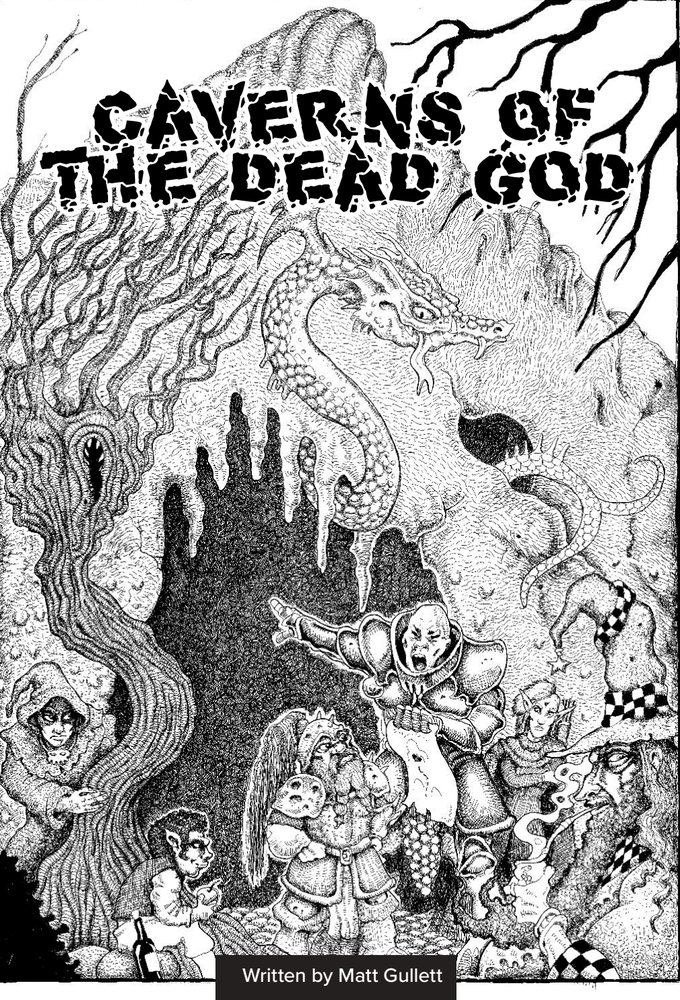
The adventure starts in the rough-and-tumble port city of Warrenburg during the revels surrounding the imminent hanging of a notorious pirate. The Player characters are enlisted to explore the enigmatic cave system some locals refer to as the Caverns of the Dead god.
This 28 page adventure uses about thirteen pages to describe a cave/dungeon full of cultists who just LUV insects. It’s heart is in the right place with a decent amount of interactivity beyond stabbing, supported by a some weirdness and some good use of language in places. It’s lacking just a little in the setup vibe, but the major pitfall is layout nd the need for a HARD edit to bring the rooms in to better focus. Your highlighter is going to go a LONG way with this one.
First off, while listed as OSR, this is clearly a DCC adventure, down to Luck and other terminology. That’s not such a high hurdle, and I used to review many a DCC adventure before finding them a little linear. There’s nothing inherently linear in DCC though, and its nice to see a more traditional crawl trying to cross game system boundaries.
The setup here has some interesting qualities. We’ve got a town of 3,000 people which has swelled to 4,000 for some festivities: an infamous pirate is about to be hanged. At the same time a group of teenagers has gone missing, including the son of a local magistrate. Did I fail to mention the new priests in town who are giving out food and items to the poor? The swelling of the towns population gives a decent enough pretext to why the town isnt looking for the teens; a riff on the old “the kings armies are engaged with a neighboring kingdom” thing. The hanging and town swell offer a nice slice of life to the adventure and are great examples of specificity leading to things that the DM can riff on to add local colour. The hooks, or perhaps “quest givers”, also have a decent mix, from the magistrate to the sheriff to a do-gooder to a local worried that HE’LL be blamed if the kids show up dead. A nice mix of chaos and town “factions” I guess you could call them. Beyond the verbosity of the town/background section, my only complaint here is the lack of a few more specific situations for the DM to riff on during play. Hirelings and rumours are well covered, but a few street scenes would have gone a long way to helping reinforce the chaos of the town swell, the jubilant and chaotic atmosphere of the hanging, etc.
The caves are a relatively simple affair, in a mostly star layout on the map. Nice use of things on the map to lend information, like curtains and statues and the like, but noting lights and sounds on the map, as well as creatures, would save me the trouble of having to note them myself. Entry is through a hole with a rope, always a personal favorite of mine. Unrealistic, but fun! This also seems like a good place to note that the cultists inside don’t really have an order of battle. There is a general note that they will prepare for return expeditions and set traps, but nothing more beyond that.
Interactivity inside is decent. We’ve got status and curtains and porculii to mess with. There’s a spinning gizmo, like a gem, in one room, and a smokey archway in another. Riddles are present, which are NOT a favorite of mine; I like my riddles a little more engrained into the adventure and more subtle than the old say the answer thing. But there’s no question it’s a classical element. Also present is a gem inside of a skull … that you feel a certain compulsion to swallow. I think the last time I saw a swallowed magic gem was in, what, Dungeon of the Bear? Wonderfully non-standard! You do get your fair share of stabbing here, cultists and bugs, but this leans heavy in to the non-standard OD&D vibe. I wouldn’t want to say it goes too far down that path, but there is a sense of wonder here and there that I generally only get from those OD&D centered adventures.
Language use is generally good as well. It’s hidden, sometimes, in the verbosity of the entries, but you do really get the sense that a scene has been painted and/or situations have been brought to life. In one room, were you find captives, “The door here is barred. This darkened cavern reeks of the eye-watering smell of filth. A dozen gaunt, reeking individuals huddle here, shielding their eyes from your light as you fight back the urge to gag.” (There’s no real read-aloud here, in spite of the use of the word “you” in a couple of places. I’ll forgive it as poetic license.) The cavern REEKs. Eye-watering. Gaunt. Huddled. And then, with one of them, “wet, rattling breaths speak of imminent death.” Just a couple of words to really bring home an awful situation. The usual “captive are here” is done more with, and then a situation is introduced, tersely, and not elaborated upon. This is what specificity buys you. Not only a great mental image but also one that you can then riff on as a DM. And this is not a cherry picked example, the use of language can be startlingly good in many of the areas.
But I’m not going to recommend this. It’s because of the layout, formatting and editing. I want to give you a mental image. Imagine a full page of text that is all center justified. So you have both a wall of text issue and the center justified issue to contend with. Now, this is NOT what the adventure layout is doing, but I think it’s the closest mental image I can describe that relates to the issues. This is all a single column, which of course contributes to the issue. When a paragraph is a sentence or so long and it ends a word or three in to the newline then you get this weird effect that almost mirrors a center justify. Especially when combined with a CRIMINAL lack of blank lines to help separate thoughts and sections. Almost a complete lack of bolding, or other elements to help orient the reader and help them locate information. And then a certain verbosity. It’s not appears to be, or room histories or motivations or anything like that, except it is all of them, and more, contributing line after line in very small ways. Things that build up, word after word and sentence after sentence, combined with the lack of formatting and single column.
This needs a REALLY hard edit to focus in without losing the specificity and vibrancy hinted at, combined with some small efforts in formatting, bolding, white space and so on to call out aspects of the rooms, combined with nearly ANY other layout style. Were that done this would be a pretty decent adventure. As if, though, you’re gonna need a box of highlighters.
I am hopeful. The interactivity is decent and the language use, what I think is the hardest aspect of writing, is good. Layout and formatting and ruthless editing can be learned easily enough.
This is $9 at DriveThru. Alas, there is no preview. A good preview of a dungeon room or two gives potential buyers a chance to judge the adventure for themselves before purchasing.
https://www.drivethrurpg.com/en/product/566897/caverns-of-the-dead-god?1892600
Categories: Tabletop Gaming Blogs
Beneath Twin Pines Farm
By Peter D Gray
Self Published
5e/OSR
Level ... 4?
Self Published
5e/OSR
Level ... 4?
Farmer Jebsom has a problem – half his farmhouse, along with all of his family fell into a sinkhole that appeared beneath his farm’s foundations. Now he is desperate to get his wife and children back from the mysterious depths and is willing to give 20% of his farm to anyone succeeding in returning them to safety.
This seven page backstory uses one page to describe nine rooms in a tunnel complex full of bugs. A general overview with a lengthy backstory and terse tunnel chambers result in an IDEA for an adventure rather than an adventure proper.
I am less than thrilled with every aspect of this adventure. There is an extensive backstory here of a wizard noble dude, exiled, back, with a gang of like fifty doppelgangers, his revenge in getting ankhegs in to a village to disrupt the farms, and then his use of a giant burrowing monster to undermine a former rival farmers fields. You’re in the village to clear out an ankheg infestation. That, alone, seems weird. It’s all very nonchalant and no one seems to care much about rampaging monsters. But, whatever. Then farer bob runs in to the tavern noting that his wife and kid fell in when a large portion of his house collapsed in to a sinkhole. Again, no one seems to care much. There’s an off-hand comment that the village priest wants you to wait a day to go save them so that the farmer can recover enough to tell his tale. None of this makes any sense to me. The casual monster infestation that no one cares about. No one really caring about a member of the communities family being in trouble. The priest urging you to wait a day. This is not how people react. I get it, we’re hiring adventurers to solve our problem, but this immediately drags me out of immersion. Things would have gone much better with some local involved and framing this as a village crisis. They won’t even form a militia because the farmers don’t want their hands away. It’s just this super long backstory and irrelevant detail to set up this absurd situation that just results in “you’re hired to …”
And then there’s a evil noble mage and his doppelganger gang. There’s a note that they are replacing people, but nothing more than that. Evil Dude gets a stat block and you find letters in the tunnel, and evidence, tying him to whats going on … but nothing more. No reactions. No evil dude lair. That’s it. The amount of backstory and time spent on him, and the gangers, would make it seem like this IS the adventure. But it’s not. Nothing is there.
The actual adventure is nine keys in a tunnel. This amount to “you enter a room and some bugs are there to attack you.” You can find the missing family. While YOU take between 4d4 and 8d10 damage from collapsing tunnels, they are ok. And, no details about what makes a tunnel collapse or anything. You can also find some dead doppelgangers with the letter from the evil noble. Yeah.
I find this so frustrating. At best you get an outline of things that could be going on. There is almost no specificity. The actual dungeon encounters are less interesting than Boggems, NO! From Legion of Gold. “Hey, heres this long backstory of stuff that could be happening. Now here’s nine rooms in some tunnels with bugs”
I get it. I get the vision. But nothing in the adventure is supporting that vision. Not even this review. OSR. Pffft.
This is $2.50 at DriveThru. The preview shows you the first two pages of baccktsory. Enjoy that.
https://www.drivethrurpg.com/en/product/569215/beneath-twin-pines-farm?1892600
Categories: Tabletop Gaming Blogs
Kaeloreth’s Tomb
By Fabricio Garcia
Kobold King
OSE
Level 3
Kobold King
OSE
Level 3
The adventurers will face an ancient mage trying to free his soul from it’s bindings in his tomb. The group has 10 sessions to reach the tomb, where they can stop the ritual or join Kaeloreth’s quest to rein the region again. In the tenth session, Kaeloreth completes his ritual and now possesses a new body. He send his undead thralls to slaughter 3 Sylvandur population, each death gives him more power. As sessions progress, the common enemy will start to change from wild life and monsters to Kaeloreth’s undead soldiers.
This 93 page adventure uses nine pages to present a small trial dungeon. Whatever the intent was is lost in its incomprehensibleness.
This is an EASL adventure, and while the EASL is thick in this, I don’t think that’s the main problem, so I’m going to ignore it.
I don’t really know what to say about this. It’s a mess. It’s trying to present a small region with the central focus being a dungeon/tomb with ye olde “ancient dude trying to return to the world.” He’s in a tomb that is a simple “challenge dungeon” with a number of rooms in which you face “challenges”; my least favorite type of dungeon. There’s a timeline, based around adventuring sessions, with the concept of escalating stakes introduced for each session the party takes to complete the adventure, rather than a strictly daily countdown.
I guess I should start with the format. Or, maybe, file type. It’s done in Obsidian, a markup tool. I downloaded the app and installed it, but still couldn’t get the files to open. It appears to have a rather steep learning curve. I THINK it’s just a system of hyperlinking. I think. There’s also a single column PDF that contains everything in the markup app, I think. But, even though I’m looking at the adventure in a non-optical manner (the PDF) I still don’t think that’s the issue.
It’s just … abstracted? I don’t really know what to say except “a mess”, but that would imply it’s not organized. But I think it IS organized. It’s just not supporting anything.
I THINK what is meant to be going on is that the party is charged with STOPPING THE EVIL and they end up in a small town. There they meet some NPCs and get mini-quests that forces them in to the region and then they get more information and find the tomb and stop the big bad.
The best example I can cite to relate the issue is the mini-quests. At the end of the adventure is a list of NPC’s. One of the NPC’s has this in their description ”His son is late to return home. He went to the forest at morning (This happens on the first session). He start searching for his son on the second day.” [sic] So, to put together the mini-quests you’re going to have to reference all of the NPC’s and what they want done and where they are. I don’t see how this is possible in gameplay, given their quantity. That means you’re going to have to essentially take so many notes that you would be rewriting the adventure. His kid, later in the NPC’s, has the description “Cerabino is lost inside the forest. He got distracted when he found Living Cave entrance. He can forage for berries and water but monsters can ambush and kill him. “ There’s no mention of the kid anywhere else, and certainly not in the living cave. So … you stick him in it? IE: you have to put together each of the mini-quests on your own. There IS no supporting information.
The living cave, proper, is procedurally generated. Roll a d12 and maybe get “6 Forgotten gear (CHA or attract the owner ghost) “ You gotta wander the cave till the DM rolls a a twelve so you can find the tomb entrance. And it changes every time, since it’s living and procedurally generated each time. This is tedium. And, again, not very well supported. One of the two central locations is essentially not described at all.
Challenge dungeons, the main tomb, are their own problem. You know the whole “door slams shit and figure out what you are supposed to do” thing. And there’s no map. Well, there is one, but it’s not keyed (maybe that is fixed with the markup file?) And then, the big bad has a 4HD fireball he tosses. At level 3?! WHat is that, 14/7 damage? Ouchies.
And the room description, what there are of them, are full of asides and backstory. “The manor don’t clean or fix itself inside this room. This was caused by a bad spell from Maliel – Corrupted Witch while she researched a way to preserve Nermanik – Human Mage’s body.” With victorian laundry lists of trivial contents and extensive room exists and the like.
The rooms and descriptions, the dungeon and towns, the quests, the entire plot … it’s all abstracted. There’s no real summary of how the thing is supposed to work together. There’s no real support for any aspect of it, except perhaps the main dungeon, and even that is written almost like it’s a generic/universal adventure. It has abandoned all conventional aspects of layout and organization, but not replaced it with anything better. It’s as if the designer had not seen a published adventure before and didn’t know to do, but didn’t have an idea anyway on how to organize it.
I’m open to this being an Obsidian issue, solved by it, but I don’t think so. The lack of a summary that makes sense, and the lack of support for the various areas just seems missing.
This is $2 at DriveThru. There is no preview.
Categories: Tabletop Gaming Blogs
Bryce rebuts – Greg Gawron, Founder, Advanced Fantasy Games

Says here I have published 2,161 posts on this blog. About three a week since August 2011. All but eight have been reviews. Let’s post a ninth, shall we?
The tenfootpole is a place of crap. Full of shit and worthless writing about it. A monument to the hubris of man that stinks like a trash container full of dead squirrels sitting the June heat for a week.
What it is not is an outpost of the great internet hype machine. But the hype machine has made a foray, testing the borders of the volcano lair. You see, Greg Gawron, Founder, Advanced Fantasy Games, has responded to my review of The Lost Tomb of Kazcuk Mot the Undying. You can read the response for yourself, or simply rely on my cherry picking. Fear not gentle ones, while there is no bad publicity, I have no great conceit here. Nothing matters and the tilting of windmills must be done, as Camus says, in spite of the results.
Our goal was to hit the market with a fun and challenging adventure that sets a new standard for Old School formats, use of cool artwork reflective of the earlier days of D&D, and other traditional things like a removable cover, blue map, challenging encounters, 12 point font for easy reading in low light, and more. However, we didn’t just put extra effort into the module itself, we also made a commitment to our customers with a quickly delivered product immediately after the Kickstarter closed. Also through our timely communications, packaging, shipping, and little details needed to earn their business again and again.We see here, the Advanced Fantasy Games creed. This line is a nostalgia play. It is an appeal to nostalgia, no doubt to those middle aged people who have a fond memory from their past about D&D. And now have money to spend. It’s a member-berry. And, note, as a major selling point, the commitment to a quickly delivered product, timely communication, packaging, shipping, and other little details needed to earn the repeat reader business. Great for your fucking revenue stream, eh? Lots and lots of shit mentioned there isn’t there? Oh, hey, wait. Do you think it’s weird that not much is mentioned about the ACTUAL ADVENTURES? I mean, i don’t. Why would he write a decent adventure anyway when the focus is clearly on the repeated buyer.
Let us look now at the comments about the adventure that Greg Gawron, Founder, Advanced Fantasy Games, specifically called out to us, as convincing testimonials as ” direct messages received from our customers:”
“Just wanted to let you know I received my copy in the mail today and it looks fantastic the art print is getting framed and hung in my game room. Thank you again. I can’t wait to play it.” – Eric F.Eric F. there didn’t say anything about the adventure. Eric F. got his in the mail. Eric F likes the art print and the way it looks. Eric F didn’t actually say anything about the adventure though, did they?
“Well packed. Carefully packed. Thanks Greg!” – Bill A.Bill A there likes your packaging. Both well packed AND carefully packed. That certainly means a fun night ahead, right? The correlation between “I literally received it in the mail” and “a great adventure to run at the table!” is obvious, no?
“Layout is beautiful and so fantastically readable, Greg, great job!” – DTFAA vote for reading the adventure from DTFA! I’m sure there will be many future readings of the adventure as well! And, well, layout, sure, right?
“OMG! This is awesome! Thanks Greg!” – SJHey, it’s awesome! Weirdly nonspecific though. I wonder what was awesome. They seem very excitable. Maybe they think Applebees is awesome also? No specific comments about the adventure.
“Just got mine today! Love it!” – Steve J.They got theirs. Presumably in the mail also, although, I must say, the lack of noting HOW they received it does raise my eyebrows more than a little. I do hope that the trend here is obvious, and was obvious from the second quoted one.
“I was lucky enough to get to play test and let me say it brought me back to my childhood and how much fun the OG of D&D was and still is very challenging and so much fun… Thanks.” – Vincent F.Sounds like someone had a good DM. That’s great! I wonder if they actually played this adventure though? Or something else? Awwww, look, a direct reference to an aging person wistfully looking back at he lost days of their youth.
“Now, after having given it a 1st “Read Through” I must say, Excellent Work! Well Done! This is a great little adventure that will serve as a perfect introduction to OSRIC/AD&D, especially with the pre-gen characters. Thank you! I’ll be looking forward to the sequel.” – Joseph Y.Maybe the closest to an actual comment about the adventure. Again, very non-specific about what is excellent and what is well done. At least they, unlike everyone else, actually read the adventure?
“Just got mine in the mail and I couldn’t be happier! Really nice job, and ahead of schedule.” – Rob H.The take away here, for everyone actually writing good adventures, is that no one gives a fuck about your quality. They care about getting it in the mail and ahead of schedule. Well, presumably tat’s the baseline anyway. I should hope that writing something good raises the floor a bit in what one can expect … as long as you deliver it. And Early.
“I have to say this was one of the fastest campaign completions I have ever seen!” – Aaron T.Again and again and again, we can see the important of commerce and not anything actually related to the adventure.
“I received mine today – looks great!” – JBCTCJoeAnd again.
“I received my physical copy in the mail this week! It arrived in great condition, your packing skills & package nomenclature (DO NOT BEND) precede you, Greg!What the fuck is obsession here? I guess you can make $6k a month slopping out adventures as long as you ship it with a DO NOT BEND on it.
The module itself is a work of old school trade dress & format beauty & I cannot wait to dive into it! Thank you so much for this!” – Robert W.Our final comment. An appeal to nostalgia.
Do you think it’s weird that NOT ONE PERSON commented on anything specifically about the adventure? It was all delivery and nostalgia trade dress. I think its weird that not one person said anything about the adventure. I also think its a lot weirder that Greg Gawron, Founder, Advanced Fantasy Games, selected those quotes to post. “Great commerce!” huh?
The post ends with Greg Gawron, Founder, Advanced Fantasy Games, making a direct appeal to marketing their latest and hyping it and noting that they are a good DM. That’s what it means when you run an adventure and people have fun. That you are a decent DM, at a minimum. Or, you don’t know what polite people look like. But, no, let’s remain optimistic and take you at face value, that you are a good DM.
I don’t really give a shit man. You’re just another in a long line of slop artists churning out nostalgia crap for an aging population that doesn’t actually play D&D anymore but just reads it. It’s their money. They can do what they want with it. Make your money. But let us not pretend you are producing anything decent or for any other reason than cranking out the old bank account. Not on this site.
Categories: Tabletop Gaming Blogs
Escape the Devil’s Eye
By David Hay
Third Castle Games
OSE
Levels 1-3
Third Castle Games
OSE
Levels 1-3
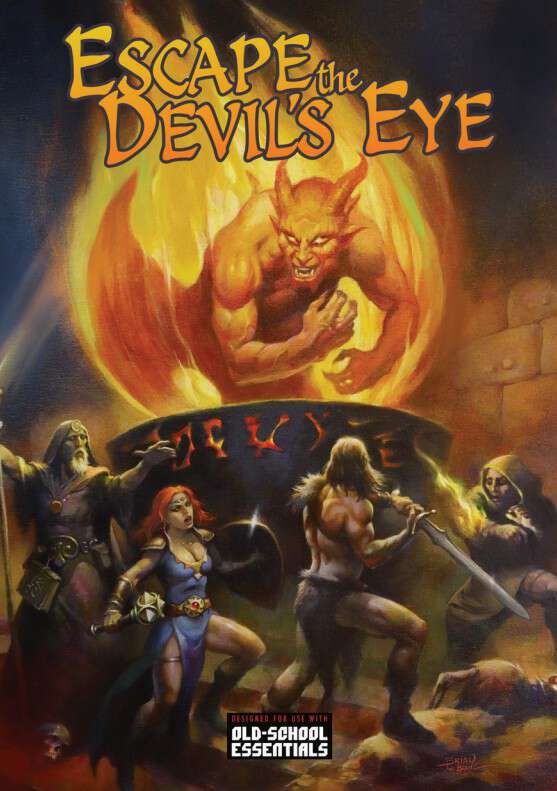
Travel from sun-drenched beaches to dense jungle trails, over vine-rope bridges and up volcanic cliffs. Encounter lizardmen, the living dead, diabolical cultists and worse. Find magical items, gold and perhaps some glory too. Or at least a good tale to tell, should you make it to the taverns of Hardwind Harbour. But don’t tarry too long – for dark smoke belches from the volcano and the earth trembles. Where will your party be when it erupts?
This 74 page adventure uses about 55 pages to describe sixteen points of interest, and some of their dungeons, on a tropical island you are shipwrecked on. It’s pretty good for what it is, combining some ok formatting and a more situational approach to the adventure. I wish the overall situation on the island, how it works together, was addressed just a little more.
Oh no! You’re shipwrecked on a topical island! You probably find your way to the pirate town and there you probably find out it’s a lot harder to join a pirate crew than I thought. The island, while it has a map, is laid out like a pointcrawl. Each location is either self-contained or has a small complex/’dungeon’ attached to it. A couple of caves, a town, a necropolis, ye olde volcano temple, and so on, each with between eight to, say, eighteen locations in them.
Ostensibly you are trying to get off the island, and many of the paths/leads go to the pirate town where you can bargain with the pirates. There’s pirate intrigue in the town, of course, and everyone wants something in order to help you out. But, also, there are other things about. You can find a small rowboat at one beach, and you see a much smaller island offshore, and it has a ship on it. A cursed ship, as it turns out. Do you know how to sail? Do you know how to recruit sailors to man a cursed ship?
And, thus, we see a larger kind of more traditional hex crawl sort of thing going on in this adventure. In those more traditional hex crawls there are generally resources and wants/needs from others that the party exploits to fulfill their needs. They are generally not explicitly noted, with perhaps a few linkages explicit but in most other cases the party comes up with some crazy thing to do to exploit hex Y to do something in hex X. And this adventure, while a pointcrawl, does much the same thing. There ARE explicit linkages between the sites, Bob wants you to deal with the cult or Frank needs their crew found before they can do THE THING. But there are more than enough resources, and weirdo things going on, that the party can exploit things of their own design as well. This is good. The designer has written the adventure to present situations, expanding that to also present some more traditional crawls, and that situation-forward writing is what enables the more free-form non-linear gameplay. And, as the adventure reiterates a couple of times: “oh, and don’t forget to make the volcano explode!”
The more traditional “dungeons” are decent, as well. Underground passages to swim to are a great example of a kind of hidden area of a dungeon that a party paying attention to can discover to get a reward/danger. A bridge over a chasm … and exploring the BOTTOM of the chasm is another example of that. Something a little oblique but obviously present, that the party can poke their noses in to. It’s the ol “cave behind the waterfall’ thing that I love so much. There are also rope bridges over a valley, complete with a corpse hanging from it and wild baboons on it. Or crack in a sea cave floor with an old rowboat, rickety, spanning it. The old “sarcophagus with something inside banging on it to get out’ thing. The rooms, much like the hexes, generally have more than one thing going on in it and many times the dangers are telegraphed well. A pool with luminescent seaweed, and when you go fucking around inthe pool you find out its strangleweed. Well, the DM told you the fucking seaweed glowed, did you think it was just window dressing. For that room, in particular, there’s a sandy floor with footprints, a pool of water, with the underground passage, a howling sound coming from somewhere and then that seaweed, and it’s all handled in one column rather than droning on and on.
As that column note implies, formatting and word count here is pretty spot on. There’s a little sections at the top of an entry that could be read-aloud or inspiration, with some bolded words that reference bullets deeper in the description. A couple of sentences for each bullet, and two to three for the read-aloud/summary. It’s easy to scan and easy to locate information. There is a case of three of information being presented a little late, with something more critical to the action being presented later in the description/bullets. If there’s an ancient red dragon in the room then maybe get to that part sooner rather than later, yes?
I do want to call out something I rarely do: the art. More than once in this I thought some associated art pieces did a GREAT job of bringing the room better to life, which is what I think ALL art in an adventure should do. I understand this is subjective to some degree, but I know it when I see it. Tommaso Devitofrancesco and Gary Trow are credited with the interior art and one/both of them did a good job. “This large room is filled with magnificently sculpted statues standing in rows. At one end of the room war relics are displayed – trophies taken from the Old Empire’s defeated foes. Mosaics depicting famous victories festoon the walls.” This is accompanied by an art piece of greek-style warrior statues on plinths that really brings home the scale of the room. It’s one of the few times that good art in an adventure made me want MORE art pieces to do the same for EVERY encounter. (Which I’d probably then bitch about, but, whatever.)
There’s not a lot of padding in this thing. A few pages of pre-gens and one page of magic items at the end. The preamble before the keys are focused on wanderers and other pertinent information. Still, I wish perhaps the ‘summary’ information was just a little more in depth. A better overview of the various linkages between sites and perhaps a bit more about … campaigning? Hiring a ship, living in town, a sentence on expeditions … this is an expansive adventure and the support for that part of the play could have been better. The whole “jungle vibe” thing doesn’t really come through much at all. I think this is related to the pointcrawl nature; the immersive jungle setting doesn’t come through because the journey to the next time is essentially abstracted in a point crawl. That doesn’t have to be bad, but it needs a little attention, I think, to bring the journey part to life. The sites feel weirdly disconnected, which I guess makes sense give the pointcrawl nature. But, as I said, the designer must then remedy this. And the lack of travel time issues almost certainly strengths this abstraction and minimizes the jungle vibe.
Still, a pretty decent adventure. I’m happy I found it and happy to see what the publisher does next.
This is $16 at DriveThru. The preview is nine pages and shows you the entirety of the starting point/cave complex. It’s a good representation of the encounters to be found, and shows off the nice Glynn Seal maps.
https://www.drivethrurpg.com/en/product/552809/escape-the-devil-s-eye?1892600
Categories: Tabletop Gaming Blogs
The Lost Tomb of Kazcuk Mot the Undying
By Greg Gawron
Advanced Fantasy Games
OSRIC
Levels 2-4
Advanced Fantasy Games
OSRIC
Levels 2-4
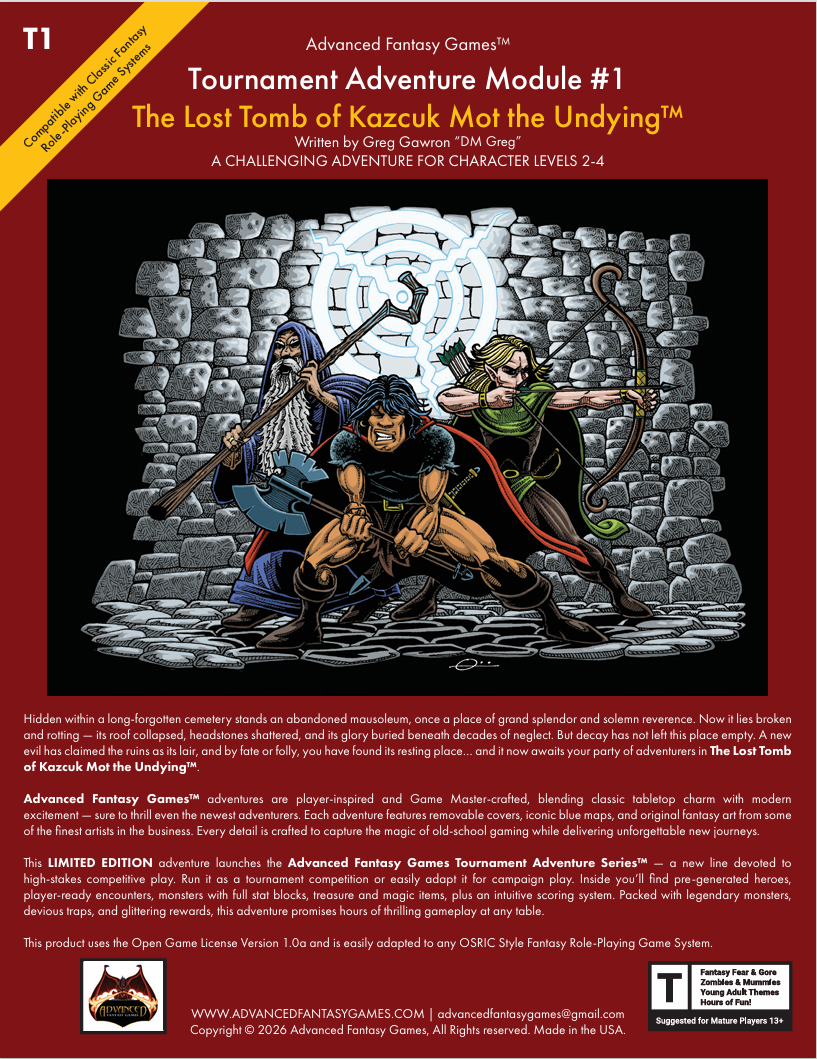
Hidden within a long-forgotten cemetery stands an abandoned mausoleum, once a place of grand splendor and solemn reverence. Now it lies broken and rotting — its roof collapsed, headstones shattered, and its glory buried beneath decades of neglect. But decay has not left this place empty. A new evil has claimed the ruin as its lair, and by fate or folly, you have found its resting place… and it now awaits your party of adventurers in The Lost Tomb of Kazcuk Mot the Undying.
This 28 page adventure presents a small tomb with fourteen rooms that is primarily aimed at tournament play. There is a certain, physicality? to it that I find interesting, however, it’s a bad tournament adventure, with mucho read-aloud and padded out DM text with rather simplistic challenges.
It’s not every day you see someone thanking both Finch AND Taormino in the same breathe, like the credits page to this one does. I assume he went to a con and they both said some kind of Gandhi shit to inspire him to publish? I hope that’s the case. I don’t know, Taormina cranks his shit piles out so maybe it was publishing tips? Anyway, this is a tournament adventure. Tournament adventures need a few things special going on so you can judge them similarly, fairly, amongst different tables. I think that’s all bullshit and it’s like comparing a Rothko to a Picasso. “You get a prize!” Fuck that shit.
And, therein, is the issue, at least with regards to the tournament aspect to this. Let us consider two different scoring systems for a dungeon. In the first, I give you one point for each room you enter. In the second I roll a d6 for every room you enter and if it comes up a ‘1’ then I give you a point. IE: what are we measuring? The ability to penetrate the dungeon by any means possible or are we measuring how lucky the dice are for the party? Further, we must be up front with the players on what we are measuring. SHould they be tearing the place apart looking for treasure, or defeating monsters, or “winning” the plot, or trying to roll as high as they can on their dice? This adventure, of course, does not disclose the scoring to the party other than to say you get a point for accomplishments and lose a point for mishaps. And then it does things like “if you search the room then roll a d6. If you roll a 1 then the party finds a pearl necklace. They get a point.” I seem to recall that some tourney adventures went so far as to have die rolls prepared for the DM in order to make things as fair as possible across tables. Rothko does not approve. So, as a tournament adventure I think this fails to do a decent job with the scoring. The answer is not more prepared die roll and less randomness, but a different axis of scoring, I think.
Ok, so, the adventure intro also says we can use this as a stand-along adventure. How was the play Mrs Lincoln? Not as bad as one might think, given the murder of the president.
I’m not happy with the adventure, or the interactivity as a whole, but there is a certain physicality to the interactivity that I think works well. One of the entry rooms has a door under a sarcophagus that flips up. There’s a grate in the floor to go down. There’s a portcullis to lift. There’s a decent amount of this kind of physical interactivity in the adventure. Or, maybe, environmental? Whatever. There are other classic elements as well, such as yellow mold, the old water monster in a pool of water thing, and so on. They don’t feel tired in this, but I’m also open to this being because the amount of text that surrounds them. Interactivity, beyond that physicality, is generally limited to stabbing. And, even that is a bit iffy. The wanderers are bats, rats, and centipedes and they show up a decent amount. One wonders at the boredom of it all.
Otherwise, the adventure has some of the long standing usual problems with the untrained. The read-aloud can be quite long. And, of course, players don’t listen to long read aloud. It’s not a new thing. You’re boring them with read-aloud. Keep it short. It’s the designers job to figure out how. Further, the read-aloud over-reveals the rooms contents. You want the read-aloud to hint at things for the players to have their characters follow up on, not to just expo dump every little detail. at the party. You want the back and forth.
EVerything here is padded out. Every read-aloud ends with “WHAT DO YOU DO” and then immediately we get a “DM NOTES” heading. Yeah, got it man. It’s not read-aloud so it’s DM notes. Yeah, got it, the read-aloud is over so now the party and do things. The first trap takes like three paragraphs to describe, and it’s a simple stair foot pit. Ok, so, I take it back. Four paragraphs. This is a quarter of a page. For a simple trap. It’s not complex. It’s just padded out. The wanderer text is padded out. “Inside the mausoleum the characters will find ample space to move about and it may appear to be a safe place to rest and take shelter. It is not.” Jesus man, that did nothing for the adventure. It is just worthless text. You didn’t actually say anything. All you’re doing is adding words to the adventure. And these filler words and paragraphs get in the way of the ACTUAL meaningful text that the DM needs to locate in order to run it at the table. The DM needs to be able to quickly scan the text, and right now they have to dig through shit like that in order to get to the stuff that matters.
It’s just relentless. The editor is the designer, which is either magnificent, if the designer knows what the fuck they are doing, or a disaster is they do not. The designer was not born with some a priori knowledge of how to write an adventure and do layout and what makes it fun and so on. Ideally, an editor, a decent one anyway, can help with some of that. YOU DO NOT KNOW WHAT YOU ARE DOING. You might be a decent DM. You are probably an ok guy But YOU DO NOT KNOW WHAT YOU ARE DOING. Seek help. Seek an editor. Learn what makes an adventure a good adventure and also an easy to run adventure.
This is $20 at DriveThru. I think that’s because it was kickstarted. I’m going to, rather generously for me, NOT say this is a fucking cash grab, even though the first thing published was kickstarted at $20. That advice above? Learning what makes a good adventure, getting an editor, etc? You can ignore that. You can go down the path of filthy lucre. Just crank shit out on kickstarter the most efficiently possible and build your market.
https://www.drivethrurpg.com/en/product/562629/the-lost-tomb-of-kazcuk-mot-the-undying-osric?1892600
Categories: Tabletop Gaming Blogs
House of the Lost Shepherd
By Ben Gibson
Coldlight Press
5e/Pathfinder/OSE
Levels 4-6
Coldlight Press
5e/Pathfinder/OSE
Levels 4-6
What’s going on in Morpheus’ villa? We’ve not heard anything from them for weeks, outside of the weeping, and the screams, and deep below, some kind of roaring…
This ten page adventure uses a couple of pages to describe a two level villa with about forty rooms in it. Overly terse, it leans hard toward the Vampire Queen style of writing, or perhaps Tegal, than a modern take.
I think I’m missing something here. This is in the OSR section on DriveThru. It’s listed for Pathfinder, 5e, OSE. The cover says “Written for 5e” on it. There’s one set of stat blocks on the back page that seems an awful lot like 5e. Is the assertion here that 5e/Pathfinder/OSE are enough alike that you can just run with it? I don’t know. I guess? Something feels wrong here.
This is a two level “villa crawl.” Some dude hasn’t been heard from and you go in to find him/loot the place/whatever. Blah blah blah, there’s monsters that drain your mental stats to represent ”draining emotions.” The mechanics are simple, you recover a point a day once the big monster is dead and if you reach zero you turn in a monster. Thusly you’ve got former residents and servants now drained of emotions and monsterized and of course the usual assortment of cultists and others looking to cash in one way or another.
Before I hit the encounters let’s talk map. It fucking SUUUUUUCKs. It’s hand drawn on … beige graph paper? The pencil weight vs the weight of the graph paper lines is too similar. You can’t tell where a wall is and where a door is. Level two, the underground, is better, but level one is all “classic gygax” map with thin walls and everything on top of each other. It’s gotta be legible man, that’s always rule number one. Handdrawn can work, but there’s gotta be enough contract that you can tell what is going on.
The encounter writing style here is terse. VERY terse. Like, twenty entries to a page terse. “Outer Patio – Both doors wedged shut. Gives a numb feeling, cold.” It just feels odd to me. Like, it’s a ten page adventure and two and a half are devoted to the room keys. That’s just odd. It FEELS like there is some artificial constraint going on here here. Like “facing pages” or something else that Gibson is trying to do that is just NOT translating AT ALL. In another place we get the room description of “Smells of rot, corpse of a slave who trapped both doors
in here wearing a lucky band (one-use, reroll failed mental save)” That’s the entirety of the entry, so I’m not quoting things out of context. (And, I don’t see anything in the intro/other keys which this could play off of.) The corpse could use an extra word. The traps two more words. It’s just sparse to the point of almost being barren. “Passing between these glyph-etched columns drains all emotion during the walk (mental damage).” I get it. I get what he’s going for. Kind of. I’d prefer this just be a little longer with a few more adjectives. I think I can make a case, also, for it being ambiguous in its effect. There ARE rules for draining emotion present in the intro. “Several traps, effects, and spells inflict mental damage, dealing 1 point of damage to a random stat (1d3 for INT, WIS, or CHA) “ So, if we take that, then … the door traps are, what, these magic emotional traps? I didn’t really get that vibe from the servant body thing. And, for the glyph pillars I’m kind of stuck on the word “all”, as in “all emotion.” Does it mean all? As in this is a death trap? Maybe I’ll chill with that at level six. Or, is it referring to one point?
And then there’s the Big Bad, The Below. The stat block is just a stat block. There’s no real description anywhere, just a reference to a spirit of earth and darkness in the intro.
I don’t want to read too much in to the intent, but it FEELS like this is an experiment to write for 5e/Pathfinder/OSE in a way that makes an adventure possible for all three. And then combine that with this kind of very terse style. Theoretically I think both of these are possible. Nothing REQUIRES a mile long state block for Pathfinder. And it’s all D&D based, after all, so with a little work I think you could do the ruleset thing. Similarly, I think you can get away with those very terse descriptions. I mean, fuck me, Stonehell is the king of this shit, but it leveraged a few pages of context for it’s terse keys. I’m also chill with some abstracted away mechanics, which saves TONS of space. “Poison needle trap-1d6” works for me. But it has to be done in a way that keeps that the enables the evocative. You have to WORK those keys, hard (and possible the layout) to stuff in enough vibe to not have this be a half step more than Vampire Queen. A few more descriptive words. Building a vibe in key after key that kind of leverage each other to create something greater than the individual entries.
If that was going to happen here, if that was the intent, then the keys needed more work. I get that a kind of “basic outline” is a different kind of structure, but I just don’t see that as being as successful in running a game.
This is $5 at DriveThru. The preview is five pages and shows the level one map and keys and intro. Good preview.
https://www.drivethrurpg.com/en/product/567820/house-of-the-lost-shepherd?1892600
Categories: Tabletop Gaming Blogs
The Tower of the Standing Stones
By Marco G. Fossati
Self Published
Dragonbane/OSR
I think this is a BRP system
Self Published
Dragonbane/OSR
I think this is a BRP system
… hear the tale of Ardana, a mage who defied the Dragon Emperor and vanished with her dark grimoire, The Heart of Ardana. Her ruined tower still stands, touched by strange demonic magic.
This eight page adventure features an old wizards tower and uses four pages to describe eleven rooms on like five floors. Long read-aloud, over-reveals, abstracted treasure. It’s really hard for to describe how “lackof adventure” this is.
So I’m out with friends and the chick next to me is like “Hey Bryce, where are some places to go to meet people. I want a summer fling.” So I turn to some stranger next to me sitting alone at the next table and am like Hey man, where are some fun places to go in Indy, Chickula is looking to meet men. And he’s like “I’m gay.” Dude, not you, I’m like 30 years older than her, maybe you, as a young fella, know of a place where the the young women might go other than a fucking D&D convention?! “So he replies: “I know of three jazz clubs …” Dude has missed the point. Oblivious to it all.
Ok man, let’s GET! IT! On! We are Dragonbaning and I couldn’t be more excited this morning. “At the first light of dawn, in the settlement of Outskirt, the player characters came across a ballad sung by a highly skilled female Bard, named Tymolana.” Oh Jesus h fucking Christ. Fortunately, that’s all there is to this. Except the ballad itself. What do they call that? At the cons? Filcing? Felching? Whatever. It then jumps to “The ancient tower, called The Tower of The Standing Stones, lies at the foot of a hill. The player characters will face a hard journey which lasts at least a full day.” So, you get the “highly filled female bard” sentence, the ballad, and then the whole “it’s a hard journey” sentences. I absolutely thought, given that bard line, we were gonna at least mary sue the chick or at least spend an hour having to deal with some read-aloud, but, no. It just tosses in that “it was a rough journey” thing and you’re at the fucking tower. I don’t understand why any of this is in the adventure. The bard has nothing to do with it. The ballad doesn’t matter. The journey clearly doesn’t matter. And the adventure is like this, time and again. This weirdly specific attention to detail and then, quick, abstract everything!
“A weathered stone tower at the foot of a low hill. Its crown has crumbled and the masonry is cracked and flaking; the whole place looks worn-out. A short run of broad stone steps climbs the slope to a heavy, skewed door. Faint chisel-marks and moss stains can be seen on the lower steps and around the lintel. Windows and fissures reveal that it is a 3-story tower. On the top, some standing stones point to the sky. From time to time, some crackles of purple energy strangely illuminate the surroundings.” Over-reveals in the read-aloud. A read-aloud that is too long. Three stories?! Let’s climb to the top! Windows? We’re in! Never use the front door, kids, when doing & B&E. Does the adventure handle any of this? No, of course not
“A narrow stone corridor with damp, flaking walls. Faded paintings of skeletons line the west wall. One skeleton has an oversized skull with purple eye sockets” Where do YOU think the secret door is? Jesus. Ok, so, when you write a description like this you start at the abstracted layer. There are faded paintings on the walls. As the party asks then you tell them it’s of skeletons and the whole purple eye thing. That’s it. That’s the core fucking mechanic of D&D. The DM describes something and the party responds. Why not just fucking say there’s a secret door behind the purple eyes? Fuck me man. Don’t do this. Please. Don’t write descriptions that over-reveal. Keep the game alive. Keep the core mechanic alive.
“Treasures: Among the crates and the sacks, the player characters can find treasures equivalent to one treasure card.” I don’t know about you, but I like to show off my treasure cards to the young ladies at the bar. They love that treasure card flash! So, I assume this is some Dragonbane shit, but, still, “treasure card?” The party wants the fabled rose of Amun-Sur or the cape of Verde Tacana, not “a treasure card.” Good treasure makes the party want to keep it and wear it, even if it’s non-magical, instead of melting it down immediately to purchase twelve more torchbearers. Why abstract this? It’s like buying an adventure and opening it to read “Have an adventure” and nothing else. That’s it. That’s a major part of the whole fucking experience.
And this extends. That fucking ballad, which is like eight short lines long, mentions The hEart f Ardana or some shit like that. A spellbook. You ready for it, the reveal, the object of infinite desire, the thing to which launched a thousand ships, The grimoire called The Heart of Ardana: “Grimoire: The grimoire is the Heart ofArdana. The grimoire is trapped (see below).” That’s it. Nothing else. No more description. Not in the text. Not in an appendix (there are none.) No mention of it or its contents. Shall I compare thee to a Summers Day? “Vecna: Seldom is the name of Vecna spoken except in hushed voice, and never within hearing of strangers, for legends say that the phantom of this once supreme lich still roams the Material Plane. It is certain that when Vecna finally met his doom, one eye and one hand survived. The Eye of Vecna is said to glow in the same manner as that of a feral creature.”
Instead we get backstory. “The demon was conjured by Ardana during the siege as her last defense, but the ritual was interrupted before it was fulfilled. It has been in that state since there and looks to be freed. In order to do so, the ritual lines must be canceled” I DON’T CARE. This nonsense adds nothing to the adventure. And it’s EVERYWHERE.
This is absolutely one of the most boring adventures I’ve ever seen of everything that actually qualifies as an adventure. And it’s not because there is, like, five bandits in the tower. It’s because of the writing, the mechanics of handling things “Place hands of altar and make a wil save”. It’s weirdly abstracted method of not tellin you ANYTHING about anything to want to know about but still making sure that the room entries are a column long. And that each one has a section about every exit in the room. Except for the ones that DO NOT have a sections about every exit in the room.
This is boring and inconsistent.
This is $2 at DriveThru. There is no preview.
https://www.drivethrurpg.com/en/product/567777/the-tower-of-the-standing-stones?1892600
Also, hey, a question for all the eurotrash: I assume each country in europe has a dominant game, aka that Das Schwarze Auge shit. But Italy seems to be the only country in which we get adventures out of. They just crank them out. Something weird in the Italian water, D&D-heavy, or something else going on? Why don’t I see frenchy adventures?
Categories: Tabletop Gaming Blogs
Shrine of the Cabbage God
By Ben Gibson
Coldlight Press
1e
Levels 4-6
Coldlight Press
1e
Levels 4-6
Gayle, priestess of the god of earth, has received visions; an annoying enemy of the god stirs up in the mountains. If servants of his temple can kill this enemy for good then the three earth elementals tasked with keeping him buried will serve the party for a month and a day.
This twelve page adventure describes a two level abandoned temple with about thirty rooms. A classic crawl that leans realistic while still not forgetting it’s a D&D adventure. And, not to worry, it’s not a joke adventure
Ye Olde Abandoned Temple Crawle, that’s what we got here. Because of maybe – “Quecho, cheerful llama-herder, pays for drinks for everyone at the caravansary with part of an ancient gold plate, he claims he found it up in the high plateau near a forbidden old valley.” or maybe “The family ancestor skull Qhawa recently woke up and started annoying his descendants, insulting them and telling them to go to the shrine where he once served. His family is desperate to get rid of him and offload him to the adventurers if possible. He knows the way to the shrine but will admit he only worked in the gardens outside of it when arriving there.” Two pretty decent hooks. Nothing more, really, than “you find a treasure map” but in both cases a couple of extra words to bring them to life a little more. Maybe a little Mort in that second example and perhaps implying a tone that is not present in the rest of the adventure, but, still, both of these have enough specificity that a DM can craft something around them. And that’s a good hook.
Once at the site we find some ruins above ground with an obvious hole in to the ground. Down you go! Oh, also, there’s a band of thieves up top who slay your followers, cut your rope, and rob you. Talk about the classics!
Down below is the two level Shrine of the Cabbage God. It’s a decent mix of traditional D&D elements along with a slight bend to a more realistic temple. One room has “Calendar Chamber: This domed chamber is painted in a yellowing white with black specks for the stars. A raised square platform is in the center; hovering 5ft over the platform is a gleaming golden +1 dagger (worth 3,500gp) with a steel core that points to the constellation currently ascendant “ Hey! Neato! Love a good ol star chamber! Also, that dagger is stuck in the middle of Gelatinous Cube. It told you. The DM told you. It was just suspended there. And you walked right up and tried to grab it anyway, didn’t you? And then half a second too late the light blub clicked on. This is a great encounter.
In other places there are nice little nods to some Indiana Jones style of traps and challenges. “This stone table holds a pair of golden masks (worth 550gp each), one with a melted face stuck to it. A dead thief, face missing, lies next to the table.” Well, yeah. Nice pairing there. The merlot goes excellently with that Stilton. I’m down.
The adventure is a mix of elements: other looters also trapped by the thieves up top, some vermin like the cube, the usual Avatar and other temply things like blessings and genuflects. “Avatar of Oleracea crouches in slumber, a vaguely humanoid shape built of bolted cabbage, half-covered by pebbles, it’s ears and eyes covered by the stony hands of a rocky statue (a patient earth elemental who only cares about silencing the petty god). Oleracea hears and sees through his avatar if the hands are removed and can give directions/ blessings (see spells) if he’s impressed by his interlocuters, but the avatar itself is wilted and cannot move “ Sounds like my fifth wife.
It’s a solid little adventure. I do find the writing a bit dry for my tastes. And the paragraph style formatting can get long in places. There is some bolding, underlining, tables, and what not to try to call out important details, but I still think it’s probably over the line of what can be absorbed quickly. Still, a decent little adventure with a wide variety of interactivity to keep things moving, situations to exploit or be exploited by that introduce some dynamism to the play.
This is Pay What You Want at DriveThru with a suggested price of $2.
https://www.drivethrurpg.com/en/product/566390/shrine-of-the-cabbage-god?1892600
Categories: Tabletop Gaming Blogs
Hell Comes to Frogtown
By Phil Martin
Self Published
Knave
Level 2
Self Published
Knave
Level 2
Come for the frogs. Leave when it all goes to hell. The small hamlet of Roudenbush moulders on the edge of the Great Cheerless Swamp. Built at a crossroads, the town sustains itself on a mix of merchant caravans stopping for provisions, those that seek treasure in the swamp, and the bounty of the swamp itself. Wooden, thatched-roofed residences and stone municipal buildings make up the town. Two weeks ago, a tide of giant frogs breached the town’s outer wall, causing chaos in the streets until they retreated back into the swamp.
This thirteen page adventure uses three pages to describe seven overland locations and a five floor wizard tower. Napkin notes for an adventure, it exemplifies the IF rather than a THEN.
My brief foray in to products recommended that live in Itch has ended as I am, and no one else, is completely shocked. I find it FASCINATING in what both people seem to be willing to pay for nothing and in what people are willing to publish. For Money.So, some giant frogs showed in a a town int he swamps and rampaged through. I guess you’re going to do something about it for some reason. There’s some abandoned wizards tower in the swamp with a magnifying glass turning frogs giant. That location is called Frogtown. There’s also a wandering knight called Sir Robin Hell. Get it?
I’m in a foul fucking mood this morning. This thing isn’t help that any. I’m not going to waste a lot of time on it. Fourteen pages and it manages to put in just a few with encounters in it. This is nothing more than napkin notes. It’s not an adventure. It’s possibilities, rather than specificity.
What do we mean by this? There is some rather common tendency to be seemingly afraid of outcomes. It is as if the designer is terrified of actually stating something concrete may happen. In this sense it is more like a hex crawl but without the scope of a traditional hex crawl. You come across a village of 100 gnomes living in a mesa. “The hive-mind seeks the return of myconids that have gone missing, believed taken by the lizard folk as food / offerings. Will exchange fly agaric mushrooms from their grove for myconids that are found and returned “ I’m paraphrasing the set up but the outcome is from the adventure. This is classic “giant hex crawl.” But it’s not “overland journey to the adventure site.” In the starting village there are a couple of NPC’s. The are not specific to the adventure, just a list of NPC’s for the most part. One of them is a guy you can hire, Buckingham Craddlethatch. The second floor of the five floor “end site” tower in the swamp reads, in its entirety “Ruined arcane library and alchemical lab. Most of the tomes are mildewed and illegible, but an intact Chaos Spellbook can be found among them. If Buckingham Cragglethatch is with the party, he finds a book bound in human skin. Perusing it, he will suddenly announce that he must leave immediately. “
Those two encounters are representative of most of what is going on in this. They are possibilities. They are the “collapsed stairwell to another level of the dungeon that the dm COULD expand upon if they were so inclined.” In a traditional hexcrawl adventure these are the core of the adventure. It’s a wide open area that the party brings themselves to in order to exploit. Contract this to the standard “overland adventure” portion of adventures where to travel to get to an adventuring site. These are instead dangers and Lair, with associated lair treasures. And then contrast these two types of things to the keys found in most adventures. Obstacles and encounters to overcome. Those three encounter types serve much different purposes, influenced by the scope of the adventure and environment.
The muddling of the streams here results in adventure that is nothing but napkin notes for a small adventure.
No more itch for awhile.
It’s Name Your Price at itch, with a suggested price of $5.
Categories: Tabletop Gaming Blogs
The Steep Mage
By brine
Self Published
Yarn & Bone/Universal
A mage sits in a cemetery, sipping tea while his diggers excavate Lady Veshra’s grave. He must speak only in rhyme lest his lungs collapse. His murdered wife possesses the living to assist his ritual. The cemetery fights back with sentinel crows and grief wraiths. Veshra’s descendant wants the Soulstone inside the coffin… her last asset. Tonight he joins his true love in life or in death.
These twelve pages describe the idea for an adventure rather than adventure.
I don’t even know what’s real anymore. I don’t know how I got here. Somehow this made it on to my list. I THINK that means someone had to specifically ask me to review it. I know itch is worse than DriveThru and so I don’t go clam digging there. Maybe while I was drugged up?
It’s just twelve pages outlining the concept of an idea. A dumb ass mage who has to sip tea is digging up a grave to get some magic thing. There are undead in the cemetery, and a ghost-thing, and some other chick shows up with mercs who wants the same thing the mage is digging for. That’s the outline. And it takes twelve pages to do that.
Look, I’m not saying all of the ideas here are bad. One of the hooks has you showing up, as relatives, to rob the grave. “You arrived early to claim it before your “dear cousin” and her hired thugs “ That’s good writing and a decent hook. Or the local official sending you to deal with some chick who he thinks is batshit crazy who insists her ancestors grave is being robbed. As “hired hands” goes at least its got some life.
And, thus, some of the framings in this are fine, or more than fine. But it never does anything with them. It’s just a collection of motivations and ideas. Heavy on art and whitespace. I can’t emphasize this enough: this is not an adventure. It is a collection of ideas that one could build an adventure from.
Whoever asked me to review this must have been trolling. I see that the system, Yarn & Bone, is variously describe as world-first, conversation heavy and solo. Who knows. But it also says its compatible with all RPG systems. In the sense that this is just a collection of ideas, yes, it is certainly compatible, just as the OED is as a roleplaying adventure.
Gentle reader, why have you not shit in a box and charged $5 for it?
It’s Name Your Price at itch, with a suggested price of $5.
Categories: Tabletop Gaming Blogs
Grotto of the Golden Gargoyle
By Brendan Barnett
Self Published
Generic/Universal
"Lower Levels"
Self Published
Generic/Universal
"Lower Levels"
If legends of the Golden Gargoyle are true it could mean infinite wealth for any who possess it. Trouble is, nobody has a clue where to find it. That is, until a goblin falls out of the sky with a pouch of gold dust and a map to a hidden cave, high in the mountains. What you can make out amongst the blood splatters is very promising.
This forty page adventure uses sixteen pages to describe eight rooms in a low-conflict cave full of goblins. It’s meh, mostly because it uses forty pages to describe eight rooms in a low-conlift cave full of goblins.
Great looking little pdf. And I assume print book? Nice cover. Pretty little isometric map inside that is itself an art piece, like you might see as a two page special insert in Dragon or Mad Magazine. Nice illustrations and a layout style that looks pretty with its use of word color and boxes and highlights and so forth. And not garish, in spite of its use of pinks and purples. Nice accomplishment there!
Did you want to buy a coffee table book? Cause this is an awfully nice looking coffee table book.
It’s just real hard to take this seriously as an actual adventure given the page count to encounter ratio. Forty pages. Eight rooms. In spreads, of course. What is it that the designer wanted to do? DId they want to write an adventure or did they want to make a great looking book? Room one. This is all of the text on the first page of room one: A large rectangular chamber. In the centre a stone gargoyle statue sits atop a tall pillar with the word ‘umop’ roughly carved into it. The word ‘uado’ is scratched above each of two sealed stone doors to the north and west. The ceiling (30′ up) is covered in spikes. The floor is littered with broken bones. Searching the floor yields 10gp in assorted coins and a silver ring (40gp). It bears the image of a human figure immersed in a river.” There’s some line breaks in there. The second page has open and down in normal and reverse print. Yeah, the words are mirrors and one opens the doors while the other does an anti-gravity. Two fucking pages. Two fucking pages for this. And this is the norm for the adventure. Simple rooms, spread out over two pages.
We can, I suppose, ignore this. We can simply accept that the designer decided two pages per room. What we get, then, is eight (or nine, for an A/B room) are some relatively simplistic rooms. The interactivity here is basic. I’m pretty sure there’s one ‘fight’, with Vampire Kinght[sic] Armour. Nobody present really cares that you are nosing around in the caves. I can’t help but think that this could have been much better i it were larger. The goblins, cultists, bats, tomb, all with zones in the dungeon, expanding the thing to something with more going on and room for the adventure to breathe.
The language used, for the room descriptions. Is rather plain. A large rectangular room. THis is not the height of language use to evoke imagery. The exception is the isometric map. It’s a pretty great art piece, harkening back to all of those Bat Cave and Hall of Justice isometric pieces from comics, or, the Starship Warden piece I have hanging on my call. Very evocative, but not exactly something you can run from. (There is a more traditional map as well, to run from, the isometric piece not being the most clear on room connections.)
I can’t say it’s true or not, but it certainly FEELS like the isometric map was the starting point of this adventure. As if it were created and then the rooms followed on. Like the adventure, proper, was secondary to this and/or inspired by the art piece. That doesn’t have to be bad, but in this case the adventure just doesn’t feel worked enough.
It remains interesting to me the many ways that the various subcultures produce bad adventures. Starting from bland, or assembly line, or wordy, or mini combats, or rote, or art, or layout, or, or, or.
https://pocket-sized-perils.itch.io/grotto-of
This is $5, Aussie, at Itch.io
Categories: Tabletop Gaming Blogs
Wyvern of Whitepeak
By Greg Daley
Tarichan Games
1e
Levels 2-3
Tarichan Games
1e
Levels 2-3
Dead bodies turn up, purple with poison. Word reaches the village that a pair of bodies have been found at the ford of a lonely vale, slashed and bloated. A wyvern has been seen on the mountain nearby. The adventurers explore the valley below the mountain, on the search for the killer. Can the characters defeat a threat from the frigid mountains? Will they defeat the creature and overcome the curse of the peak?
This 55 page adventure presents a small wilderness area and a four level dungeon with about 75 rooms, with the dungeon proper using about sixteen pages. There’s a conspiracy afoot, or two, all caused by the dwarves in the dungeon that the party will no doubt get mixed up in. You might think of this as a “normal” dungeon that then has some framing to it to spice it up by way of the conspiracies. While not particularly evocative, it’s a solid little bit of adventure that perhaps illustrates how to add emerging plot to an otherwise “normal” dungeon.
The marketing blurb above lays out the basic situation that the party stumbles upon. Two imperial tax collectors turn up dead, fat with poison and covered in wounds and a wyvern has been seen flying about in the mountains nearby. If you poke about the wilderness some you find a few unusual things. A stream full of grey silty runoff. A farm near the mountains has had some improvements. A nerid is pissed her pond is now polluted with the grey runoff. There’s also a trio of ogres and their minions who have taken up residence on a small hill, waylaying passersby that the party can run afoul of.
In the mountains there was an old dwarf diamond mine that suffered a cave in and has been shut for a long time. A clan has moved back in and restarted the mine, surreptitiously. That’s causing the runoff. The farmer is working with them in exchange for his brand new roof and some new dwarf tools he has, as well as a future payoff. So far, just run of the mill stuff. But, the dwarves DID poison the tax collectors, who were getting too close to their secret, and have been flying a wyvern kit to scare folk off. Which is a tad complicated because there IS a young wyvern nearby as well. So, the party can kill a wyvern and the killings continue, which puts the party in bad with th (not really detailed) town. Not nice dwarves. Talking to the dwarves reveals a problem, there are monsters in the mine, could you pretty please? This is a trap, with the dwarves planning, through several subterfuges (including drugged food; breaking Host law! Forshame!) to kill off the party. The monster in the mine is a rock dude who is overseeing a nursery of rockling eggs that the dwarves fucked with and thus he’s been causing tremors to drive the dwarves away. Finally, the dwarves stole of “gem seeds” from him, and they are playing to make the underlying kindof dormant magma/volcano erupt to score a big diamond haul from the gem seeds. Which is also going to result in the nearby town and settlements getting ravaged from the eruption. And then, a dimensional dude is going to show up who wants the gem seeds also to create a gem warrior army for his rebellion efforts back home in his own dimension.
It sounds like a lot going on and maybe a bit convoluted, but I assure it is not. Instead, it is CONSTRUCTED, with what’s going on being the goals of the various entities. Let’s start by, say, building a dwarf mine/home/dungeon. They’ve moved back in to reopen a family holding and, being greedy fucks, don’t want to pay taxes and want to keep their secrets. So we’ve got a level or so of their clanhome and workings. And then have some abandoned parts with more verminy type creatures and a creature on the bottom causing them major problems. All pretty standard, yeah? And grounded in some real motivations, those yahoos who hate the gubberment and their taxes. Which fits in perfectly with the greedy dwarf thing. I love that it is playing to that, not just stout humans, but greedy fucking dwarves. And this is causing the killings, the wyvern thing, the fucking with the rock dudes nursery, the trick violations of host law, and finally the potential eruption. Who gives a fuck about the people nearby? We care about our clan .. and gems. Really nice implementation of demihumans as an alien culture that LOOKS normal until you dig deeper, and, one of the dwarf themed adventure I think I’ve ever seen.
Then, lets take that and build in the killings as a hook, and the required wilderness/overland portion to support the investigation of the “wyvern” attacks. We put in some clues for those paying attention, and dump in the nearest farmer as a further clue as they need a little support in their mine and have paid him off ‘in kind.’ We expand that wilderness a little also with the ogre fort to throw in some extra danger as the party tools around and then add the real juvenile wyvern as a decoy/aside to complicate the situation further. Everything is built around and supports the initial idea: the dwarf clan home/mine. Really excellent job constructing the supporting situations around the central conceit, which is itself built on the solid greedy dwarf foundation.
The encounter style is relatively terse. There some summary up front of the overall situation which helps frame the terse encounters. That summary could be clearer, it’s a little scattered, but it’s fine; one read through and you’ve got it. This allows for a wilderness encounter that reads: “3/Grey Brook- This stream is filled with a grey, cloudy silt. Dwarves or other underground creatures may identify the contaminant as dust from crushed rock. Those who have mined previously may identify this as mine tailings, from a process which pulverises rock.” That’s it. It’s a clue to more going on, a fact for the DM to build on. Or, a freshly hewn fence at the farm. A creek near the farm with a gangway hidden in bushes on one side and a cart hidden on the other side. Hmmm. Why’s that there? A body, killed by the “wyvern” may reveal stomach swelling … ingested poison. But you’ve got to pay attention, both as a player and as a DM to build on these little dropped facts and make it your own … in exactly the way a DM should in an adventure.
On the downside, the summary/intro is a little bit of a mess. It’s not a disaster, but things are scattered, repeated, and so on. It needs a hard edit with some laser focus to make it really stellar, but, again, not a disaster by any means. There’s not much for the town AT ALL, and a little bit more there in terms of personalities or complications would have gone a long way to supporting this part of the adventure. It’s essentially nonexistent. And the “adventures” presented in this section are really more of telling the DM the arc of how the designer expects things to happen. Investigating the killings, hunting the wyvern, finding the dwarves, getting fucked over by them maybe, the rock dude and dimension guy showing up … potentially the party being led there by the dwarves, and the potential eruption. The dwarves don’t really have an organized order of battle for when/if things go south with them. More of arcs or milestones than “adventures.” And, then the scale on the overland map is fucked up I think? It’s putting everything pretty much on top of each other if the “one square equals 20 feet” legend is to be believed. The writing could be a bit more evocative also. The rooms are fact based, maybe with a sentence or two on usage which is not supremely relevant. For example “7/Ablution Rooms These are a set of sparse washing rooms, divided for female and male dwarves. “Beard” dwarves wash with their sisters, for modesty. The rooms contain each contain three sets of chambers. The first is for dry clothes and towels, the next contains (cold) showers, and baths. The final room is for necessary (if unpleasant) functions. All of the rooms are solid, stone hewn, and work with hidden mechanisms, hiding unnecessary pipes, levers, or drains. “ No great sins here, but also nothing too evocative. The greater situations in the complex lend themselves to this fact-based descriptions, still allowing the greater play opportunities.
Pretty solid. Maybe a little cumbersome in places, which more focus would help with, but I suspect that comes with time and practive.
This is $3.50 at DriveThru. The preview is fifteen pages with a decent variety in there. Good preview.
https://www.drivethrurpg.com/en/product/553089/em3-wyvern-of-whitepeak-old-school?1892600
Categories: Tabletop Gaming Blogs
The Ruins of Manor Thalanor
By John Webb
Self Published
OSR/5E
Level 2
Self Published
OSR/5E
Level 2
[…] Years later, a band of opportunistic brigands took shelter in the manor ruins. In the depths below, their leader, Halren Pike, discovered the dagger and fell under its influence. Compelled by its will, he now seeks out elves and half-elves, testing their blood in search of a surviving bastard heir to House Thalanor. Though the bandits themselves are not uniformly cruel, their leader’s fixation has led to kidnappings, imprisonment, and worse. Some captives are released after being “tested.” Others are not so fortunate.
This twenty page adventure uses about seven pages to present sixteen rooms, six above and the rest below, in the ruins of a manor occupied by bandits. It’s a tactical deathtrap as your small band charges in to a mesatop fortress with a lot of lookouts and bandits present. It’s a raid, with nothing going on beside that.
I dunno know. Either the designer asked for a review or it was in the OSR category trying to Puffery its way in to a few more sales. Ok, so, a long time ago there was an elf noble house that was mean to its subjects. People rise up and the lord kill himself and his family when things go south. His god is pissed at that. (So, you can be a despot and have a chill god but killing yourself and family so you won’t be taken is just a step too far.) Bandits move in a long time later. Their leader finds a dagger, cursed, that makes him test elves and half-elves by cutting them to see if they are the heirs to the elf noble house. This entire nonsense of stuff I find lame, with despotic elf nobles and the like. Man, just make them human. The whole “Demihumans are humans with pointy ears” thing is kind of lame. Where’s Jorune when you need it?
Back to this, the designer tells us, up front: “With a mere sixteen rooms, this adventure’s complexity lies not in a vast sprawl, but more so in the behavior of its inhabitants and the unpredictability of its emergent narrative. Will the party fight, bluff, negotiate, or sneak their way into the lower level? Will they seek a peaceful resolution, or simply kill all in their path? Will they rescue prisoners at the expense of time and stealth, or leave them to an unjust fate? These are the questions that must be answered, Gamemaster, over the course of play. Alas, I cannot prescribe them nor would I, even if I were so capable! “ Just to be clear, none of that really exists in any practical manner. I mean, yes, there are prisoners to rescue, but they are not really troublesome other than wanting to leave, just like all prisoners freed are. Nothing mentioned in that section is anything other than the normal course of play. Nothing special is going on. In fact, there’s a lot less special in this adventure than in most adventures. I don’t know. I guess if you play Napoleonic Miniatures and someone introduces a dungeon it might be remarkable, so, if you play D&D in hardcore 4e tactics mode then “Look! You can roleplay also!” might be interesting?
“Wood Door: AC 13, 18 Hit Points, and immunity to Poison and Psychic damage.” Oh, how I have missed this nonsense. There’s nothing funnier than then when pay-per-word padding becomes the de rigueur standard because people grow up with it. But doctor… I am Pagliacci!. And, of course, married to that are explicit illumination notes in each room. This is so dumb. I’m not sure who these things are being written for that this kind of garbage has to be included. Well, no, I guess I stated it above. It’s written for someone paying by the word. But the designer writing THIS adventure doesn’t know that. They think that’s how you write an adventure. The sins of PF Changs Pad Thai run deep. That’s not real Pad Thai, but you don’t know that. Once you have the real thing you’ll never be fooled again.
This is a frontal assault. There are nineteen bandits present, but six start not-at-home and return 10-40 minutes after the party starts fucking shit up. There’s not a super good description of the outside ruins environs, but from the map it looks like a cliff face with a landing on it ten or twenty feet up with fortress ruins on it. There’s a broad stair case up running parallel to the cliff face that then turns 90 degrees to run perpendicular to in to it. There are the remains of three watchtowers on the cliff “landing” ruins. There’s a bandit in the towers watching the approaches. There’s guard dogs sniffing shit out. The bandits have planted shriekers on the “unused” cliff edges as an alarm bell. There’s also a patrolling bandit, watching specifically the approach of the stairs, walking along the cliffside it is on looking for intruders. I’m afraid this is a tough nut to crack, even for my “burn it down and reroute the river method of murder-hoboing. There is a 10% chance a guard is asleep. Yeah? And, there is a secret door in. Right in playing view of all of the guards, on the stair landing where it turns 90 degrees. You gonna have to search for it and then make a history check at DC14 to recall the password. I don’t see how you do this under the guards’ noses. This all seems a bit much at level two. Well, for anything other than a pitched battle. Which is fine, but, it looks like a death trap to me with that approach. You could silence the shriekers … if you knew about them? And had access to level two spells? The secret door doesn’t seem reasonable. I guess that leaves bluffing your way to the top? I don’t know man. This feels like a hack … with the odds stacked against the party.
Inside it’s more of a hack, although not quite in the same “its a trap!” set up. There IS a curse you can break. You need to make an offering to a goddess of the correct type. Then commune with here. Then make a DC14 check. Then you’ll get a scroll that of remove curse. Then you gotta figure out that there IS a curse on the bandit leader and use the scroll. Yeah! Now they are just a normal group of bandits instead of a group of bandits that also “test” elves and half-elves by cutting them. Uh. Ok? Or, just stab the bandits? Oh no! The bloodthirsty demon has acne! Good thing you have him some zit creme, now he can get on with his reign of terror AND look good for his portraits!
None of this shit makes much sense, and, it’s just a hack. I have no idea why it is in the OSR section of DriveThru. Usually that means Shadowdark, but not this one. I mean, it’s basically just a 4e adventure. And you KNOW that’s not a compliment. More minis combat min-maxing then RPG.
This is $5 at DriveThru. The preview gets you eight real pages, including some keys. Good preview.
https://www.drivethrurpg.com/en/product/564113/the-ruins-of-manor-thalanor?1892600
Categories: Tabletop Gaming Blogs
Field Trip to Zu
By Operant Game Lab
Self Published
OSR/Rovers & Riches
Level ??
Self Published
OSR/Rovers & Riches
Level ??
Even the most ignorant children know the realm is divided by a massive, transparent wall. Everything outside the wall is “normal.” Everything that lies inside is “wrong.” The “wrong” lands are called Zu. Today, we take a field trip into strangest Zu…
This 35 page decently-sized hexcrawl adventure presents a bunch of hexes in Zu, a weirdo land full of bizarre things going on in a fantasy/post-apoc/PoMo mashup. The hexes can be interesting and are certainly creative, but they lack tension.
Let’s call this a farcical Rifts setting. A giant glass wall separates the Normal lands from the Weirdo place beyond the wall, which everyone calls Zu. There’s a break in the wall at Happy Town, to let you in. Tonally, a giant mecha made of junk is on the wanderers table and is described as “It powered by a dozen subjects running on human treadwheels. Six troopers (p. 24) with scoped rifles float from balloons lashed to the giant’s shoulders, poised to rain down leaden death.”
This thing has a niche audience and it’s not me. And I mean this in two regards. First, the setting. It might be closest to that 4e D&D version of Gamma World, the Paranoia Zap of gamma worlds. Those things like Troika and Mork Borg come to mind as well.There is a strong element of absurdity here, maybe even Theater of the Absurd if I get a little meta. There’s an old school with a janitor in it and a teddy bear that needs stories read to it. Or, a water slide aqueduct trickling water to an empty pool where cleric chicks covered in sponge suits dole out the water to bedraggled people standing in line ala Fury Road. Happy Town itself is ruled by a little twilight zone Anthony with a wand of transmutation who turns people in to stuff if she doesn’t get her way, so the people there only make candy and cakes and force smiles here in Peaksville. Tonally, you’re going to have to be ok with this kind of content being your game if you want to use this, and I suspect the more niche sides of the OSR are where this is aimed. You not gonna be happy with this if you don’t like zaniness.
I’m struggling to find a way to frame this second point. There is, in my mind, a difference in game play in certain systems. D&D, of the classic OSR style, leans more towards a game. You are typing to stay alive and level. There’s an inherent tension in that, and staying alive and leveling is ‘winning’ at D&D. It lends itself to campaign play well since there is continuity, your character. This is one of the reasons that ‘museum adventures’ are so frustrating to me; you are actively discouraged to interact, which works against what you are playing. Other RPGs fall more in to an Activity. Baron Muchausen is the classic example. Your enjoyment comes from something different. And that, I think, is where this adventure lies.
The hexes in this have two general types of encounters. First there are some filler hexes, making up about half of the hexes. Short, with only two-three sentences, they provide some flavor. A hex full of wines, walking through them wakes them up, and they feel the party members and pat them on the back before opening up to allow them to pass. Freaky? Absolutely. But nothing else going on.
The second type of hex, representing the other half of the hexes, take about a page or so each. There is more text and whats happening is more involved. But, i would assert, to the same end. There’s nothing really TO DO. Oh, you can get involved, but why? Touching things and getting involved brings trouble. And there’s not really anything to exploit, as one might in a traditional hex crawl game. If you were just trying to interact to have a good time then you’re chill, yeah, freaky things will happen. But no one is going out out their way to gack you (other than perhaps the wanderers) and there’s not really treasure to loot to exploit, at least in a traditional sense. Some of the hooks DO send you on the hunt for something. Happy Town wants you to go get a candle. Ok, so, I guess we can explore and look for that. SOme hexes ARE mentioned in other hexes, but they are not really interconnected, either explicitly or, I would assert, implicitly, in that you can, say, break the dam in hex X to flood the orc caves in hex Y, or some other wacky scheme that the party were to come up with. You enter a hex, have a wacky encounter, and move on to repeat.
For the more Activity-based RPG”s this is going to be a great adventure. I think it serves everything they need to get in to wacky situations. But for a more campaign/game based game I’m not sure its overly useful. (Not that you can’t campaign Mork Borg or Troika or DCC, but I don’t think it works out that way in practice.)
This is Pay What You Want at DriveThru with a suggested price of $5. PWYW and then preview is the entire thing, so good preview.
https://www.drivethrurpg.com/en/product/483434/field-trip-to-zu?1892600
Categories: Tabletop Gaming Blogs
Under the Caustic River Ahnd
By Dale Houston
Duck & Crow Press
OSR
Levels: Low/"Rookies"
Duck & Crow Press
OSR
Levels: Low/"Rookies"
Under a raging river of turbulent, caustic water that melts organic material in moments lies the decrepit remains of a nefarious wizard’s lair. Opening a passage under the river would mean commerce and prosperity, and every brave adventurer worth their salt knows that a wizard’s den is guaranteed to have some reality-bending magical loot! Get ready for some liquefactive necrosis.
This 32 page adventure uses about eight pages to describe seventeen rooms in a wizard lair/passage under a river. Great specificity. Good challenges. Good formatting. A good and solid basic adventure that, white not exactly the most memorable, is setting everything up for success.
This is the first adventure in Dale’s Undying Expanse series. It’s not Thundarr, or even gonzo, but there are absolutely hints of it, at least in this adventure. The premise here is that there was once this fortress spanning a river. The river is caustic, like, full on acid. Up and down the river for ten miles along both banks is a prismatic wall. One of the former fortress dwellers was a wizard who hated the locals, it seems. Anyway, time passes, wizard dies, fortress collapses, and now there are just some crumbling remains, a passage UNDER the river. Trade routes anyone? And, as usual, there are some bandits hole up and some wizard leftovers.
The rumors here are interesting. You get about a page of them, sixty, arrayed in ten tables of six each, by topic. So, each village, the bandits, the river, etc. That’s a nice way to zero in on various topics the party may be asking about. The villages in the surrounding area map are tied in to the hooks and half about a column each; a couple of notable businesses that an adventurer might visit and a couple of people, all don in a manner that’s easy to follow, terse, and full of flavor. “Big Hierome: Always laughing, compulsively eats sweets; this brute manages the bulls when they get a bit too feisty” The hooks, likewise, are short but have that specificity to them that helps a DM bring them alive. “Magistrate Yeldo of Flont will pay the crew six month’s wage to open the passage.” or “Jane Blood, local crime boss in Rockton, will forgive your incredible debt if you open the passage. She wants it to be a toll road.” One of these is exactly a “pay the party” thing, but its founded in something realistic, wanting to open a trade road. This helps elevate it beyond the normal old “someone hires you” hook that people toss out. And the crime boss one is grounded in her entry in the village, “Unassuming and simply dressed local business woman; rumored to be a heartless psychopath in charge of a criminal gang, has a large number of ‘cousins’ always nearby. “ There is MORE than enough there to make Jane a mainstay of the adventurers life, both in this adventure and in future ones. You can really riff on that and yet it’s terse. That’s good writing. It’s specific. Cousins. The rumor. Dale hits these very well and is certainly in the top tier of folks when it comes to that part of the adventure.
Each room entry is offset in a little light green box with an entry that could be read-aloud or room details to summarize to the players, and then some well formatted bullets, starting with a bolded keyword, to help focus the DMs attention in on the things of import in the room. There are little embedded tables or “tracker boxes” present as well, where appropriate. Nothing goes on for more than a couple of sentences, making it easy to scan and parse information at the table during play. A little “modern” in terms of generous whitespace, with rooms taking between a third of a page or a full page to describe, but it’s all easy to use.
The text does a decent job of being evocative as well. “Low oily fires giving little light” or “Cauldron: A mess of “villager stew” is thickening in the cauldron. “ or “Tarp: Made of human skin leather, faces and hair still intact. It is recently made and still a bit damp. “ Still intact. A bit damp. It’s a tarp. Good word choices to really bring these things to life.
Interactivity is decent as well, both in terms of individual rooms and in the larger context. One room has a trapped demon in it. Pulling a lever in an earlier room releases the demon and he starts to move throughout the dungeon. Peepholes show you other places. An initial room has a bunch of skeletons on stakes in it … it’s full of crude traps (think jugs of river water and sharp sticks) … but the skeletons face the individual traps, so you can use them to help navigate across the room. Of course that’s how the bandits inside navigate it. There are consequences for your actions. It’s not world ending, but you can feel them. You could do enough damage to collapse the ceiling and flood the place. Oops. No trade route. And if the demon gets loose then there are some notes on what happens in the game world; not the end of the world but trouble for a while. Coming out of the dungeon on the other side of the river “This is where some of the “bad” kids from Rockton come to smoke, drink, and make out.” and you freak the kids out. Drunk bandits. Stripping magic inlaid circles of their inlaid silver. The rooms have consequences, many of which are telegraphed in subtle ways for those paying attention. A rubble filled room with gold braziers stuck in the rubble. Dig em out? What about those crumbling walls, signs of impending collapse? Prisoners of the bandits to free, connected to the town (and, potentially, hooks.) You’ve got the dungeon environment to interact with, the walls and rubble and leaks and such. You’ve got the bandits and their ogre boss at the beginning. You’ve got old wizard shit. Lots to do.
Things are also supported well. There are a couple of art handouts, one of which cleverly conceals some imps hiding that negates surprise if you notice them in the drawing. Handwritten notes. A good hex map, new monsters, notes on the dungeon map about “always on” things like the leaking walls, so the DM can emphasize them
The dungeon map, proper, is a little busy and not the easiest to read. While the use of color to highlight text is done well through the rest of the adventure, the dark maroon keying blends in a bit much, and the “art” use of shading on the map, with rubble, makes things a little less clear then I would prefer. It’s not a disaster in any sense, just not as clear as I would prefer. And, we get a little sloppy with the use of the word “turns.” That skeleton/trap room “Following the paths takes 3 Turns to get to any other wall, 4 turns if moving cautiously” Thirty to forty minutes, or three to four actions, you think?
These are just nits. This is a solid adventure. Easy to use, evocative, interactive, with lots of fun specificity. There’s a 4HD ogre and an 8HD demon, so, challenging for a level one group, but it does a solid job.
This is $12.50 at DriveThru. The preview is fourteen pages, showing you the intro, hooks, rumors, villages, and numerous dungeon rooms. Great preview.
https://www.drivethrurpg.com/en/product/540645/under-the-caustic-river-ahnd?1892600
Categories: Tabletop Gaming Blogs
The Banquet of the Starved King
By Jason Youngdale
Youngdale Productions
DCC/OSR
Levels 1-2
Youngdale Productions
DCC/OSR
Levels 1-2
Long ago, beneath the fertile valleys south of Castle Dragonwater, a minor baron swore fealty to the Starved King, a demonic entity of hunger. In exchange, the baron’s land flourished with endless crops and fattened livestock. When the baron died, his descendants sealed the King’s shrine in terror—but the hunger below never ended. Now, farmers near Horndale report crops rotting overnight and livestock turning feral. Strange lights flicker in the old Granary Hill Mound, and the smell of roasted meat fills the night air. The locals beg the adventurers to descend into the forgotten vault and end the demonic banquet once and for all.
This twenty page adventure uses about four pages to describe twelve boring rooms of boringness using single-column formatting. Here are words that should be a contradiction: it’s a boring DCC adventure.
The turn of the millennia was an exciting time in RPG’s.the 3.0 explosion, indie RPG’s everywhere. I remember Polaris. Or, rather Polaris: Chivalric Tragedy at Utmost North. Conflict can be ended by someone saying “Thou are but a warrior …” Yeah, that’s tragedy all right. Your force of arms can do nothing here to resolve things. Noice! You know ol Brycy Bryce loves some human relatability and complexity in his game. Not to punish the party for wrong choices but to muddle the affairs of the way the word REALLY works in to an RPG and still have it be fun. Let us imaging, though, after saying this the party then stabs the NPC. And then they go all Lancelot-at-the-wedding and stab the king, queen, prince, half-brother, wedding guests, and everyone else in a ten mile radius. Ha! Damn skippy I’m a warrior biatch! I’m not sure that one is playing Polaris then, even though you might be using the Polaris rules. Blah blah blah its art is the creator calls it art blah blah blah. Whatever. It’s lost the point of Polaris.
And thusly this adventure and DCC. Let us imagine a DCC adventure with three 30×30 rooms in a row. No doors. 4 orcs in each room. Each room is otherwise empty. Is this DCC? It’s stat’d for DCC. Does that make it DCC? Sure. But it has lost the point of what a DCC game is. What is it, Mighty Deeds or something, where you can describe using what’s in the room to do cool shit? That’s the point of DCC. It makes cool shit happen. The halfling, the thief, the mage, the fighter, they are all built around making cool shit happen ORGANICALLY. The person has an ability, but the environment and set up is there for the party to riff on. The designer takes us to the McDonalds PlayPlace and the fighter drowns someone in the ball pit. Except. What if there is no ball pit? Or slide. Or anything else. It’s just an empty room. I’ve played in DCC games like this at cons and the difference is marked.
Examining this adventure, room 1 save or vomit. Room 2 save or eat dirt. Room 3 is a ghost kitchen with nothing to use to fight in. Room 4 has a banquet table to fight in. Room 5, finally, is larder is hanging hooks to fight in. Room 6, pantry of jars to fight in. Room 7 had a bed to fight in. Rooms 8 and 9 have nothing but saves. You get it. There’s is little to build on here. What the fuck am I supposed to Might Deed in a ghost kitchen in which nothing is real? The banquet table isnt fucking stupendious but at least it has a table, and the same goes for the larder, at least there are hooks with shit hanging on them. Not exactly a complex environment but at least its SOMETHING.
And the save rooms. Ug. Save or vomit. Save or eat some dirt. These have no meaningful impact on the game. It’s window dressing. Just a reason to roll dice. It’s fucking lame.
The locals are starving, crops withering, livestock fading away. “The locals beg the adventurers to descend into the forgotten vault and end the demonic …” WHat about them? DId they try and fail? No? We don’t care about them? Because we don’t care about the adventure? It’s just a flimsy pretext for a VERY lightly themed “hunger” dungeon? Yeah, I know, because it comes off like that. There’s no immersion here. All these pages. Nothing.
“Giant rats could also be in this room, waiting to attack any intruders.” Wonderful. “Four ghouls here jerk their heads sharply as you approach.” Great, embedded tenses in the summaries. “This appears to be a” Padded out wording. It’s only four fucking pages rooms and it’s still padded out.
Nothing to see. Move along. Move along.
This is $10 at DriveThru. The preview is the first three pages and shows you nothing but the credit and table of contents. You can’t make a purchasing decision based on that, so it fails at being a preview.
https://www.drivethrurpg.com/en/product/555500/the-banquet-of-the-starved-king?1892600
Categories: Tabletop Gaming Blogs