
Your wildly multifarious home!
Tabletop Gaming Feeds
40 Years a Gamer: The Beginning
Someone recently asked me when I started playing D&D. When I told them it was the mid-80s, their eyes lit up. “Wow! The 80s. You had the Stranger Things experience.”
I stopped reflecting on it, and I realized: Yes. Yes, I did.
We didn’t have the Demogorgon (well, not in real life), and we didn’t have the basements. But we had the dinner table, the dice, and the absolute mystery of this game that seemed to exist in the shadows.
The Artifacts of Legend
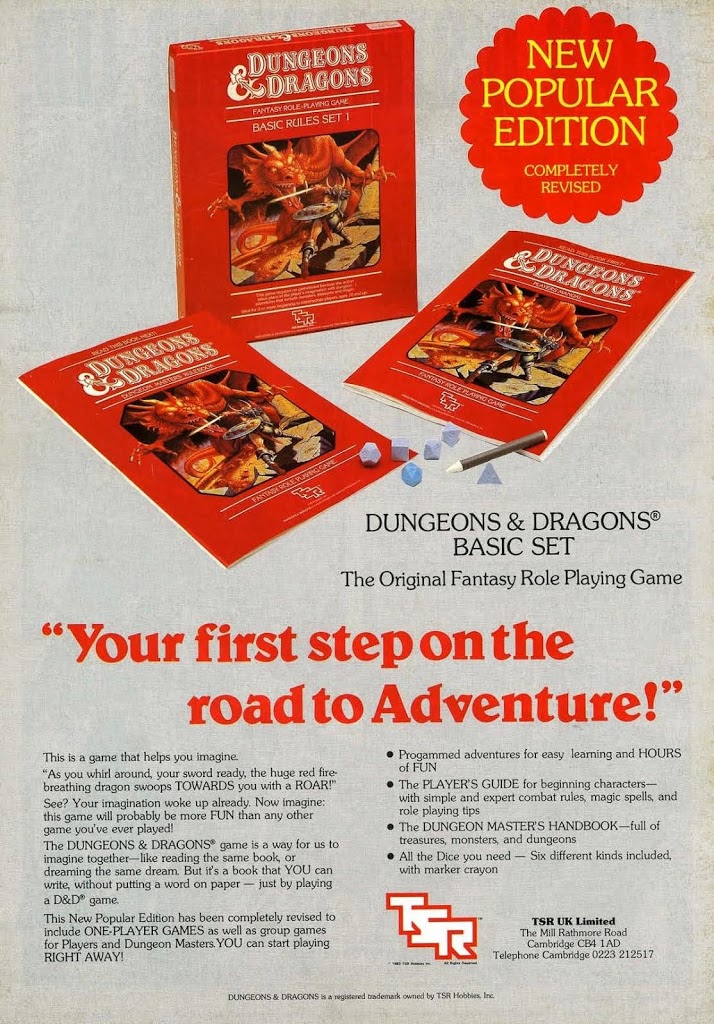
I was aware of Dungeons & Dragons long before I rolled a d20. As I mentioned in my “Proto-Years” post, the game was already seeping into my life through the LJN action figures and those iconic ads in the back of comic books. I would see the books and boxed sets sitting on the shelves at The Book Store in Old San Juan or at B. Dalton in the mall—forbidden tomes promising adventure.
My curiosity finally won out in 1985. I bought the Frank Mentzer Dungeons & Dragons Basic Set—the legendary Red Box.
I opened it up and devoured the solo adventure immediately. That part made perfect sense to me; it was just like the Choose Your Own Adventure or the Be an Interplanetary Spy books I loved, but with dice!
But then I turned the page to the rest of the book. The rules. The text. The procedures.
It made no sense.
You have to remember, this was a time before the internet. There were no “actual play” video series, no YouTube tutorials, no Reddit threads to ask for clarification. I didn’t know anyone who played D&D properly.
I did have a classmate who I used to see walking around the schoolyard with a group of friends. He would carry a notebook, reading from it while the others jumped over imaginary obstacles or walked along a line on the pavement. When I asked him what they were doing, he said, “Playing Dungeons & Dragons.”
I didn’t quite know how you played D&D, but looking at them, I thought: That doesn’t seem right.
I learned later that his older siblings played the game but wouldn’t let him join. So, he had done some espionage, taking notes from their books when they weren’t looking, interpreting what he could from overhearing their sessions, and making up his own rules based on the fragments he understood.
I had to find out the truth. I had to know how you really played. But after that initial attempt with the Red Box, I hit a wall. I didn’t understand the rules, and I didn’t have a party. So, the red box languished on my bookshelf, unused.
The Challenge Accepted
Fast forward to the summer of 1986.
A neighbor, one or two years my senior, came back from a friend’s house buzzing with energy. He had played D&D. He was fascinated by it. He wouldn’t stop talking about the adventure.
I blurted out, “I have that game! We should play it.”
“We definitely should,” he said.
I looked at him, relieved. “Since you’ve played it, you should run it for us.”
He hesitated. He admitted he wasn’t sure how to do that part. He looked at me and suggested that since I was the one who owned the box, I should be the Dungeon Master.
Never one to shy away from a challenge, I grinned. “Sure, let’s play tomorrow!”
The Long Night
I went back home, pulled the Red Box off the shelf, and started reading.
Panic set in immediately.
It made even less sense than before. I realized, with dawning horror, that I had to read the whole thing, learn to play the game, and run the game… by tomorrow morning.
I should have canceled. I should have asked for a few more days. But I didn’t.
I stayed up late, poring over the text, trying to decipher to-hit rolls and saving throws. Late into the night, I developed a splitting headache. I took some painkillers, rubbed my temples, and went to bed with my brain buzzing. I had learned as much as I could. I just hoped it was enough.
As an aside, looking back now, the Mentzer Red Box was a masterpiece of instructional design. It was steeped in the style of the day—callers, mappers, strict procedures—but it did a wonderful job of teaching that specific style of play. I ran my first session without ever seeing the game played, taught only by the words on the page.
The First Roll
The next day, we met at my house.
There were seven of us—neighbors and childhood friends—sitting around a table. We used my collection of LJN toys to keep track of the marching order. I opened the book, and we wandered into our first dungeon.
That was my first time Dungeon Mastering. It was chaos, it was messy, and it was magic.
The rest, as they say, is history.
Categories: Tabletop Gaming Blogs
OSR Sword & Sorcery Undead Encounter Tables with Rumors, Relics and Boss Monsters For Especially Castles & Crusades & Other Old School Games
In the tradition of Howard, Leiber, and Smith, undead in a Sword & Sorcery setting shouldn't just be "stat blocks"—they should be atmospheric, grotesque, and often tied to ancient, forgotten sins.Here is a D100 Random Encounter Table designed for grim, low-fantasy grit.D100 Sword & Sorcery Undead EncountersRollEncounter Description01-05The Salt-Caked Rowers: 2d6 skeletons of galley Needleshttp://www.blogger.com/profile/11243274667834930867noreply@blogger.com0
Categories: Tabletop Gaming Blogs
OSR Sword & Sorcery Ruins Treasure Table With Lingering Curses, Guardians and Encounter The Monolith Crawl For OSR rpgs Especially Castles & Crusades
In the world of Sword & Sorcery, treasure isn't just about "gold pieces." It’s about history, weight, and the lingering scent of ancient sorcery. Gold is heavy, cursed, or minted by kings long dead.Here is a D100 table designed for the grit of a monolithic ruin.The D100 Table of Ruins & RelicsRoll (D100)Item CategoryDescription01–20Currencies of the DeadStained silver dirhams, heavyNeedleshttp://www.blogger.com/profile/11243274667834930867noreply@blogger.com0
Categories: Tabletop Gaming Blogs
Wednesday Comics: Warlord (Omnibus) Wednesday

Though I've mentioned it before, I haven't talked about DC's Warlord by Mike Grell Omnibus Vol. 1 since it came out, which is kind of a lapse given how many years I spent blogging about Warlord here. This volume collects the character's debut in 1st Issue Special #8, issues #1-50 of the series, and material from Amazing World of DC Comics #12. Hopefully we'll get the rest of Grell's run and his follow-up series in a second volume.The first thing one notices about this omnibus is how much lighter it feels than most. Opening it, you can see why: it's on a different type of paper than most omnis. When it came out, there was a lot of discussion of it being "on newsprint" with some fans angry it wasn't on the glossy paper they were expecting, and others appreciating it being closer in appearance to the original issues. Well, it isn't on newsprint, but it is on a slightly off-white paper with a matte finish. I'm sure I've seen some trade paperbacks from DC on this sort of paper before.
Here's some images I snagged from reddit:

And here's a comparison with the interiors of an old issue. The omni is on the right:

Categories: Comic Book Blogs, Tabletop Gaming Blogs
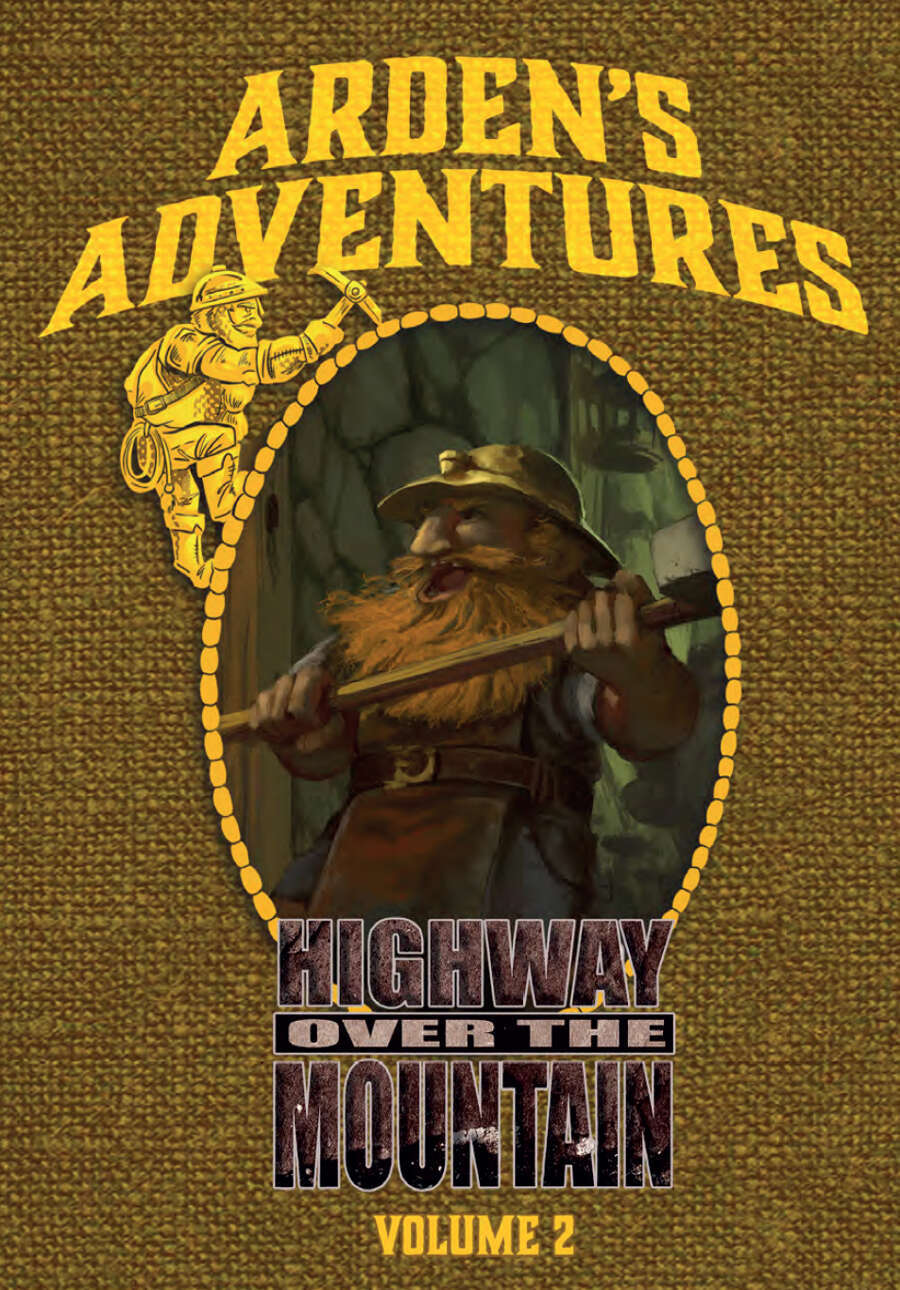
Highway over the Mountain
By Edwin Nagy
Parallel Dimension Gaming
OSE
Level 1
Parallel Dimension Gaming
OSE
Level 1
Construction camps along a new mountain pass are being destroyed, and danger awaits along every twist and turn. Can your heroes uncover the source of these deadly attacks?
This 33 page adventure details a little wilderness journey and a small thirteen room mine full of murderous dwarf miners. It’s fucking weird; it’s got the underpinnings of something decent, but never goes all in on it and pads everything out terribly. Lost potential, I guess.
Getting trade goods from Town A to Town C means taking the river through Town B, which is run by a tough, and probably corrupt, business family who controls a portage. So Prince Dipshit builds a road through the mountains directly to Town C, bypassing Town B. Groovy. Except the road construction camps got attacked. Since this is an important project he hires a bunch of no-names to go figure it out rather than sending the army. Well, to be fair, the party is supposed to present each of the towns guilds, which does seem chiller. Playing up the guild angle would have been nice, but as is you don’t get anything more than “they represent each of the towns major guilds.”
And that IS the major problem with this adventure; it hints at things but never goes there. The “evil town” doesn’t get much more than the fact they are shrewd and a maybe a little shady. The freedom fighters get that “they meet in the basement of the local pub and are all talk.” Clearly these things, covered in the thirteen page intro, are meant to provide some play opportunities, false paths, other various sorts of entanglements and fun. But they don’t show up again.
Instead you get to plod along a half-built road, with a work camp about a day apart, four in total. Here’s a sacked one. Here’s an abandoned one. Here’s one with three dudes in it. Focusing in on that last one, you have three guys patrolling camp. Nothing else. There’s a mention that they are charmed and that the party can roll to detect that they are. That’s it. Stats? No. Direction, like they attack, or challenge the party or something else? No. What do they know if they wake up? Nothing. In spite of this being about a column … of large type. What’s a boy in love supposed to do? “The horses are anxious to eat and drink not having been fed in a few days.” Ok. And the dudes? What about them. NOTHING. Absolutely Nothing. It absolutely boggles the mind how one could leave out something so trivial. And, there are lots of editors and producers and the like attached to this.
No one cares. Remember. No one cares. Your publisher does not care. If something decent pops out then thats great, but they do not gie a SHIT. Someone, somewhere, has to care about the adventure that’s about to get published. Sometimes we pay an editor to care. Rarely a small press publisher cares. And seldom does anyone else. If you pay them then they care. If they pay you then they do not care. Usually. Blech. I hate it when I’m not optimistic.
Somewhere along the road you’re gonna be the victim of a rockslide. Caused by a dude who triggers it. I guess the party sees him do it? The entire layout isn’t clear, there’s the road being constructed and a ravine and a dead-end and a mine entrance and none of it makes sense. In my own head I don’t know who you see the dude who triggers the rockslide (and then retreats in to the hidden mine entrance.) And, therefore, I don’t see how the party finds the hidden mine entrance. And this is important because this is where the actual adventure is. I’m open to being wrong here (Page 14 of the document/page 15 of the PDF) in that I’ve missed something or an not understanding something. But I don’t think so. So, good luck finding the actual adventure.
Inside the mine you’ll get a bunch of boring rooms that described in a boring way. “Crossroads This is the first area of worked stone, with passages leading in each cardinal direction.” Exciting! And then six lines of text telling us where each corridor goes. Joy. That’s the fucking map. That’s the purpose of the fucking map. I know some of you fuckwits like it when the text explicitly describes the room exits and where they lead, but I think we can all agree that when it SUBSTANTIALLY outnumbers the room description/text then we’ve lost site of the goal. Don’t do things by rote. Do them because they make sense in the situation you currently find yourself. Yes, there are guidelines, but don’t follow them off of a cliff.
Anyway, inside you find some dwarf miners. I guess this is a kind of illegal mining operation and they feel threatened by the road being constructed. I don’t think there’s really any way to tell this. You can see where a barge might come up one of the mine entrances and infer, I guess. But, also, the miners always come screaming out of the darkness and attack the party. That’s it. No playing dice or whatnot. They just come charging out of a hallway and attack. All … eight of them? In two encounters? Plus Lareth, of course, in charge of everything, with no foreshadowing or hint. Wasted potential everywhere, Lareth. Mom always knew you were gonna grow up to be a failure.
Not mentioned: the single encounter on the wandering table that only occurs once. About a messenger found dead on the road. Roll twice on the random message table to determine the contents of his message. Don’t fucking do this. That’s not how randomness is used in an adventure.
This is $5 at DriveThru. There is no preview. Joy. That seems to be a trend these days. We need a preview, a substantive preview that shows us some encounters, so we can make an informed decision on if to buy or not.
Categories: Tabletop Gaming Blogs
Adapting Steve Millers The Ghost of Hong Kong Into The Red Rooms New Flesh Rpg Campaign
Adapting Steve Miller's The Ghost of Hong Kong (Mae Ling Chen) into the New Flesh RPG (the Red Room's Burroughsian/Cronenbergian biopunk setting) creates a perfect synthesis of noir-assassin tropes and body-horror mechanics. This session picks right up from here on the blog. In this conversion, Mae Ling Chen—the "Ghost"—becomes more than just a stealthy assassin. She is a master of Needleshttp://www.blogger.com/profile/11243274667834930867noreply@blogger.com0
Categories: Tabletop Gaming Blogs
New Flesh Rpg Adventure - The Crimson Orchid Heist & Adapting The Cultclassic TV show T.H.E. Cat into our New Flesh campaign.
Fusing the 1960s suave "cat-burglar-turned-bodyguard" aesthetic of Thomas Hewitt Edward Cat with the visceral, biotech-heavy world of New Flesh is a brilliant move. You're taking a classic "gentleman rogue" and dropping him into a setting where "breaking and entering" might mean infiltrating a living, breathing databank.So I've been slowly adapting the suave and sophisticated cultclassic TVNeedleshttp://www.blogger.com/profile/11243274667834930867noreply@blogger.com0
Categories: Tabletop Gaming Blogs
D100 Stygian Relics & Treasures Table, Lair, Adventure, and Boss Monster From Conan's Era For An OSR Sword & Sorcery Campaigns Especially Castles & Crusades Rpg
Plunging into the depths of a Stygian vault or a sunless underworld requires loot that feels heavy with history, a bit dangerous, and distinctly "other." This blog post picks right up from D100 Random Dragon from Conan's era Hoard & Treasure Table, The Lair: The Maw of Ben Morgh, For An OSR Sword & Sorcery Campaign Especially Castles & Crusades RpgHere is a D100 Stygian Needleshttp://www.blogger.com/profile/11243274667834930867noreply@blogger.com0
Categories: Tabletop Gaming Blogs
Practice First: An Approach to Campaign and RPG Design
As I wrap up Into the Majestic Fantasy Realms, the Northern Marches, I am thinking ahead to my next major project, the full version of the Majestic Fantasy RPG.
While I still need to write the final manuscript, the rules themselves are written and have been playtested extensively. I started out with Swords & Wizardry by Matt Finch back in 2008 and adapted it to my Majestic Wilderlands setting. This involved adding a light skill system so players could have their characters be better at things other than combat and spellcasting, adding viz and other tweaks to the magic system to reflect how magic worked in my setting, tweaking the cleric class to reflect the diversity of religions, and so on.
The design process I used was iteration. Starting with Swords & Wizardry, informed by ongoing research into the origins of D&D, I added, tweaked, and modified the system until it took its current form. The final proof was always how it played at the table, measured against how I described the Majestic Wilderlands and what people actually did as their characters in past campaigns using other systems like GURPS or AD&D 1e.However, the point of the campaign was never just to play these rules. How I used these rules mattered. I have discussed sandbox campaigns many times, along with my own specific variant, which I call a Living World Sandbox. My living world sandbox approach started out as me finding it fun to let my players trash my setting back in the late 70s and early 80s. Over time, it developed as I tried to make trashing the setting both fun and an interesting challenge.
In time, I realized that what I was doing to make this happen was bringing the setting to life in a way that left the players feeling as if they had opened a door, stepped into my world, and pursued some interesting adventures of their choice. The setting endured, reacted, and changed as a result of what they did.
Again, my design process here involved iterating across many different groups and using many different systems. I also applied my Living World Sandbox techniques to other settings in other genres, including Middle-earth, the Third Imperium, the four-color world of superheroes, and so on. In each case, I weighed what happened at the table against whether it left the players feeling as if they were in the campaign's setting and had the freedom to pursue the adventures that interested them.
While doing this, I experienced other RPGs like Fate and Blades in the Dark that played very differently from my own campaigns and those of my friends. As I learned more about RPG history and encountered various ideas and theories about RPG design, I noticed that all RPGs shared certain practices, regardless of how they were implemented or the rules they used.
- At some point, the campaign's circumstances were described, including the characters involved.
- The characters' actions were described.
- Those actions were adjudicated.
- The outcomes of those actions were determined, and the campaign's setting was altered as a result.
- The session and the campaign involved repeating the above over and over again, in various orders and at various levels of detail.
What makes individual RPGs distinct from one another is how these shared practices are implemented, including the order in which they occur, not just what the rules say. The rules are only part of the equation. To understand how a campaign or system actually operates, you have to look at how the rules are used, how they are practiced, and what the group does at the table. This includes the order in which situations are described, actions are declared, and outcomes are resolved, as well as how adjudication is handled and who is responsible for making those decisions.
As I discuss RPGs, campaigns, and design going forward. I will start with practice and work outward from there.
Wrapping up this post, I want to give a shout-out to my friend Greg, known as the Chubby Funster, who also made a good video on this topic. In the video, he tackles the same issue from the angle of individual referees' "spheres of practice".
Categories: Tabletop Gaming Blogs
D100 Random Dragon from Conan's era Hoard & Treasure Table, The Lair: The Maw of Ben Morgh, For An OSR Sword & Sorcery Campaign Especially Castles & Crusades Rpg
In the Hyborian Age of Conan, a dragon's hoard is not just a pile of gold; it is a graveyard of lost civilizations, the plunder of fallen empires, and the grim trophies of a beast that may have lived since the days of Atlantis.Treasures in this era are heavy on ivory, jade, bronze, and blood-stained silk, rather than the high-magic items found in standard high fantasy. This blog post picks Needleshttp://www.blogger.com/profile/11243274667834930867noreply@blogger.com0
Categories: Tabletop Gaming Blogs
Mayhem in the Market
By Graeme Davis
Mondiversi
OSE
Levels 1-5

Mondiversi
OSE
Levels 1-5
Rudgen’s Square is a small open space in one of the more modest parts of a city. You can place it in any city or large town in your campaign. Named after a long-forgotten hero whose cracked and weathered statue – now headless – sits on a plinth atop a fountain at its center, the square sees a modest but constant stream of foot traffic, and a few small-time merchants have set up stalls around the edge selling all manner of goods
This 22 page adventure details about four hours in a street market as things happen around the party. It’s two pages of content, padded out, in a museum tour of an adventure. At least it ends with people shitting and puling their guts up in public while zombies attack. It just needed more of that.
Dude claims to be the inventor of the “multi-plot” adventure, for Warhammer, back in 87. I don’t know, it’s just a lot of things going on at once. Maybe. I take it for granted now, but, also, the concept of Romantic Love, right? In any event, our definitions of “a lot of plots going on at once” are a little different.
You are sent to the marketplace to find The Maltese Falcon, or whatever. Slimy junk merchant has it and he wanted like a bajillion million dollars for it. This is the first place the adventure breaks down, and maybe the most critical. Do they just stab the dude and leave? Do they steal it and leave? Or do they hang around for a minute? The entire adventure hinges on the party hanging around for a bit. If they do not hang around the marketplace then the adventure is not going to work. For it relies on, about every fifteen minutes, some kind of event happening in and around the party. There are a number of plotlines, seven or so I believe, and they unfold over the next four hours at about one event every fifteen minutes, related to one of the subplots. A dude smuggling himself out of the city as a poly’d horde. Food poisoning. A Romeo & Juliet lovers tryst. The dude that has the Maltese Falcon has sold a crime lords kid a love potion that actually turns him green. Maybe the answer to DO YOU KNOW WHO I AM?! Should be Yes if its the crime lords son and you’re a shady merchant?
Anyway, every fifteen minutes or so some observant person in the party, asking questions about whats going down, is going to be asked to make an intelligence check to get some kind of extra knowledge. I hope they succeed on the roll. A lot. Or else everyone is going to be quite bored tonight during the game.
The inherent concept here, of having a lot going on, is in fact correct. That should be the default for just about any adventure, and a town and/or social adventure adventure especially. There SHOULD be a lot going on at once. That gives the world a lived in feeling and creates a sense of urgency; you can’t deal with everyone at the same time, right? Faction play in a dungeon. The outdated mind map relationships I like for villages/social encounters. But the problem, gere, is one of passivity.
In a perfect world, for the party at least, you steal the Jade Skull and/or kill the slimy stallkeeper. And then leave the square. So don’t stick around. So nothing happens after you get the skull. That means that the action must take place between the initial bargaining dialog (“ONE BILLION DOLLARS!”) and the party putting in to motion their inevitable wacky scheme. And during that time they must succeed in a number of intelligence checks to see other trivia going on. And there scheme must take more than four hours to implement, all while they stand in the fucking square, so they can the rest of the plotlines develop. Oh, chick sitting by a statue alone. Dude comes up to her, her obvious lover. They approach the horse merchants. They go off together. Noblemen come in to the square looking for her. They leave. Couple comes back to hide ta the horse merchants. Etc. And this sort of thing unfolds for each of the plots.
So the entire concept here is for the party to NOT take action. You must be in the square to see whats going on. You must be there at the end for the shit/puke/zombie fest. You must succeed on your rolls to get the context of what is going on. There are these competing passive things going on. It is, obviously, putting interesting things behind skill checks. Don’t do that. Share interesting things. Don’t make the party beg and plead over the course of four hours in order to be able to get the hook from the king. You WANT the party on the adventure and them invested in it. Watching what happens with the check, understanding a bit of the situation and missing other parts, is what is going to make this a fun and zany side-quest that the party is invested in. And then they must stand around, taking four hours to implement their plan, in order to see any of it at all. You want the party invested, so don’t put that shit behind skill checks. And rework the adventure such that the timeline is greatly advanced or something else, in order to handle the “stab and grab”, or some derivation therein, of the party.
You know the deal, other than that how was the play? Meh. Some decent chaos at the end when people start shitting themselves and vomiting and a bomb goes off killing a bunch of people and then they reanimate and start Brains!’ing. That, alone, as the climax, perhaps deserves some set piece treatment instead of just another paragraph. The rest of the adventure is full of long timeline events that lean toward the prescriptive end of the spectrum as well as long descriptions of “The Stall of Martha Johnson.” And the bombing is pretty random. Some old woman drops off a bomb at the junk dealers, leaving her shopping bag, and then sprinkles poison on food at several food stalls. Which is weird. I thought it was just some kind of rando deus-ex thing, but there is another thread, one event in which a protection racket causes a mess at a food stall. So maybe its a protection thing? But blowing up a stall and killing a bunch of randos? I get that the bandits want revenge for a fake love potion, but, mass murder? That seems a tad excessive, even for an RPG?
Dude might be a fine DM. And he might have invented the “multi-plot adventure.” But this is not a good implementation, either in its form or function. Long backgrounds and trivia. Detailed events to dig through, a set piece end that is not a set piece. And an overall assumption about the length of the time in the market that is almost certainly not accurate. Yeah, we want to play the game tonight, but too much of that, or too blatant, breaks the illusion of agency.
This is $10 at DriveThru. There is no preview. Bad Publisher! No cookie for you! We need a substantive preview to determine if we want to buy it.
https://www.drivethrurpg.com/en/product/548756/mayhem-in-the-market?1892600
Categories: Tabletop Gaming Blogs
What is Known of the Mind Flayers

The malefic Outsiders of the astral void beyond the Earth are myriad in the Latter Age, but few are as distinct from the hosts of horrors as the beings known popularly as Mind Flayers. Though they are believed to be long extinct, they still feature promptly in folklore and popular entertainments, attesting to their hold over humankind's collective imagination.
Little is known for certain about these beings. In Denizens of the Beyond by Pseudo-Vespydron, the most widely known work to examine them in detail, Mind Flayers are said to have come from the sphere of Mars, but whether they are natives to that world or from some even more distant home, even Denizens rather credulous author does not say.
Pseudo-Vespydron uncritically accepts the cephalopod-headed humanoid appearance of popular portrayals and the idea that they were obligate consumers of human brains. The later (and comparatively more sober) histories of Malgrunda note no reliable descriptions of their physical form exist and put forward the theory that their purpose in preying upon the Earth was to acquire not foodstuffs but slave minds, derived from the destructive mapping of the brains of still-living captives. Perhaps the only place where she might be criticized in straying from established fact is in the time she devotes to Hseng's baseless assertion that the cephalopod skull is actually the memory of an environmental helmet with attached manipulators.
Categories: Comic Book Blogs, Tabletop Gaming Blogs
Actual OSR Christmas Reboot - Right Now!
.jpeg)
So, I'm finally free from the insane sinus headaches that went right into my upper jaw. Not fun. They lasted off and on for the better part of the past month. This year's flu is nothing to f' around with.
Well, it's time to clear the plate of OSR Christmas 2025.
As the failure lies in my hands, I'm doing the following:
I'm putting 10 $20 DTRPG Gift Certificates and 1 $50 DTRPG Gift Certificate into the gift pool.
The Emperors Choice Kickstarter Boxed Set is still in the mix.
I'll reach out to our other donors and find out who's still in.
All gifts will be awarded on January 31st, this coming Saturday @ 2 PM ET
If you have already emailed OSRChristmas@gmail.com, you are in the mix to be gifted.
If you HAVEN'T emailed yet, do so by NOON, January 31st, to get into the mix to be gifted.
Thank you for your patience - Tenkar
Categories: Tabletop Gaming Blogs
OSR Games Compatibility: Warriors & Barrows - Warriors of the Red Planet Rpg Combined With Barrows & Borderlands Rpg
Porting Warriors of the Red Planet (WotRP) into Barrows & Borderlands (B&B) is a fantastic idea because both games share a "Science-Fantasy/Gygaxian" heart. B&B is explicitly designed to be a bridge between 0E and 1E, while WotRP is a sleek 0E-based system.Here is the blueprint for porting the classes and mechanics effectively.1. The Four WotRP ClassesSince B&B uses a "Needleshttp://www.blogger.com/profile/11243274667834930867noreply@blogger.com0
Categories: Tabletop Gaming Blogs
TSR's module A1, Slave Pits of the Undercity
TSR module A1, Slave Pits of the Undercity, is the first and the most coherent of the Slavers modules: inventive and challenging while being the most sensibly drafted of these disorderly villain lairs.
The history of the series further emerges from a thread on Dragonsfoot remembering the specifics of the GenCon tournament that gave rise to the four A series modules. The temple and dungeon levels of A1 and A2 each were a single, linear adventure. Player groups in the first round were randomly assigned into one of these four qualifiers or a fifth one corresponding to the early section of A3. From these five, the best-scoring made it to the semifinal and final rounds, which respectively used versions of the later (city) part of A3, and all of A4.
From such a genesis we can trace the design of Slave Pits of the Undercity (and here, perforce, the spoilers begin). Helpfully for our archaeology, the module includes the original tournament railroad maps for the top and dungeon levels.
TEMPLE LEVEL
The tournament scenario gives the players inside information about a secret door in the wall of the temple. This door is trapped but not guarded - such is the security protocol of a disorderly fortress - and leads to a twisting corridor through an abandoned area of the building. The "railroad" takes the party past some well-set fights, and other situations that act like puzzles without seeming contrived, such as a deceptive plank over a pit, or a combat dilemma involving a new plant monster, the giant sundew, that becomes much easier if the party realizes how the fortress forces manage this menace in its midst. After this gauntlet, the party will run into the actual slaver forces, and these encounters are devised with the same art, combining trickery, interesting combat problems, and traps.
That's the end of the railroad; but even the tournament scenario has a couple of distractions and dead-ends. One of them, a roughly patched wall that if broken through leads to a face-to-face encounter with a basilisk, had the distinction of taking out a player-character in my own 5th edition campaign. And in the campaign version of the module, more areas are added branching from the tournament path - a stable guarded by slaver forces, a haunted cemetery and a garrison of terrified orcs, and a spacious courtyard, possibly a shortcut, but where more undead lurk. The reissue of the module in 1986 added a gate from this courtyard into the midst of the organized opposition area, further adding options for the attack.
This expansion allows different approaches to the temple complex. Jason Thompson's cartoon walkthrough of the module shows two of these: one party sneaking in through the tournament entrance, the other masquerading as slave-buying customers to go through the front door. Entering by the stables, by the graveyard orc door, or simply climbing the wall in an unguarded spot are also possibilities.
DUNGEON LEVEL
There are ways down from the temple, most obviously at the end of the final boss fight of the temple railroad; but the full module places two more descents to vary play in the dungeon level. This underground jams together four quite different areas: the eponymous slave pits, with slaves, slavers, and minions; a set of caves that hosts a tribe of orcs allied with the slavers; another set of caves that hosts a population of another new monster, the fearsome four-armed insectoid aspis folk; and a network of wet and filthy sewer passages that ties the whole place together.
The railroad version of the dungeon has the players first encountering some nasty larvae in the acidic spawning pool of the aspis; then crossing the sewer to muscle through a protracted fight with most of the orc tribe; then finally engaging the slavers, including some of their aspis allies, before confronting the slaver leader - who, it has to be said, is less formidable and treacherous than the final encounter of the temple.
The open version develops the aspis zone and has more connections to approach the bad guys. While the temple is infested with ghouls and a wight, the underground is only semi-unruly - these are groups cooperating with the slavers for now, but if a way can be found to communicate, faction bargaining in the classic big-dungeon style can happen.
BEST OF THE SERIES
My current party cleared out most of A1, using a conversion to 5th edition. Running it was a delight -- the combat challenges tough and packed with surprises, but not in a way that felt forced or unfair. The tricks and traps have a gritty, naturalistic feel to them, and the different areas of the complex are balanced between abandoned/haunted, main bad guys, and side factions. We see how the garrison of orcs, half-orcs, and evil humans deals with the unruly forces in their midst - finding a way to tame the sundew, cringing in fear from the haunted cemetery, hiring some of the aspis. This was also the deadliest module of my campaign, claiming two PCs. Probably, this is just due to incautious player mistakes snagging on two of 5th edition's few remaining teeth. One, doppelgangers have an absolutely deadly surprise attack if they can catch a party member alone; two, even with two saves, there is no easy answer to petrification until characters hit ninth level.
As we'll see in the pieces to come, the other A-series modules, in my opinion, are less deft at presenting an unruly stronghold: A2 is ambitious but strained, A3 a mess, and A4 returns to better form but famously hangs on a railroading premise that may not sit well with new-old-school values.
Categories: Tabletop Gaming Blogs
North West of Earth By C.L. Moore - Orbital Decay (MicroRed version) From The Red Room & The New Flesh Rpg - The "Alendar Contract" Encounter & The Shambleau
This d100 table blends the atmospheric, weird-pulp horror of C.L. Moore’s Northwest Smith stories with the industrial, desperate sci-fi of The Red Room’s Orbital Decay. This blog entry picks right up from here on the blog. In this setting, space is not a vacuum of physics, but a "cold void" inhabited by ancient, psychic vampires, forgotten gods, and the debris of a solar system Needleshttp://www.blogger.com/profile/11243274667834930867noreply@blogger.com0
Categories: Tabletop Gaming Blogs
Updating The Zothique Campaign For Castles & Crusades Rpg - Campaign Notes, Further Adventures, NPC's, Demons, Black Magick Trinkets, & The Lotus Eater PC class
To capture the essence of Clark Ashton Smith’s Zothique, we must lean into the "Dying Earth" aesthetic: a world where the sun is a dim, crimson ember, science has been forgotten in favor of necromancy, and the air is thick with the scent of lotus and decay.In Castles & Crusades, this means emphasizing High Sorcery and Horror, while making resources like light and sanity feel Needleshttp://www.blogger.com/profile/11243274667834930867noreply@blogger.com0
Categories: Tabletop Gaming Blogs
Druids of the Latter Age

Contrary to the popular entertainments of the Latter Age, there is no cohesive group known as the druids. Rather, there are individuals and networks of individuals across several cultures that adhere to similar beliefs and practices. Though the Instrumentality labels druidism as heretical "Earth-worshippers," these practitioners generally no more worship the Earth Mother than the Instrumentality itself does.
Like the clerics of the Instrumentality, those that might be termed druids are aware to one degree or another that in more lucent ages the environment of the Earth and its citizens interaction with it were managed by a great Mind. This Mind is no more, at least not in any unified form (so the clerics believe), but the many of the component minds still haunt the world, and the particles of its sensory apparatus of that superintelligence still weave through the winds, fall with the rains, and course through the bloodstreams of animals.
By means of secret lore and technology, the druids are able to converse and with the lesser minds that record and synthesize this sensory data. These processes are known as elementals. While the elementals occasionally form connections with more active systems on their own, the druid's involvement often bridges the two, giving the earth a voice to humankind that dwells upon it. Like the magi, druids are at times able to command the remnant nanotechnological systems, though how they achieve these powers is a closely guarded secret. Among their more impressive abilities, they can cause avatars to be instantiated from natural features for short periods of time or effect change in local weather patterns.
Unlike the Instrumentality, the druids do not believe that the Gaean mind is irrevocably destroyed. Instead, they view her as suffering from an illness, and illness from which they work to help her recover. They don't seek the re-ascendence of humankind, but rather the restoration of a balance they feel the Ancients achieved but then squandered.
Categories: Comic Book Blogs, Tabletop Gaming Blogs
My Current Two Favorite TTRPG Systems, Part 2: Savage Worlds
In Part 1, I talked about my love for Worlds Without Number and how it scratches that specific itch for fantasy d20 gaming. But what about everything else? What about pulp sci-fi, weird westerns, or space operas?
For everything that isn’t strict fantasy, my heart belongs to Savage Worlds.
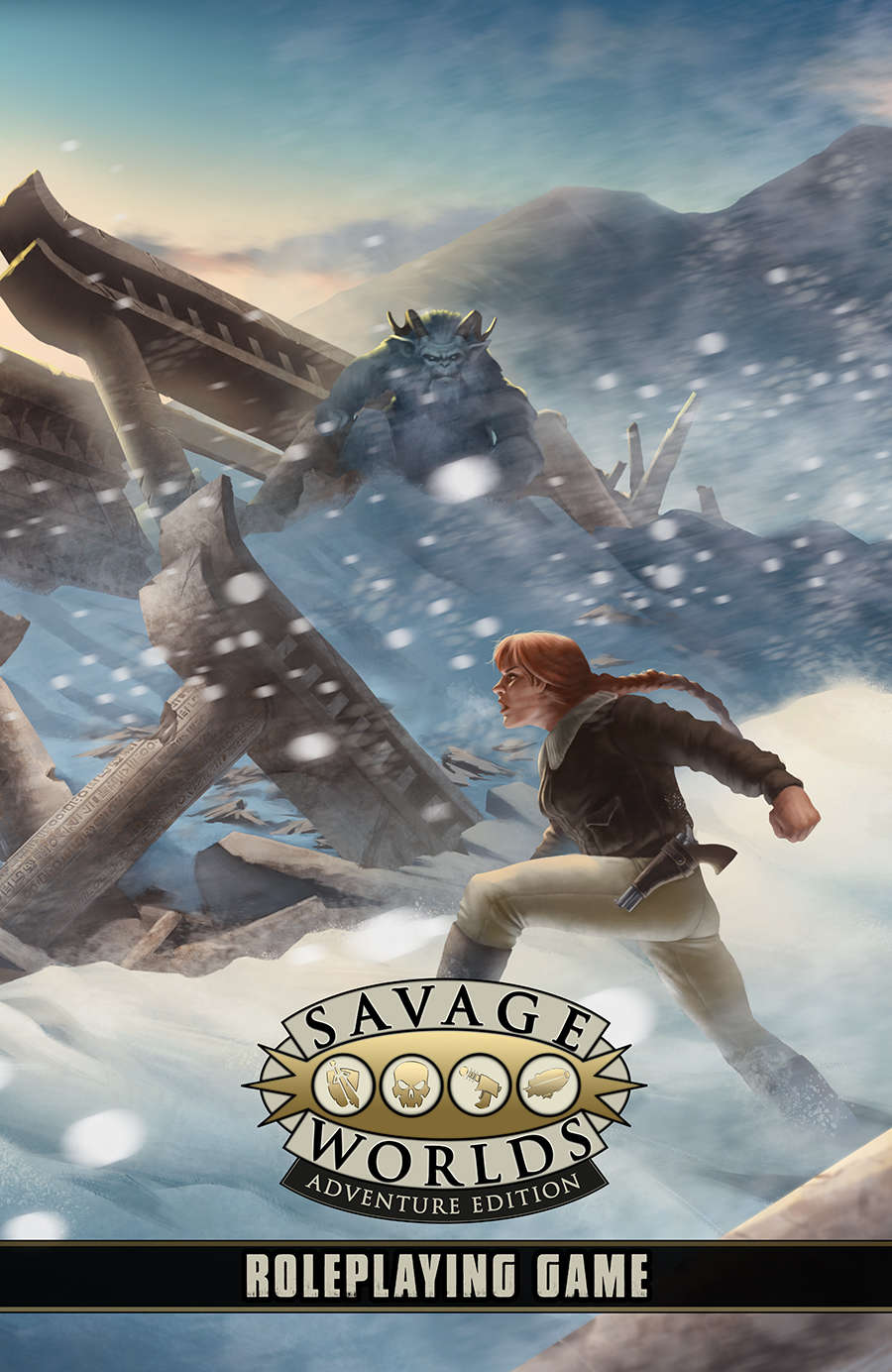
If you follow me on social media, it may not be a shock, but if you’ve been reading this blog for a long time, that might come as a surprise. I didn’t always love this system. In fact, if you dig into the archives, you’ll find a long-winded retrospective from 2012 where I detailed my struggle to “get” it. I eventually ran a sci-fi campaign, a nearly two-year-long Wanderers of the Outlands campaign, using it. It resulted in two follow-up posts (the 1st and 2nd post) in which I detailed what I liked and did not like about the experience, as well as the house rules I proposed back then.
I’ve always said that Savage Worlds is a system that plays better than it reads.
For me, it was actually crucial to play it to get the mechanics to click. Coming from a strong d20 background, the shift was jarring. Things like card-based initiative and wound levels (instead of hit points) felt alien. I remember struggling to understand the difference between “Shaken” and “Wounded” during those early attempts.
But once it clicked? It became second nature.
Savage Fading Suns
I am currently running a Fading Suns game using the Savage Worlds rules, my Savage Fading Suns conversion, and it has been incredibly successful. We have been playing for three years now.
The system is not “rules light,” on the contrary, it has all sorts of fiddly bits and options, but it is easy to understand. It provides a toolkit that lets the group make the game as complex or as streamlined as they want.
The current Adventure Edition (SWADE) is a vast improvement over previous editions. It does a fantastic job of making the system easier to parse and follow. I don’t use any of the house rules I proposed before! Even the conversion rules I put together for the Savage Fading Suns campaign seem overly wrought. Looking back, I added more than the system needed. Live and learn!
Why It Works for Me
The biggest plus for me is the narrative control it hands to the players. The use of Bennies—tokens that allow players to reroll dice or soak damage—changes the flow of the game. It makes players feel competent and heroic.
I also swear by the Adventure Cards produced by Pinnacle. They add a layer of chaotic fun and player agency that I absolutely love.
There are so many different campaigns, published by Pinnacle or other companies, and the game itself is easy to adapt to many settings and properties. When I get around to running my long-awaited (at least for me!) Torg campaign, I will use Savage Worlds.
Currently, I have the Without Number games for whenever I get that d20 fantasy itch, and Savage Worlds for literally everything else. I haven’t played with the current Fantasy Companion yet, so who knows? That distinction might blur in the future.
Addressing the Recent Controversy
I can’t write about Savage Worlds without addressing the reality of the recent controversy. I know the game’s creator made some unfortunate comments in the current fraught political climate in the US. While he has since apologized and attempted to make amends, I know that for some, that bridge is burned. I have friends in that camp, and I respect their decision to walk away from the system.
However, I also know other people who work on the game—folks I know personally who are well-meaning, talented, and kind. Because of them and the joy this system has brought to my table over the years, I’ve decided to continue supporting it cautiously for now.
It’s a personal choice, but one I wanted to be honest about.
Final Thoughts
If you are looking for a game that can handle pulp action, horror, and sci-fi with equal ease—and you’re willing to unlearn a few d20 habits—Savage Worlds is hard to beat. It might read a little strange at first, but trust me: get it to the table, deal the cards, and let the dice explode. You’ll see what I mean.
Useful Links:
- Savage Worlds Adventure Edition is $9.99 for the PDF at the time that this post is written.
- Test Drive Rules: Try the rules for free.
- Pinnacle Entertainment Group
Categories: Tabletop Gaming Blogs
Eastern Spark
By Greg Daley
Tarichan Games
1e
Level 1
Tarichan Games
1e
Level 1
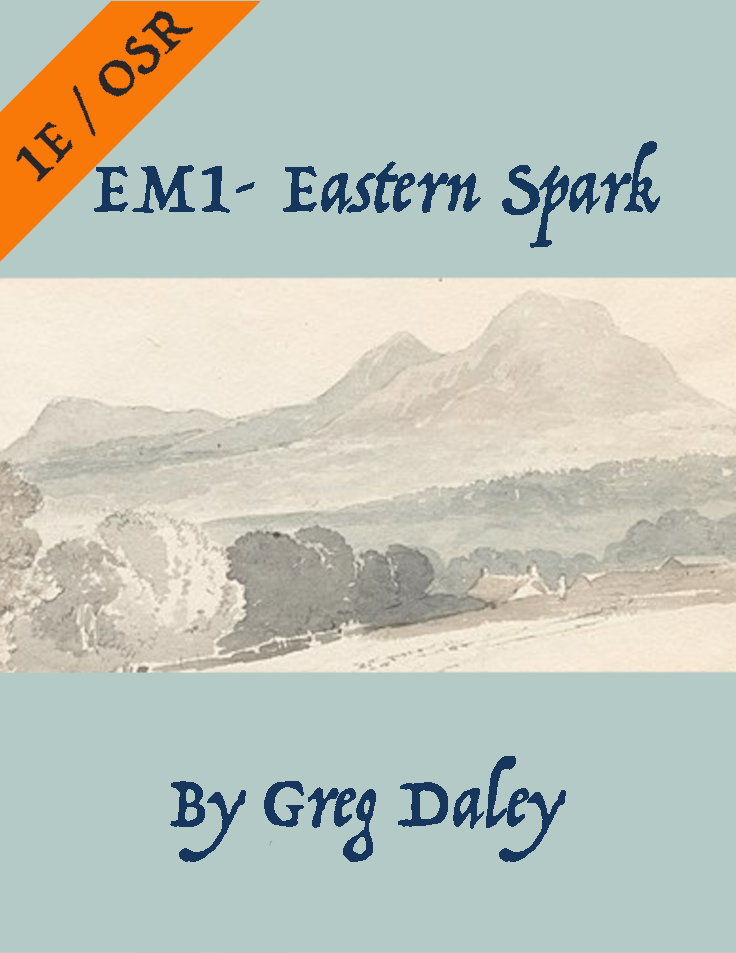
There’s work a-plenty at the edge of civilised lands. Can young adventurers help a local community and forge new ties? A village at the far end of civilisation offers our novice adventurers employment, and the chance of advancement. Do the scrub and plains beyond The March offer discovery, daring, or death? A shady offer of work at the hidden gnomish settlement of Opus beckons the adventurers into the wild. Can they truly fathom the danger that awaits?
This 41 page regional sandbox presents one of the more grounded and fun versions of a local starting setting. Each site has something short, a line or so, that is also memorable without being over the top. It is also clear that the designer has no idea how to present and format information. But interactivity, relatability, and specificity? It brings it without going over the top.
Man, this thing is great! There’s no wormhole monsters or saving the world or anything exotic or set piecey. I’m not even sure there’s a whole lot of treasure in it. But what there is a game world full of shit that you are just BEAMING to run as a DM. Glee, just glee. Or, maybe, scene after scene that builds to a great finale.
You’ve got the innkeepers perhaps making some inquiries, on the side, for “Thieves’ Guild financier Clarence Stoddard, staying upstairs.” There’s something interesting, the thieves guild financier. In a regional encounter, the party comes across a farm with a fence around it and a horse grazing in it’s pasture. You watch three men take down a fence railing and approach a horse. Hmmm. Then a middle aged woman comes running out of the house with a sword … horse thieves! Horse thieves in D&D?! Of course! Everything is taxed, labour allotted for, and someone out to steal it. I’m an idiot for not thinking of this. It’s obvious. And the three dudes on the road taking down a fence railing. The party is just going to stand there and watch. They won’t know. And almost certainly be just as stunned as I was. And stunning me in a D&D adventure is a rare event. Those witches that were harpies got me in that one adventure. And the horse thieves in this one got me. But it’s so natural. The designer TOLD you what was going on. It’s so natural. In one place you might go out with the fishermen to catch some fish. You ever go out fishing with the dregs of the earth? “Those who go out with the fishers may get into arguments with them. If there is an argument, the fisherfolk will turn violent.” This is fucking great! A surly fisherman, just drinking enough to be pissy, breaking the parties balls, starting fights, hazing them. OF COURSE the fishermen are a rough crowd. Duh! I love it! They may also make some conversation with the party. Asking about their lives, where they come from. “If they believe the no-one knows they are here, they may attempt to drown them.” Gah! “Yes, I am travelling along and no I have no friends or family at all and no one knows I am here and I am traveling with a large amount of expensive gear. Why do you ask?” This fucking shit is wonderful. A herald in the inn taproom announces news in a great way. It FEELS like a dude stopping by to spread the news.
There’s this whole element of some druids causing problems, with a lot of little quests and tasks that the party can perform, some that track with the thieves (pirates and shipwreckers!) and some with the druids and some isolated. Things end up with the party returning to the town/village and seeing dead bodies and animals attacking people! Packs of dogs! Wolves! More! Fucking Earth First druids man. D&D: if you have any alignment then you’re the problem. Anyway, shit kicks off in to high gear. At least in terms of the shit I love in an adventure. You gonna maybe meet three fellow adventurers kicking the shit out of some wolves. You geta bit about them and then “These adventurers are slick, amoral, and spend freely on alcohol and meals. If a player character hangs out with them, they may easily leave them with the bill for entertainment. Ser Christan is particularly well connected, coming from a prestigious family in Origee (the nearby civilised province)” You know the type. And here they are! How about the bar?! “Barkeeper Jasque and her husband cook Ferdo have closed up the inn, and even blocked the fireplace. Several villagers wait in the bar, drinking from boredom or tension.” Every apocalyptic movie ever has sullen people holding up in the bar. And here it is! “Nalia will crush on an adventurer who helps save them, but her affluent family will overrule and engage her to a titled, or landed bachelor” Fun! Hey man, the village school has kids hanging out of the windows hooting and jeering. Fuck those brats! How about the town well, eh? “The well of ancient stone has all four side basins full, but no-one is around, and this area is still. A sound rises from the well, like the skirl of bagpipes. A nightmarish, heaving, hairy carpet washes toward the characters.” Fuck yeah! Classic! These fucking things are short. Almost all of the good shit in this is. It reminds me of the very best of the hex encounters in Wilderlands. “Here is something greatI can build and riff off of. I can’t wait!” Except I think maybe this does that better than WIlderlands. The scale is smaller, and thus you can have perhaps some more interconnections and so on, which perhaps helps. It doesn’t drone on. It doesn’t skip the mechanics. It fucking hits hard and moves the fuck on, letting you riff. And it’s fucking great at it!
What it does NOT do well is almost everything related to actually publishing an adventure. Dude knows what makes a D&D adventure good and almost nothing at all about how to format one. It does have two column. But the words and tables spread across pages and columns in weird ways (Guy Fullerton has a series of articles about the most basic of layout issues: http://www.chaotichenchmen.com/2012/05/publishing-tips-introduction-and-order.html) There’s a kind of lack of summary of the situations going on, at least in a way that makes sense and a potential DM could follow. The formatting is such that the encounter areas are hard to pick out and had to tell when a new one begins. Following threads from A to B to C could be reinforced a bit. The chaos of the village attack needs a little summary of MAJOR things that could attract attention.
It’s fucking great is what the fuck it is. But, also, it has those ease of use/formatting and layout issues. I do fucking love the shit going on here. It’s perfect as a starting region. Get to know people. Shit goes down. This iis going to take some study and a highlighter, but it is packed with good stuff. If dude can figure out the mechanics of layout, editing, and publishing then their next could be really good.
This is $3.36 at DriveThru. The preview is three pages and shows you nothing with which you can make an informed purchasing decision with. Shitty preview.
https://www.drivethrurpg.com/en/product/549622/em1-eastern-spark-old-school?1892600
Categories: Tabletop Gaming Blogs
Pages
