
Your wildly multifarious home!
Feed aggregator
VAULT COMICS ANNOUNCES THAT NETFLIX WILL ADAPT HIT FANTASY SERIES, BARBARIC, AS NEW EPISODIC SERIES
Missoula, MT (05/13/2026) – Netflix has announced it will be adapting Vault’s hit fantasy series, Barbaric, as a new episodic series. “Barbaric has been the mainstay of fantasy comic books for…
The post VAULT COMICS ANNOUNCES THAT NETFLIX WILL ADAPT HIT FANTASY SERIES, BARBARIC, AS NEW EPISODIC SERIES appeared first on First Comics News.
Categories: Comic Book Blogs
NEW VOLUME OF ESSENTIALS PROVIDES THE PERFECT JUMPING-ON POINT FOR THIS POST-APOCALYPTIC SAGA.
A bold graphic novel series where Inception meets The Walking Dead from The Lab Press. LOS ANGELES, May 14, 2026 – Drawing comparisons to Inception and The Walking Dead, Essentials…
The post NEW VOLUME OF ESSENTIALS PROVIDES THE PERFECT JUMPING-ON POINT FOR THIS POST-APOCALYPTIC SAGA. appeared first on First Comics News.
Categories: Comic Book Blogs
Generate Influencer-Style Content from Photos Without Filming Using AI Tools
Generate Influencer-Style Content from Photos Without Filming Using AI Tools The influence of influencers extends far beyond beauty tutorials, outfit transformations, and product recommendations – influencer content covers every corner…
The post Generate Influencer-Style Content from Photos Without Filming Using AI Tools appeared first on First Comics News.
Categories: Comic Book Blogs
Video of the Day – Reel Film Productions, 2026
The post Video of the Day – Reel Film Productions, 2026 appeared first on Blogtor Who.
Categories: Doctor Who Feeds
Indie Comics Community Erupts After Adult-Themed Kickstarter Campaigns Face Mid-Campaign Shutdowns
The independent comics industry is facing one of its most heated controversies in recent years after multiple adult-themed crowdfunding campaigns on Kickstarter were reportedly suspended, rejected, or flagged during active…
The post Indie Comics Community Erupts After Adult-Themed Kickstarter Campaigns Face Mid-Campaign Shutdowns appeared first on First Comics News.
Categories: Comic Book Blogs
Two D100 Random Sword & Sorcery Underdark & Underground Encounters Table For Castles & Crusades Campaigns
This d100 table is designed for the high-adventure, "siege engine" style of Castles & Crusades, blending classic dungeon crawling with the eerie, atmospheric tension of the deep earth. This blog post continues from Two D100 Sword & Sorcery sewer & dungeon encounter tables For Castles & Crusades CampaignsUnderdark & Underground Encounters (d100)d100EncounterDetails /Needleshttp://www.blogger.com/profile/11243274667834930867noreply@blogger.com0
Categories: Tabletop Gaming Blogs
BEAST CONFRONTS HIS DARK DESTINY, MAGNETO HOLDS THE KEY TO THE X-VIRUS AND MORE AS X-MEN #35 AND #36 SET THE STAGE FOR DNX!
This August, X-MEN #35-36 by Jed MacKay, Tony S. Daniel and Netho Diaz serve as pivotal prologue issues for DNX, the upcoming X-MEN and FANTASTIC FOUR event launching this September.…
The post BEAST CONFRONTS HIS DARK DESTINY, MAGNETO HOLDS THE KEY TO THE X-VIRUS AND MORE AS X-MEN #35 AND #36 SET THE STAGE FOR DNX! appeared first on First Comics News.
Categories: Comic Book Blogs
OSR Review & Commentary On The Crusader Journal #28 For Siege Rpg System, Castles & Crusades and OSR Games
The Crusader Journal #28 marks the significant revival of Troll Lord Games' flagship magazine after a decade-long hiatus. Released in 2025, it serves as both a "journal of intrepid adventure" and a bridge between the classic era of the publication and the modern OSR (Old School Renaissance) scene.
Categories: Tabletop Gaming Blogs
DC Announces Next Level: One Shot #1
Gerry Duggan and Fernando Blanco Take Deadshot to the Next Level in a New 48‑Page Special This August To Come Out on Top, Deadshot Only Needs One Shot. DC today…
The post DC Announces Next Level: One Shot #1 appeared first on First Comics News.
Categories: Comic Book Blogs
Arcton: From Ingala to the Wastes Crowdfunding
Do you remember my interview with Eliana Falcón-Dvorsky a few weeks ago? She is officially crowdfunding the project we discussed, Arcton: From Ingala to the Wastes, over on BackerKit!
Here is the description of the setting directly from the campaign page:
What is Arcton?

“An uncontested and insurgent undead army laid waste to the frozen nation of Arcton centuries prior. Now, 8 oligarchical Liches oversee their respective regions, sending their Officers to craft their undead labor force out of their own living citizens. These powerful and arrogant entities consume and destroy the land that once held a vast resource of wild and unpredictable magic.
However, the story is not truly about them. Arcton is a vast and distinct nation with various cultures, people, customs, and beliefs that remained isolated from region to region. This is the story of the details, the inhabitants, and the dangerous, but beautiful, land, as complicated and nuanced as it can all be. But most importantly, this story is about you.”
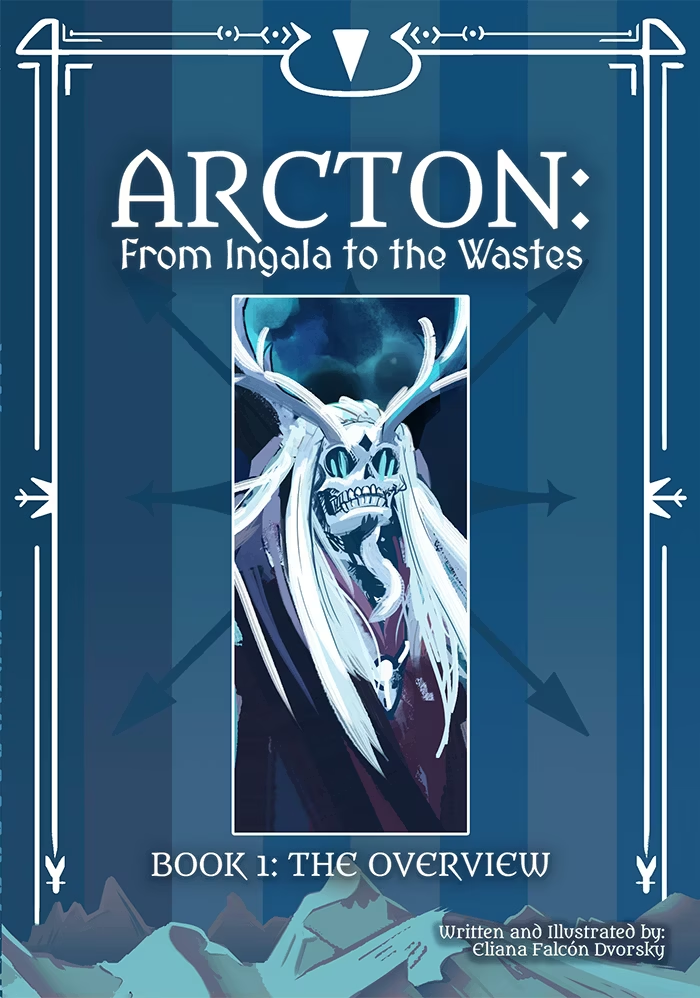
Eliana is an active member of the Puerto Rico TTRPG community and an absolutely amazing creator. The project is already fully funded, which is fantastic! I am proudly a backer, and if this setting interests you, I highly invite you to check it out and support it if you can.
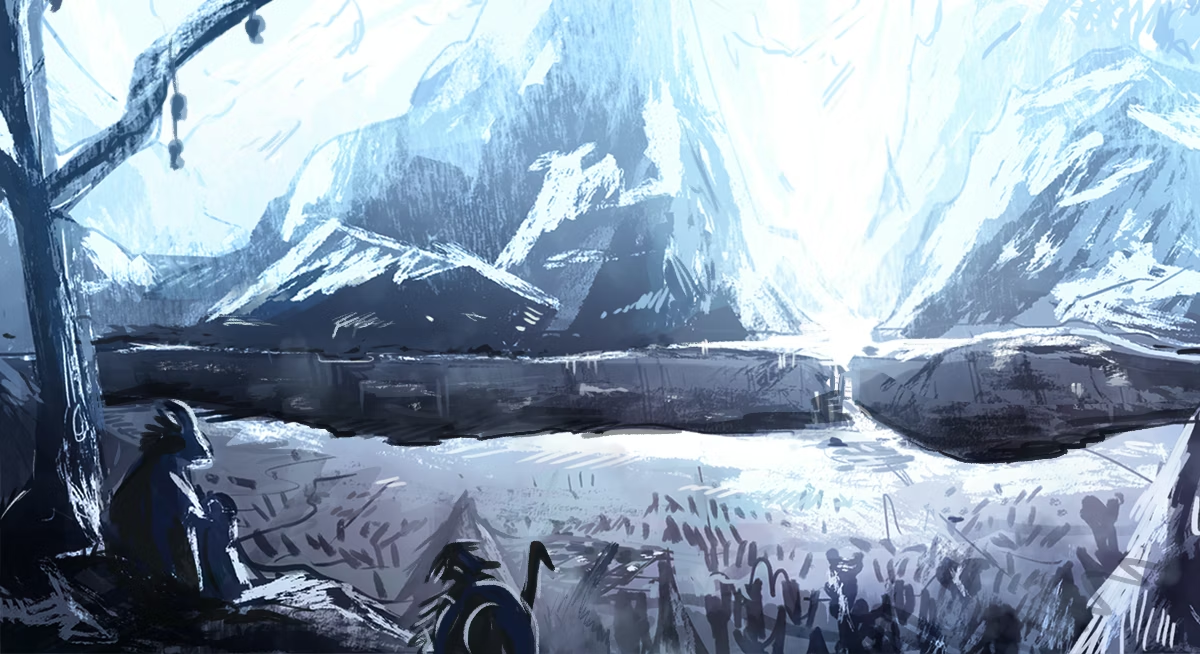
I wish Eliana continued success with this amazing project!
Project link: https://www.backerkit.com/c/projects/cosmographia/arcton-from-ingala-to-the-wastes-books-1-and-supplements
Categories: Tabletop Gaming Blogs
Crochet and Catch Up with Moogly - May 13, 2026
I'm back in the basement, and that means it's time for Crochet and Catch Up with Moogly! I've spent a week and a half at a fiber fest and trade show, and I've got some fun new things to share! Join me for a relaxed crochet chat and behind-the-scenes peeks. Join in live, or watch […]
The post Crochet and Catch Up with Moogly - May 13, 2026 appeared first on moogly. Please visit www.mooglyblog.com for this post.
0
Categories: Crochet Life
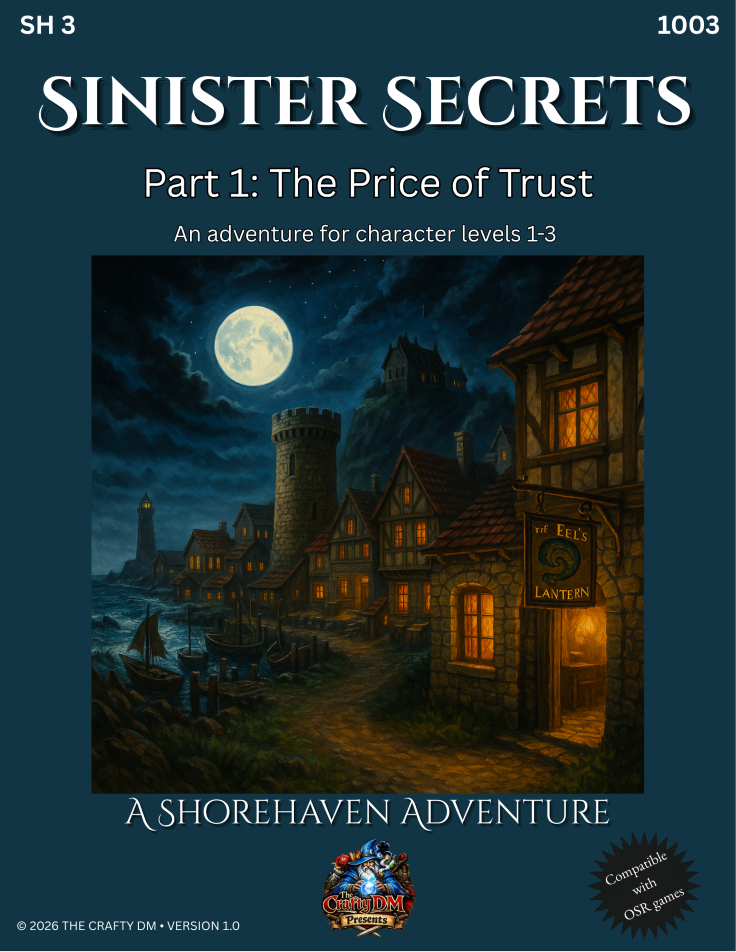
The Price of Trust
By The Crafty DM
Self Published
OSR
Levels 1-3
Self Published
OSR
Levels 1-3
Arriving with little coin and no reputation, the player characters must earn their place through action, not titles. The town is wary, its people practical, and its problems real. Strange signs gather along the docks, the nearby wilds grow unstable, and something stirs beneath the waterline. Through investigation, negotiation, and hard-earned victories, the party builds trust with the townsfolk while uncovering the first threads of a larger danger.
This 39 page adventure presents three mostly scripted fights mini-quests in a small fishing town. They follow a pretty rigid outline with some kabuki of interactivity that amount to monologue, fight, monologue. It seems to have some U-series overtones.
We’re not starting out strong with this one. The pretext here is that the party is new to town and they have to do a bunch of mini-quests to gain the town’s trust. Then, in another module in the series the town will trust them enough to give them an actual task.This strikes me as aking to the asshole quest-giver tropes who treats the party like shit and still expects them to run errands. The implicit assumption is that you can treat the PC’s like shit and that they have no free will. Yes, we all want to play D&D tonight but how many hoops do we need to jump through before they just go somewhere else to seek their fortune? The party has free will. This is followed up with bythe designer with a comments “Not all of these quests are presented with full detail in this module. This is intentional, allowing you to tailor certain tasks to the personalities, abilities, and backstories of your players.” I see this sometimes in adventures. This is inevitably NOT a sealed off passage for the DM to expand upon. It is instead getting ahead of criticism by saying the flaws exist on purpose. The whole It;s Up To The DM To Bring Life To The Game thing. Which, while true, ignores the central tenant of adventure writing for others: you’re supposed to be helping the DM out. Leaving a sealed off passage is great. Flaws in execution are not.
You’re in town, arriving in a bar in the opening read-aloud. What follows is a series of mini-quests that all follow the same outline. Some comes up to you to ask you to do something. You talk to them. You go to a location and maybe roll some dice in a performative way to “investigate.” You get in a fight. You talk to the person who gave you the quest. I know, this sounds kind of like the platonic outline of a quest, but, the difference is that this is three scenes. Someone runs to get you. You talk to a fisherman and look at a body and talk to an old lady. You might roll some dice to look at a body. You go back to the docks at night (I hope …) and get in a fight. You talk to more people the next morning and are told you did a good job. You talk to someone about a druid. You go looking and fight some woodland beasts in three waves. You talk to the druid and do the performative thing. It’s all a really simple pattern here.
There is nothing really to fail, except I guess the combat. If you don’t do the thing you are railroaded in to then you’re instructed to modify the end monologue but to keep the arc going. On the docs, the Sea Devils you fight are looking for the body you examined, and that get stolen no matter what you do. I guess if you have it strapped to your chest and chained to you it still gets stolen?
It’s just so … obvious? Low effort? Read a bunch of text. Lots of read-aloud and lots of italics. Everything just follows along the “plot” without any deviation, no matter your actions. Your actions and die rolls don’t really matter. What’s the point of this?
It’s just a railroad of an adventure with a VERY simple outline of a pattern that repeats. I mean, again, I get it. We;re playing D&D tonight. But the meaninglessness of it all. Rolling dice for no reason. No pretext of choice at all. Yes, the DM can fill in and bring it to life. But you have to give them something to work with.
A haunted house on a hill. Sea Devils Lizardmen, The house in this is red herring, not even really covered. The lizardmen are friendly. But it’s the same elements as the U series. It’s fine, I guess. You get to reimagine and respin the classics. Well, if done right. And this isn’t done right. Perhaps the platonic example of a low-effort adventure that one might throw together on the back of a napkin in three minutes before the game starts?
There is no price of trust in the adventure. And I’m not sure I’d come back for anothe rgame if this were the campaign kickoff.
This is $3 at DriveThru. There is no preview. There is an annoying youtube promo.
https://www.drivethrurpg.com/en/product/563326/sinister-secrets-the-price-of-trust?1892600
Categories: Tabletop Gaming Blogs
Wednesday Comics: DC, August 1985 (week 3)
I'm reading DC Comics' output from January 1980 (cover date) to Crisis! This week, I'm looking at comics that were published on May 16, 1985.
Batman #386: This was the subject of the last recorded but to date unreleased episode of The Bronze Age Book Club and an episode I am fond of. Moench and Mandrake set out to create a new major Batman villain, and they are more successful here than Moench's attempt with Nocturna and Night-Slayer at least to the extent that Black Mask continues to appear and has even been in a movie.
We're introduced to Roman Sionis scion of a wealthy family and subject of childhood trauma in parallel to Bruce Wayne. After his company releases a poorly tested cosmetic that has horrible potential side effects, Sionis is ruined and snaps, becoming the masked crime boss Black Mask and contesting with Batman as the head of the False Face Society of Gotham. Black Mask uses his toxic cosmetic to kill his enemies, and Bruce Wayne is his next target.
Jemm, Son of Saturn #12: Potter and Colan/MacLeod bring the series to an end, if not a definitive one. The Red Saturnians storm the one remaining ship of the White Saturnians and Synn, grieving the death of her lover, distractedly agrees to end hostilities, but in no way indicates a willingness to make peace with Jemm. In fact, Jemm's own people are still ambivalent about his actions. He flies to Earth to save Luther from the Kamah, the last belligerent Koolar. His fight with her is sort of perfunctory, but its decisive. Meanwhile, Lincoln and Crazy Eddie find Bouncer still alive in the rubble. They offer him to come with them to find a place to live and he agrees. They reunite with Luther along the way, but not before the boy and his alien friend say their goodbyes. Jemm returns to his people even if they are not yet ready to embrace him.
Amethyst #8: I have this issue, but I didn't remember anything about its contents. Mishkin/Cohn and new artistic team Jurgens/Kesel (though we're told Colon will return to the title he co-created next issue) finish the Fire Jade arc. After her identity is revealed to Princess Emerald, Fire Jade attacks, but Prince Garnet appeals to her, and she hesitates, allowing Amethyst to take out the demonic creature commanding her. Then, what's left of Lady Emerald in Fire Jade, sacrifices herself to stop the grim reaper from taking Citrina. It's doesn't have the old woman, but it does give her enough time to pass on custody of Gemworld to Amethyst before dying.
Meanwhile, Prince Topaz and Lady Sapphire are caught in a storm and seek refuge in an isolated city which is under the leadership of White Opal, brother to evil overlord.
Arak Son of Thunder #47: Arak and friends are in a harbor in China and Arak is unsettled by all the dragonboats given the beef he's got with the Serpent. Seemingly confirming his suspicion, a real dragon attacks some ships and Arak dives in to save a woman, but Arak himself is knocked out. He's rescued by his old ally Haakon who is in China possessing as a Byzantine ambassador as part of a scheme. After all that, Valda and Arak get some time alone, but then Mu-Lan attacks, and it isn't the Disney version!
Flash #348: After seeing the footage Frye recorded, the Flash believes Reverse Flash is back. He tells Cecile, who starts an investigation of her own. Meanwhile, Reverse Flash keeps taking down the Rogues, and some in the police force wonder if the Flash is responsible.
While all this is going on, the jury in the Flash's trial deliberates. They are deadlocked until Nathan Newbury steps in. Contrary to my expectations, he actually seems to be trying to help the Flash. He uses a device to show the jury what really happened: that the Flash is Barry Allen and so had a good motive reason to murder use lethal force to stop Reverse Flash. They jury members are all going to vote for acquittal, but then Reverse Flash appears in the strange realm Newberry has taken them to and somehow possesses him. He then uses Newberry's power to make the jury vote unanimously "guilty."
Legion of Super-Heroes #12: Levitz and Lightle/Mahlstedt send Timber Wolf and Karate Kid's Sensei to Lythyl, a planet like a combination of a deadly martial arts tournament and a bondage club, to fulfill a request from their dead friend. Things get bad enough that some other Legionnaires have to come to the rescue, but they managed to rescue a boy named Myg.
Omega Men #29: Klein and McManus/Mitchell continue the Omegans' trying to get out of the Psions' research station. Their benefactor, the mysterious Artin, through robot minions requires them to complete a task on their way out. The Omega Men penetrate the Psion temple of the Four Questions with Kalista projecting an image of the Psion leader Malthus. In the end, the identity of Artin is revealed, and its Primus, only he doesn't look like the Primus we've known.
Red Tornado #2: Busiek and Infantino/McLaughlin continue on from last issue in pretty much the same mode. The Construct gloats while civilians reject Tornado even as it helps them, and Superman shows up to enforce that the JLA meant their prohibition of Tornado's heroics by tearing the android limb from limb. He self-repairs but in the end he's had enough and says he's never going to help humans again. The Construct takes control of electronic devices across the globe. T.O. Morrow figures out the Construct is behind all this and begins formulating a plan to fight back.
Star Trek #16: We get a new writer this issue, L.B. Kellogg, with a same artistic team. This story is less like a TOS episode and more like something we would have gotten in a later series. Sulu, Uhura, and Bryce go on an undercover mission in a capture ship to make contact with a dilithium smuggler on a space station who happens to be an old flame of Uhura's. Meanwhile, Kirk and the Excelsior discover the mining is being done by slave labor. Uhura and Sulu take down her old lover, putting an end to slave trading and illegal mining, and Kirk promises to relocate the aquatic native species whose environment has become untenable.
Superman #410: Bates and Swan/Williamson give us another one of those action-free puzzle stories so common to Superman comics in the era. Superman stops a satellite falling toward Hawaii by kicking it into a volcano, but after Clark Kent writes the story evidence goes forward that it didn't happen, and Clark's fired in disgrace after (as Superman) he's forced deny being the source of the story to keep Earth's trust in Superman. It's all a hoax contrived by Lex Luthor in a plot to take down Superman, but how it plays out we'll have to see next issue.

Batman #386: This was the subject of the last recorded but to date unreleased episode of The Bronze Age Book Club and an episode I am fond of. Moench and Mandrake set out to create a new major Batman villain, and they are more successful here than Moench's attempt with Nocturna and Night-Slayer at least to the extent that Black Mask continues to appear and has even been in a movie.
We're introduced to Roman Sionis scion of a wealthy family and subject of childhood trauma in parallel to Bruce Wayne. After his company releases a poorly tested cosmetic that has horrible potential side effects, Sionis is ruined and snaps, becoming the masked crime boss Black Mask and contesting with Batman as the head of the False Face Society of Gotham. Black Mask uses his toxic cosmetic to kill his enemies, and Bruce Wayne is his next target.

Jemm, Son of Saturn #12: Potter and Colan/MacLeod bring the series to an end, if not a definitive one. The Red Saturnians storm the one remaining ship of the White Saturnians and Synn, grieving the death of her lover, distractedly agrees to end hostilities, but in no way indicates a willingness to make peace with Jemm. In fact, Jemm's own people are still ambivalent about his actions. He flies to Earth to save Luther from the Kamah, the last belligerent Koolar. His fight with her is sort of perfunctory, but its decisive. Meanwhile, Lincoln and Crazy Eddie find Bouncer still alive in the rubble. They offer him to come with them to find a place to live and he agrees. They reunite with Luther along the way, but not before the boy and his alien friend say their goodbyes. Jemm returns to his people even if they are not yet ready to embrace him.

Amethyst #8: I have this issue, but I didn't remember anything about its contents. Mishkin/Cohn and new artistic team Jurgens/Kesel (though we're told Colon will return to the title he co-created next issue) finish the Fire Jade arc. After her identity is revealed to Princess Emerald, Fire Jade attacks, but Prince Garnet appeals to her, and she hesitates, allowing Amethyst to take out the demonic creature commanding her. Then, what's left of Lady Emerald in Fire Jade, sacrifices herself to stop the grim reaper from taking Citrina. It's doesn't have the old woman, but it does give her enough time to pass on custody of Gemworld to Amethyst before dying.
Meanwhile, Prince Topaz and Lady Sapphire are caught in a storm and seek refuge in an isolated city which is under the leadership of White Opal, brother to evil overlord.

Arak Son of Thunder #47: Arak and friends are in a harbor in China and Arak is unsettled by all the dragonboats given the beef he's got with the Serpent. Seemingly confirming his suspicion, a real dragon attacks some ships and Arak dives in to save a woman, but Arak himself is knocked out. He's rescued by his old ally Haakon who is in China possessing as a Byzantine ambassador as part of a scheme. After all that, Valda and Arak get some time alone, but then Mu-Lan attacks, and it isn't the Disney version!

Flash #348: After seeing the footage Frye recorded, the Flash believes Reverse Flash is back. He tells Cecile, who starts an investigation of her own. Meanwhile, Reverse Flash keeps taking down the Rogues, and some in the police force wonder if the Flash is responsible.
While all this is going on, the jury in the Flash's trial deliberates. They are deadlocked until Nathan Newbury steps in. Contrary to my expectations, he actually seems to be trying to help the Flash. He uses a device to show the jury what really happened: that the Flash is Barry Allen and so had a good motive reason to murder use lethal force to stop Reverse Flash. They jury members are all going to vote for acquittal, but then Reverse Flash appears in the strange realm Newberry has taken them to and somehow possesses him. He then uses Newberry's power to make the jury vote unanimously "guilty."

Legion of Super-Heroes #12: Levitz and Lightle/Mahlstedt send Timber Wolf and Karate Kid's Sensei to Lythyl, a planet like a combination of a deadly martial arts tournament and a bondage club, to fulfill a request from their dead friend. Things get bad enough that some other Legionnaires have to come to the rescue, but they managed to rescue a boy named Myg.

Omega Men #29: Klein and McManus/Mitchell continue the Omegans' trying to get out of the Psions' research station. Their benefactor, the mysterious Artin, through robot minions requires them to complete a task on their way out. The Omega Men penetrate the Psion temple of the Four Questions with Kalista projecting an image of the Psion leader Malthus. In the end, the identity of Artin is revealed, and its Primus, only he doesn't look like the Primus we've known.

Red Tornado #2: Busiek and Infantino/McLaughlin continue on from last issue in pretty much the same mode. The Construct gloats while civilians reject Tornado even as it helps them, and Superman shows up to enforce that the JLA meant their prohibition of Tornado's heroics by tearing the android limb from limb. He self-repairs but in the end he's had enough and says he's never going to help humans again. The Construct takes control of electronic devices across the globe. T.O. Morrow figures out the Construct is behind all this and begins formulating a plan to fight back.

Star Trek #16: We get a new writer this issue, L.B. Kellogg, with a same artistic team. This story is less like a TOS episode and more like something we would have gotten in a later series. Sulu, Uhura, and Bryce go on an undercover mission in a capture ship to make contact with a dilithium smuggler on a space station who happens to be an old flame of Uhura's. Meanwhile, Kirk and the Excelsior discover the mining is being done by slave labor. Uhura and Sulu take down her old lover, putting an end to slave trading and illegal mining, and Kirk promises to relocate the aquatic native species whose environment has become untenable.

Superman #410: Bates and Swan/Williamson give us another one of those action-free puzzle stories so common to Superman comics in the era. Superman stops a satellite falling toward Hawaii by kicking it into a volcano, but after Clark Kent writes the story evidence goes forward that it didn't happen, and Clark's fired in disgrace after (as Superman) he's forced deny being the source of the story to keep Earth's trust in Superman. It's all a hoax contrived by Lex Luthor in a plot to take down Superman, but how it plays out we'll have to see next issue.
Categories: Comic Book Blogs, Tabletop Gaming Blogs
Video of the Day – Doctor Who: The Talons of Weng-Chiang, 1977
The post Video of the Day – Doctor Who: The Talons of Weng-Chiang, 1977 appeared first on Blogtor Who.
Categories: Doctor Who Feeds
OSR Commentary & Review The Book of Valkyries, published by Night Owl Workshop For Old School Campaign
The Book of Valkyries, published by Night Owl Workshop (authored and illustrated by Thomas Denmark), is a 108-page supplement designed for the Original Fantasy RPG and compatible with a wide range of OSR systems.Released in late March 2026, it serves as a companion to Denmark’s previous work, Norse Beasties, providing deep lore and mechanical integration for the demigoddesses of the Norse Needleshttp://www.blogger.com/profile/11243274667834930867noreply@blogger.com0
Categories: Tabletop Gaming Blogs
The New Crochet Stitch Dictionary - Spiral Bound Review and Giveaway
The New Crochet Stitch Dictionary by Nele Braas and Eveline Hetty-Burkart features "440 Patterns for Textures, Shells, Bobbles, Lace, Cables, Chevrons, Edgings, Granny Squares, and More." While this book has been out for a few years, today we're celebrating a new edition - Spiral Bound! Take a peek inside below, and then enter to win […]
The post The New Crochet Stitch Dictionary - Spiral Bound Review and Giveaway appeared first on moogly. Please visit www.mooglyblog.com for this post.
1
Categories: Crochet Life
Video of the Day – The Tracks Of My Years, 2026
The post Video of the Day – The Tracks Of My Years, 2026 appeared first on Blogtor Who.
Categories: Doctor Who Feeds
REVIEW: Doctor Who: Helter Skelter
Scream if you want to go faster, as Helter Skelter brings you on a thrilling ride of twisted horror and fun
The latest set of Fifth Doctor Adventures arrives under the collective title Helter Skelter. It’s a slightly misleading name for a couple of reasons. Most obviously, it names the entire set after James Moran’s middle story despite it being the odd man out. That’s a fun and fast adventure sandwiched between two scripts by Big Finish’s resident king and queen of chills and thrills, Lauren Mooney and Stewart Pringle. It also suggests the chaotic yet inexorable downward spiral of the traditional fairground ride. But this trilogy of Doctor Who stories actually goes in much more unexpected directions.
All three stories feature the TARDIS team of Peter Davison’s Doctor, Janet Fielding’s Tegan, and Mark Strickson’s Turlough. It’s a particular treat, given Australia based Strickson’s limited availability and it results in an excitingly fresh dynamic. As with most of Big Finish’s recent Fifth Doctor stories, the genuine affection of the cast for each other is plain to hear. It does soften the relationship between the three characters. The bickering between Tegan and Turlough, or the eye rolling at the Doctor’s driving, here feels more like the love language of this close knit family, with no real suspicion or rancor in it. It does, however, create a wonderful moment when Turlough comes under the malign M’s charismatic influence in Land of Fools. Tegan basically rolls her eyes at his sudden yet inevitable betrayal. The lad, let’s face it, has form.
Field of Miracles and Land of Fools bookend the set, and despite drastically different settings, mirror each other’s themes of grief and desperation
Mooney and Pringle’s Field of Miracles and Land of Fools are united by some common themes. The heaviness of grief and loss hang over both of them, along with the desperation that the unscrupulous will prey upon. Field of Miracles takes the TARDIS to the sleepy English village of Hetherington. It’s 1951 and the community still struggles under the shadow of so many of its young men dying at war. They think they have a miraculous solution, as one by one those they lost return, wandering home out of the darkness of a nearby field.
Land of Fools mirrors it but on a grander scale, while throwing in a dash of political commentary. The story’s alternate 1980s London embodies Thatcherism in its purest form. A dream for some, with a BMW in every garage and champagne on tap in the section of the city segregated for use by the ‘luminary’ yuppie elite. A nightmare for others, as poverty runs rampant outside their gates and increasing numbers of people are ‘disappeared.’
Of course, this being Doctor Who, it’s not as simple as basic human authoritarianism at work behind the disappearances. There’s something growing under the heart of the City. Something which promises much, but demands even more. And it’s hungry.
Both stories are full of delightfully horrible imagery, including a field weaving a macabre crop out of its roots and vines
The pair of writers’ trademark folk horror vibes made them stand-outs of the already critically acclaimed Torchwood range. By now they’ve also mastered the code shifting needed to bring it to the more family friendly Doctor Who lines. So this pair of tales are full of imaginatively grotesque images, like a field growing televisions and luxury cars from gnarled roots below ground, or a rustic farmhouse and its unsettling mistress perched inside a skyscraper’s penthouse.
However, the real success, in both Field of Miracles and Land of Fools, is their ability to create real, believable, guest characters to visit all these horrors upon. There are no crude shortcuts to elicit our sympathies either. Whether 1950s unmarried mother Joanie, desperate to save her newborn baby, or Tegan’s terminally ill friend Jackie, it’s the reality of these women and their fear and dreams which heightens the fantastical drama around them.
Title story Helter Skelter gifts the main cast a script full of opportunities for fun mischief
In contrast, middle entry Helter Skelter is not terribly concerned with verisimilitude. Comedy science fiction stories are always difficult to pull off, but James Moran’s script is rightly confident in his cast’s comic skills. It takes inspiration from the classic fairground ride, and the Beatles song. Both in its theme park planet setting, and the nature of the trap awaiting our heroes.
When I get to the bottom I go back to the top of the slide,
Where I stop and I turn and I go for a ride
Time loops have become a standard go-to when science fiction shows want to let the cast have a little fun, but Helter Skelter is a particularly great example. Its particular stroke of genius is putting Tegan at the centre of the chaos. Only she’s aware that the planet keeps exploding over and over again. The Australian firecracker has never had the longest fuse in the Whoniverse. So there’s a special pleasure in seeing her move through the cycle of denial, anger, bargaining, anger, depression, anger, acceptance, and, indeed, anger, even as she moves repeatedly through the cycle of rude staff, candy floss, skeptical security guards, killer cultists, and exploding planets.
And, of course, explaining. So much explaining. The script successfully turns one of the more annoying time loop tropes on its head. Yes, the Doctor should be pretty open to the possibility of time loops. But it’s precisely because he’s so familiar with them that he’s doubtful he’d be trapped in one without realizing it. Both Davison and Fielding take full advantage of the reversal, having fun with the long suffering Tegan expositioning technobabble to a befuddled Doctor always three steps behind.
Both the supporting cast and the threat at the heart of the time loop are only lightly sketched in. Even Turlough gets little to do other than sighing that he has little to do. But that’s all to give more space to Janet Fielding’s delightfully sparky Tegan. It’s all hugely entertaining.
Like a true Helter Skelter, the latest Fifth Doctor Adventures will leave you laughing and screaming so much, you just may stop being able to tell the difference
Perhaps Helter Skelter is an appropriate over-arching title after all. It’s a set which zigzags unpredictably from folk horror, to technicolor riot, to urban dread. You’ll certainly enjoy the ride all the way down, even if you’re screaming…
Doctor Who: Helter Skelter. Cover by Rafe Wallbank (c) Big Finish Doctor Who: Helter Skelter

Doctor Who – The Fifth Doctor Adventures: Helter Skelter is available to purchase now for just £19.99 (download to own) or £24.99 (download to own + collector’s edition 3-disc CD box set). Please note: the collector’s edition CD box set is strictly limited to 1,500 copies and will not be re-pressed.
The post REVIEW: Doctor Who: Helter Skelter appeared first on Blogtor Who.
Categories: Doctor Who Feeds
OSR Commentary - Adapting AX2: Secrets of the Nethercity For ACKS II rpg & Barrows & Borderlands Rpg
Adapting Secrets of the Nethercity—a sprawling, "classic-style" underworld crawl—to Adventurer Conqueror King System II (ACKS II) is a match made in gaming heaven. Both share a love for high-lethality exploration and meticulous underworld ecology.Since Secrets of the Nethercity was designed for a similar OSR chassis, the conversion is less about rewriting the book and more about mapping theNeedleshttp://www.blogger.com/profile/11243274667834930867noreply@blogger.com0
Categories: Tabletop Gaming Blogs
The Singing Lake
By Nicole Mattos, Icaro Agostino, Davide Tramma
Angry Golem Games
OSE
Levels 2-4

Angry Golem Games
OSE
Levels 2-4
After being denied recognition as the supreme lord, Severo cursed the region, bringing a devastating drought to the Village of Rangdum. In desperation, a Council of Elders performed a forbidden ritual, sacrificing a young woman who became a Rusalka, bound to preserve the lake through a hidden artifact deep beneath its waters. After being denied recognition as the supreme lord, Severo cursed the region, bringing a devastating drought to the Village of Rangdum. In desperation, a Council of Elders performed a forbidden ritual, sacrificing a young woman who became a Rusalka, bound to preserve the lake through a hidden artifact deep beneath its waters.
This fifteen page document is the outline of an adventure, in which most of what’s presented doesn’t make much sense given two seconds of thought about it. It’s just the usual low effort crap that gets churned out.
Ohs Nos! People are disappearing down by the lake! There’s singing coming from the lake. Nobody knows whats going on! People are moving out! The village is dying! Blah Blah Blah. No one mentions that the villagers sacrificed a young woman awhile back. To the lake. To keep the lake fruitful.
There are some timeline issues here. It’s not really apparent how long ago the sacrifice took place. It’s implied, and stated in one place I think, that the Council of Elders are the only ones who remember. But, also, how long as chickcula been doing this? Since day one? Did it start suddenly? Did the lake go from Dying to Healthy But You Never Approach It Or She Kills You in like two hours? None of the backstory makes any sense, which is gonna make an investigation pretty difficult to conduct. Oh, also, the lake is, I think, called “Cursed Lake.” Anyone? Anyone? No? No ideas? Ok, gee, I don’t know then, why people are disappearing in to the lake called Cursed Lake, that you hear singing from, that the elders know they sacrificed a young virgin to for prosperity.
Not that it hatters, there’s not really anything to investigate. The Council of Elders are not mentioned in any detail, even by name, and have no personality other than NEVER talk about the sacrifice. No one in the village has a name or personality. There’s a short six entry rumor table of abstracted information but that’s it. There’s one dude, in a cabin, a level five magic user who shoots lightning bolts at you and then sleeps the entire party and captures them. He’s the only one with a name, or any information. He’s also extremely paranoid, so, you know, good luck with that.
Besides the MU cabin there’s also an abandoned tower i the wilderness. It gets no map, just a text description like “On the first floor of the Tower there is a guard room, along with a small fireplace and a spiral staircase.” and so on. PUT IN A FUCKING MAP!!! Jesus Christ, the effort is minimal. Just stop phoning it in and do it.
Not that I would suggest wandering too much. The table has things like 1d6 wraiths on it. Civilization this is not. If they don’t get you then the bears will. This is a rough table to put right outside a town that you NEED the party to push through to explore. Oh, fuck, did I mention that the hook table is a 1d4 table? Fucking people who don’t understand the point of a table in an adventure. I guess its just de rigueur these days to slap a table in for this, nit that it matters, it just irks me.
It’s an EASL adventure, I’m pretty sure, and that’s ok. There’s an awkward turn of phrase here and there like “The sight of the Village is devastating.” There’s no real expansion on WHY the sight of the village is devastating, just it looks a little abandoned. I am going to say this is NOT an EASL issue, but rather a general adventure writing issue, not providing any descriptions that are concrete, specific, etc.
At some point, I think maybe in the Lake entry, there are notes on how to kill the monster. Like a stab its shadow with cold iron sort of thing. We are told we can learn this trick from the council of elders or the MU. But, would it not be better to put that information in the entry of the place we learn it from?
The adventure is rife with these sorts of basic disorganization issues. With missing descriptions. With a lack of specificity that would tie things together and bring it alive. This is just a hand wave of text balh blah blah monster in the lake blah blah blah. It’s just an idea of an adventure, some napkin notes that don’t really introduce anything interesting to the “lake sacrifice” genre. I think I’m done with the Angry Golem for awhile, especially since their liner notes say that their adventure have been well received. These designers to write this. Pffft.
This is $5 at DriveThru. The review is eight pages and doesn’t really show you anything of note.
https://www.drivethrurpg.com/en/product/563628/fortnightly-adventures-7-the-singing-lake-ose?1892600
Categories: Tabletop Gaming Blogs
Pages
