
Your wildly multifarious home!
Feed aggregator
Faceless Howl

Faceless Howl is an adventure from Kabuki Kaiser for the rules lite, dark Sword & Sorcery system Many Sought Adventure, but is easily useable with any D&Dish system with a bit of work and a lot of other systems as well given it isn't a rules heavy adventure. I received a review copy of the pdf. I don't do a lot of reviews here, but previous publications from Kaiser have received praise from quarters I trust so I wanted to check it out.
The adventure involves "malign entities of pure oblivion" known as the Faceless who are devourers of information and have been drawn to an ancient repository. Not only is this bad for said repository, but it's also bad for the townsfolk of the neighboring of Bec de Corbin ("Raven's Beak") who have their identities and knowledge eaten by the Faceless, turning them (eventually) into Howlers. Complicating matters (if they were already complicated enough) are the Ragshadows, who are subterranean evil, fairy-tale-ish goblin sort of creatures who opportunistically operate alongside the Faceless to steal physical physical valuables.
That's the set up. The adventure is broken into two parts not counting getting the PCs involved: the village and figuring out what's going on, then a crawl through the repository. There's a clock to ensure the situation escalates. The presentation is fairly terse with prose that is informal, generally evocative and occasionally staccato delivery.
It's style and the overall graphic design place it in the tradition of things like Mörk Borg and the sort of NSR/OSR stuff you find on itch. Like those sorts of publications, it values brevity but supplies you with random tables and other necessary tools, and atmosphere, but expects the GM to bring it to life. Beyond aesthetic, this isn't standard, D&D fantasy either, so people looking for that find not find it's weird, horror sort of approach to their taste.
For me, though, Faceless Howl, is the sort of adventure I tend to look for when I don't have any other particular thing in mind. It isn't particularly combat heavy, and its atmosphere and bit of mystery is the sort of thing that intrigues my players. Its brevity would make it easier to reskin to make it fit whatever setting I'm running at the moment.
If that sort of stuff sounds appealing to you, you should check it out. It's available on drivethu.
Categories: Comic Book Blogs, Tabletop Gaming Blogs
40 Years a Gamer – ‘Cause we’re living in a world of thieves, shaking us down!
I’ve written about the first TTRPG books I ever got at a garage sale a couple of times here on the blog over the years. I think it’s worth recapping the event for those who have not read about it—specifically because it relates to the topic of today’s post, which is (not so cleverly) revealed in my take on the classic Bee Gees’ lyrics in the title: Thieves’ World.
The Garage Sale Loot
In the summer of 1987, about a year after I had begun playing TTRPGs with my neighbors, I went to my Uncle Chechin’s house on the other side of the island for a few days. When I came back, my friends had brand new (to us!) D&D books. I remember them having a few modules from the Slavelords (A-Series) and Giant (G-Series), and I was immediately curious. They told me that a neighbor was having a garage sale, so I rushed right over to his apartment.
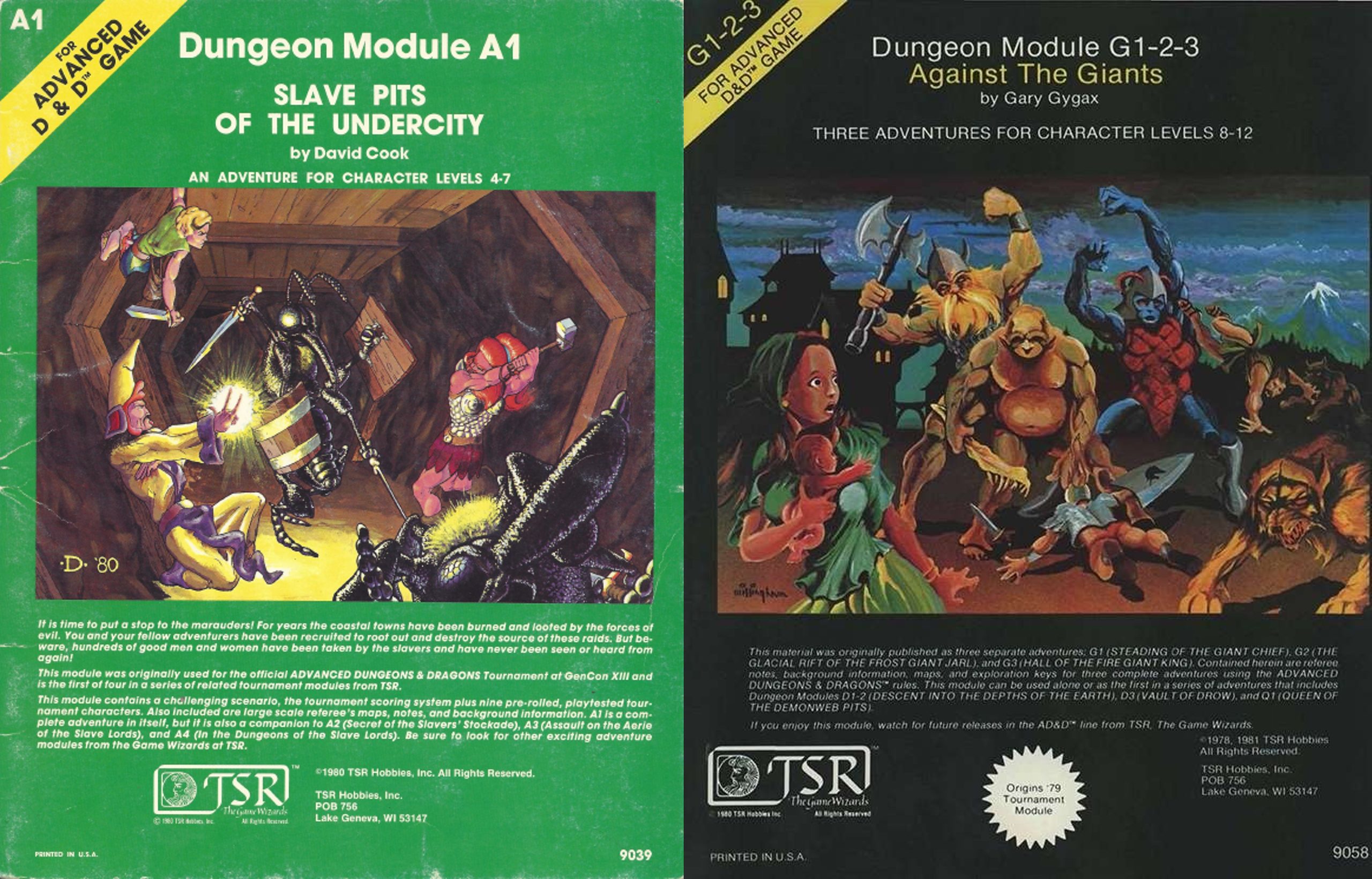
When I got there, he dismally told me my friends had already gotten most of the “good stuff” and that all he had left were the more expensive items. I was unfazed and told him I had money my grandfather had given me!
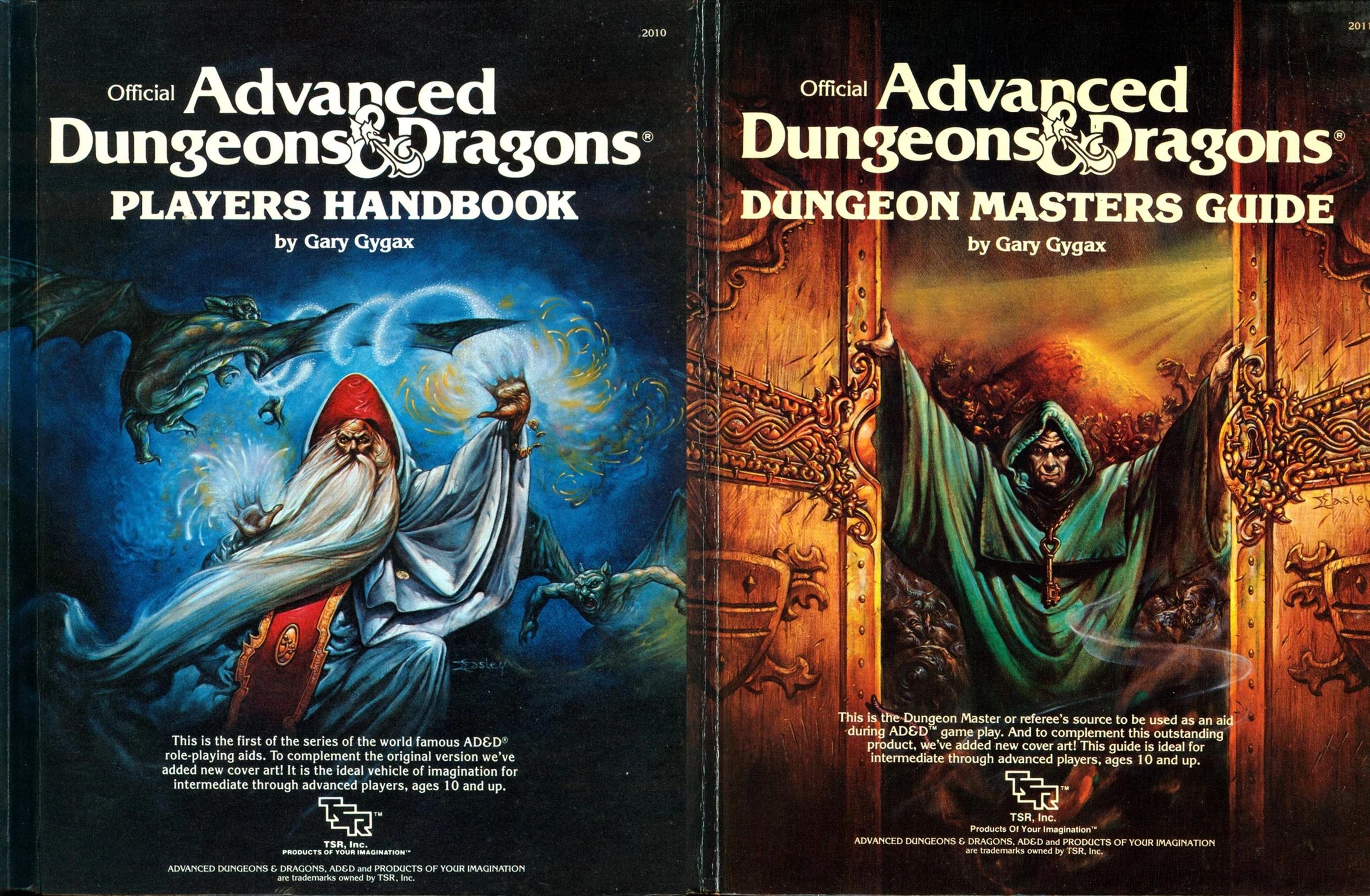
Before I go on, some context: while we had been playing D&D for months, I had recently purchased the AD&D Players Handbook (PHB) and Dungeon Masters Guide (DMG) and was in the process of reading them to “level up” our gaming experience to the advanced rules.
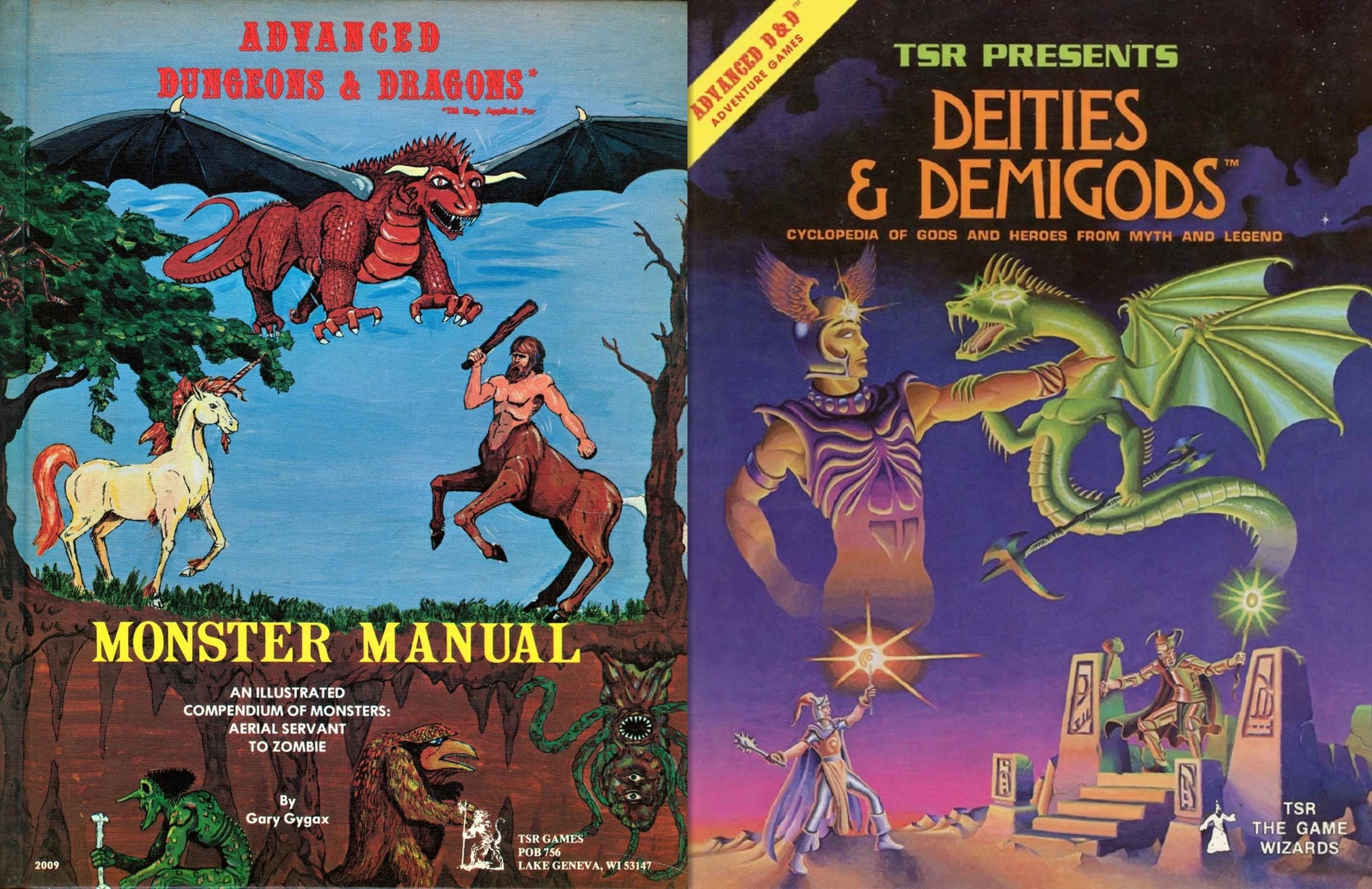
The neighbor pulled out a large piece of luggage, unlocked it, and showed me what he had left. Imagine my surprise when I saw the Monster Manual and Deities & Demigods. As I’ve mentioned recently, both featured the original covers, and the Deities & Demigods included the Cthulhu Mythos (which was famously removed from later editions). Furthermore, the owner had photocopied the “Saturday Morning Monsters” article from Dragon Magazine #48 and glued it to the end sheets. This was an extra cool find, and I had no idea at the time!
He asked for $10 per book, which had been too much for my friends. If memory serves, I had paid $15 for the PHB and $18 for the DMG, so $10 seemed very reasonable. Knowing what I know now, I think that was the original cover price for those books when he got them, so he was selling them used for what he paid—but that didn’t stop me! I had a very generous grandfather, so I handed him twenty dollars and walked out with two new AD&D books.
The Second Trip
But as I left, I knew there were two other things left in that luggage. So, the next morning, I convinced my grandfather and came back with $15 for the other two items.
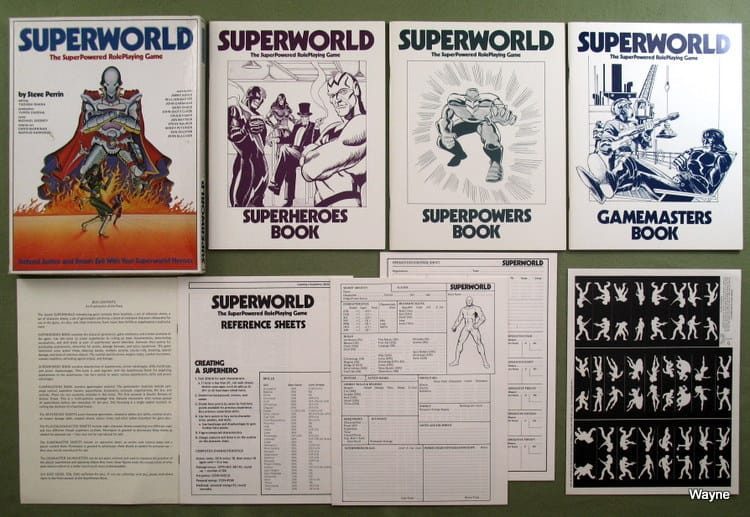
One was a book from the Superworld boxed set—just the character creation book. By itself, it wasn’t enough to play the game. I was a fan of the Wild Cards shared-universe anthology; I had read one or two books by then, and I had heard somewhere they were based on the author’s TTRPG Superworld campaign, so I was really interested. Alas, I was never able to play it since I never got the original Superworld box.
However, the other item I got was part of another shared-universe anthology: Chaosium’s 1981 Thieves’ World boxed set!
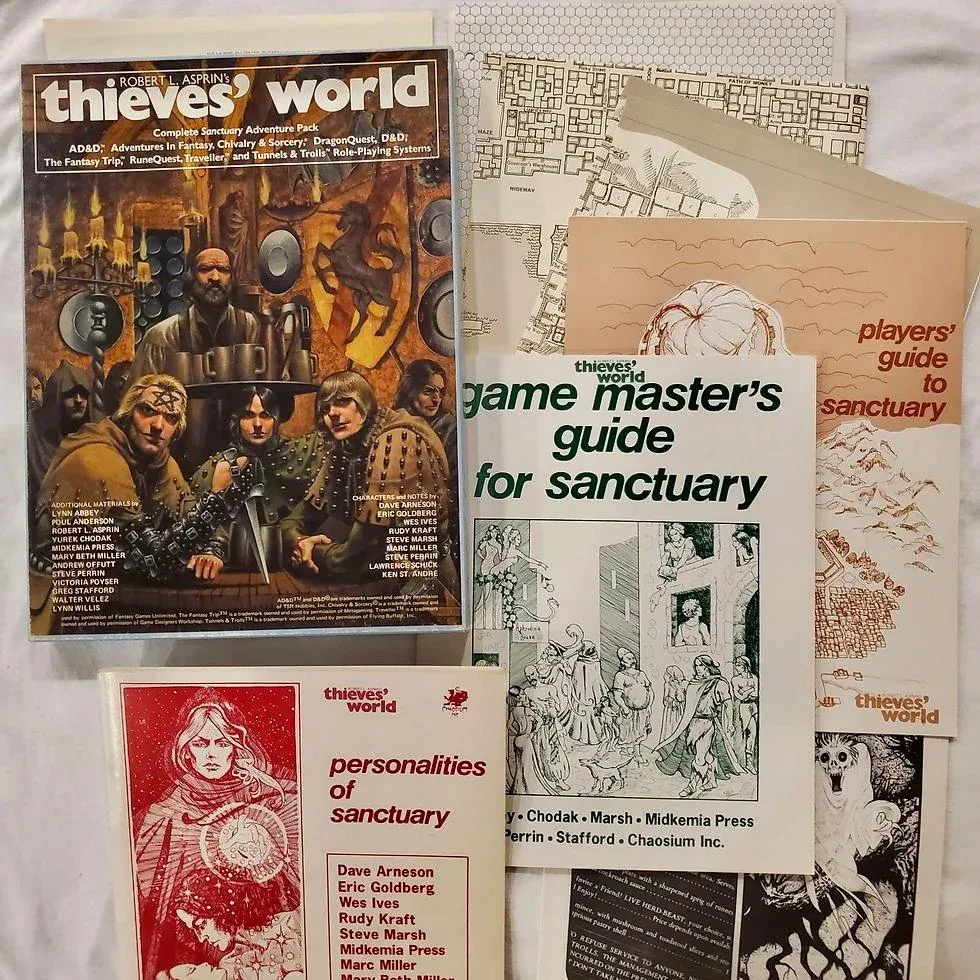
Discovering Sanctuary
I had never read the Thieves’ World anthology, so I had no context for what this was. The neighbor who sold it to me simply said it was the setting for a series of books, so that was all I had to go by.
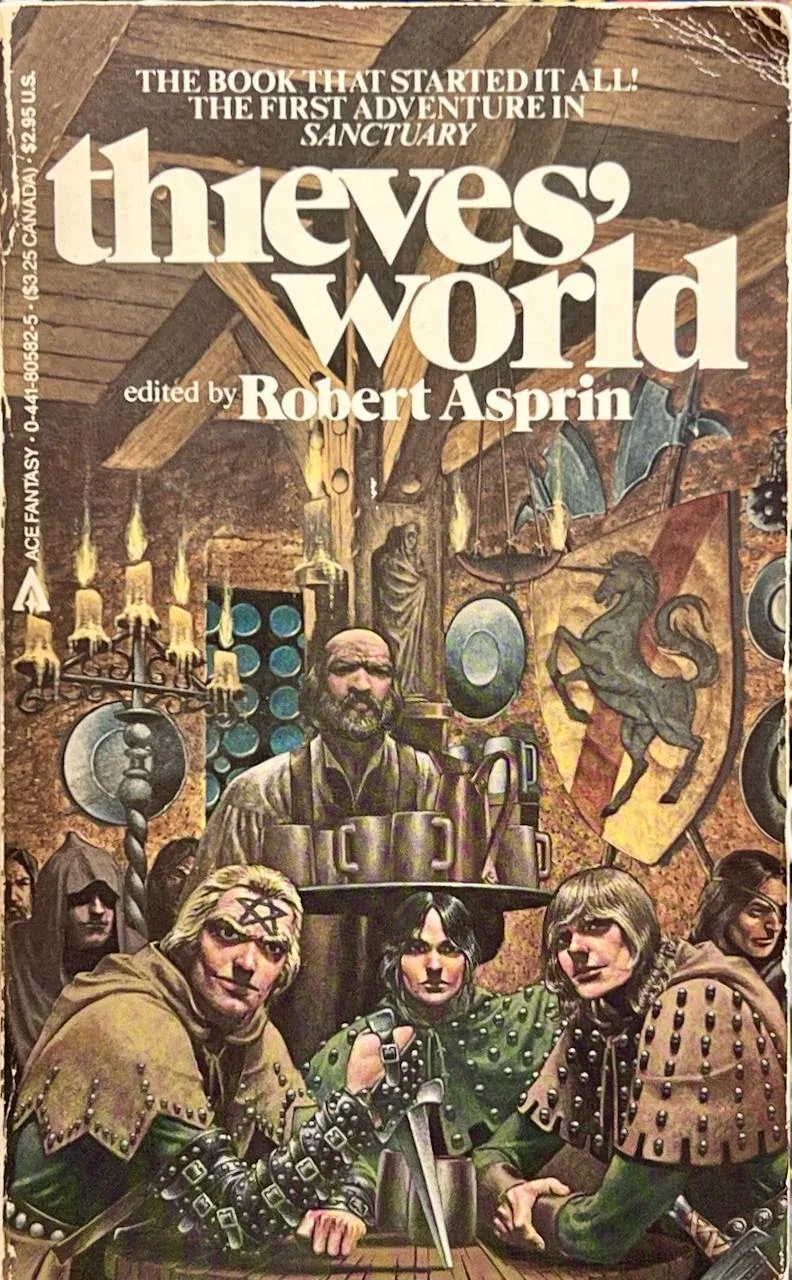
However, Walter Velez’s cover was so evocative that I had to open the box and delve in. I’ll admit there was a lot I did not understand. I was 14 years old, and my reading comprehension was still developing, but I absolutely loved what I did understand.
I loved the cover of the Player’s Guide to Sanctuary. To me, it looked exactly like a GM looming over his creation!
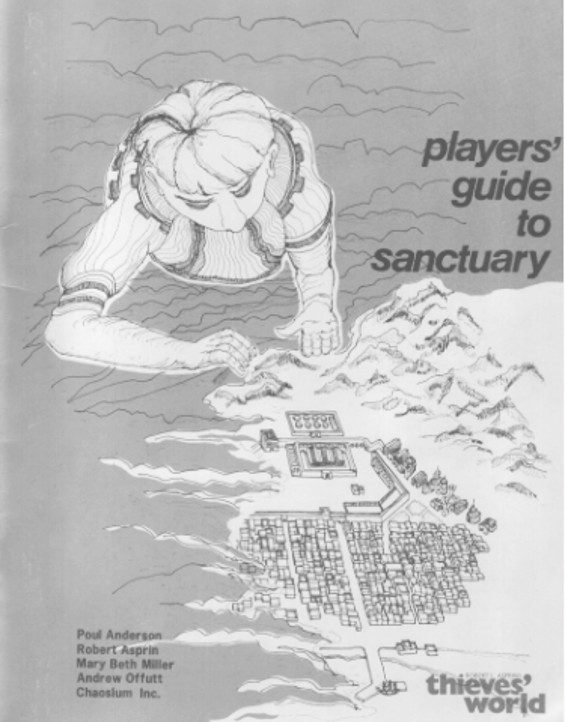
The discussion of the city, the details, the glossary! If the AD&D books felt textbook-like, this felt like a living, breathing, lived-in world. As an adult, I understand there was a lot of implied world-building in the early D&D books, but to my teenage mind, this was the opposite extreme—it was explicit and detailed. Come to think of it, this was perhaps the first fully fleshed-out campaign setting I ever encountered. There was the “Known World” section in the D&D Blue Box Expert Rulebook, but this was something else entirely.
The Maps and the Multiverse
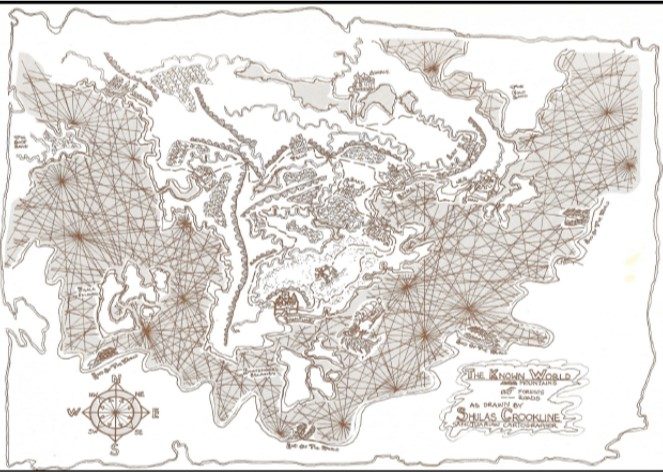
I loved the maps! I had actually forgotten this was also labeled as the “Known World” on the map at the end of the Player’s Guide to Sanctuary.
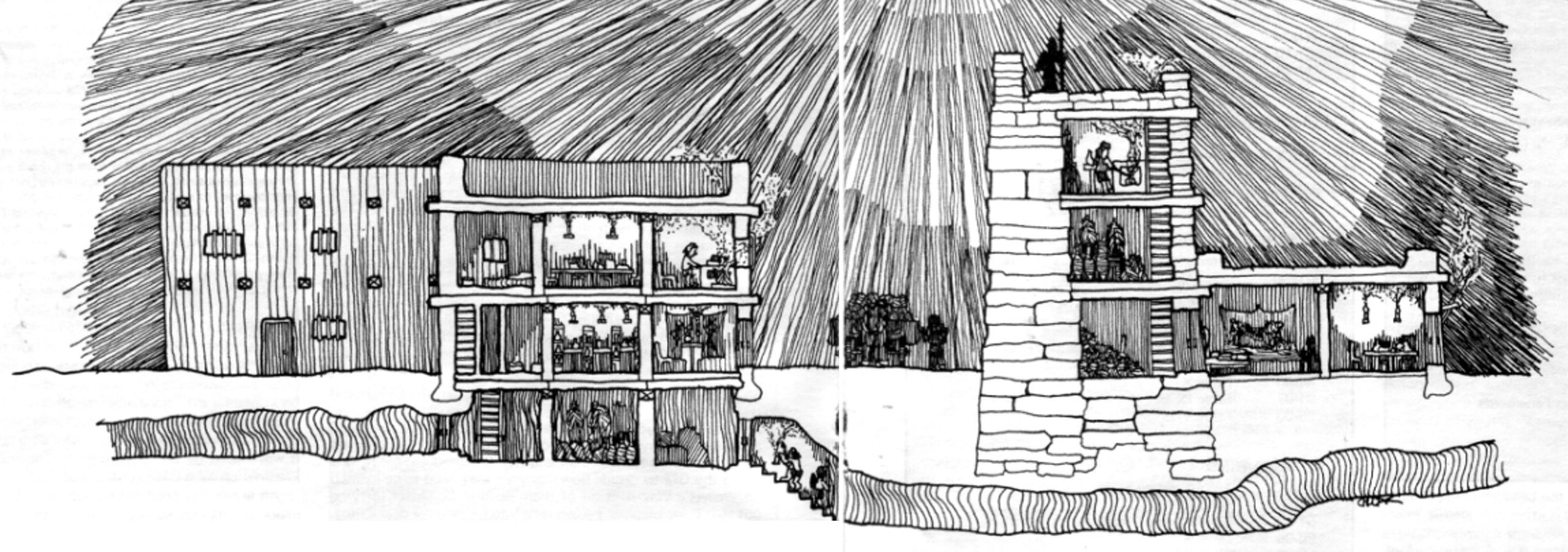
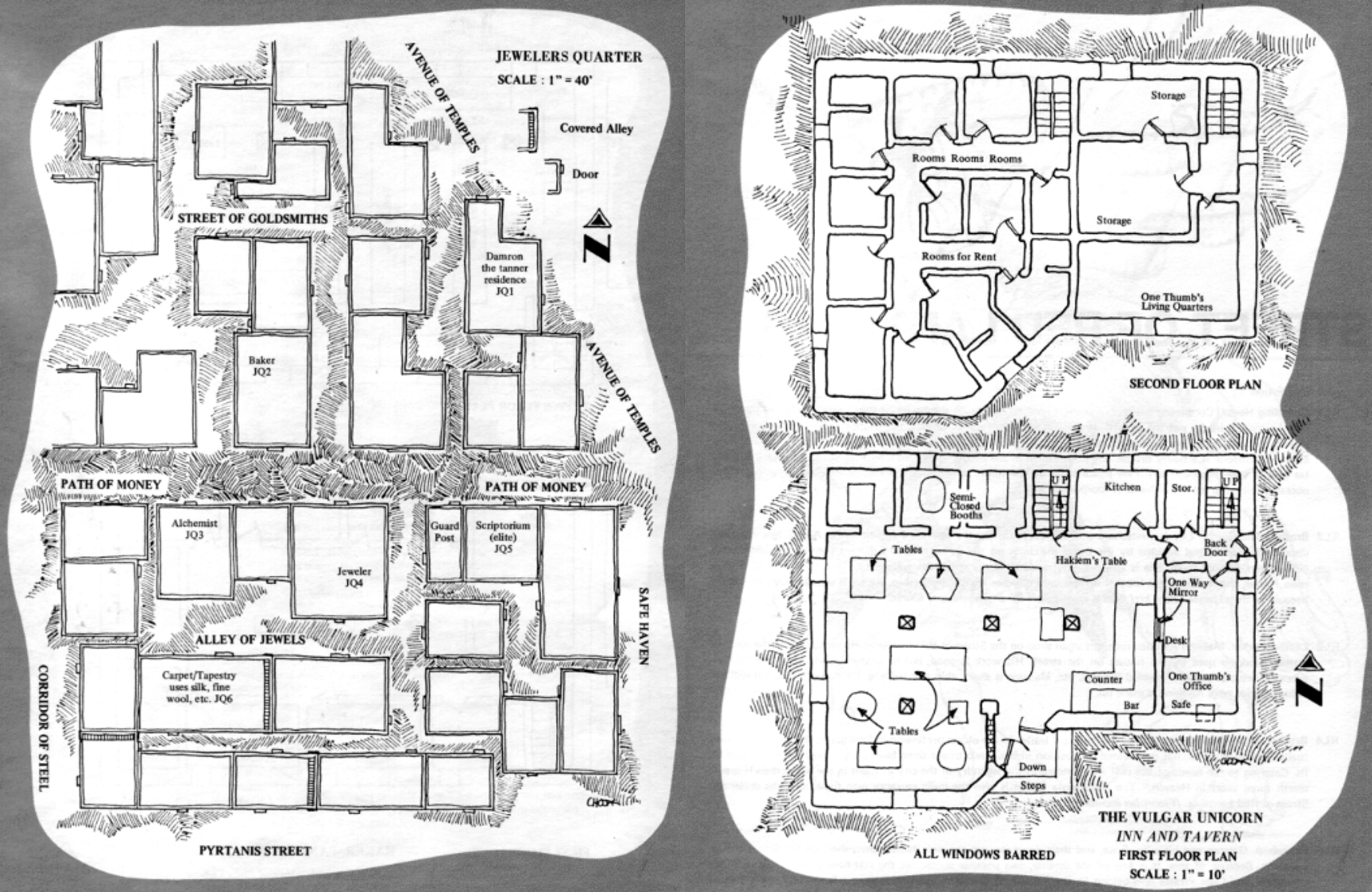
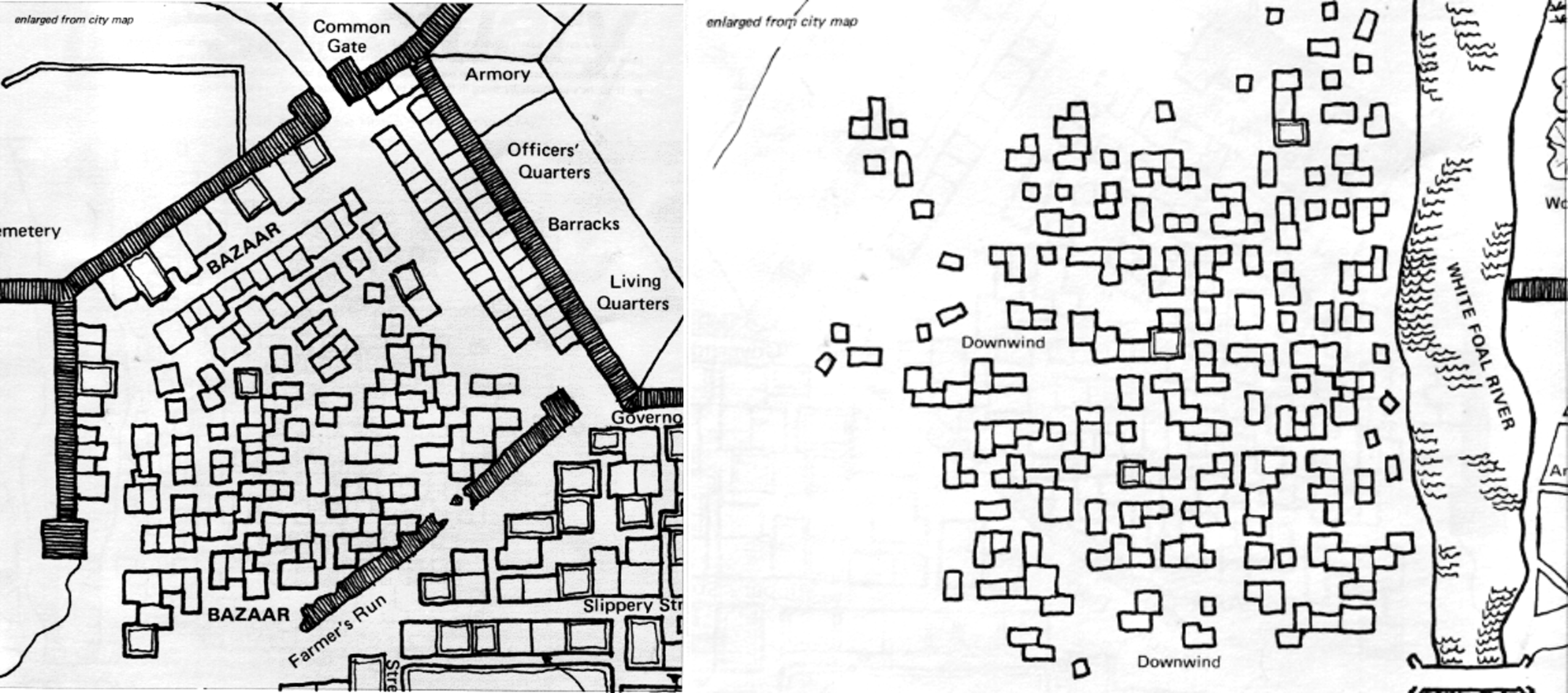
The maps in the Game Master’s Guide to Sanctuary were even better. I look back at the cut-aways on pages 33 and 34, the maps of buildings starting on page 37, and the details of city sections on pages 63 and 64, and I realize just how much these maps inspired my own map-making at the time and in the years to come. To say nothing of the incredible full-page Hellhound knight illustration on page 9!
The Personalities of Sanctuary book was like a mysterious compilation of other games. I knew what D&D and AD&D were, but I had no idea about other systems. I pored over the stats, trying to figure out what these other games must be like.
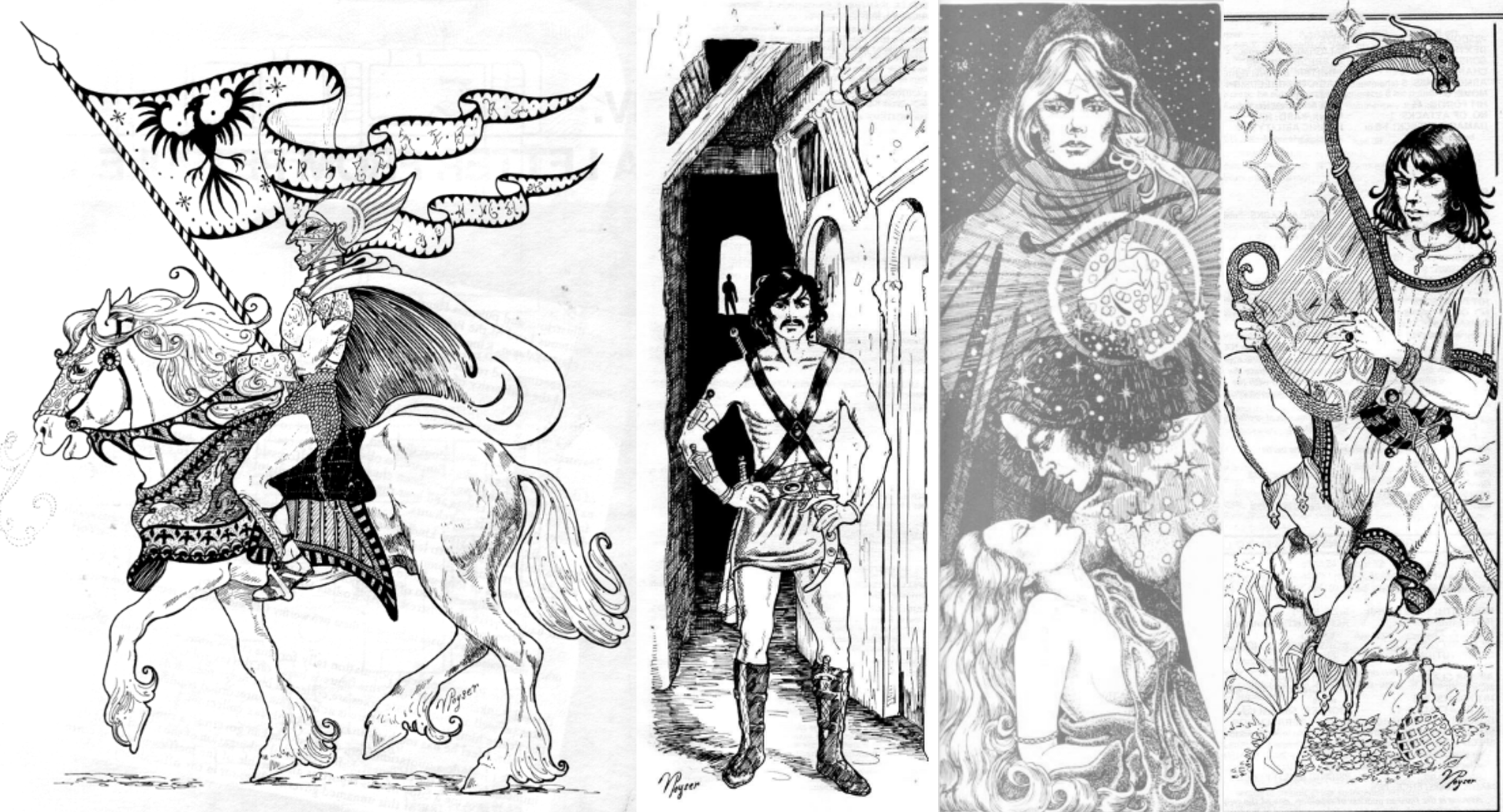
The art throughout the books was sparse but evocative, creating a unified feel and a deep sense of wonder for Sanctuary. Concepts like “The Maze” heavily influenced my concept of fantasy slums, and the “Vulgar Unicorn” inspired many of my tavern names in the same vein.
Looking Back
The maps were my favorite part, hands down. Early on, I would frequently use the map of Sanctuary in my games without necessarily using the setting itself.
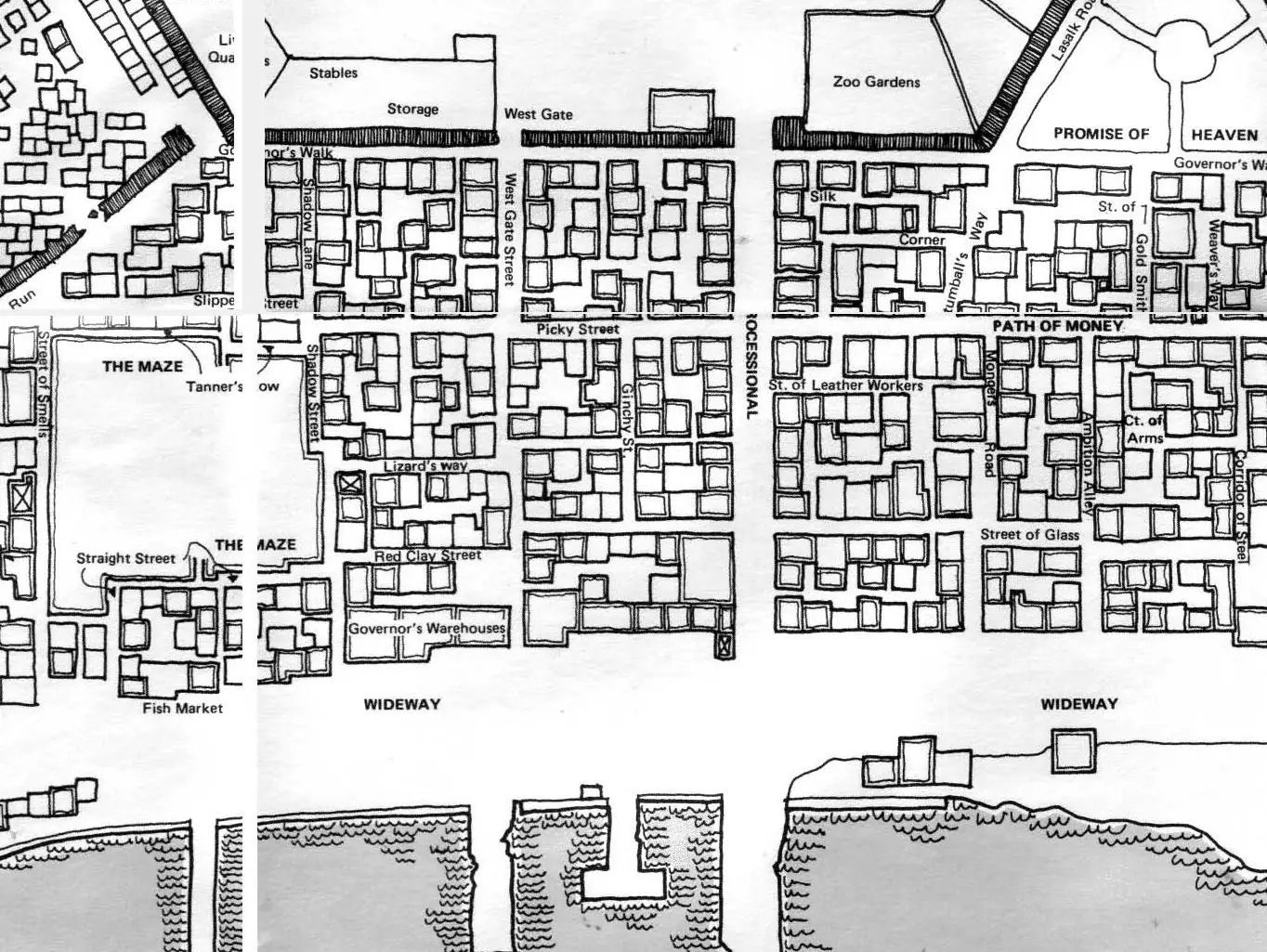
I still have the books and the maps, and taking them out to peruse before writing this was a delightful trip down memory lane. There were so many incredible details I had forgotten.
Sadly, I got rid of the actual box years ago. To save space, I threw out many of the boxes for my classic boxed sets. I really wish I had kept them.
Two more things before I go.
If you’ve read the wonderful Designers & Dragons by Shannon Appelcline, you might already know this, but just in case you don’t: the inclusion of the Melnibonéan and Cthulhu Mythos in the original Deities & Demigods is actually what made it possible for Thieves’ World to include stats for D&D and AD&D!
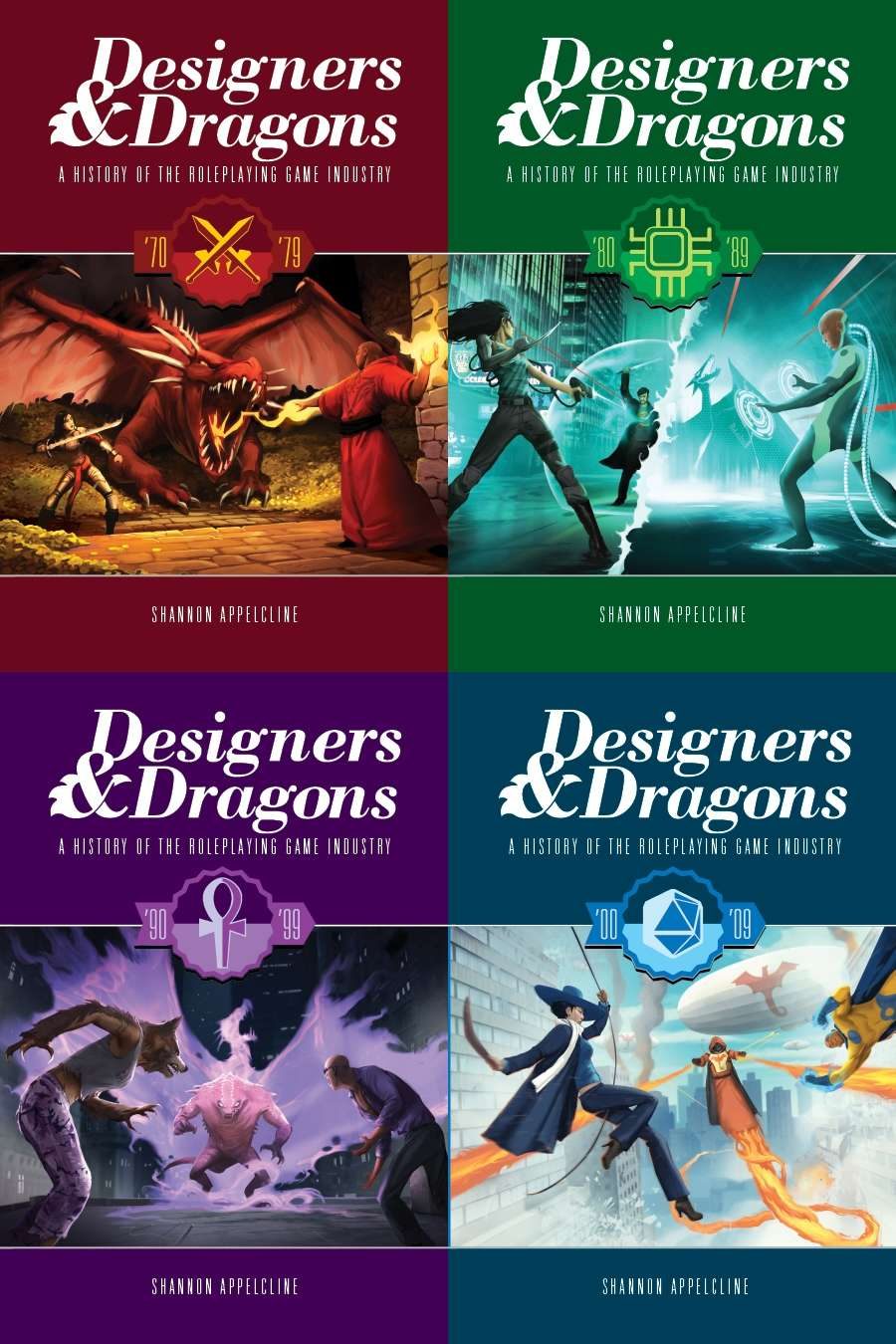
Here is a quote from Appelcline detailing this exchange from this RPG.net column:
“Chaosium (1980). Jim Ward characterizes what TSR received from Chaosium as a “C&D”. Knowing most of the principals at Chaosium, I find it unlikely that anyone wrote anything that antagonistic or legalistic. In any case, at the time Chaosium held contracts giving them gaming rights to Michael Moorcock’s Eternal Champion novels and H.P. Lovecraft’s mythos stories. But TSR published deities for both of those fictional settings in Deities & Demigods (1980), and Chaosium complained. The end result was that Chaosium granted rights to the usage based on a thank-you in the credits (but the Blumes quickly decided to remove the mythos entirely because they didn’t want to mention another roleplaying publisher) and that Chaosium got rights to use D&D stats in Thieves’ World (1981), which would be one of the last major licensed uses of the D&D game under TSR.”
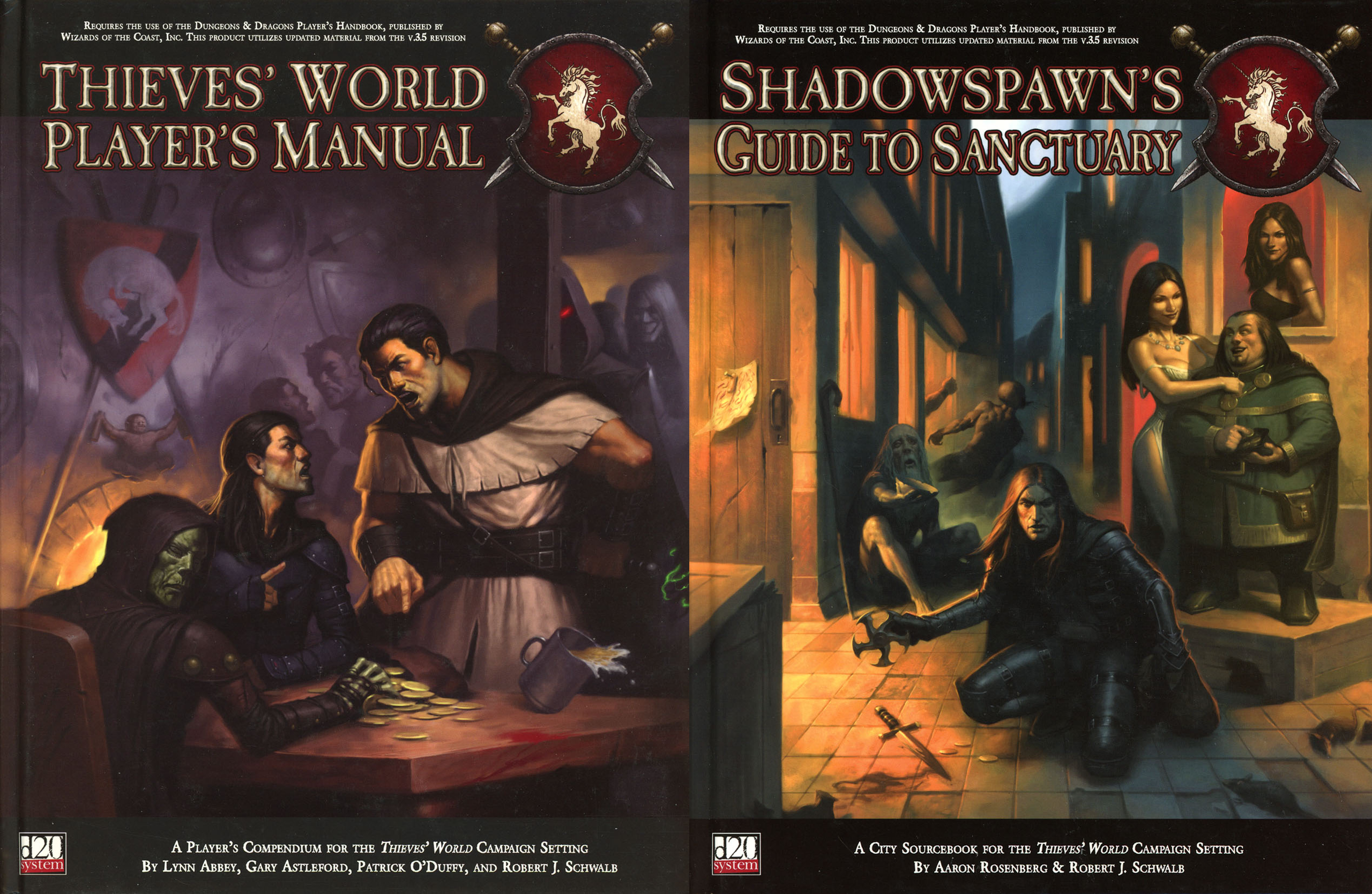
In the early 2000s, Green Ronin published new materials for Thieves’ World using the d20 rules. I own those books as well, but sadly, they no longer hold the license.
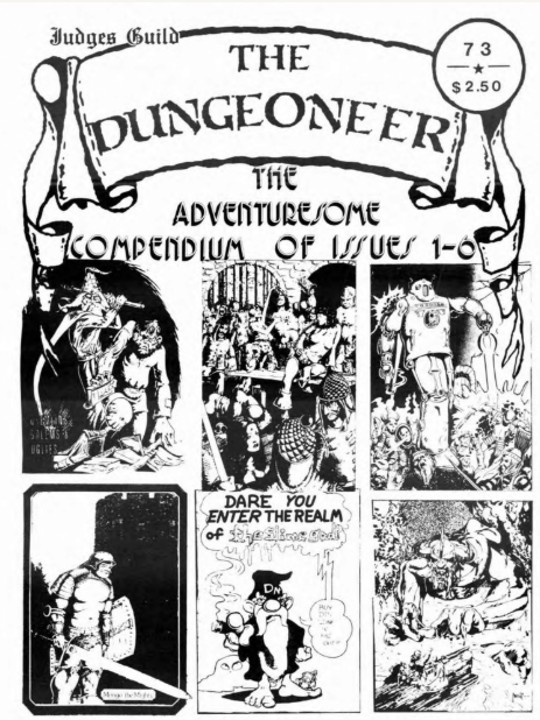
One final thought, at one point, I can’t remember if the first time or the second time, I visited my neighbor’s garage sale, I also got the Dungeoneer Compendium of issues 1 to 6. It was in bad shape, so I remember getting it for $1. It was $2.50 brand new. My neighbor fleeced me, really!
Categories: Tabletop Gaming Blogs
D100 Sword & Sorcery Chimera monsters & creatures for OSR Rpgs & Castles & Crusades Campaigns
In a Sword & Sorcery setting, a chimera isn't just the classic "lion-goat-snake" triad; it is often a blasphemous union of beasts or a sorcerous mishap. Here is a d100 table designed to generate unique, horrific hybrids for your Castles & Crusades campaign. This blog entry picks right up from Two D100 Sword & Sorcery sewer & dungeon encounter tables For Castles & Needleshttp://www.blogger.com/profile/11243274667834930867noreply@blogger.com0
Categories: Tabletop Gaming Blogs
Video of the Day – Doctor Who Confidential, 2006
The post Video of the Day – Doctor Who Confidential, 2006 appeared first on Blogtor Who.
Categories: Doctor Who Feeds
An Interview with Lala Mágica, a Sorceress with a Needle
Hello again, reader! Welcome back to my continuing series highlighting the art of incredibly talented Puerto Rican creators.
This week I’m talking to Laura, aka Lala Mágica. I’ve known about Laura for a few years. I’ve been following her on social media, seeing her creations. Laura happens to be married to a friend and longtime member of Puerto Rico Role Player (who I hope to interview in the future about his TTRPG content). It is a pleasure to talk to her and learn more about her as an artist and a gamer.
Without further ado, here is the interview.
Introduce yourself! Who are you and what do you create?
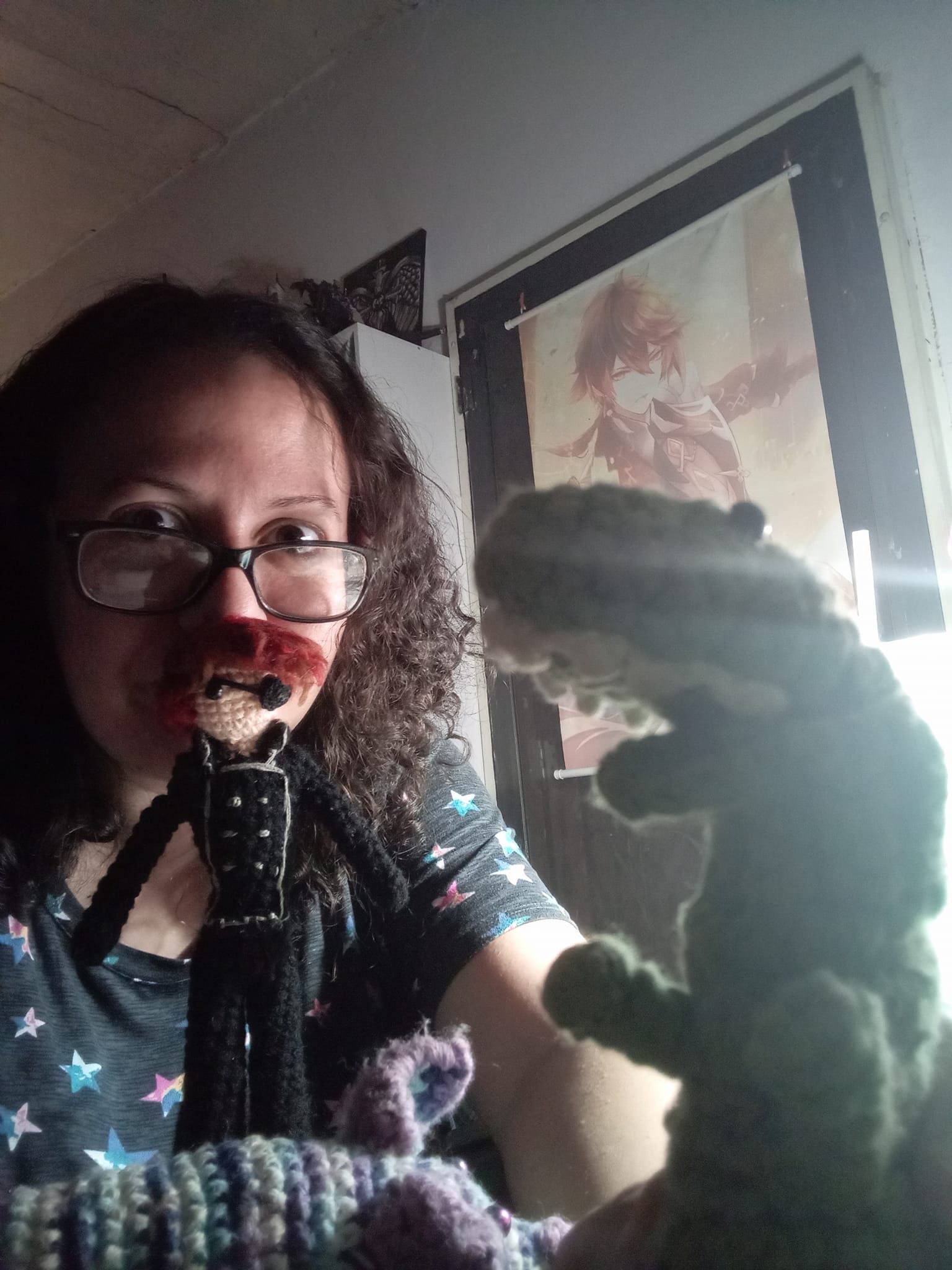
My name is Laura, but with my knitting needle, I am Lala Mágica. With a creative spirit in crafting, I like to knit original characters that aren’t easily found. I started with dice bags and then expanded into other accessories, such as keychains and garments.
How would you describe your art or creative endeavor?
Karso the Halfling Barbarian from Juego La Mesa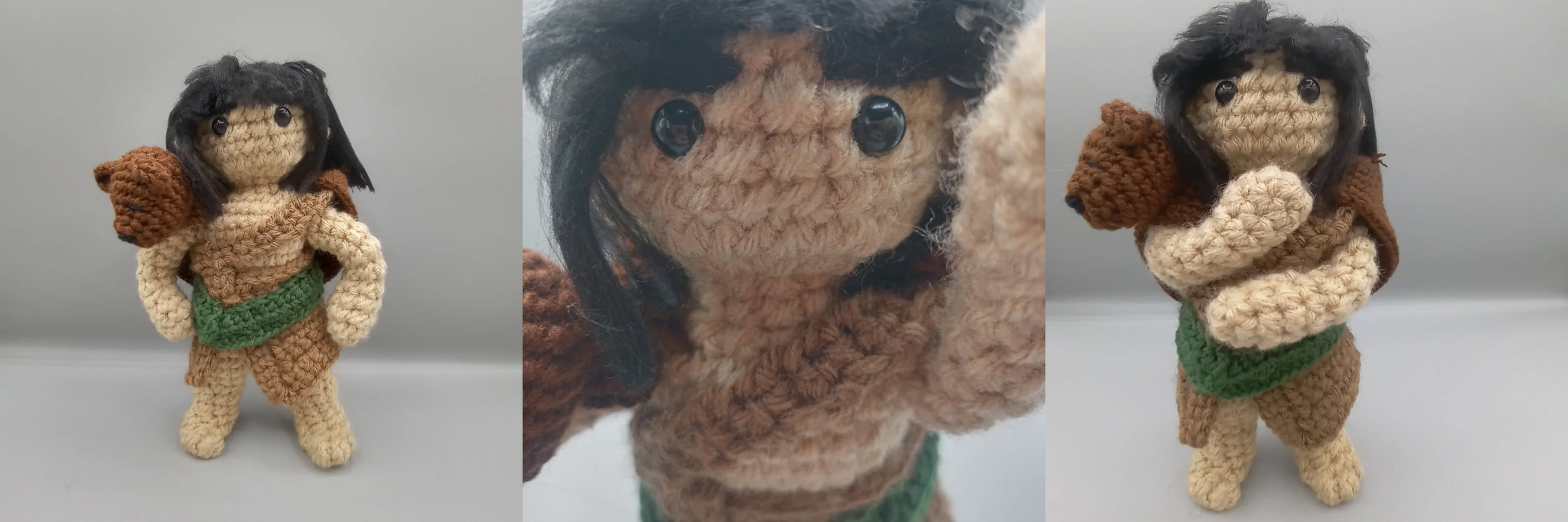
I would describe my art as 3D printing, but with yarn. Usually, I do what is known as “freehand,” which is knitting without following a pattern. So, creating a plush of your original character is possible for me.
How did you discover TTRPGs?
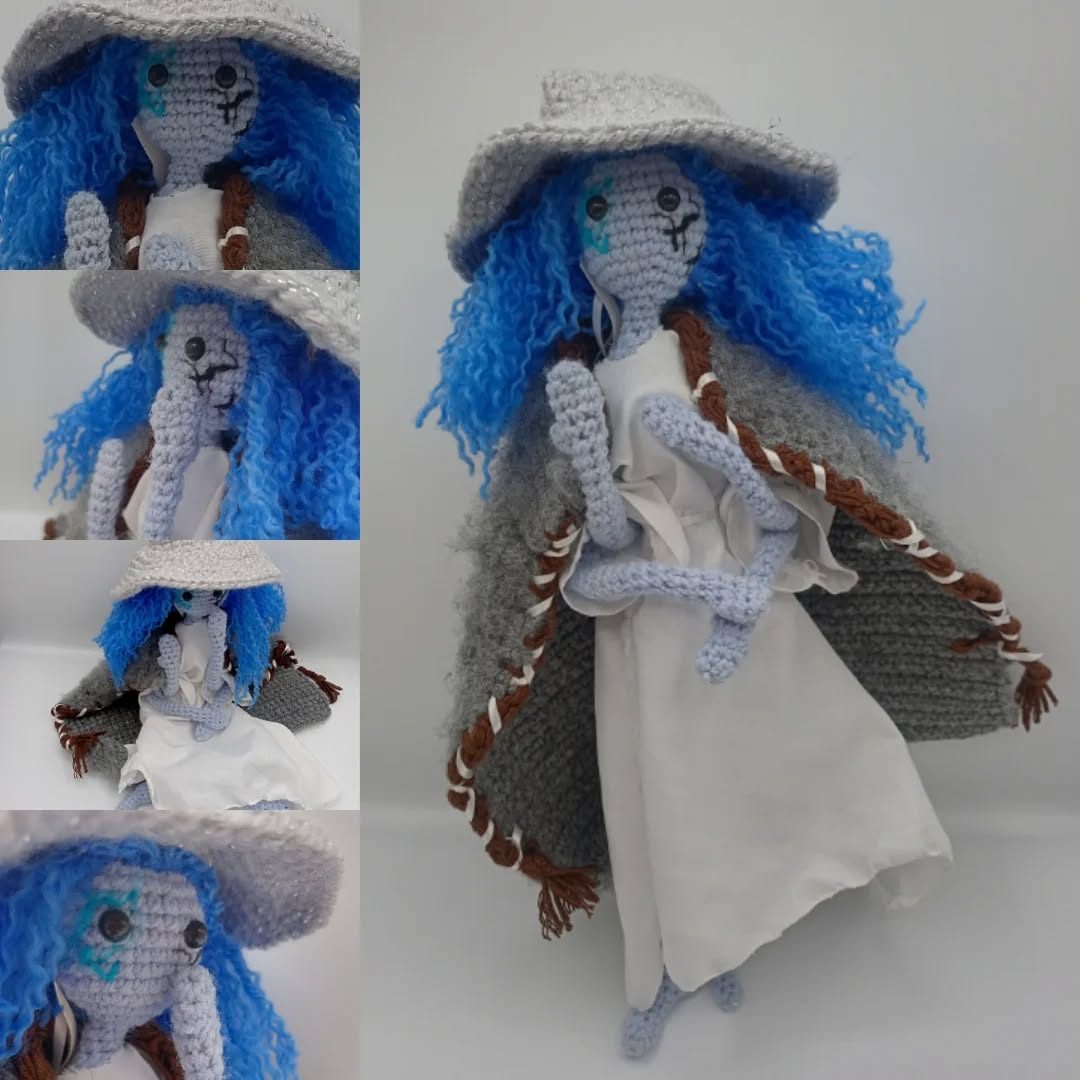
I discovered tabletop role-playing games through friends in college. I played two sessions of Mage: The Ascension, but I was able to get into the hobby properly after getting married. My husband is a DM, so we share that.
Do you actively play TTRPG? What are you playing?
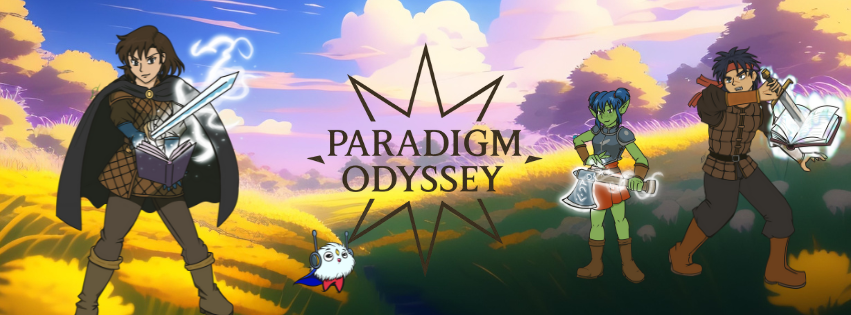
At the moment, I’m active in two campaigns: one of Paradigm Odyssey: “War is Raw” as a clown “living doll”, the system is being developed by Enyol currently, and one of Daggerheart: Age of Umbra as a fairy Seraph.
What do you want to play next?
What do I want to play next? Honestly, whatever my next session 0 throws at me. I’ll be honest, probably more Paradigm Odyssey.
What projects are available, and what are you working on next?
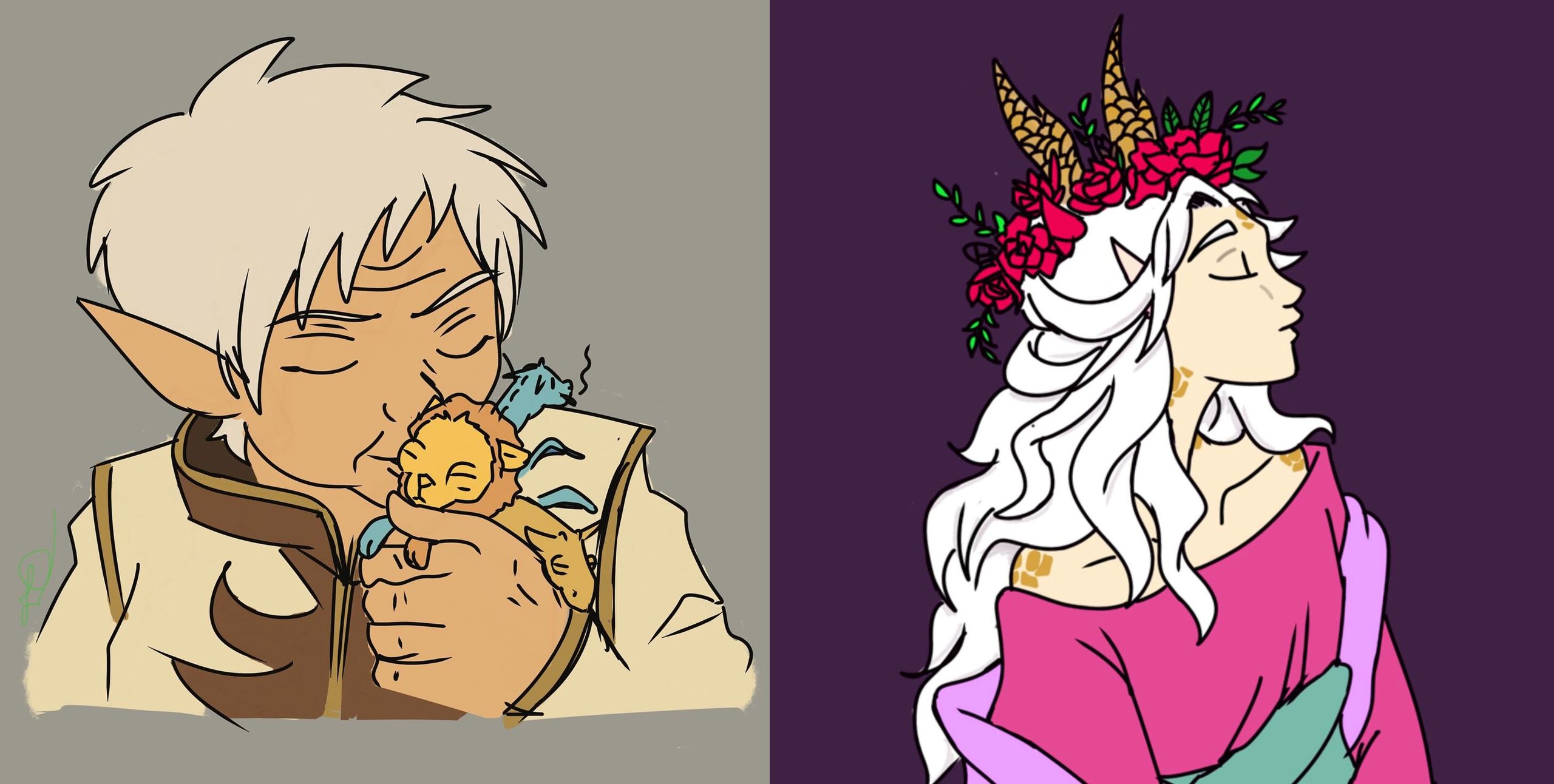
I’m in the process of a “restock,” since I gave away dragon and dinosaur coasters at the Juego La Mesa event last month. Besides that, I’m also recreating one of the small puppets that came out in the movie “Five Nights at Freddy’s.” On top of that, I’m illustrating the supplements that Enyol is sharing on DriveThruRPG, since drawing is another passion of mine.
Where can people find your creations?
You can find me actively on Instagram as Lala Mágica, and I have a FB page with the same name.
Any closing thoughts?
My hook is “My wand and my yarn is the magic”—whatever you can imagine, I can create.
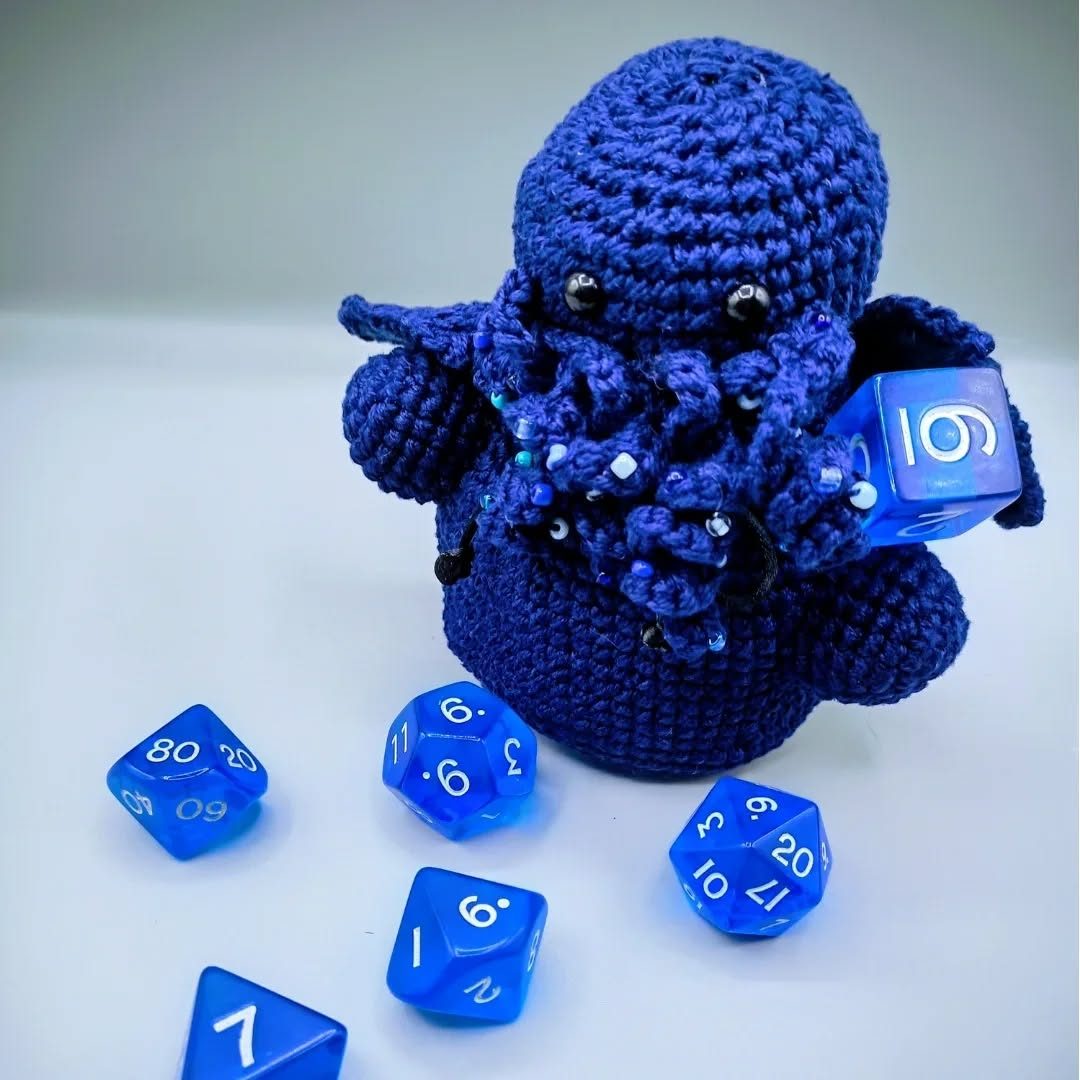
Thank you, Laura, for your time and for sharing your creations. As a Cthulhu Mythos fan, I must admit I love the Cthulhu dice bag below. It looks terrifyingly adorable.
Categories: Tabletop Gaming Blogs
Artists I Like: John McKenzie
I started seeing John McKenzie's work on Facebook a while back and was immediately smitten by it. John has the perfect balance of silly cartoonery and grit. It's almost as if Basil Wolverton and Mike Mignola conspired to create a new life form and I truly love it.
My instinct is to say his work begs to be animated. It FEELS animated. But I don't want to suggest it would better if animated... It lives and breathes as is, but it would translate to animation quite easily.
Also sounds like he's making an RPG. Gotta have that for sure.


Categories: Tabletop Gaming Blogs
Video of the Day – The Jonathan Ross Show, 2026
The post Video of the Day – The Jonathan Ross Show, 2026 appeared first on Blogtor Who.
Categories: Doctor Who Feeds
Shrieks in the Dark
By Martin Cubas
Weird Adventures by Martin A. Cubas
Castles & Crusades
Levels 2-3
Weird Adventures by Martin A. Cubas
Castles & Crusades
Levels 2-3
They can’t see you. They don’t need to. A colony of blind, grotesque predators has infested an abandoned temple deep inside a canyon. They hunt by sound. They move in packs. And they’re starving.
This thirty page adventure uses about fourteen pages to describe seven rooms. Obviously long-winded and padded out, you kill a few monsters. Also, it’s not dark.
Oh lop-sided page count, where have you been? I’ve missed you. Look, I get it, PDF pages are “free”; you’re not paying to print them. Why not put in a bunch of appendices, and lead in, and backstory, and everything else? It’s free! Academically, I agree. But, in practice, what I see time and time again is a poor adventure with a low “core” page count with a whole lot of extra information. While a bit hyperbolic, one must ask oneself, is the designer interested in writing an adventure or ar they interested in world building and the adventure is just a pretext for that? Again, I don’t care if you world build. I don’t care if the page count ration is one adventure page per one hundred pages of backstory. But if you’re selling me an adventure then it had better be a ROCK. FUCKING. SOLID. Adventure. And it almost never is. The designer is distracted by the fluff. They spend their effort there instead of in the core adventure text. What pops out the other end is just another crappy adventure surrounded by a bunch of backstory and appendices. Who would like to guess if this is in the one in a thousand adventure in which there is a lot of fluff and a solid adventure? We all know the fucking answer already. You have to AGONIZE over the adventure text. It should be the best possible, that you are capable of (… ) and more.
Ok, so, we’ve got some eyeless creatures in a cave. There’s a long backstory here about bandits, a holy order, orcs, and so on but all that really matters is that there are eyeless creatures in a cave. They hunt by sound. This whole “shrieks in the dark” thing doesn’t really matter. They can use a sonic attack, but the party is never limited on light. So, you’re just stabbing some monsters in a cave. The central conceit, of these creatures who can hunt without sight, is never capitalized on. We get long monster ecologies (in fucking italics …) who nothing about them putting out lights, etc. So, you’re fighting 5HD orcs in a cave that have a sonic attack.
Room descriptions average a couple of pages each. There’s no need for that. Nothing that interesting is going on. “The disc was collected by the Shrieklings along with other debris from the caverns and has no special significance to them.” Great. You want me to etll you about the pile of shit I collected this morning? It has no bearing on anything, so why not? Backstory, meaningless trivia. Overexplained things. “The Shrieklings’ thick, mucus-coated skin produces a scent that naturally repels the barracuda, allowing them to swim and hunt freely.” Explanations on ecology. Great. That’s not coming up during play, so it’s a great thing it’s in there clogging up the descriptions (as my aforementioned shit this morning may have the toilet?) These are simple rooms with simple interactivity that are just padded out in what amounts to a wall of text. Bullet point up the main issues, but if the bullet is half a page then what’s the point? Sixty some words to describe “+4 to move silently when within 15’ of the waterfall.”
The designer notes that this is inspired by the a Dungeon Design Framework. Monsters have patterns and routines, etc. There are a couple of charts to help with the monsters wandering patrol paths. I’m not saying they are wrong, but they are poorly done, not noting the creatures locations. Just dots and blips that you must then interpret and expand on. Hooks are all “you are hired to “ nonsense. And, in particular, the claim that “Inside, you’ll find tightly written areas built around meaningful encounters, and systems that keep the dungeon active between player actions.” would not be true. Tightly written. Meaningful encounters. I think not.
This is likely the last Cubas review, joining Mohr, Filbar, Elven Tower and the rest.
This is $2 at DriveThru. The preview is ten pages. Meaning nine pages of background/fluff/intro and one that starts to show the first room. (There’s another full page of room one info.) Take a look at that Gannt chart like thing. The blue and reds could be handled much better to show current location, not moves.
https://www.drivethrurpg.com/en/product/563481/c-c-shrieks-in-the-dark-c-c-edition?1892600
Categories: Tabletop Gaming Blogs
Two D100 Sword & Sorcery sewer & dungeon encounter tables For Castles & Crusades Campaigns
Exploring the depths beneath a decaying city requires a mix of environmental hazards, weird sorcery, and gritty martial threats. This table is designed with an OSR (Old School Renaissance) sensibility, favoring traditional mechanics and a "Dying Earth" or Sword & Sorcery atmosphere.This blog post picks right up from Detail d100 Sword & Sorcery Random back alley encounters For Needleshttp://www.blogger.com/profile/11243274667834930867noreply@blogger.com0
Categories: Tabletop Gaming Blogs
Video of the Day – Doctor Who: World War Three, 2005
The post Video of the Day – Doctor Who: World War Three, 2005 appeared first on Blogtor Who.
Categories: Doctor Who Feeds
Big Finish’s New Writer Competition 2026
This year’s Big Finish Paul Spragg Memorial Short Trip Opportunity focuses on the First Doctor
The Big Finish Paul Spragg Memorial Short Trip Opportunity honours the memory of a stalwart of the Big Finish production office who passed away suddenly on 8 May 2014. Each year it finds a new talent to write a Doctor Who short story for release at Christmas. And this year, the topic is The First Doctor. The competition runs for five weeks, starting on the 8th of May and closing in the middle of June.
Big Finish’s Executive Producer Nicholas Briggs said: “It’s always a special time to remember our dear friend Paul. It’s particularly exciting for me this year as we’re focussing on the First Doctor, who has been something of a passion of mine recently. Can’t wait to read the story submissions for this!”
Range producer Peter Anghelides said: “In the ten years since we launched this memorial competition, we’ve never had a winning story featuring the First Doctor. This is the year we’re changing that.
“We want to read your proposal for a standalone Short Trip with a brand new idea that showcases him in a short story for a single reader that we’ll publish at the end of this year.
“Your story will be inspired by the character of the First Doctor as we saw him on TV. It’s an era when each story naturally offered a new perspective on the continuing series – so we want your proposal to demonstrate that kind of originality and inventiveness. What fresh characters, adversaries, locations, concepts and perspectives can you devise for a compelling short story?”
In addition to naming a winner, Big Finish will also identify a shortlist of commendations. “In recent competitions, the standard of entries has been wonderful,” said Peter Anghelides. “Although we will have only one winner, we thought it appropriate this year to name and commend other strong contenders.”
You can find more details, including the official submission guidelines, on the Big Finish website.
The post Big Finish’s New Writer Competition 2026 appeared first on Blogtor Who.
Categories: Doctor Who Feeds
Reverb The Dimensional Dandy For The Belle Époque, Red Rpg By The Red Room & Troll Lord Games Victorious Role Playing Game
In the Victorious RPG, where Victorian-era aesthetics meet superheroic action, a character like Reverb fits perfectly as a "dimensional dandy" or a cosmic traveler grounded in 19th-century theories of the luminiferous ether.Here is a profile for Reverb, designed for the Victorian supersetting.Hero Profile: ReverbSecret Identity: Alistair ThorneArchetype: Astral Traveler / Sound Needleshttp://www.blogger.com/profile/11243274667834930867noreply@blogger.com0
Categories: Tabletop Gaming Blogs
[Parsulan] Scavengers and the Field of the Fallen Colossi
Art by Guy Wurley
The ramshackle boomtown called Salvage by its inhabitants and the Scrapyard by outsiders is built amid the fallen combatants of an ancient battle. The colossi are named for their color. Red Knight lies on its back, reaching for a sword that is out of reach. Blue Knight fell forward. Its weapon is long gone, but one hand is raised. The plains have made half-hearted attempts to reclaim the giants, and the knives of time have marked them, but they remain, tempting those interested in making a quick fortune or simply curious about their enigma. The colossi are unusual treasure troves, or above ground mines, made as they are from rare materials and magitechnologies unreproducible in the current age.
All the prospectors, adventurers, scholars, and thieves looking to claim their own piece of the colossi, and the merchants, dealers, entertainers, and bandits looking to get rich off them, crowd into haphazard buildings constructed along and amid the fallen giants. It's a dangerous place. There is no law in Salvage and plenty of desperate characters. Guns are more common that elsewhere given the relative abundance of both artificers and the raw magitech materials.
The danger isn't just from the inhabitants. There are caustic fluids, poison gases, and other environmental hazards to be sure, but also the colossi are not as dead as they appear. They haven't moved in ages, but not all of their internal parts have been stilled like their limbs. Component constructs, perhaps something like immune system elements, sometimes react violently to scavengers crawling through a colossus's insides. Some grow independent and feral and prowl outside the bodies as if their look for prey or raw materials to affect repairs.

The ramshackle boomtown called Salvage by its inhabitants and the Scrapyard by outsiders is built amid the fallen combatants of an ancient battle. The colossi are named for their color. Red Knight lies on its back, reaching for a sword that is out of reach. Blue Knight fell forward. Its weapon is long gone, but one hand is raised. The plains have made half-hearted attempts to reclaim the giants, and the knives of time have marked them, but they remain, tempting those interested in making a quick fortune or simply curious about their enigma. The colossi are unusual treasure troves, or above ground mines, made as they are from rare materials and magitechnologies unreproducible in the current age.
All the prospectors, adventurers, scholars, and thieves looking to claim their own piece of the colossi, and the merchants, dealers, entertainers, and bandits looking to get rich off them, crowd into haphazard buildings constructed along and amid the fallen giants. It's a dangerous place. There is no law in Salvage and plenty of desperate characters. Guns are more common that elsewhere given the relative abundance of both artificers and the raw magitech materials.
The danger isn't just from the inhabitants. There are caustic fluids, poison gases, and other environmental hazards to be sure, but also the colossi are not as dead as they appear. They haven't moved in ages, but not all of their internal parts have been stilled like their limbs. Component constructs, perhaps something like immune system elements, sometimes react violently to scavengers crawling through a colossus's insides. Some grow independent and feral and prowl outside the bodies as if their look for prey or raw materials to affect repairs.
Categories: Comic Book Blogs, Tabletop Gaming Blogs
Using the Belle Époque, Red Rpg By The Red Room & Troll Lord Games Victorious Role Playing Game
Setting a campaign in the Belle Époque (roughly 1871–1914) using the Victorious RPG system—and specifically integrating the Red RPG (The Red Book) mechanics—creates a unique blend of superheroic "Steampunk" and gritty, high-stakes tactical play.Here is how you can detail and merge these two influences for a campaign.1. The Setting: The Beautiful EraThe Belle Époque was a period of optimism,Needleshttp://www.blogger.com/profile/11243274667834930867noreply@blogger.com0
Categories: Tabletop Gaming Blogs
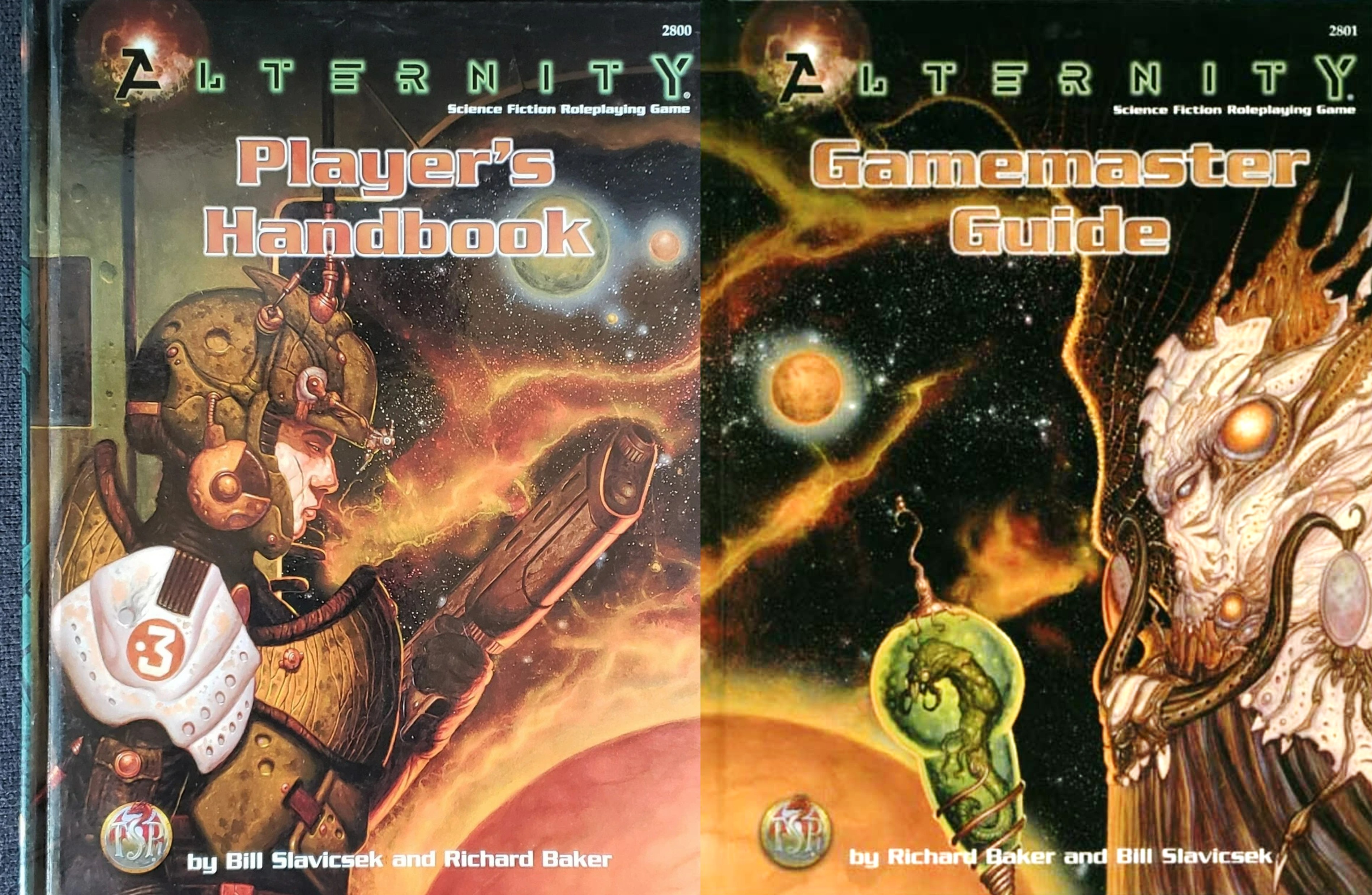
Knights of the Celestial Canticle – The Indomitable Order: Rules for the Original Alternity Game
Let me start by saying that I blame Michael (aka the Stargazer) for this! He recently started writing about the original Alternity game here and here, and it made me so nostalgic that I began digging through the files for my old campaign. That is where I found the topic for this post. Let me give you some context.
It was 1998. Alternity had been published earlier that year by TSR (which Wizards of the Coast had already purchased). I was obsessed with it. I wanted to run a campaign in a setting I had originally conceived around 1990 and had been tinkering with over the years: the Nirvani Alliance. Alternity felt like the perfect system for it, so I started adapting the rules for the campaign.
In September, I was busy planning my upcoming wedding, which was just three months away. Then, Hurricane Georges hit Puerto Rico! We lost power for days, so I spent nights by flashlight and candlelight, writing the campaign material discussed in this post.
What I wrote were the Alternity system rules for a mystic order of armored religious knights, inspired by various classic sci-fi influences. I eventually typed up the pages and showed them to my players. Naturally, none of them wanted to play one of the knights, so I shelved the rules and didn’t work on them any further.
Below are the rules, written 28 years ago, for an out-of-print game I still deeply love! I made no changes to the mechanics. I cleaned up the text, fixed some grammar, and made a few tweaks for clarity. This is not a professionally written or edited piece; it is a slice of house rules from my old Alternity campaign. I am sharing them purely for nostalgia’s sake, and I hope someone finds them useful.
This post includes an introduction and summary of concepts, rules, and ideas. At the end, you’ll find a link to the Alternity Indomitable Order Rules, an 11-page PDF with detailed information on this Order of warrior-knights. Don’t judge me too harshly, I wrote this almost 30 years ago!
The Age of the Nirvani
Of all the races inhabiting Alliance space, the Nirvani are the only ones not native to this galaxy. Even their name was a gift from the Keriani, who encountered them as they fled the forces of the TukNi-Amak puppet government. These refugees, who called themselves “humans,” claimed to hail from a distant galaxy decimated by a devastating plague.
The Keriani—whose name translates as “born from the womb of Ker”—named the newcomers Nirvani, or “born of no womb”. Though they arrived in the middle of a great interstellar war, the Nirvani were ready to start anew, and their arrival signaled a new order for the galaxy.
The Indomitable Order
The Knights of the Indomitable Order serve as the warrior sect of the Church of the Celestial Canticle. The Order traces its legacy to the foundation of the Alliance and the liberation campaign led by Lord Sparrowhawk. Selected by The Ever Present as a sword of vengeance, Sparrowhawk identified twenty-three soldiers of great faith—the Enlightened, or Saints of War—and bestowed upon them his wisdom and power.
These Enlightened formed the Bloodlines, passing their knowledge and unique abilities to subsequent generations. In modern times, the Order remains the Church’s premier fighting branch, though its influence has waned. Today’s knights survive by breeding strictly within the Bloodlines to retain their diluted, yet still formidable, birthright.
Life as an Indomitable
A member of the Order is born, not chosen. They serve as guardians, fighters, and symbols of the Church’s power. Those who abandon their destiny are branded Fallen, stripped of their heritage through an excruciating process involving power-inhibiting nanites. Those who openly rebel become Renegades, hunted down as enemies of the faith.
The Major Bloodlines
Each group within the Order has its own outlook and specialized abilities:
- The Sisterhood of Heimdal: Traditionalists and keepers of records who use “Bloodsense” to identify a newborn’s destiny. In Alternity terms, they possess the Enhanced Sense mutation.
- Bloodline Gilgamesh: The highly militaristic ground troopers. They receive a +1 to their STR score and a +3 to their Wound rating.
- Bloodline Zeus: Known as the “Scions of Thunder,” these warriors can manifest an Electrical Aura to damage enemies.
- The Conclave of Ra: Progressive tacticians who possess a variation of Energy Absorption, allowing them to turn light into energy.
- The Icarians: Independent and reclusive, these members have an improved DEX score and the Adaptation Gravity (light gravity) power.
- The Fellowship of the Jesesites: The only ordained Bloodline within the Church. They are healers who possess the Enhanced Healing power, though using it on others can cause them to suffer physical strain.
Relics of the Order
For players navigating the Alternity system, the Order’s equipment provides significant tactical advantages:
- Rune & Relic Armor: These suits are powered by the hero’s own bio-field. While wearing them, the specific powers of each Bloodline are augmented—for example, a Jesesite gains Hyper Healing, while an Icarian gains the ability to fly.
- Star Swords: Members of the Order receive a -1 step bonus to their Melee Weapons—Powered weapons skill base situation die when wielding these blades. They can even parry energy attacks.
- The Indomitable Ancestry Perk: A new 3-point Perk that allows a normal Nirvani hero to use Rune or Relic armor, though it costs them fatigue points to do so.
The life of the Indomitable is one of pride and strict adherence to the faith. Whether you are a dedicated soldier of the Church or a Renegade running from your heritage, you are “the chosen among the chosen”.
Want to dive into the mechanics? Check out this file: Alternity Indomitable Order Rules, for my complete notes on the Indomitable Order using the Alternity rules.
Are you ready to wield a Star Sword in your next session? Let me know which Bloodline fits your playstyle!
Writing and reviewing this document really stirred up my nostalgia for the game and for the campaign setting. I hope you find the Indomitable Order concept and its mechanics interesting. Let me know what you think of the application of the Alternity rules, the lore, or the campaign itself.
Would you be interested in reading more about the concepts or the Nirvani Alliance? I’m really looking forward to your comments!
Categories: Tabletop Gaming Blogs
Video of the Day – Victoria Season 2, 2017
The post Video of the Day – Victoria Season 2, 2017 appeared first on Blogtor Who.
Categories: Doctor Who Feeds
Cheery Cherry Booties
The Cheery Cherry Booties are a quick, beginner-friendly project that adds a playful pop of summer style and charm to any little outfit. With their simple stitches and adorable cherry details, they are designed to fit babies 0-6 mths. These booties come together quickly and make a thoughtful, handmade gift - now free on Moogly! […]
The post Cheery Cherry Booties appeared first on moogly. Please visit www.mooglyblog.com for this post.
3
Categories: Crochet Life
Immersion is not what you think, player
Here we go, another post on the Substack. I think I can claim that I'm back at it. There are already two new essays lined up, and I'm aiming at one a week with one of those for those who have also subscribed. I can say one more thing: people are seeing the posts and it gets Likes, which is far and beyond of what blogger is offering. Good. Anyway, check out my new essay:
[link].jpg)
Excerpt:
Sometimes I just get hit by a topic. This is one of those times. You know how some issues will just not stop returning into the general discussion how a thing is done or not? The performative aspect of that aside (which has gotten worse, tbh, but it’s just a phase), it may be an indicator that something is either not understood properly or (and?) that an idea really needs looking into. Immersion is one of those.
What we agree upon is not what we think.
There is a new kind of meme going viral just now where someone takes music videos of famous bands and replaces the music and singing with just squeaky shoes and grunting. It’s unbearable (and funny, to a degree), but it manages to point something out that we tend to forget: many of the visual media we look at need something as abstract as music to even allow immersion. It’s not just what we see, it’s the combination of seeing and hearing that may create the kind of trance we need to lose ourselves in what we see.
Language can be, in that sense, like music and entrance a listener just the same (and that will be important later on). That is mostly due to the fact that we are reduced to seeing and listening with visual media. Many are not aware that those are skills we learn, actually.
It is hard to tell if allowing that kind of immersion for playing video games (which has an active part, of course) needs the training we naturally receive for growing up with visual media. But assuming that you need some proficiency in how moving pictures work before you could play something like Quake seems to be evident. Just give your grandma a controller and see how she’ll fare.
Anyway, the base line here are two factors: rhythm and the skill to interpret it towards an experience. That’s a good start, but not the whole picture, because we need to know the frame of what we explore, too. In other words, the experience needs to pose a question we need to be able to understand in order to work our way along the rhythm towards an answer.
Very broadly speaking, that question needs to be rooted in our understanding of reality. Specifically speaking, if the question leading into an experience is based on a compromise we can agree upon, then we are more willing to leave that base towards where the experience is leading to (which is why playing a character helps along the way so easily).
Categories: Tabletop Gaming Blogs
Video of the Day – Doctor Who Confidential, 2006
The post Video of the Day – Doctor Who Confidential, 2006 appeared first on Blogtor Who.
Categories: Doctor Who Feeds
Pages
