
Your wildly multifarious home!
Feed aggregator
OSR Commentary - Detail the best classic D&D modules for A Castles & Crusades Rpg Exploration Campaigns
When it comes to exploration-heavy campaigns, the best modules are those that provide a solid "sand-box" environment—giving the players a destination but leaving the "how" and "where" of the journey entirely up to them.Here are the quintessential classic modules for a campaign focused on discovery and hex-crawling.1. B2: The Keep on the BorderlandsThis is the gold standard for introductory Needleshttp://www.blogger.com/profile/11243274667834930867noreply@blogger.com0
Categories: Tabletop Gaming Blogs
The Ghost of Hong Kong by Steve Miller Pulp Hero and the Trail to San Moros, CA - Very Evil & Very Nice Part II
Danhausen and Joe Hendry distracted the brother enforcers with a curse and a song enabling them to get hit with a nasty shot by Mae Ling. A single promethean bullet ended the lives of The Crimsiki Brothers (Anton & Viktor) shot by the assassin Mae Ling. This session picks right up from The Ghost of Hong Kong by Steve Miller Pulp Hero and the Trail to SanNeedleshttp://www.blogger.com/profile/11243274667834930867noreply@blogger.com0
Categories: Tabletop Gaming Blogs
Doctor Who Magazine 629
This month’s Doctor Who Magazine hunts down everything you need to know about the recently rediscovered episodes
The First Doctor’s companion Katarina makes her DWM cover debut with the latest issue! She, the Doctor, and Steven star in two episodes of The Daleks’ Master Plan, lost to viewers since 1964. Doctor Who Magazine 629 uncovers how Film is Fabulous! recovered them, and gets the reactions from those seeing them for the first time.
Coverage of the recovery of The Nightmare Begins and Devil’s Planet
- Peter Purves – the actor who played the First Doctor companion, space pilot Steven Taylor shares his delight on seeing episodes he recorded over 60 years ago!
- Film is Fabulous! – meet the people behind Film is Fabulous! Hear the story behind this remarkable find, and what hope there is for further discoveries…
- Toby Hadoke – the Doctor Who historian on the enduring fascination of the show’s missing episodes.
- Reactions – Find out what Doctor Who celebrities and experts made of the episodes now they can finally see them. Among those discussing the episodes are Russell T Davies, Katy Manning, Matthew Waterhouse, Ben Aaronovitch, Rob Shearman, Pete McTighe, Nicholas Pegg and Matthew Sweet
- Reviews –Gary Gillatt on The Nightmare Begins and Devil’s Planet
Other highlights this issue
- Rutans vs Sontarans – check out exactly how a Big Finish audio drama is recorded, with contributions from Paul McGann, Colin Baker, and Nicola Bryant
- The Fact of Fiction – a deep dive into the mysteries of Twelfth Doctor episode The Pyramid at the End of the World.
- Back to 1987… – and the discovery of two missing episodes of Doctor Who…
- The Caves of Androzani – How does the poll-topping fan favourite compare to modern TV drama?
- Corruption of the Daleks – The Fifteenth Doctor and Mel battle the Daleks in the comic strip…
- Gallifrey Guardian – your monthly round-up of news from across the Whoniverse.
- Other Worlds – the essential guide to new stories in Doctor Who’s expanded universe – including the latest Eighth Doctor audio box set, the 100th monthly Torchwood release and an interview with Siobhan Redmond about playing the Rani.
- Competitions – prizes to be won include the Steelbook edition of the TV movie.
Doctor Who Magazine 629 (c) Panini Doctor Who Magazine 629

DWM Issue 629 is on sale Thursday the 30th of April from the online Panini store, TG Jones and other retailers priced £8.99 (UK). Also available as a digital edition from Pocketmags for £7.99. You can also save with a subscription, as well as receiving exclusive, text-free covers.
The post Doctor Who Magazine 629 appeared first on Blogtor Who.
Categories: Doctor Who Feeds
Little Princess Baby Blanket Tutorial
This Little Princess Baby Blanket Tutorial walks you through every step of creating this beautiful afghan! It's been nearly 10 years since I designed this pattern, but I still get requests for a tutorial - it's a truly timeless piece, fit for any little prince or princess. Crochet along with the right and left-handed video […]
The post Little Princess Baby Blanket Tutorial appeared first on moogly. Please visit www.mooglyblog.com for this post.
1
Categories: Crochet Life
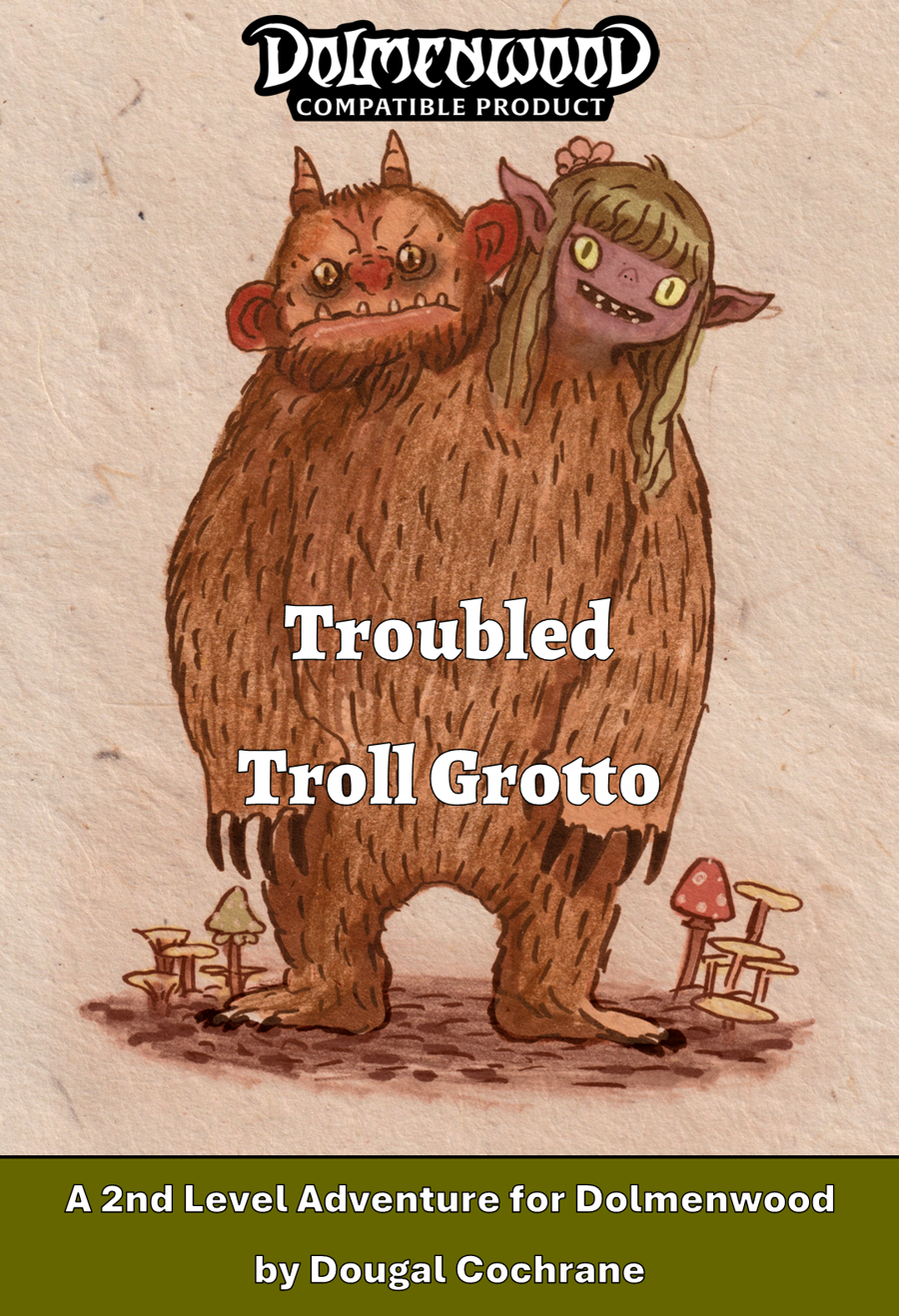
Troubled Troll Grotto
By Dougal Cochrane
Self Published
Dolmenwood
Level 2
Self Published
Dolmenwood
Level 2
South of Fog Lake, where the Cave Path plunges into the Ballow-Clefts, the horizon narrows to a ravine of glistening wet stone, steeped in shadow. Pale yellow celandine flowers bloom ankle-high in the gloom, their petals never fully opening except at noon when the sun shines in. Narrow clefts riddle the rock, most shallow and choked with roots. From one fissure seeps the earthy scent of moss and the sickly odour of mildew. The cavern leads down into the Grotto of Grundlow Greenteeth.
This 22 page adventure uses about nine pages to describe twelve rooms in an underground troll den/garden. It’s wordy, cutsy, and has both too much going on and not enough at the same time.
Can you be nicely formatted and STILL have wall of text issues? Why, yes, I think, now, that you can, after reading this. Is it wall of text, actually? I’m not so sure. It is certain A LOT of text. Because A LOT is going on. And the text, while not in traditional straight paragraph wall of text format, does repeat certain patterns that obfuscates.
But first, our setup. There’s a two-headed troll in a cave, with a grumpy head and a romantic head. He eats moss. He’s got a mossling cook enslaved. Mossling hates grumpy head and is in love with romantic head. Mossling grows herbs and puts grumpy head to sleep. Thus the Bog Red Button. Don’t wake the grumpy troll head … that you generally don’t know exists. Then, there’s a dude with a body switching thing. He’s trying to dig up a gate in the troll cave. He’s made several people switch bodies and minds. And a gang of skeleton thieves (as in, they are skeletons who are thieves.) is trying to knock off a prospector for his emeralds … and the prospector and his donkey have both been mind-switched. And, there’s a slumbering demon who does NOT give eternal youth when awakened. All that shit, and more, is in twelve rooms.
There’s A LOT going on in here. Rooms can range from a column to a page. And this is where things start to get rough. Rooms start with a little description in an offset box that is easy to locate. Let’s say, something like this: “Dark, earthen tunnel (wet stone floor) tangled with thick tree roots (beaded with dripping water). Several wooden buckets (half-filled) sit beneath the largest roots, placed to catch water. A skull is wedged in a crevice halfway along the tunnel.” So, king od a mashup from OSE style to paragraph style. I’m not sure it works. If this had been a paragraph, without parens, or terse OSE, I think it would have gone better. The sentences with lots of parens distracts. I mean, not a bad description by any means, I’m nitpicking here. Certainly better and more evocative than the vast majority of adventures.
And then we move on to the details of the contents of the rooms. And this is, I think, where things start to get rough in terms or formatting. There is a bolded heading and bullets with more details on what to see and do. Maybe a couple of words of description or explanation or mechanics or whatever. And they are nested, so, looking at one thing that has more subparts SHOULD be fine.
I think the issue here is sheer quantity and the use of the bold/bullet/indent format on, essentially, everything. Let us assume I have a bookshelf with 24 books on it. Each book gets a bolded heading/bullet, a sentence or two, and then I move on to the next. A few get a few indents and a mechanic or two. Everything is relatively mundane. Book eleven kills you when you open it. Meh, bad example. You REALLY need to know book eleven is there and it is the only book that does something meaningful, most of the rest is trivia, or else meaningless more or less to the adventure. Should book eleven be in the exact same format as everything else? Should it be highlighted? I’m not sure of my example, here, but I know the principle involved: when everything is special nothing is. I’m looking at a page of, I don’t know, a couple of major headings with read-aloud, major bolded headings, several subheadings, bolding at the start of major sections and in the paragraph text. It’s too much. EVERYTHING is calling for attention. You know how garbage adventures tell you what ‘AC” means and what “read-aloud” looks like? This may be the first adventure in which I think I actually have failed to understand the formatting involved. Everything is calling for your attention. What should I pay attention to? I’m not willing to say this format doesn’t work for complicated rooms, but I am willing to say that it doesn’t work HERE, on THESE rooms.
I don’t know what to say about interactivity. Don’t wakey wakey the grumpy troll head. Feed people sleeping herbs. Maybe do a deal with the skeleton dudes or the wizzo doing the body/mind swaps. I think it’s hard to dig through here and figure out what’s going on. I’m thinking of a room with a kind of west garbage pit in it. I’m thinking like the Trash Compactor scene from Star Wars. There’s a description. There’s a columns of bullets and bolding and sentences. And then there’s this note that a major NPC (mind swapped in to a donkey) is “braying piteously and thrashing to stay afloat in the muck.” Well fuck me man. That’s obviously the reason the room exists. Don’t you think maybe I should know about it sooner, and the party should as well? Why go through all this trouble of description and mechanics of staying afloat and then bury the lead? Most rooms are like this; something important is in there and it’s almost certainly NOT getting called to your attention in any meaningful way.
There’s a lot going on here in a short amount of space over a short amount of time. And, yet, it’s not written to run as a kind of madcap adventure, as that would imply. There’s not enough room for everything going on and there’s both too much going on in the room descriptions while, at heart, not an extreme level of interactivity. It LOOKS like there is, due to all the herbal concoctions and hooks and ind swaps and so on. But I don’t think any of it really means much at all. I’m not going to commit fully to that opinion, this thing is a bear to dig through and that may be impacting my judgement. But, also, I’m pretty sure I’m right. Just fucking walk around and stab everybody and everything is solved and you’re much safer in the end.
This is $5 at DriveThru. There is no preview. Boo! Hiis! We need a preview to make an informed purchasing decision.
https://www.drivethrurpg.com/en/product/563700/troubled-troll-grotto?1892600
Categories: Tabletop Gaming Blogs
Wednesday Comics: DC, August 1985 (week 2)
My mission: to read DC Comics' output from January 1980 (cover date) to the end of Crisis. This week, I'm looking at the comics that were on stands in the week of May 9, 1985.
Warlord Annual #4: This was the first Warlord Annual I bought off the stands, because it has a map of Skartaris in it, which will appear again in Who's Who. I reviewed this issue here.
Atari Force #20: Baron and Bareto/Villagran give the Martin Champion and by extension the rest of the Atari Force their day in court on New Earth. Thanks to Morphea and Targg the court gets a good look at the malevolence of the Destroyer through his psychic residue. Though they are exonerated, there are still powerful forces in New Earth society arrayed against them, so Champion and friends choose to use a device to jump to a new universe to see what else is out there. There's also another humorous Hukka story by Fleming/Giffen/Kesel.
Helfer tells us in the editorial that Atari Force isn't getting canceled because of sales (it's a middling seller) but because it was decided this was the right ending for the characters. I have to say, I'm a little skeptical. I buy it's middle of the pack on sales, but it is a licensed book. Surely a middling wholly DC owned book would be better for the company than having a publishing slot taken up by a licensed book? I do think, though, that the creative teams they've put on the book couldn't figure out anything more to do with the characters. Conway's later issues and Baron's entire run have mostly relied on them being on the ship but not encountering much interesting. No "strange new worlds and civilizations" here. The only mystery is why they didn't have anyone would better ideas, particularly when they were giving the book great artists?
Crisis on Infinite Earths #5: Wolfman and Perez/Ordway open with the Antimatter a bit confused. He thought he destroyed Earth-One and Two, but he hasn't gotten the victory he should have gotten. He lets Psycho-Pirate play the Flash while he investigates. Earth-One and Two have sort of merged and different eras in time are bleeding over. Harbinger and Alexander Luthor assemble a group of heroes to explain what is happening: the Monitor gave his life to power a transfer of the Earths to a netherverse to hide them from his Adversary, but now they now are trying to occupy the same space which will destroy them anyway. The only choice is to re-integrate them as a single universe as it was in the beginning.
We get a lot of cameos, and Travis Morgan, the Warlord, even gets some dialogue.
The Adversary adapts to these developments, though. He takes control of Red Tornado (In a limited series on sale now! Or then, I mean.) and transforms the android for his own purposes. Flash briefly breaks free of the Psycho-Pirate, and we get a glimpse of the shadowy Adversary's face, and he names himself as the Monitor, though he doesn't look like the Monitor we have seen.
Fury of Firestorm #38: Conway and Kayanan/Akin/Garvey have Stein arriving at Vandermeer University in Pittsburgh to start a new position only to find the campus afraid and under siege due to mysterious and vicious killings of facility members. Stein is in danger of becoming the next victim as he is attacked by the Weasel in his apartment. The Weasel keeps ranting about once he kills Stein, he'll be out of danger. Ronnie is out for a date with Doreen where Cliff accuses him of cheating, thanks to his uncharacteristically good grade on a test, when he is summoned to form Firestorm.
Thanks to poor vision and bumbling, both Stein and Raymond are captured by the Weasel and put in a deathtrap with molten steel about to pour on them.
Jonni Thunder #4: Thomases and Giordano bring this detective story/superhero hybrid to a conclusion. First, Jonni has a confrontation with "Slim" Chance which she only wins by wielding the power of the Thunderbolt without the idol. Then after some uncertainty and romantic tension with Harrison Trump, the rival PI, they are ambushed by Red Nails and her crew. Luckily, Jonni has now figured out that the power is in her, not the statue, which gives her the element of surprising, keeping them alive along enough for Detective Sanchez to swoop in with the police. The series ends with a hope for more Jonni Thunder adventures. We'll see how that goes.
Justice League of America #241: The Tuska/Machlan combination on art doesn't do this issue any favors, but mostly it's tough to get back into the New League after the disruptions. A conversation with Vixen prompts Aquaman to head out without telling anyone to find his estranged wife, Mera. Vibe agrees to let Steel date his daughter then gets a new less garish (slightly) costume. Then the team under J'onzz's leadership heads off to Canada where Amazo is on a rampage. J'onzz splits the party, and he and Dale are almost immediately attacked by the android.
Tales of the Teen Titans #56: Wolfman and Patton/DeCarlo bring Raven and the Fearsome Five (minus 1!) into the story. Agents of Gizmo assault STAR Labs to steal Neutron who has been brought in in a containment capsule. Raven shows up and deals with them ruthlessly, but when she realizes what she's doing, she instead uses her power to heal the patients there. Meanwhile, Gar greets Jericho and his mom at the airport to bury the hatchet, and Cyborg undergoes surgery to replace his obviously mechanical limbs with more natural looking ones. The rest of the Titans deal with an attack by the Fearsome, uh, Four, and are defeated in two engagements. The Fearsome Folks make off with a another encapsulated super-being from Tri-State Prison.
Vigilante #20: Wolfman/Kupperberg and Smith/Maygar reveal that giving up the Vigilante identity may not prove so easy for Chase. The Vigilante is still in the streets, more violent than ever, including killing a cop. Meanwhile, Chase seems like he's having a nervous breakdown as he is tormented by nightmares where he is the Vigilante committing these acts. He wonders if he might somehow have lost his mind and actually be responsible. Nightwing fights with the murderous Vigilante in the streets, but winds up getting thrown off a bridge. Later, he crawls in through Chase's window to confront him.

Warlord Annual #4: This was the first Warlord Annual I bought off the stands, because it has a map of Skartaris in it, which will appear again in Who's Who. I reviewed this issue here.

Atari Force #20: Baron and Bareto/Villagran give the Martin Champion and by extension the rest of the Atari Force their day in court on New Earth. Thanks to Morphea and Targg the court gets a good look at the malevolence of the Destroyer through his psychic residue. Though they are exonerated, there are still powerful forces in New Earth society arrayed against them, so Champion and friends choose to use a device to jump to a new universe to see what else is out there. There's also another humorous Hukka story by Fleming/Giffen/Kesel.
Helfer tells us in the editorial that Atari Force isn't getting canceled because of sales (it's a middling seller) but because it was decided this was the right ending for the characters. I have to say, I'm a little skeptical. I buy it's middle of the pack on sales, but it is a licensed book. Surely a middling wholly DC owned book would be better for the company than having a publishing slot taken up by a licensed book? I do think, though, that the creative teams they've put on the book couldn't figure out anything more to do with the characters. Conway's later issues and Baron's entire run have mostly relied on them being on the ship but not encountering much interesting. No "strange new worlds and civilizations" here. The only mystery is why they didn't have anyone would better ideas, particularly when they were giving the book great artists?

Crisis on Infinite Earths #5: Wolfman and Perez/Ordway open with the Antimatter a bit confused. He thought he destroyed Earth-One and Two, but he hasn't gotten the victory he should have gotten. He lets Psycho-Pirate play the Flash while he investigates. Earth-One and Two have sort of merged and different eras in time are bleeding over. Harbinger and Alexander Luthor assemble a group of heroes to explain what is happening: the Monitor gave his life to power a transfer of the Earths to a netherverse to hide them from his Adversary, but now they now are trying to occupy the same space which will destroy them anyway. The only choice is to re-integrate them as a single universe as it was in the beginning.
We get a lot of cameos, and Travis Morgan, the Warlord, even gets some dialogue.
The Adversary adapts to these developments, though. He takes control of Red Tornado (In a limited series on sale now! Or then, I mean.) and transforms the android for his own purposes. Flash briefly breaks free of the Psycho-Pirate, and we get a glimpse of the shadowy Adversary's face, and he names himself as the Monitor, though he doesn't look like the Monitor we have seen.

Fury of Firestorm #38: Conway and Kayanan/Akin/Garvey have Stein arriving at Vandermeer University in Pittsburgh to start a new position only to find the campus afraid and under siege due to mysterious and vicious killings of facility members. Stein is in danger of becoming the next victim as he is attacked by the Weasel in his apartment. The Weasel keeps ranting about once he kills Stein, he'll be out of danger. Ronnie is out for a date with Doreen where Cliff accuses him of cheating, thanks to his uncharacteristically good grade on a test, when he is summoned to form Firestorm.
Thanks to poor vision and bumbling, both Stein and Raymond are captured by the Weasel and put in a deathtrap with molten steel about to pour on them.

Jonni Thunder #4: Thomases and Giordano bring this detective story/superhero hybrid to a conclusion. First, Jonni has a confrontation with "Slim" Chance which she only wins by wielding the power of the Thunderbolt without the idol. Then after some uncertainty and romantic tension with Harrison Trump, the rival PI, they are ambushed by Red Nails and her crew. Luckily, Jonni has now figured out that the power is in her, not the statue, which gives her the element of surprising, keeping them alive along enough for Detective Sanchez to swoop in with the police. The series ends with a hope for more Jonni Thunder adventures. We'll see how that goes.

Justice League of America #241: The Tuska/Machlan combination on art doesn't do this issue any favors, but mostly it's tough to get back into the New League after the disruptions. A conversation with Vixen prompts Aquaman to head out without telling anyone to find his estranged wife, Mera. Vibe agrees to let Steel date his daughter then gets a new less garish (slightly) costume. Then the team under J'onzz's leadership heads off to Canada where Amazo is on a rampage. J'onzz splits the party, and he and Dale are almost immediately attacked by the android.

Tales of the Teen Titans #56: Wolfman and Patton/DeCarlo bring Raven and the Fearsome Five (minus 1!) into the story. Agents of Gizmo assault STAR Labs to steal Neutron who has been brought in in a containment capsule. Raven shows up and deals with them ruthlessly, but when she realizes what she's doing, she instead uses her power to heal the patients there. Meanwhile, Gar greets Jericho and his mom at the airport to bury the hatchet, and Cyborg undergoes surgery to replace his obviously mechanical limbs with more natural looking ones. The rest of the Titans deal with an attack by the Fearsome, uh, Four, and are defeated in two engagements. The Fearsome Folks make off with a another encapsulated super-being from Tri-State Prison.

Vigilante #20: Wolfman/Kupperberg and Smith/Maygar reveal that giving up the Vigilante identity may not prove so easy for Chase. The Vigilante is still in the streets, more violent than ever, including killing a cop. Meanwhile, Chase seems like he's having a nervous breakdown as he is tormented by nightmares where he is the Vigilante committing these acts. He wonders if he might somehow have lost his mind and actually be responsible. Nightwing fights with the murderous Vigilante in the streets, but winds up getting thrown off a bridge. Later, he crawls in through Chase's window to confront him.
Categories: Comic Book Blogs, Tabletop Gaming Blogs
40 Years a Gamer: The Artists Who Inspired Me – Early Artistic Luminaries of TSR
I began playing D&D during the heyday of the artists known as the “Four Horsemen” of TSR—Elmore, Easley, Caldwell, and Parkinson—which I discussed in my previous post on the artists who inspired my TTRPG gaming.
However, I switched from BECMI D&D over to AD&D around the winter of 1987, if memory serves. I remember it vividly because during one of those very first sessions, I was running the game as the Dungeon Master while listening to the American Top 40 end-of-year countdown. But I had actually been buying and reading the AD&D 1st Edition books for a few months before we ever rolled dice.
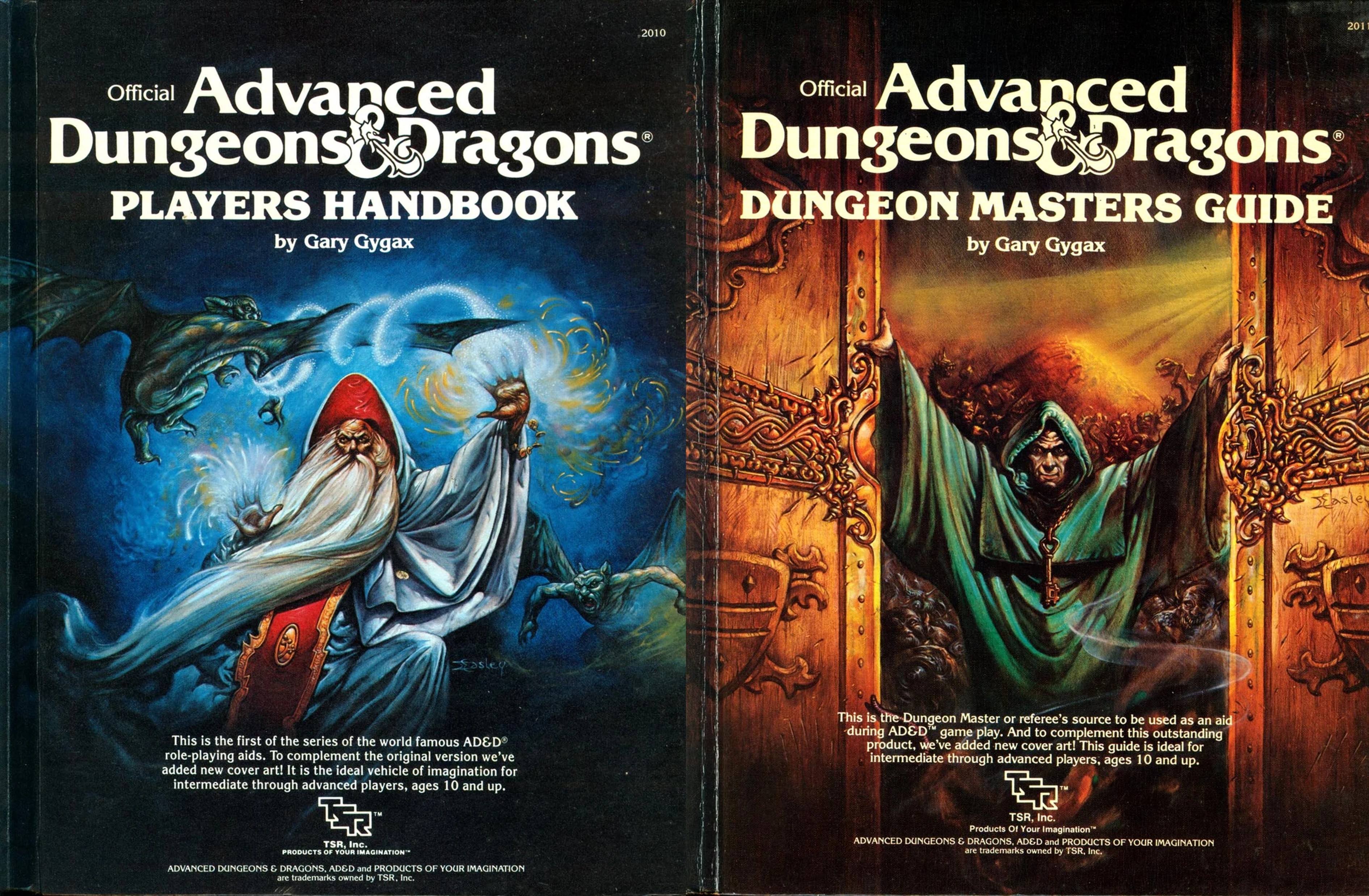
My original AD&D 1e books were the orange-spine printings featuring the iconic covers by Jeff Easley. I got the Dungeon Masters Guide (DMG) first, followed by the Players Handbook (PHB). The only two AD&D books I owned that were not orange-spine editions were the original Monster Manual (MM) and a copy of Deities & Demigods (the rare printing that still included the Cthulhu and Melnibonéan Mythos!), which I scored from a neighbor’s garage sale. You can read the full story about that lucky find right here.
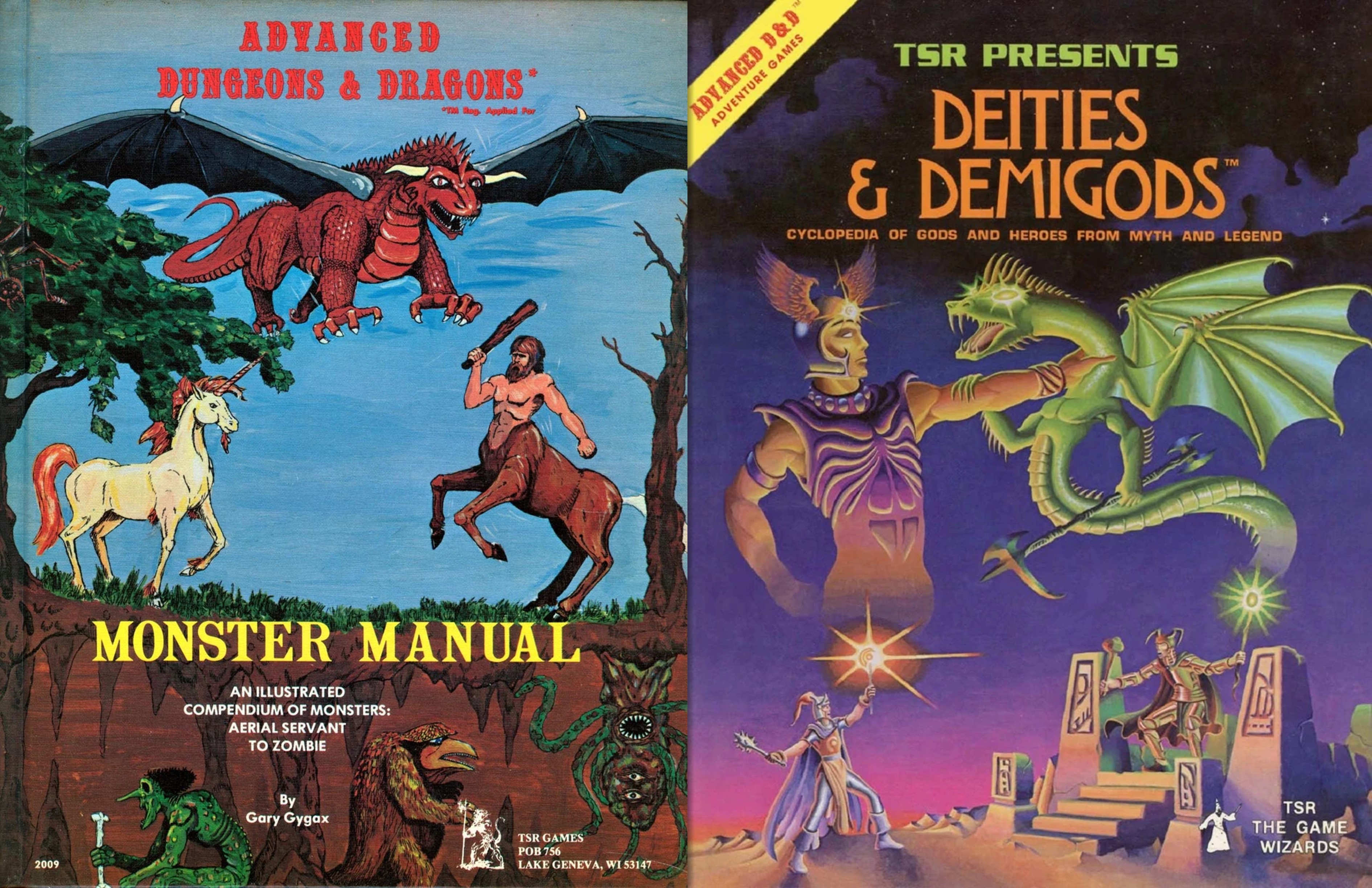
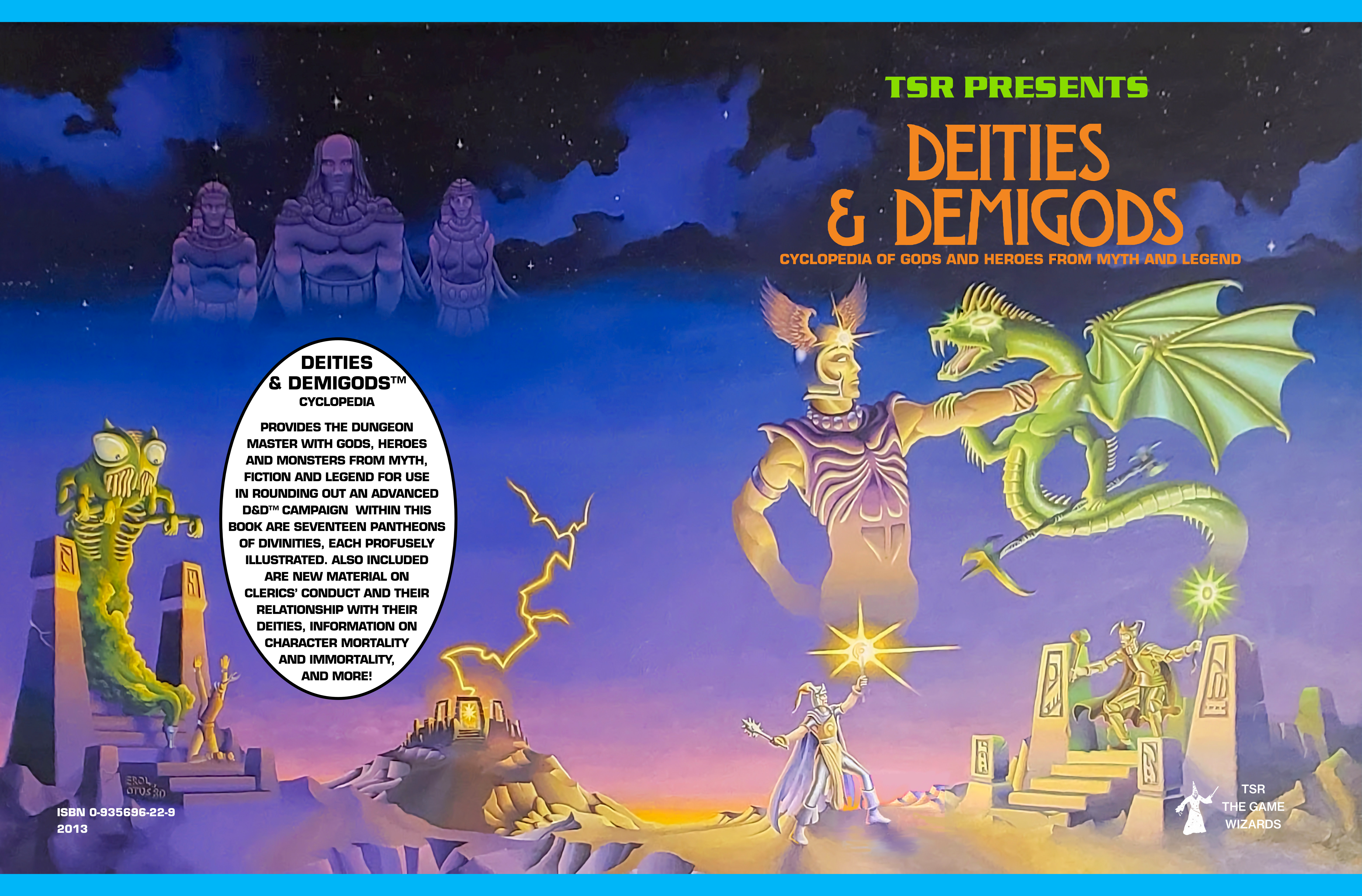
The covers for Deities & Demigods by Erol Otus and the Monster Manual by David A. Trampier served as my true introduction to TSR’s earlier art style. But, despite my books sporting the newer Easley covers on the outside, the interiors still featured the original 1e layout and illustrations. And I must admit… at first, I was turned off by them.
Let me explain before you burn me at the stake!
I came into the hobby through the Mentzer Red Box and the rest of the BECMI sets. While they weren’t anywhere near as cleanly laid out as modern games, they had a very approachable, easy-to-use style. They were specifically designed to welcome you in and teach you the game.
When you dive into the 1e PHB—and especially the DMG—they are not easily approachable books. I know now that their design came directly from the layout style of miniature wargaming rulebooks, but to young me, they just felt like inscrutable, textbook-like mystery tomes.
To add to my confusion, I started reading the books in the opposite order to their publication! Starting with the DMG didn’t make much sense if you hadn’t read the PHB first. I eventually figured it out and switched books, but coming directly from the polished look of BECMI, I was a little disappointed by the interior art.
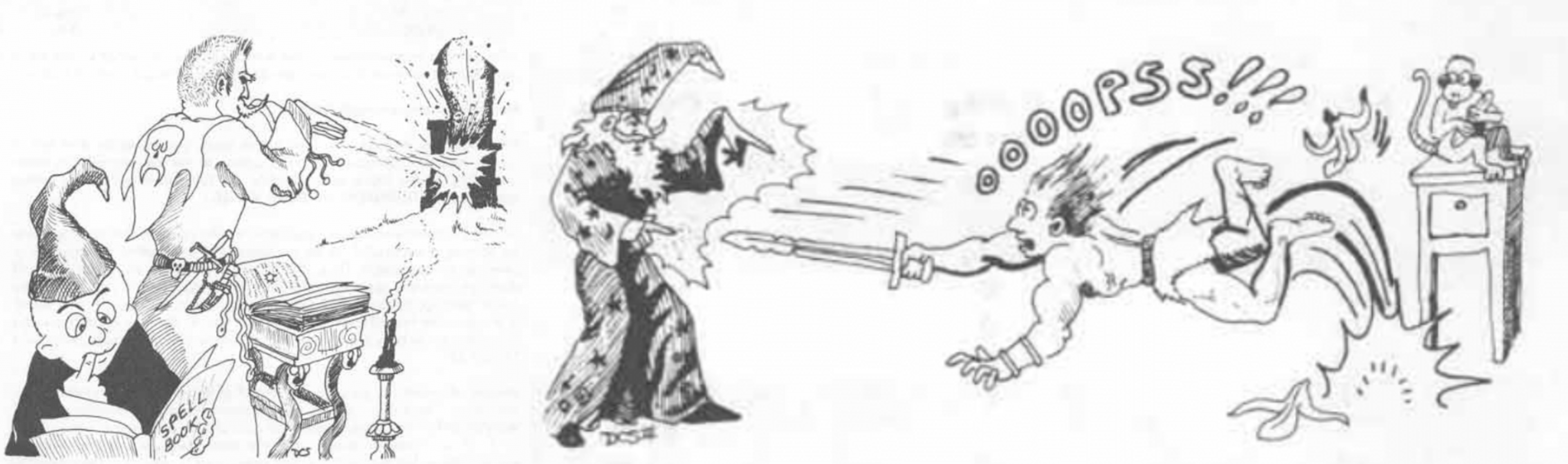
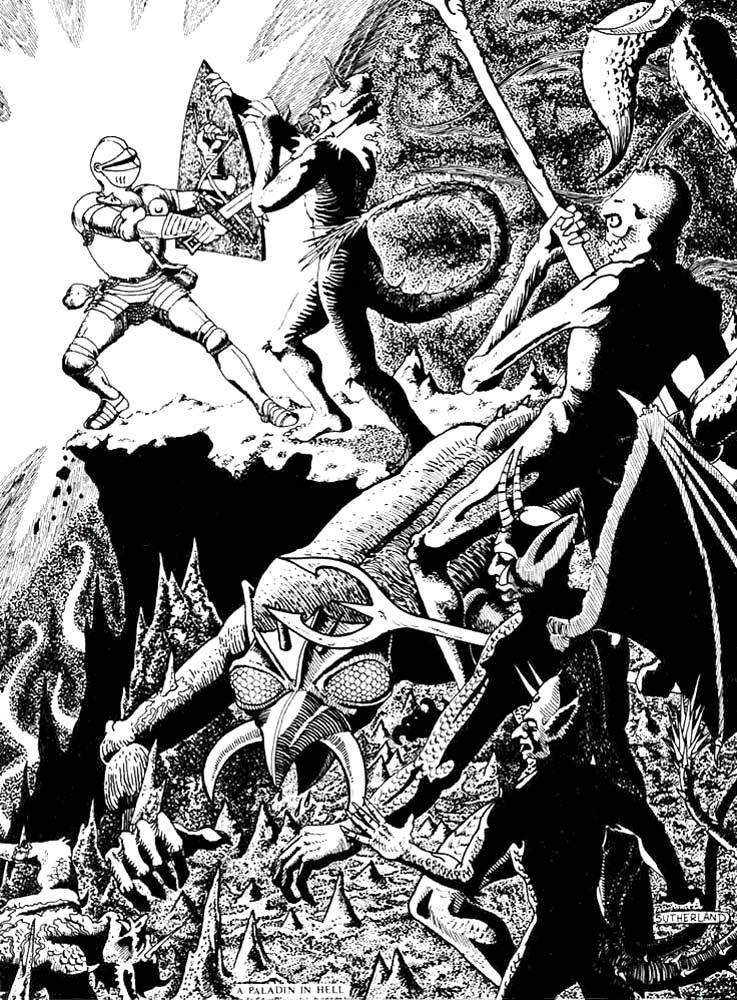
The cartoonish illustrations next to the Intelligence and Dexterity tables in the PHB were okay, but they didn’t quite match my epic expectations for the game. I’ve also never been a huge fan of the “races” lineup on page 18 by David Sutherland. But then I flipped a few pages and saw his A Paladin in Hell full-page piece… and I was absolutely blown away!
The MM had more illustrations that captured my imagination. But it was truly through the original Deities & Demigods that I learned to appreciate the old-school, foundational art of early TSR deeply. So, let me talk about these luminaries—Jeff Dee, Erol Otus, David C. Sutherland, David A. Trampier, and Jim Roslof—the artists who were there at the birth of the hobby, and how their work inspired me!
Jeff Dee
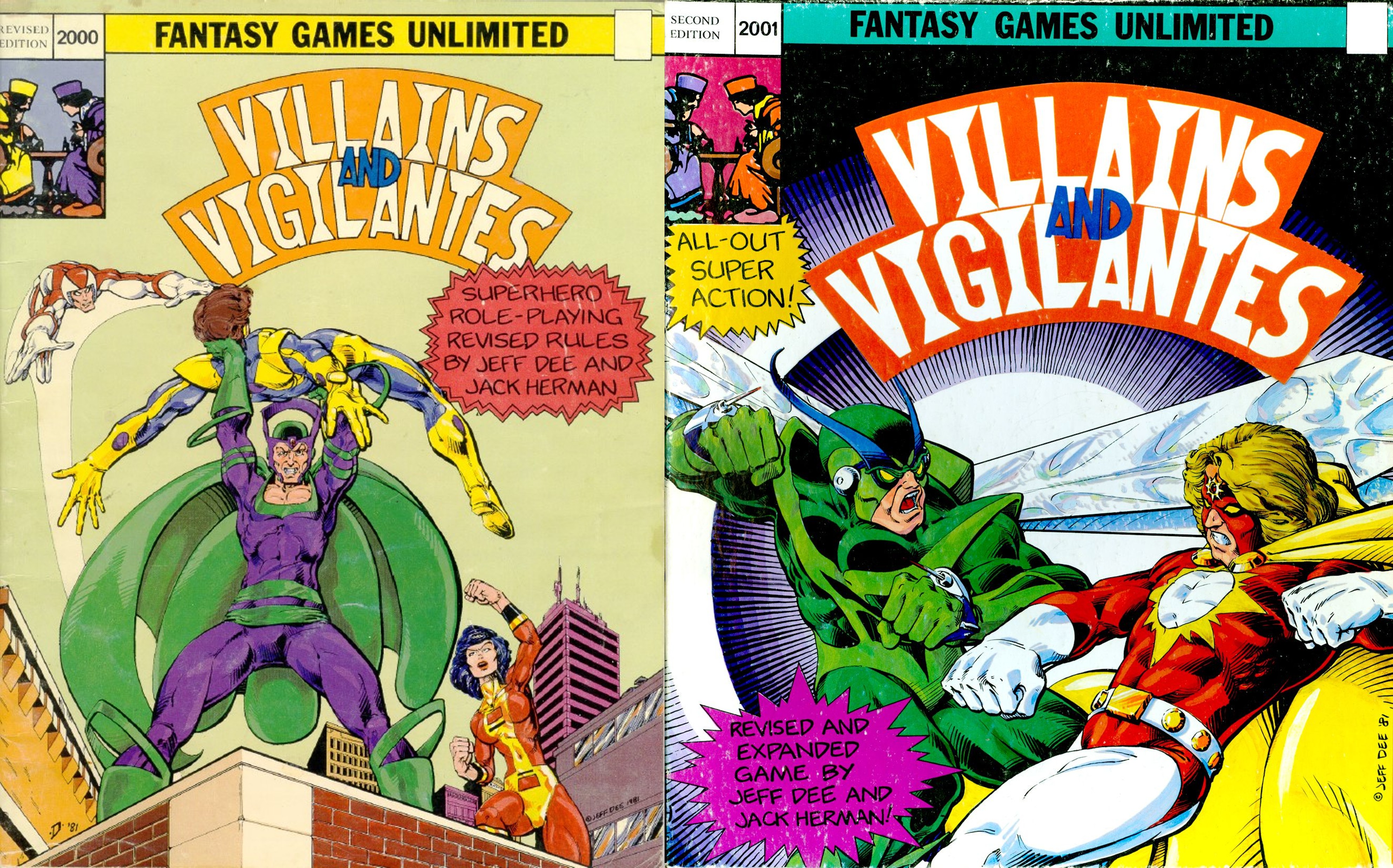
Of all the artists who originally worked for TSR, Jeff Dee is my absolute favorite. He has a distinct, clean style with clear comic-book influences. He didn’t just work on D&D; he also illustrated Villains & Vigilantes and The Mighty Protectors. I was actually lucky enough to interview him here on the blog back in 2015.
I must admit that of all the original TSR artists, his was the only name I knew by heart for a long time. As my interest in the hobby grew, I learned about the other legends and their trajectories, but Dee’s name always stuck with me. Strangely enough, I had no idea what he actually looked like. So, when I started watching episodes of The Atheist Experience and heard his name, I thought, “Huh, this guy has the same name as the fantasy artist.” Little did I know they were the same person!
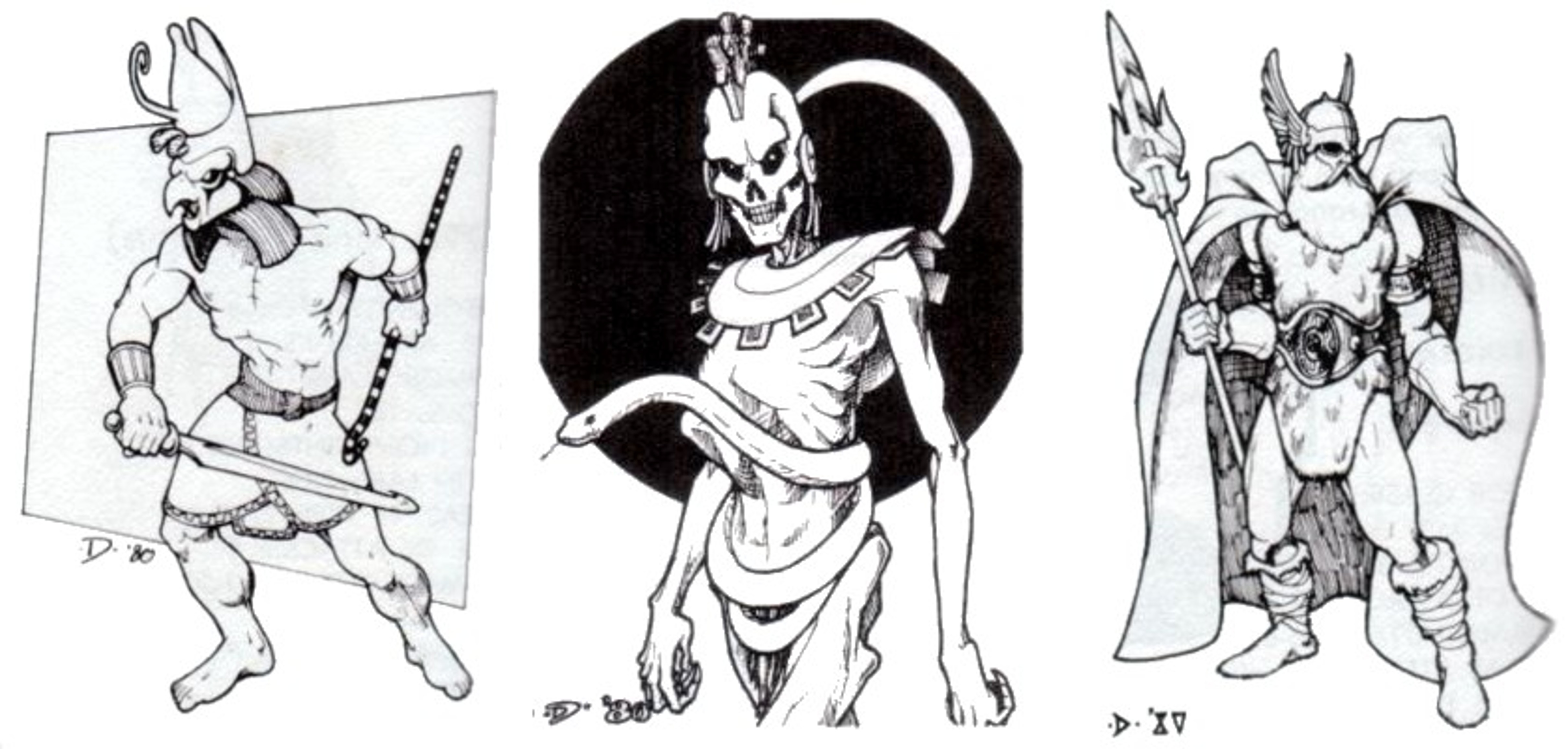
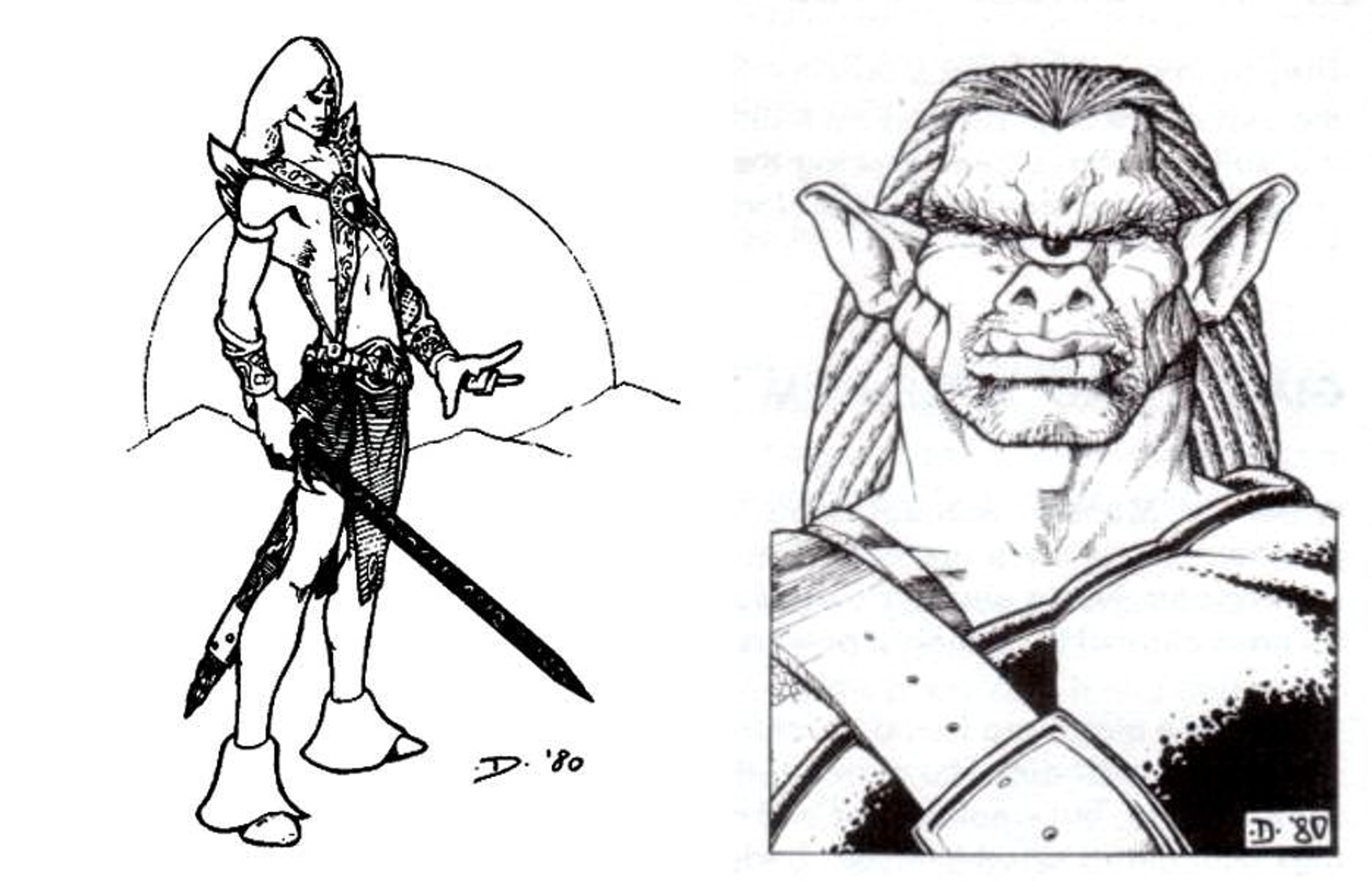
His work on the Norse, Egyptian, Melnibonéan, and Non-Human Mythos sections of Deities and Demigods blew me away. That book was my first introduction to Elric of Melniboné, and Dee’s illustration of Gruumsh is still exactly how I imagine the orc god today. Jeff worked on a lot of classic modules that I read but never actually played, and because of his distinctive line work, even as a teenager, I could immediately tell when he had drawn something.
Later on, I discovered his art for Villains & Vigilantes, which completely solidified my love for his work. His aesthetic reinforced for me the connection between comic books and the fantasy genre, which I still think is a perfect fit.
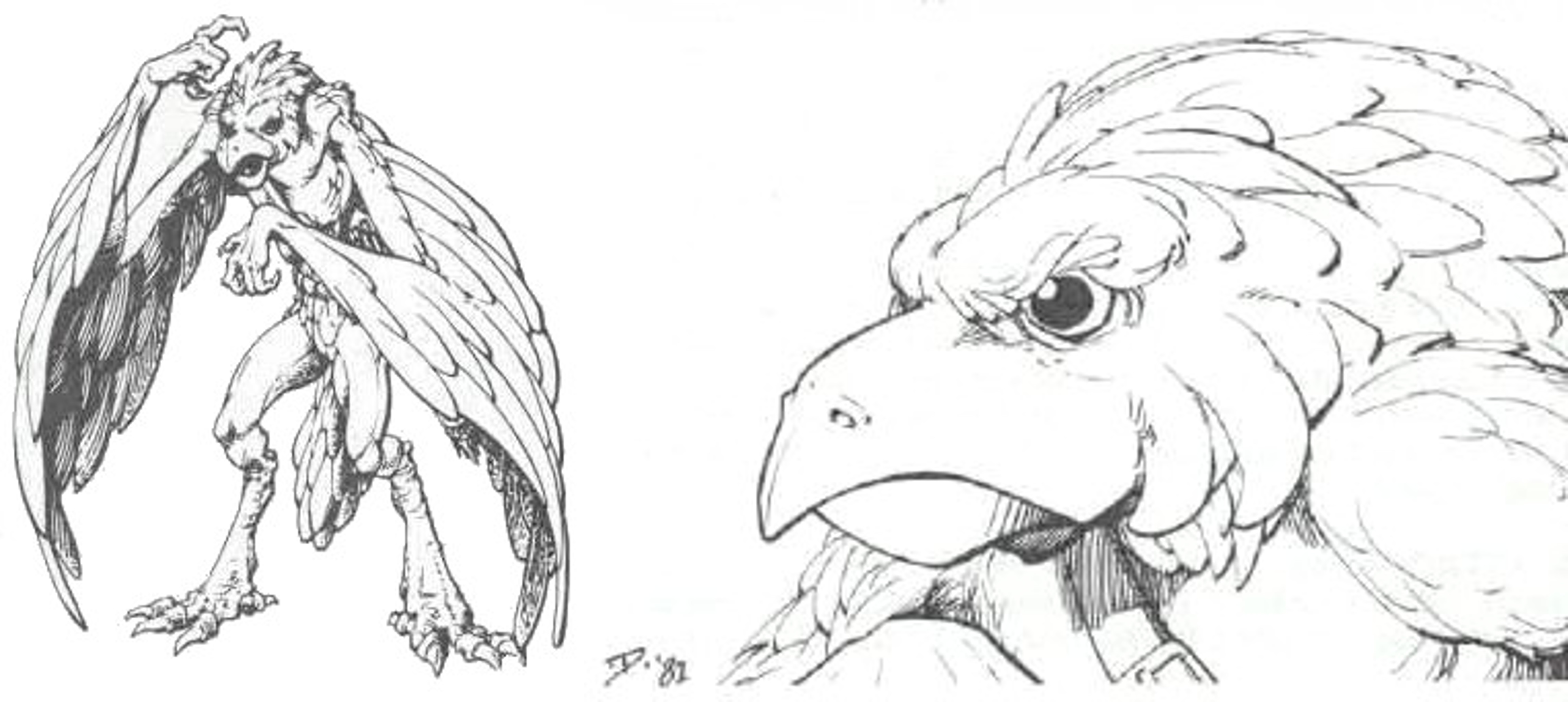
Jeff Dee didn’t draw any of the monsters in the original MM. But he did draw my absolute favorite monster in the Fiend Folio—which also happens to be my favorite non-traditional D&D ancestry, the Aarakocra! Their physiology in the game may have changed over the years (they now have separate arms and wings), but to me, Dee’s illustration is the true Aarakocra.
Erol Otus
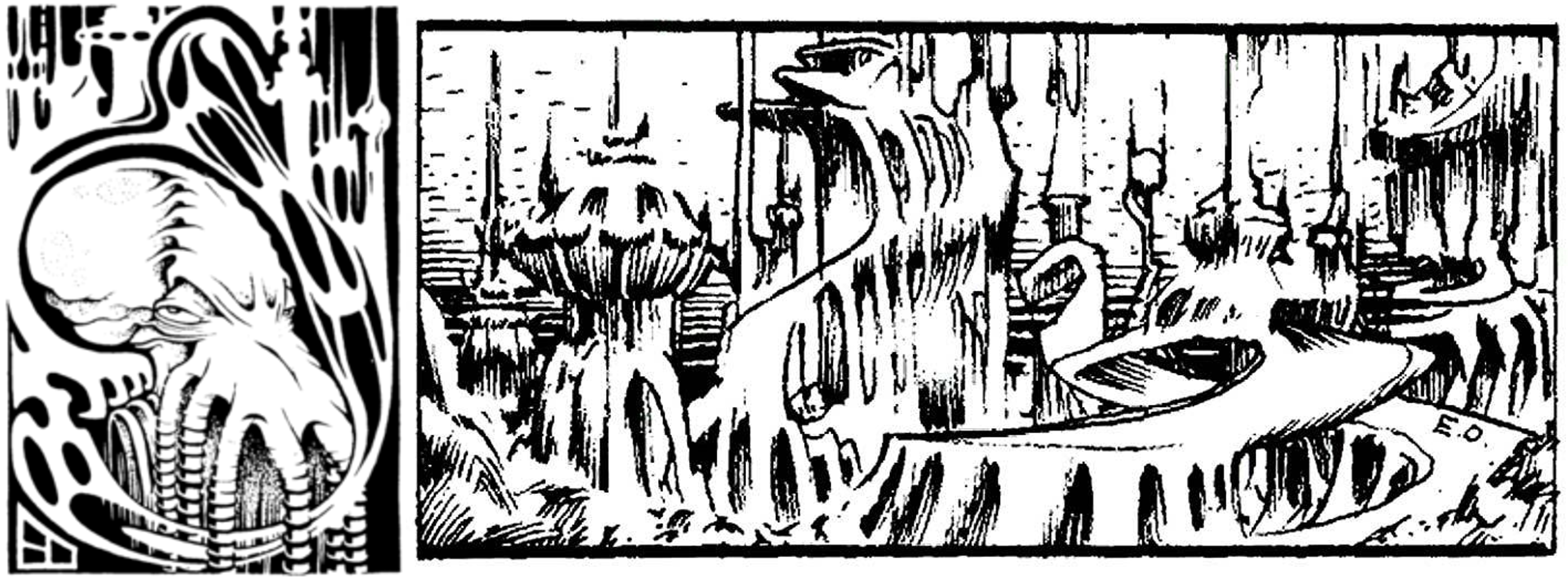
Otus is my second favorite artist from this period. Just like Jeff Dee introduced me to Elric, Otus introduced me to Cthulhu via Deities & Demigods. While I wouldn’t discover H.P. Lovecraft’s actual writings or the Call of Cthulhu RPG until a year later, this book was my very first exposure to the Mythos.
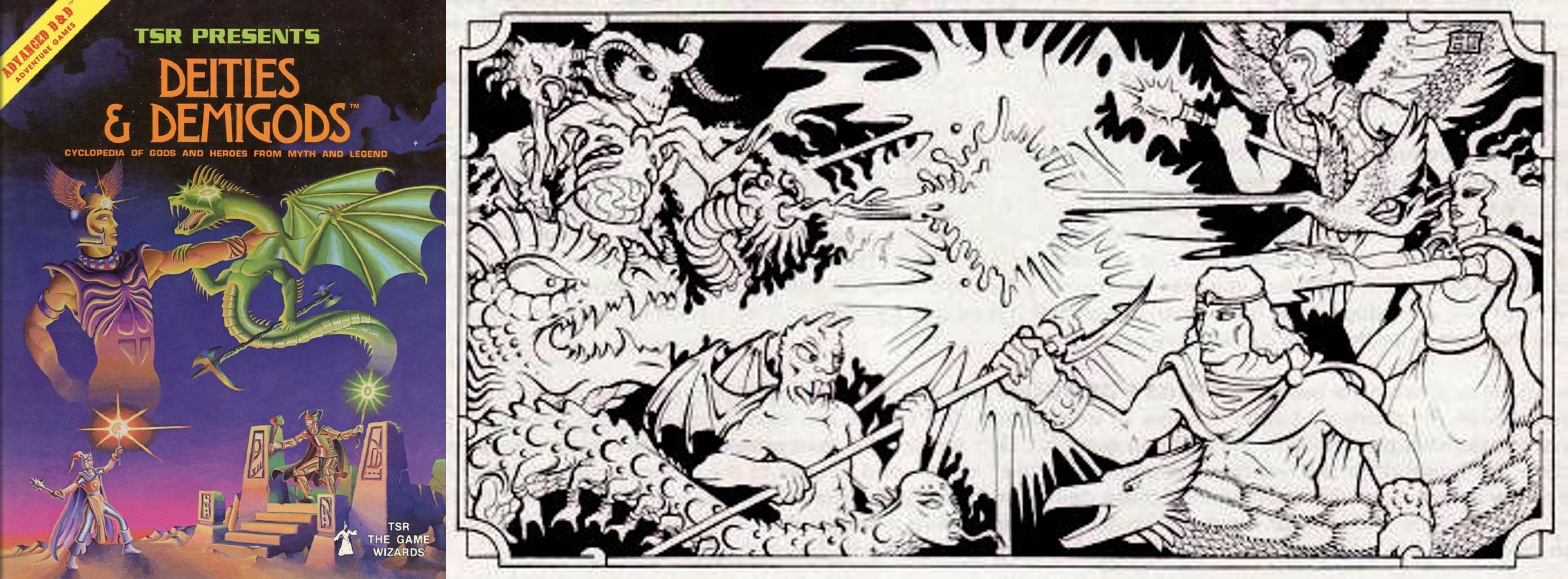
Erol Otus’ cover for that book absolutely beckoned me. While Sutherland’s MM cover was great for showing you the creatures inside, Otus’ Deities & Demigods cover illustrated the terrifying, cosmic connection between mortals and deities perfectly and efficiently.
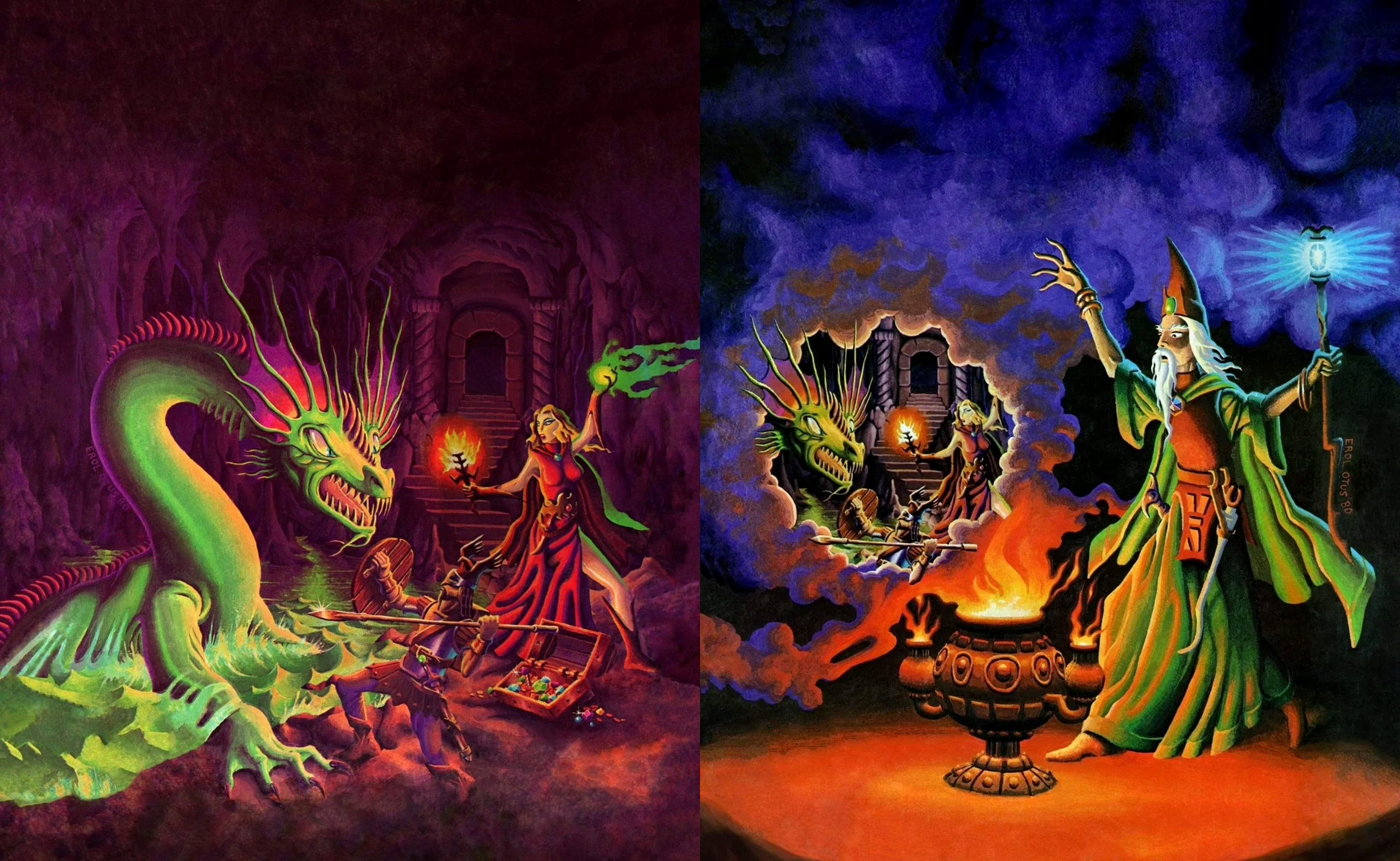
I would only discover and come to appreciate his iconic covers for the Basic and Expert sets much later in the late 90s, when I finally tracked down used copies. Perhaps because I discovered it so much later, his dragon on the Basic set isn’t my definitive mental image of a dragon—Elmore had already imprinted that concept onto me with his Red Box art.
But when I began collecting old Gamma World supplements and adventures, I was thrilled to find his work scattered throughout that line as well.
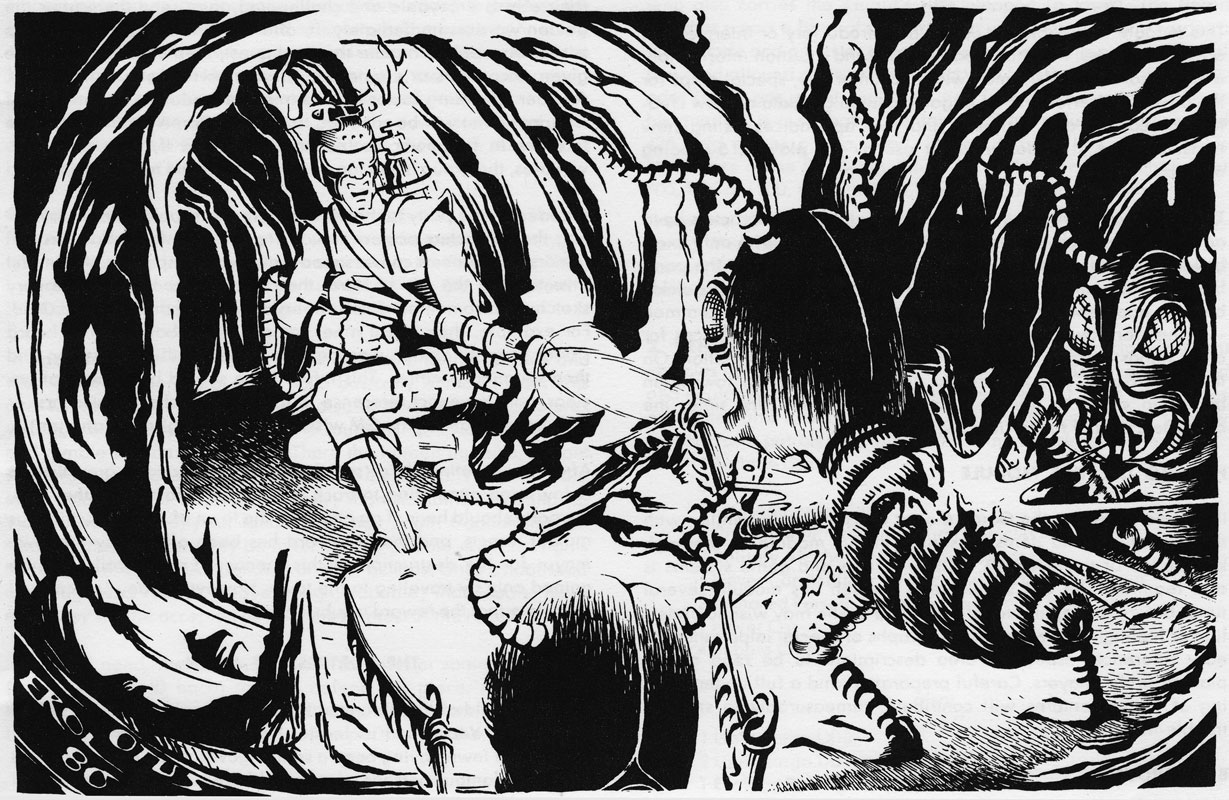
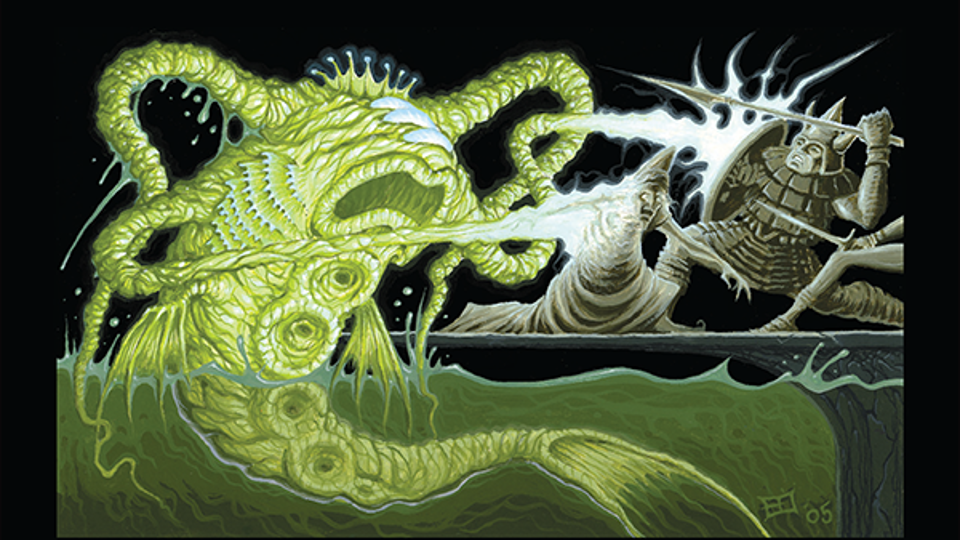
Erol Otus’ modern work is reminiscent of a psychedelic dream, and I mean that as the highest possible praise. His style is a perfect fit for the weird, gonzo feel of Goodman Games’ Dungeon Crawl Classics (DCC). He even drew one of my favorite interpretations of my favorite D&D Cthulhian monster—the Aboleth—for the cover of DCC Module #25: The Dread Crypt of Srihoz.
David C. Sutherland III
Sutherland wasn’t my favorite artist of the bunch, but his A Paladin in Hell is arguably a masterpiece of early RPG art. When I rolled up my very first character—a Paladin—that illustration was exactly how I imagined him!
His cover for the DMG is an undeniable classic. It’s incredibly evocative, and much like the MM cover, I can deeply appreciate the nostalgia it elicits and how it influenced later generations of gamers, even if it isn’t my personal favorite piece.
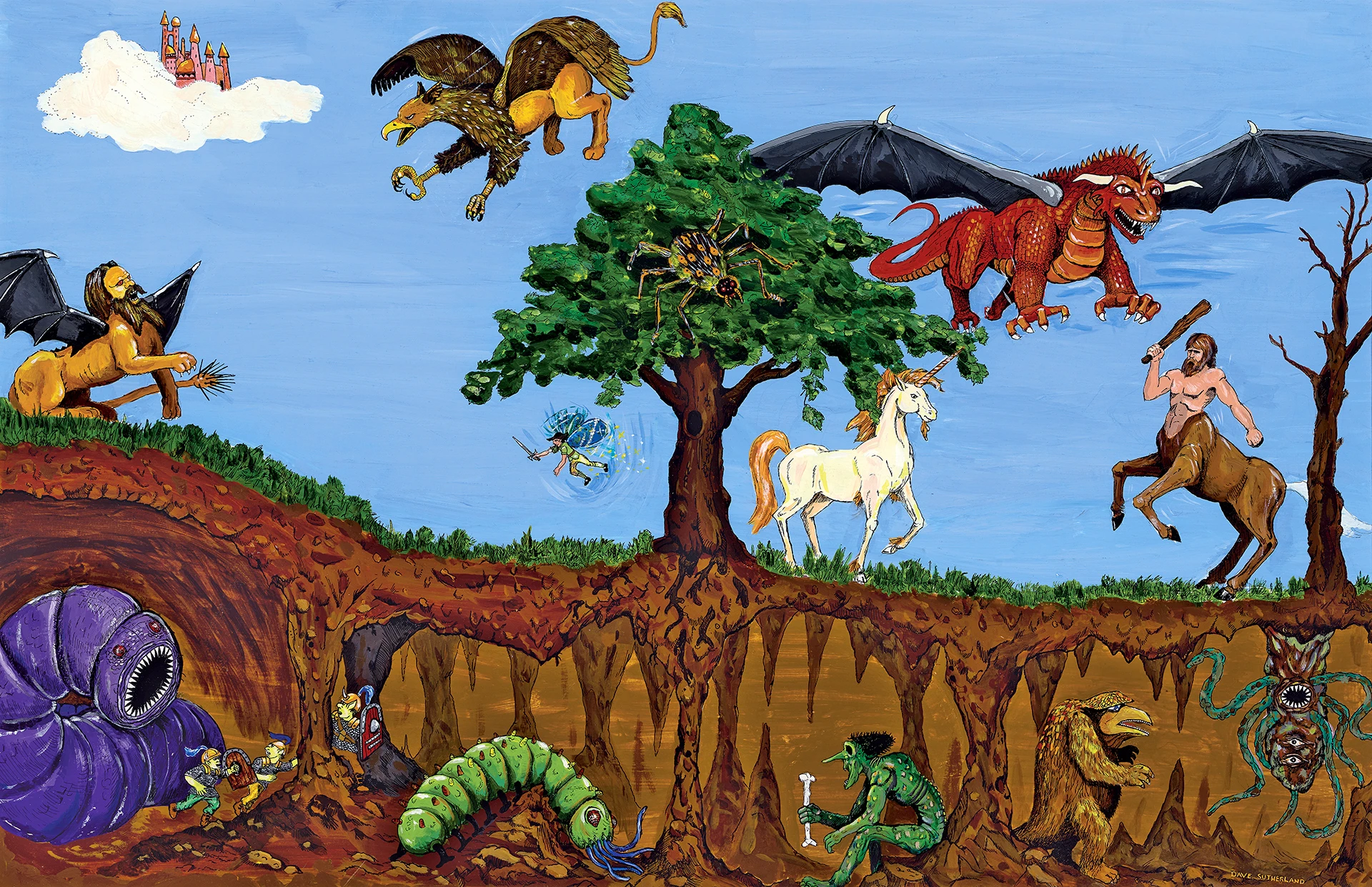
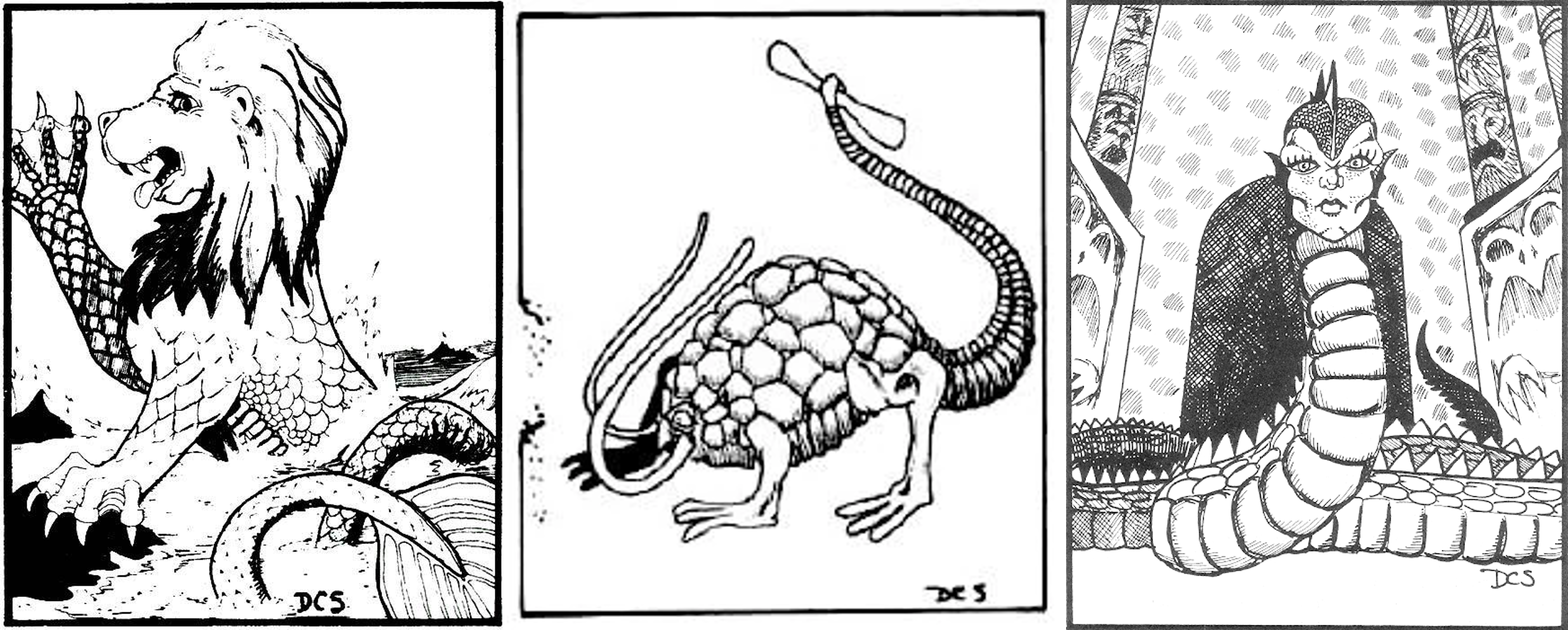
What I do love is his monster illustrations inside the Monster Manual. Some of them were quite simple, but they captured my imagination completely. I prefer his smaller, in-text illustrations to his full-page spreads. His Mind Flayer is so basic, yet incredibly charming. I love his Sea Lion and Rust Monster, but his Naga remains my absolute favorite in the book.
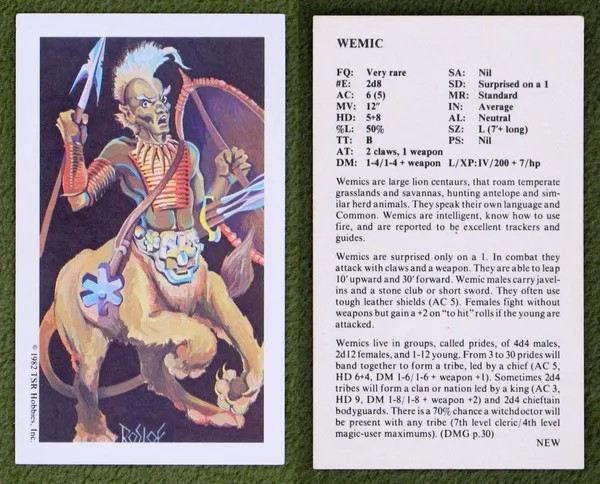
Fun fact: While researching this post, I discovered that Sutherland designed my favorite creature from the Monster Manual II—the Wemic—which was first published in Monster Cards Set 3 with art by Jim Roslof!
David A. Trampier (DAT)
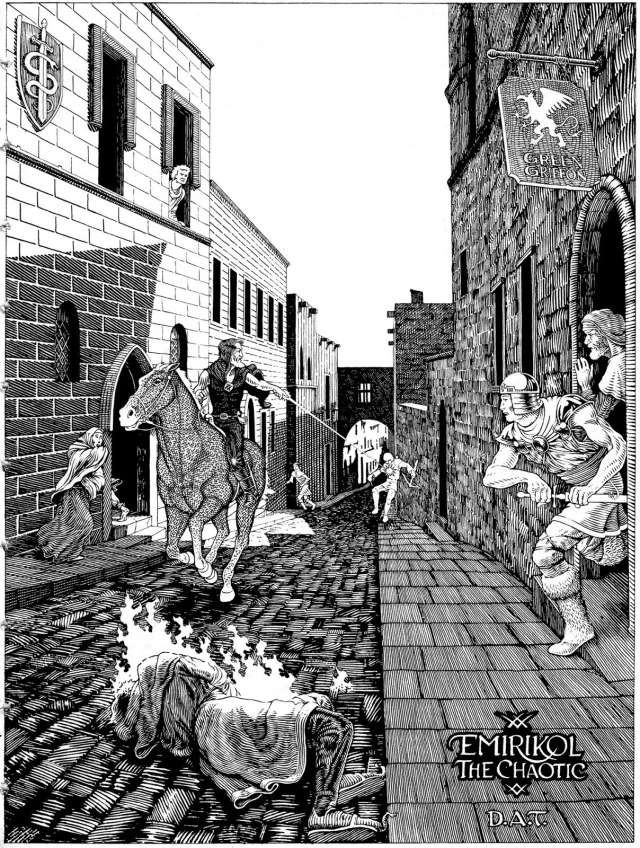
I was never really into Trampier’s Wormy comic strip; it just didn’t catch my fancy. I primarily knew his art from the AD&D 1e rulebooks. His illustration of Emirikol the Chaotic riding through the streets in the DMG is my favorite piece in that entire book. The sheer action and excitement of it invited you to imagine the story happening around the frame. I desperately wanted to play in a game that felt like that!
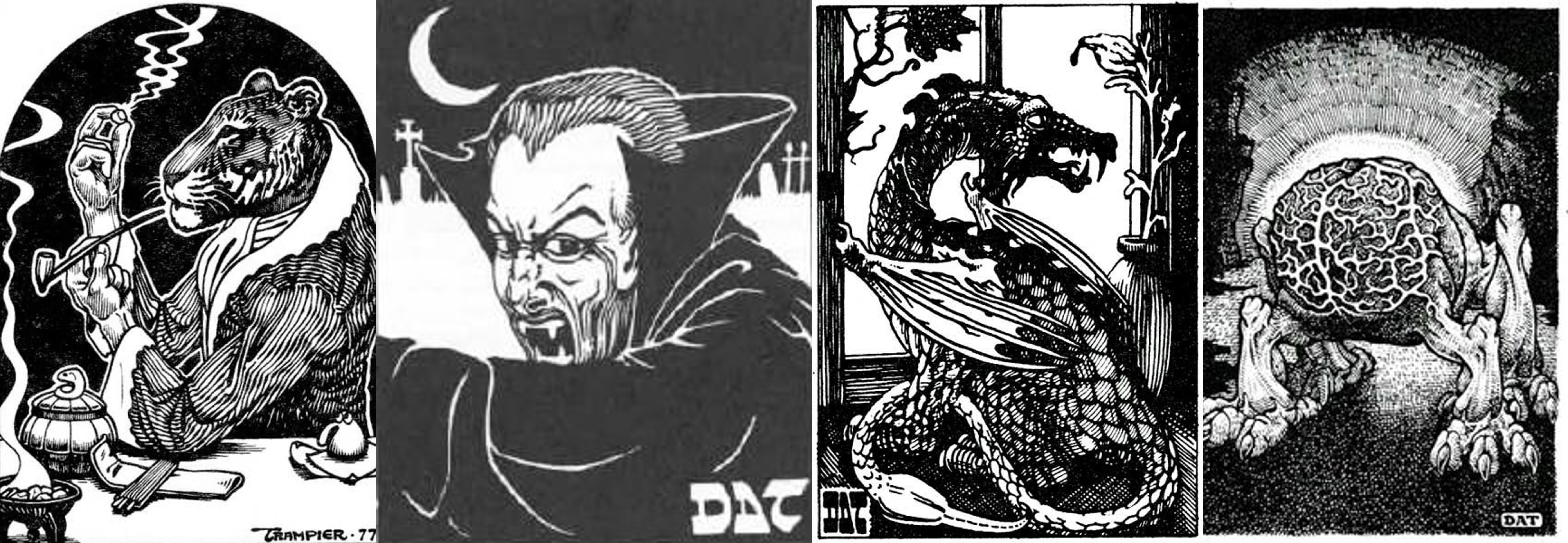
In the Monster Manual, his illustrations for the Rakshasa, Vampire, Pseudodragon, and Intellect Devourer immediately made me want to throw those monsters at my players.
I finally got a second-hand copy of the PHB featuring his original cover around 1993, and of the three original AD&D core books, it is my favorite cover. It is the perfect classic murder-hobo scene; it captures the dark, dangerous feel of an old-school dungeon crawl.
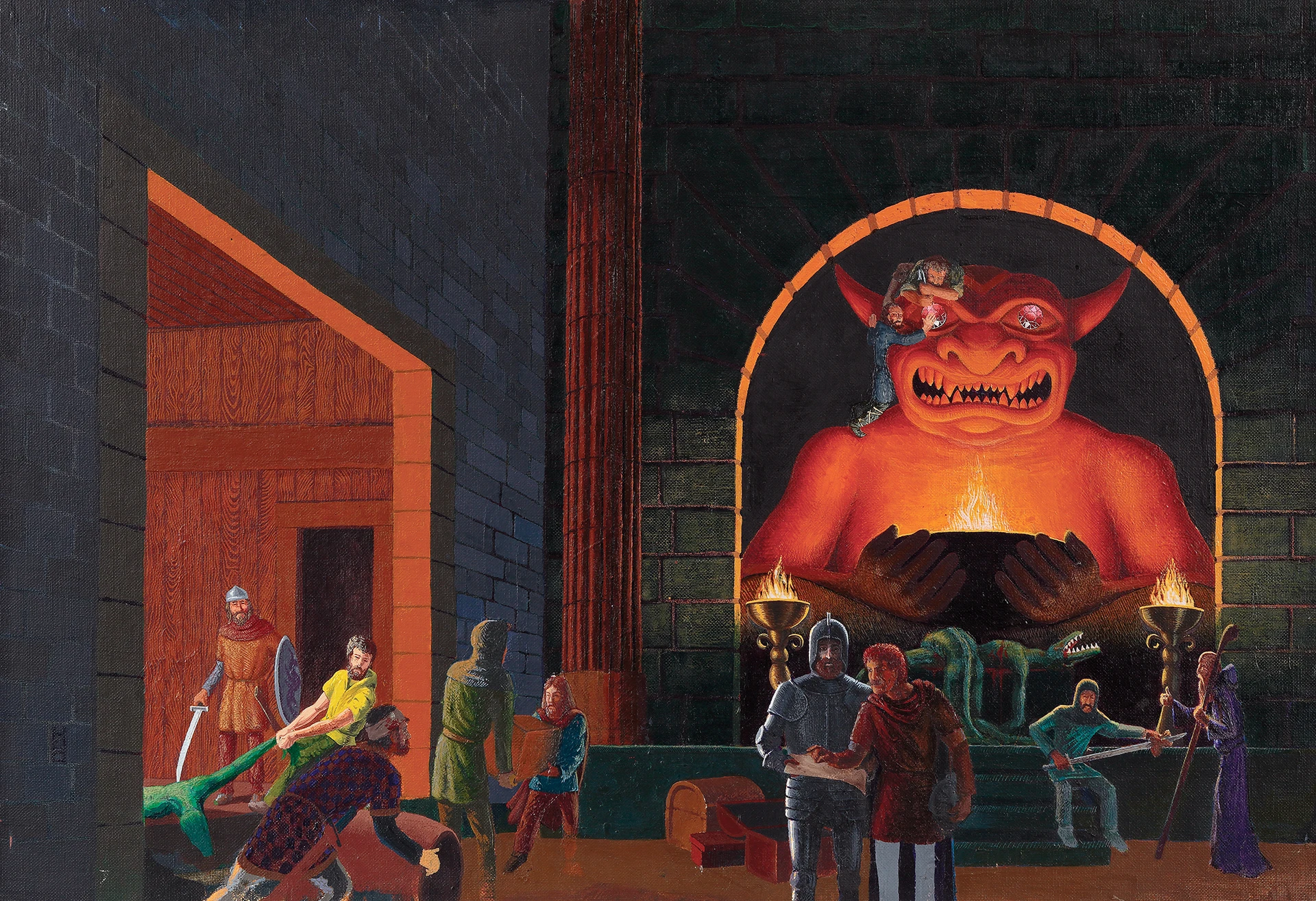
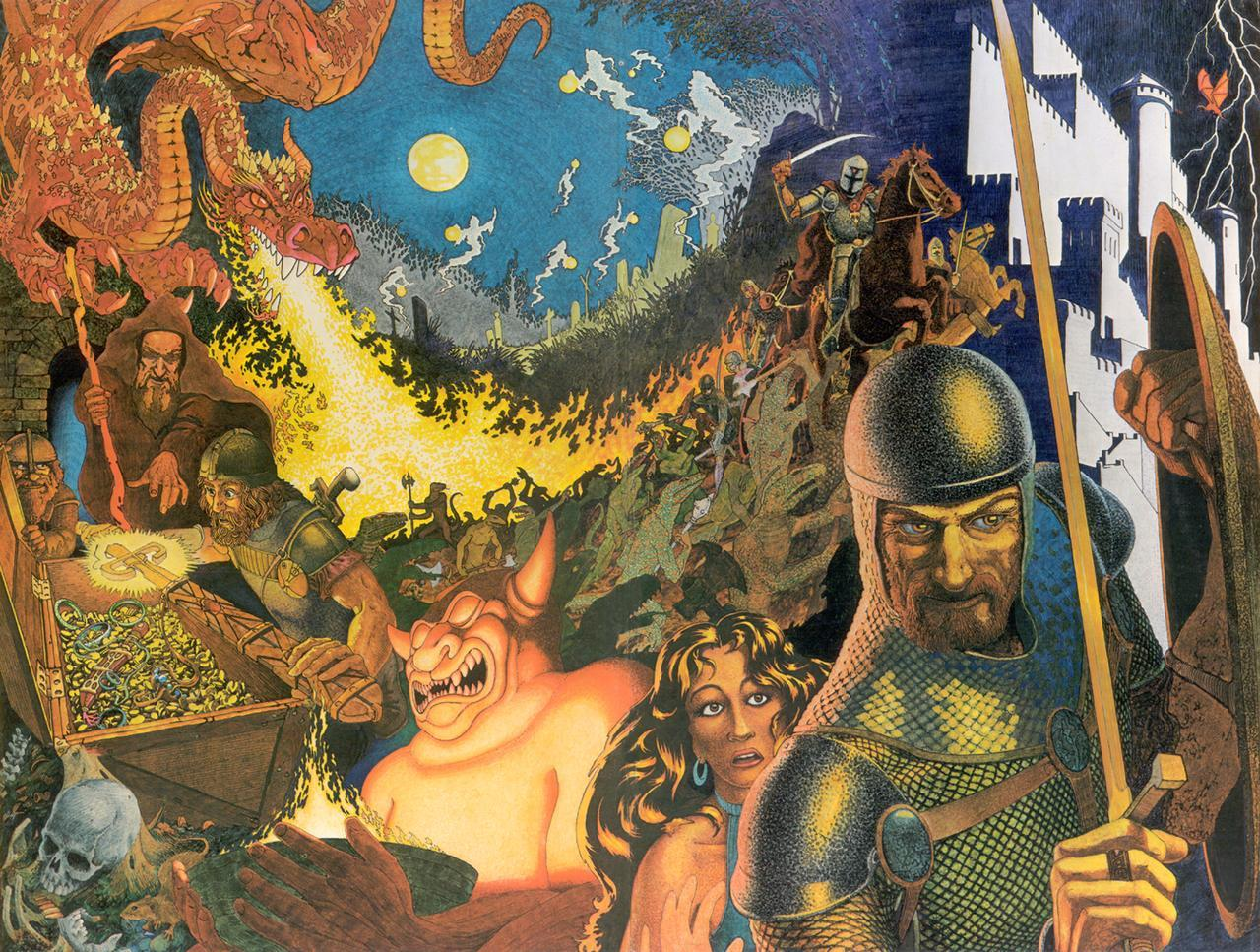
However, my second favorite piece of art by DAT is something I never actually owned: the panoramic art for the original AD&D 1e Dungeon Masters Screen. It is a masterpiece. You might argue it’s technically better than Emirikol, but the DMG art remains near and dear to my heart simply because of how deeply it inspired my games.
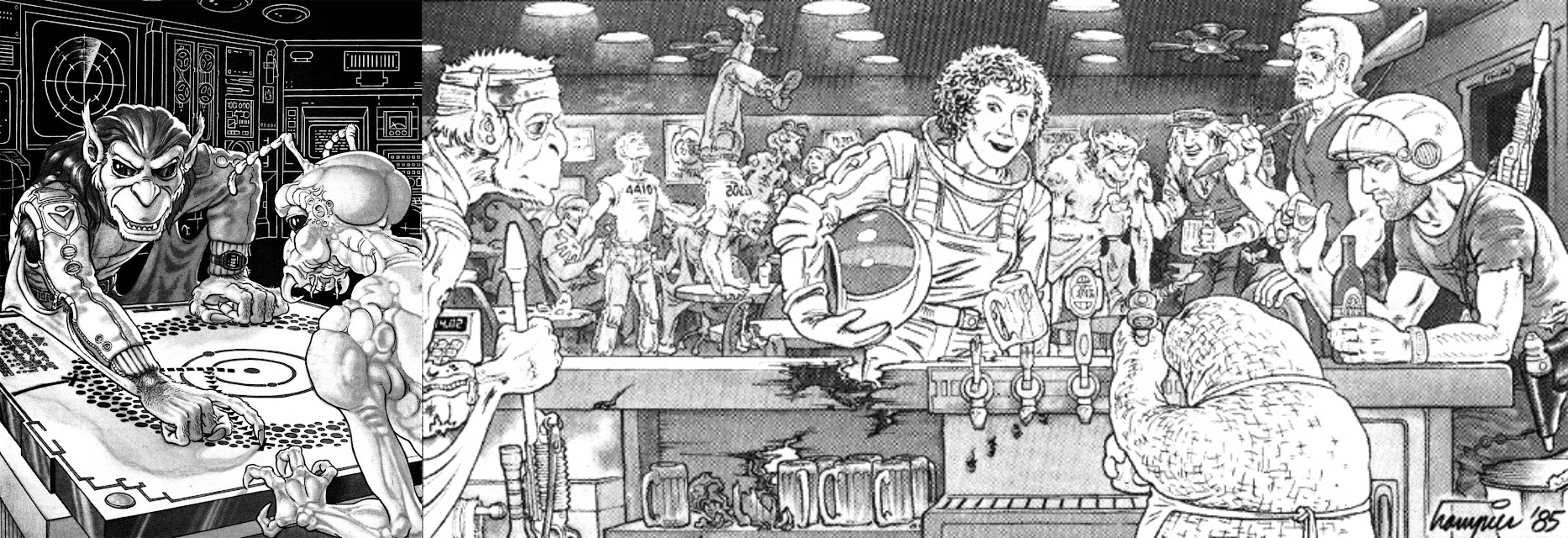
Another fun fact I learned while writing this: DAT also created illustrations for one of my favorite sci-fi games, Star Frontiers!
Jim Roslof
When I originally outlined this post, Roslof wasn’t on my list. But as I flipped through my old books for research, I saw his full-page illustration of Thor. I immediately realized just how important that specific piece of art was to sparking my lifelong interest in Norse mythology. It is a powerful, inspiring image and an absolute classic of D&D art.
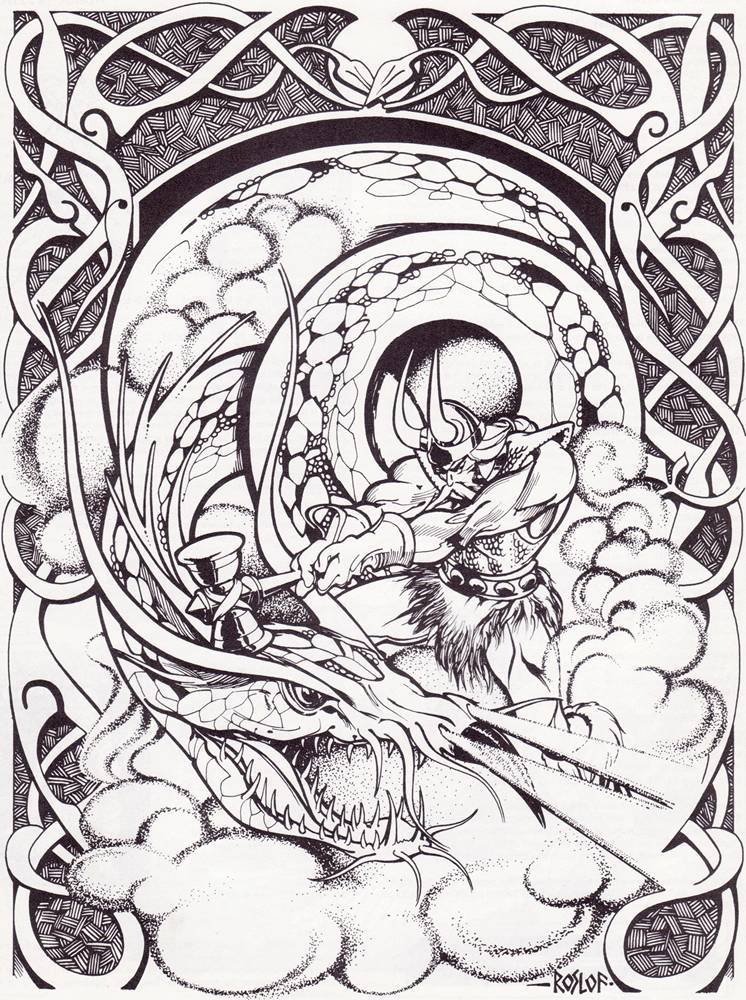
It’s also worth noting that, as TSR’s Art Director, Roslof was pivotal in hiring the exact artists I wrote about in my previous post in this series (Elmore, Easley, etc.), so the inspiration really does come full circle!
I am still not done talking about the classic TSR artists! Keep an eye out for the next post in this series as we continue the 40-year retrospective.
Categories: Tabletop Gaming Blogs
The best classic Dungeons & Dragons modules for an Inner Earth campaign For The Castles & Crusades rpg
For a campaign diving deep into the foundations of the world, "classic" D&D offers everything from gritty survival to high-fantasy politics. If you are looking for the definitive adventures that shaped the concept of "Inner Earth," these modules are the essentials. This blog post picks up from OSR Commentary Adapting C1: The Hidden Shrine of Tamoachan To Aethel, the Sunken Core Needleshttp://www.blogger.com/profile/11243274667834930867noreply@blogger.com0
Categories: Tabletop Gaming Blogs
Video of the Day – Doctor Who: The Silence, 2011
The post Video of the Day – Doctor Who: The Silence, 2011 appeared first on Blogtor Who.
Categories: Doctor Who Feeds
Talon and Company Adapted From The Sword & Sorcerer 1982 for Sword of Cepheus 2nd Edition
Bringing the 1982 cult classic The Sword and the Sorcerer to the tabletop requires capturing that specific "heavy metal" fantasy aesthetic. In the Sword of Cepheus (2nd Edition) system, Talon is a high-powered protagonist, likely built with more than the standard three terms of experience.Here is the breakdown for Talon and his Mercenary Warband.TalonCareer: Mercenary (4 Terms)Rank: Needleshttp://www.blogger.com/profile/11243274667834930867noreply@blogger.com0
Categories: Tabletop Gaming Blogs
Oh Catherine! – Catherine Tate Stars in Oh Mary!
Doctor Who’s Donna Noble, Catherine Tate, stars in dark comedy Oh Mary! until July
Doctor Who’s Catherine Tate is the latest star to take the role of Mary Todd Lincoln in the West End production of Oh Mary! The play is an uproariously dark comedy about a miserable, suffocated Mary Todd Lincoln in the weeks leading up to Abraham Lincoln’s assassination. Unrequited yearning, alcoholism, and suppressed desires abound in this 80-minute one-act play that finally examines the forgotten life and dreams of Mrs. Lincoln. It depicts her as an alcoholic former cabaret star trapped in a largely loveless marriage with the deeply closeted Abraham.
Tate takes over the role from Mason Alexander Park (The Sandman, Quantum Leap.) Across the Atlantic, the Broadway production of Oh Mary! has starred actors such as Jinkx Monsoon (The Devil’s Chord), Jane Krakowski (30 Rock), and currently Maya Rudolph (Saturday Night Live.)
Declared “one of the best comedies in years” by The New York Times, Oh, Mary! received Tony Awards for Best Leading Actor in a Play (Cole Escola) and Best Direction of a Play (Sam Pinkleton).
The former Doctor Who star, who played companion Donna Noble from 2006 to 2010 before returning to the role for the 60th anniversary in 2023, will be appearing in eight performances a week until the 18th of July. You can buy your tickets now from the Trafalgar Theatre website.
Though best known for her television roles, such as Doctor Who, The Office, and her own Catherine Tate Show, Tate has been appearing on stage in dozens of productions since 1988’s Blood Wedding. Notable roles including Lydia in Arthur Miller’s All My Sons, Michelle in Under the Blue Sky, and Peggy in The Enfield Haunting. Perhaps most famously, however, is her astonishingly entertaining double act with Who co-star David Tennant for the 2011 production of Shakespeare’s Much Ado About Nothing.
The post Oh Catherine! – Catherine Tate Stars in Oh Mary! appeared first on Blogtor Who.
Categories: Doctor Who Feeds
Thread and Maple Telescopic Tool Case Giveaway
The Thread + Maple Telescopic Tool Case is a touch of functional luxury you can enjoy every time you stitch! This zip-top genuine leather case transforms into a stand-up cup to hold your tools - great on flat surfaces or in your car's cup holder! Take a closer look and enter to win your own […]
The post Thread and Maple Telescopic Tool Case Giveaway appeared first on moogly. Please visit www.mooglyblog.com for this post.
0
Categories: Crochet Life
Is there a chance of bringing Alternity back?
As I’ve wrote in one of my recent posts I am currently rereading all of my Alternity books. Alternity is a roleplaying game I’ve wanted to run since I first bought it but something always got into the way. But there’s a problem. Even though I own quite a few Alternity books, I don’t own all of them and since the game has been out-of-print for many years it gets increasingly hard (and expensive) to track down copies. But what about digital copies online? There are actually quite a few Alternity books available for purchase on DrivethruRPG. Unfortunately they are not easily found since most of them are stuck in the d20 Modern Generic section. Another problem is that the two core rulebooks are not available online aside from the “Limited Preview Edition” of the Players Handbook.
But I hear you asking “what about the new Alternity”. A couple of years back Rich Baker, one of the original designers of TSR’s Alternity released a new version of the game after a successful Kickstarter. Sasquatch Game Studio, Baker’s new company was actually able to register the Alternity trademark back then since Wizards hadn’t bothered to renew it. Unfortunately not much of Alternity’s original ideas made it into the new game. So while there’s still a game called Alternity out there, it doesn’t have much in common with the original besides being a sci-fi tabletop roleplaying game. But like it predecessor it’s pretty much dead at his point. The last update on the Sasquatch Game Studio website has been in 2018 and no new products for the game has been released since then.
Could Wizards of the Coast actually bring back Alternity properly? That’s highly unlikely. The most we can hope for is that they release all the Alternity products as PDF downloads on DriveThruRPG and hopefully also add a POD option at some point. A limited reprint of the original corebooks as an “anniversary edition” like FFG did it with WEG Star Wars 1st Edition would be brilliant, but unlikely due to the trademark situation. The trademark is still owned by Sasquatch Game Studios and I don’t know what kind of deal Sasquatch has with Wizards which allows the latter to release products using that name.
One option I haven’t written about yet is a retro clone. In a post a few years ago I stated my belief an Alternity clone could cause ire from WotC’s lawyers but that’s probably not the case. As long as someone rewrote the rules without directly copying the texts things should be fine. Mechanics are not copyrightable after all. The bigger question is if there’s an interest in doing so. Sure, there are countless D&D retro clones, but D&D was way more popular than the rather niche scifi TTRPG released shortly before TSR vanished as an entity completely.
Roleplaying games aren’t really dead as long as some people still play them, but in the case of Alternity there’s a true risk of it going extinct. It’s out of print and it was a niche product even when it was new. There are other, more popular options for Sci-Fi fans which are available like for example Traveller in its many incarnations. But if we keep talking about Alternity there’s a chance someone at WotC will commit to bringing all the books back or someone writes a retro clone so that at least its mechanics are available to find new fans.
What are your thoughts on the state of Alternity? Would you like to see it properly resurrected? Do you actually prefer the Sasquatch Game Studio’s version? Please share your comments below!
Categories: Tabletop Gaming Blogs
Detail d100 Sword & Sorcery Random back alley encounters For Castles & Crusades rpg
In a Sword & Sorcery setting, back alleys shouldn't just be empty paths; they should feel like the digestive system of a decaying city—dark, cramped, and dangerous.Here is a d100 table tailored for the grit and high adventure of Castles & Crusades. This blog entry picks right up from D100 Sword & Sorcery Random Urban Encounters Table for Castles & Crusades rpgThe Back Needleshttp://www.blogger.com/profile/11243274667834930867noreply@blogger.com0
Categories: Tabletop Gaming Blogs
Video of the Day – The Whoniverse Show, 2026
The post Video of the Day – The Whoniverse Show, 2026 appeared first on Blogtor Who.
Categories: Doctor Who Feeds
The Barbarians a 1987 sword and sorcery film for 2nd Edition Sword of Cepheus including NPC's, Items, and More
To bring Kutchek and Gore into your Sword of Cepheus (2nd Edition) game, you need to emphasize their sheer physical dominance and their "Dual-Hero" dynamic. In this system, they function as high-Stamina tanks who can dish out massive damage but are vulnerable to social manipulation or complex technology.The Barbarian Brothers (Kutchek & Gore)Trait: High-Octane SiblingsSocial Class: 2 (Needleshttp://www.blogger.com/profile/11243274667834930867noreply@blogger.com0
Categories: Tabletop Gaming Blogs
Doctor Who: The Story, the Engine & the Hugo Award
Doctor Who episode The Story & the Engine is among the 2026 Hugo Award nominees
Doctor Who has its 37th Hugo Awards nomination ahead of the 2026 ceremony taking place at WorldCon in California on the 30th of August. This year’s nomination goes to the fifth episode of the most recent season, The Story & the Engine.
The episode brought the Doctor and Belinda to Lagos in Nigeria. There they discover the sinister unnamed Barber has taken over the barber shop of the Doctor’s old friend Omo. He uses their stories to power his engine’s journey through the web of fiction, to further his mission to strike at the gods themselves. It’s a voyage which will also reveal a secret from deep in the Doctor’s past…
The prestigious Hugo Awards recognize the best in science fiction literature, film, TV, art and journalism every year. Doctor Who’s nomination is in the Best Dramatic Presentation, Short Form category. This broadly, but not strictly, functions as the category of outstanding television episodes. This year Doctor Who is up against episodes of Murderbot, about a security robot with a mind of its own, Pluribus, in which an alien virus turns almost the entire human race into one vast hive mind, Severance, about a nightmarish office where workers’ personalities and memories are divided between work and time off, and The Wheel of Time, set in a world of magic and destiny.
Best Dramatic Presentation, Short Form
- Doctor Who: The Story & the Engine, written by Inua Ellams, directed by Makalla McPherson (BBC One, Disney +)
- Murderbot: All Systems Red, written by Paul Weitz & Chris Weitz, directed by Roseanne Liang, based on the book All Systems Red by Martha Wells (Apple TV)
- Murderbot: The Perimeter, written by Chris Weitz & Paul Weitz, directed by Paul Weitz, based on the book All Systems Red by Martha Wells (Apple TV)
- Pluribus: We Is Us, written and directed by Vince Gilligan (Apple TV)
- Severance: Cold Harbor, written by Dan Erickson, directed by Ben Stiller (Apple TV)
- The Wheel of Time: The Road to the Spear, written by Rafe Lee Judkins, directed by Thomas Napper, based on the book The Wheel of Time by Robert Jordan (Amazon Prime Video)
Billie Piper returned to Doctor Who at the end of the 2025 season.. But is she the Doctor? Doctor Who returns to BBC One and iPlayer this Christmas

The post Doctor Who: The Story, the Engine & the Hugo Award appeared first on Blogtor Who.
Categories: Doctor Who Feeds
The Tower
By Pat_Sagor
Pat_Co Productions
Nimble/OSR
Level 3
Pat_Co Productions
Nimble/OSR
Level 3
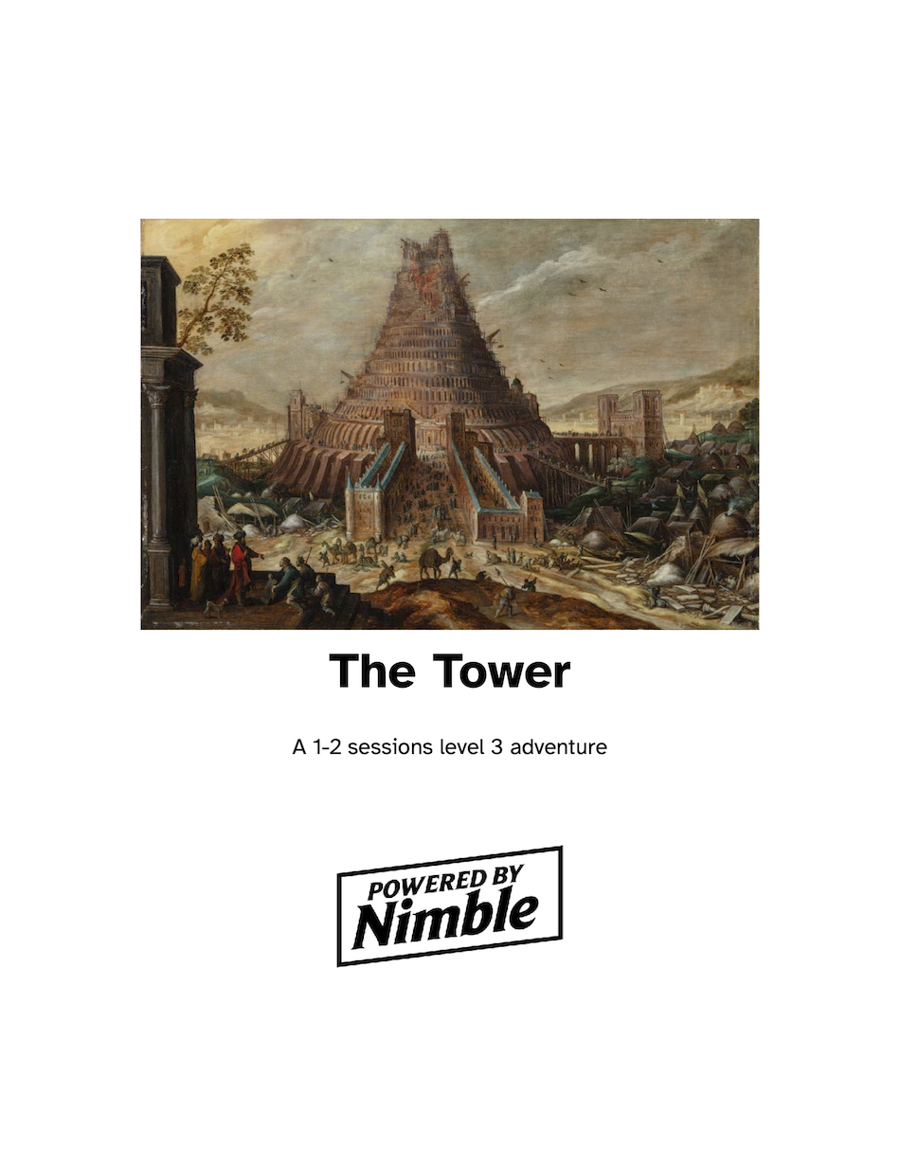
In the heart of a volcanic wasteland, the Tower rises amid fire and ash, a slender edifice of stone. Its citizens never leave the Tower, and keep their mysterious traditions out of sight from the outside world. But they have gained immense wealth trading wondrous artifacts extracted from the depths below the Tower… Outside the Tower, Baron Hugues DeMort’s massive army has been laying siege for over a month. Unable to breach its impervious gates, frustrated and desperate, he has devised a plan to infiltrate the Tower, and he just heard of a group of adventurers that are brave, capable, and … expendable. The perfect team to send on a probably suicidal mission!
Greetins Green Level adventurers! Friend baron has a new, fun, and exciting adventure for you! This fifty page adventure describes about twelve scenes inside a gigantic tower/city that is under siege. The party travels through a rigid caste-based society that really be in a 70’s social commentary scifi movie instead. Follow the script, stab the bosses and then … win?
Ok, so, Baron von Evil is laying siege to the massive tower city and sends the party in through some lower cave/tunnels to get to the city gates and blow them up with the bombs he’s devised for you to carry. You get in and find a massively caste-based society. The tower/city has four levels. The lowest, black are the workers, then the level above has the red managers, then the golden enforcers and judges above that, and then the white intelligentsia above that. We’ll let you decide if Black=Worst and White=Best has any meaning here. Anyway, it’s right out of a scifi movie and, in fact, this probably should have been a Gamma World adventure but, then, of course, it wouldn’t sell any copies at all. Ok, so, anyway, you’re in this city on the lowest levels. You gotta get ahold of some levitation bands to Ascend through the central shaft. Along the way you meet rebels, learns about the rape of an 8 year old by a cop, and find out that hte whites are not white, they are all really just one lich in charge of everything.
The designer kind of knows they’ve written a railroad and has some words on advice on how to make it not a railroad and more interactive. There are some very basic maps of the city regions, but, ultimately, the adventure comes down to the twelve or so scenes/events that make up the plot here. You’re in the tunnels and then watch some cops kill a couple of citizens just minding their own business. You watch an Ascension, where citizens are promoted to the next color up. You meet a rebel and then get arrested by the ol “four more show up every turn” trick. Youre in the middle of the Barons army invading the tower, you boss fight Golden Centurion Marigold 1 (that’s one of the tower peoples names. Like I said, SciFi) who covered up the rape of the little girl. Let’s see, one of the lich’s victims telepathics you, and then you fight the lich. Let’s see … have I bitched about rape yet? Of a child? Why are people putting this shit in their adventures? This is supposed to be fun. You know what’s not fun? Child rape. People just seem to toss that shit around the way they toss around Hitler when arguing. Maybe give it a rest and find something else for the cops to cover up? Maybe Soylent Green is people. That’s fun. Can you imagine? People love it. They riot over it. And it’s actually people. And, notably, not child rape. (and murder! Don’t forget the murder after the child rape.)
The adventure gives you a list of NPC’s, a list of scenes, and a list of locations. There’s a decent number of summaries and background information as well, but, really, it is the people, places, and events that drives this.
Well, I say people drive it, but it tends to be more of a “Guest Star of the Week” kind of the thing. You get an NPC in a scene or situation and then you’ll be lucky if they continue to show up. Thus there is a relatively large number of named NPC’s, each with decently long NPC descriptions. Those descriptions are fairly well done but at some point you’ve got to ask yourself why we have so many people. You can’t possibly form a bond with any of them, not in the amount of time they are showing up. There is supposed to be this underlying theme pr regression, rebelling against order, blind adherence to order and the neutral observers to it all that is handicapped (Let’s see the judiciary enforce their decisions when enforcement power belongs to the people they are ruling against.) And then, of course, ultimately the entire system comes from corruption at the very top, the farce of the liches leadership.
We’ve all seen a lot of liches. Party liches, grim liches. We’ve got a master manipulator here, that shows up a couple of times in public ceremonies impersonating a “white,” Possessing, really. And he has some tells. He raises his hands to his face and says “Actually …” a lot. There’s a fun little gimmick to get the party wondering, This is just slightly farcical and one of the better parts of the adventure.
Looks, it is essentially a railroaded scenebased adventure. The designer tries to help it not be that with some locations and a tad bit of free will, but that’s what it is. There’s nothing wrong with that. It is, I suspect, how the vast majority of people play D&D, some derivations of scene based with a lot of hand-waving. Not my favorite type, but I get it. If you’re gonna have scenes then lean in and write a scene based adventure. If you want your location based adventure to have events then dump those in. This adventure never fully commit to either and is the worse for it. Devo says you need to Sartre this baby up! This needed to be all events/scenes or a location based adventure with “secrets” to discover and a few events thrown in.
This is Pay What You Want at DriveThru with a suggest price of $1. The preview is eleven pages and gives you a good cross-section of different aspects of the adventure. Good preview.
https://www.drivethrurpg.com/en/product/563227/the-tower-for-nimble?1892600
Categories: Tabletop Gaming Blogs
[Parsulan] The Weird Wood

The Weird Wood of southern Parsulan is an ancient forest infused with potent arcane energies. In halls of Magical Academy at Abraxad, surrounded and protected by the wood, it is labelled as Forbidden and students have been disciplined or even expelled for entering it other than by the proscribed paths. Treasure seekers and adventures from other places sometimes travel the forest, however, but many don't return.
What is known from the reports of those that enter it is that the forest is a place of unusual magical power. At the very least, it alters a visitor's perception of time and distance. The wood is also said to be the abode of strange spirits, beings inhabiting both biological and mechanical forms.
Faerie woodlands are hardly a rarity in Parsulan, but somehow, the Weird Wood has become infected or entwinned with technomagical devices in addition to its natural, elemental powers. Some point to its relative proximity to the Field of Fallen Colossi and suggest some stray, animate portion of the giant combatants may have made its way to the forest. Others argue that given the sheer number of constructs and amount armament debris found there, moss covered or half-buried, it must be the remnant of an assault by a substantial force. Perhaps in times past someone marched against Abraxad, and this is the result? If that is true, then Abraxad would surely have record of it in its extensive libraries, but those remain closed to outsiders.
Whatever their origins, it is these artifacts that draw the scavengers.

The commonly encountered fae of the forest are mostly harmless and appear as small, crude figures or vaguely animal or insect shapes of metal. They seem to mimic biological life in a rough but analogous way to the manner Meks resemble humans.
The larger, more dangerous entities are harder to describe with certainty. Some appear as beasts with mechanical and biological parts. Others are shifting shapes of churning metal, churning storms of fury and blades.
Categories: Comic Book Blogs, Tabletop Gaming Blogs
OSR Review - The Type 3 Security Cutter For The Clement Sector Rpg Campaign
The Type 3 Security Cutter (also known as the Type 3 System Security Cutter) is a specialized law enforcement and patrol vessel in the Clement Sector RPG setting by Independence Games. While the Type 2 is a common sight in local system navies, the Type 3 represents an up-scaled, more formidable evolution of the security cutter concept.Here are the detailed specifications and background for Needleshttp://www.blogger.com/profile/11243274667834930867noreply@blogger.com0
Categories: Tabletop Gaming Blogs
Pages
