
Your wildly multifarious home!
Tabletop Gaming Feeds
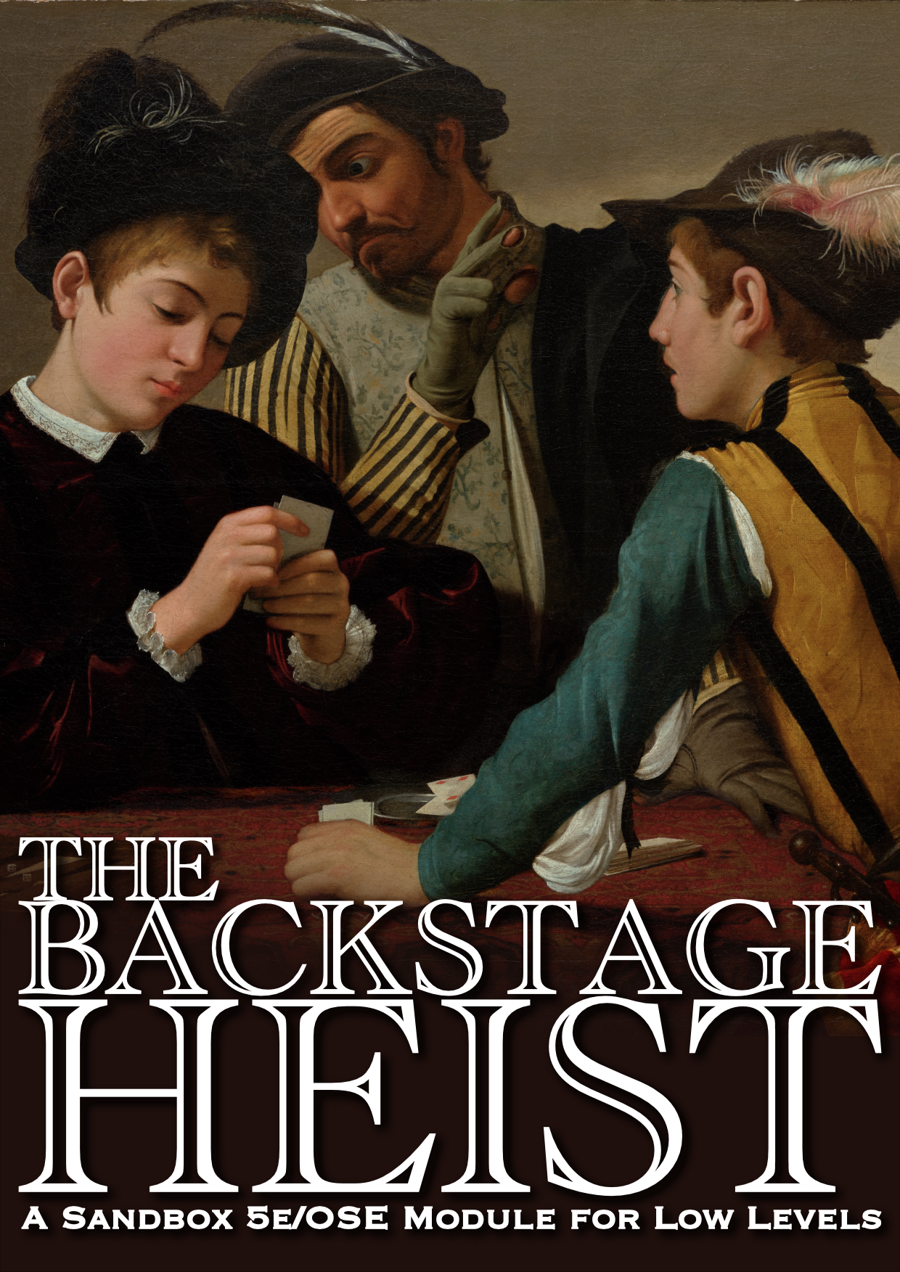
The Backstage Heist
By Inkblot Gibberling
Self Published
OSE/5E
"Low Levels"
Self Published
OSE/5E
"Low Levels"
The Bragazzi crime family runs the Backstage, an illegal casino and mushroom-juicing drug laboratory hidden behind an opera-costume shop. Steal their stuff.
This fourteen page adventure presents about twenty locations in an illicit gambling establishment. It wants to be a heist movie. It doesn’t provide you the tools needed to be a heist movie. It’s also clearly 5e.
I’ve got a lot of issues. And ten also this adventure is a mess. It’s going for some Oshean 11 vibes. It doesn’t know how to pull that off. It’s got a couple of tone issues. It’s trying to get fancy with the formatting and not pulling it off. And it is not OSE.
Let us start with this statement from the adventure “This module attempts to be system-agnostic. Where relevant, combat statistics are offered for” Someone clearly has written a blog post recently about how 5e and OSE are the same power level because I’ve seen a recent trend of adventures being listed as 5e and OSE and generic/universal all in the same breathe. I guess, yes, it’s generic/universal in the same way that every adventure is generic/universal if you just ignore the stats and skill checks. There’s a reference to both a 5e monster and an OSR monster (fighter 4 or Tough Boss MM25.) In other places we get things like “Safe: Locked with an arcane lock to increase lockpicking difficulty [+10].” I guess that 5e? I’m not morally opposed to a fantasy gambling location that is roughly universal and stats thrown in as examples, but the skill check thing throws it off every time. Also, one of the guards is invisible, and drinks a potion every hour to stay invisible. This says something about the game world and is perhaps the most jarring. You can reskin cat-people to be humans but something like the prevalence of magic, and relying on it for a core part of the adventure, just throws things off. (To be clear, there are no cat people in this adventure, or any other ren-faire tropes.)
The core conceit here is a heist. It’s in the title. One of the hooks involves getting a bank teller out who is currently being coerced by the mob, by punching him in the face, to give the gang the security features of the bank. You’re told, by your patron “The rescue can’t involve any bodies and can’t involve any Bragazzi seeing anything suspicious. His escape must appear to be a series of plausible coincidences.” This is one of the hooks. Another hook is just a straight up robbery. The heist, the plausible deniability, these imply some things that the adventure should have that it just lacks. You want to case the place, right? The classic heist involves a casing. Scoping it out and then coming up with a wacky plan to execute that will inevitably go wrong, as these things do in D&D. The guards are noted on the map, which is good. A few have a routine (with two dudes taking leaks with a frequency that makes my BPH look like a dream.) This is about the extent of the support you get here. Working against this is the current goings-on in the gambling den. The teller is actively getting the shit beaten out of him. The NPC’s, the notable other gamblers, are, I guess, just always there, in your case and during your heist. There is a degree of randomness as well, for people present in hallways, that works against a heist. Sure, things can go wrong. “Oh no, I wasn’t expecting the wine delivery!” but there needs to be some degree of consistency that the degree of randomness in the people present in locations, randomly, works against. This makes the adventure much less of a heist and much more of the usual “lets just try something and start hacking when things go wrong” sort of loosy goosy approach that most adventure raids have. There too much in the writing that frames it as HAPPENING RIGHT NOW instead of COULD HAPPEN DURING THE HEIST. And the entire premise of the “coincidences”, I think, works against the level range here. It would require a lot of skills and magic items and spells that just are not going to be present at low levels.
Tonally this is off also, in places. I’m not thrilled that the old ‘italians are mobsters” thing is relied upon. There’s no reason for that in a generically fantasy rpg. Pulp Fiction was fine without relying on these tropes. Further, there is, I think, generally a more light-hearted tone to a heist. And that is pretty consistent throughout this. After all, these are gamblers, right? As far as things go, screwing the tax man is a time honored tradition. But then, in the drug den upstairs, we get the gang doing some weird vivisection/bleeding of people to drain juice from them as a drug. This is probably a bridge too far. We have crossed the boundary from simple gambling and drug dealing to torture. We’re not even soylent greening here, more to the point of Thorns prediction about being raised as cattle. We are now in the “muder every last one of them” category, even in my skewed murder hobo vision of D&D. It’s not that either tone is wrong, but it’s the mixing of them. You CAN discover something more evil afoot in an adventure, but then you have to be prepared for the consequences. And they here for a zany madcap ending in which you free them and they run around every which direction in some kind of 1930’s madcap comedy manner. You can manage finding the EVIL HORRIBLE THING in the pickpockets house, but then the adventure needs to support that. And this doesn’t.
There’s a page or so up front that tells you how to read the formatting being used. Nothing too special here or weird; bolding, room names, etc. I would note though that if you need a page to describe your formatting them its probably not intuitive formatting. In practice, though, I think the formatting has issues. It’s hard to see room breaks, or sub-area breaks, and things tend to seem to run together. I think some line breaks are really what’s needed here in order to provide some additional separation between different sub-areas of room and concepts. The bolding tends to run together otherwise and the sub-areas get lost.
I don’t think it’s a heist, as least not with the content provided. The tone stuff, with the mushroom, seems off to me and not supported either.
This is free at DriveThru. The preview is the entire thing. I would maybe look at page seven of the preview for an idea of the jumble.
https://www.drivethrurpg.com/en/product/571925/the-backstage-heist?1892600
Categories: Tabletop Gaming Blogs
Wednesday Comics: DC, November 1985 (week 3)
I'm reading DC Comics' output from January 1980 (cover date) to the end of Crisis! This week, I read the comics on sale on August 15, 1985.
Batman and the Outsiders #27: I remember seeing this Barr/Davis issue on the spinner rack at the Pac-N-Sac gas station a few blocks from my house. Twelve year-old me found the "We call it WAR STARS! (or we'd get sued!)" cover blurb very clever. Anyway...Continuing from last issue, the U.S. fires missiles at the Star Wars station in defiance of Kobra's extortion, but the missile defense works on the station too, and they are disabled. In a show of glastnost, Gorbachev only pretends to make a deal with Kobra (reasoning rightly that the cult leader will turn on the USSR, too) and instructs his people to contact the U.S. and offer an alliance against the villain.
Meanwhile, our heroes are trying to get to the station to stop Kobra and rescue Halo, but the U.S. government refuses to loan Batman a shuttle. We see a computer screen labelling him "politically incorrect" due to his leaving the JLA and fighting with the Force of July. Harsh! So, the team just has to steal Kobra's own spacecraft and fly it up there. There's a fight in the station and the bad guys are defeated, but Kobra bests Batman in a one-on-one fight and escapes. Batman seems to relish the tough opponent though and looks forward to his next confrontation with the villain.
Halo's beau David decides to take some time to patch things up with his father, so she's free to return to the Outsiders.
Fury of Firestorm Annual #3: Conway and Kayanan/Akin/Garvey rewind to just power Ronnie and Stein left New York. Firestorm notices some fluctuations in his powers. Stein has a theory its due to sunspot activity and the two test it, leading Stein to figure the parameters of their powers. Largely, this seems like a way for Conway to rein in and clarify the limits of what Firestorm can do as we are given Official Handbook level quantifications.
While all this is going on, Frido, a guy in Miami with a drug problem, is having particularly bad time trying to get his fix to deal with his withdrawal. As the sunspot activity increases, Frido is somehow transformed into a being of (I guess) electricity. Still in pain, Frido takes out his frustrations on those who refuse to help him until Firestorm who has heard about this intervenes. He wins the day by short circuiting Frido (or Sparx as Firestorm names him) in the ocean.
Blue Devil #18: Mishkin/Cohn and Kupperberg/Maygar cheekily present "The Last Parallel World Story!" in this Crisis crossover issue. After the events of COIE #8, Blue Devil finds himself in space with some of the Omega Men. Luckily, they are picked up by a spaceship in the hands of a film crew composed of alternate universe versions of Cassidy and Blue Devil's supporting cast who had been sucked through a black hole into this universe just before theirs was destroyed by anti-matter. This being a somewhat humorous book, the characters take the potential trauma of being the last survivors of their universe and having lost everyone they know completely in stride. However, they soon find they are fading away, going to a Limbo since their universe no longer exists. Both Cassidys have to work to find a way to vibrationally stabilize both the crew and their ship.
The crew decides to go with the Omega Men to Vega via a teleporter as they know their universe's version of Harry Hokum has one. They try to send Blue Devil back to Earth, but he disappears before they can.
Green Lantern #194: Crisis crossovers often reveal that Harbinger had a tougher time than initially depicted assembling the heroes in COIE #1. Engelhart and Staton/Patterson again give us a bit of s scuffle, before Stewart agrees to go with her. This crossover is unusual as it depicts events on the Monitor's station from Stewart's perspective. We also see how the Anti-Monitor strikes a blow at the Guardians so that they can't interfere. A blast through the central Power battery kills many of them.
With everything going on Katma Tui turns to Hal, and the two of them reconcile. Hal seems ready to stop feeling sorry for himself, but feeling in a nostalgic mood, I guess, visits Abin Sur's grave. He finds Guy Gardner out of the nursing room, and misguidedly attempting to dig up a ring and power battery. The two fight, but then a Guardian shows up and gives Gardner exactly what he's looking for, inducting him into the Corps and snubbing Hal.
Infinity, Inc. #20: Another Crisis crossover by the Thomases and McFarlane/Bair, as the Infinitors deal with the weather disruption and natural disaster part of the Crisis. A hospital is threatened by extreme weather and an earthquake, and members of the JSA and the Infinitors must work together to try to save people. In the...well, crisis, a new hero emerges: Previous NEET Rick Tyler decides to follow in his father's footsteps and become a new Hourman, a move that worries both his father and Dr. Mid-Nite. There's another new hero in the making, too. McNider's medical protege, Beth Chapel, is blinded in the disaster and jokes bitterly the only sort of doctor she is fit to be is the next Dr. Midnight.
Interestingly, a caption in this issue tells us it is "July 1985," which is (as George Olshevsky would have it) a "topical reference" to be ignored, but since this universe is going away anyway, I think it's usual in placing when the "modern day" events of the Crisis are occurring. This timeline goes with that idea.
New Teen Titans #14: Yet another Crisis crossover from Wolfman and Barreto/Tanghal. Under red skies, Arella searches for her daughter and finds out she was for a time a faith healer in Alabama but has moved on by the time Arella gets there. Meanwhile, Captain Karras convinces Starfire to return to Tamaran, and Nightwing and Jericho choose to accompany her, leaving the others to deal with this whole Crisis thing. At the end of the issue, we find out Blackfire is waiting to greet her sister.
The Titans that stay on Earth have to deal with Steve Dayton who is dying of cancer. Or at least he was. He may have used his Mento helmet to cure himself, but that seems to have driven him insane. He attacks his butler, then a club of wealthy men that denies him membership, then the Titans when they show up.
Sgt. Rock #406: We finish Kanigher's and Gonzales's tribute to the 332nd Expeditionary Operations Group. In the end, this story seems to have been largely for didactic purposes, which is a reasonable goal I suppose when we think about the assumed kid audience of comics. We get a lot more on the groups exploits and highlights of important members. Then, sometime later, Rock and Easy meet Captain Dennis again briefly. After that, we return to the frame of the civil rights era where the racist lieutenant turned police officer seems to recognize Dennis among the marchers and silent moves aside. Dennis feels Rock is with them in spirit, with the implication being that (as Kanigher as stated, I believe) Rock did not survive the War.
Saga of Swamp Thing #42: Continuing the story from last issue, as Swamp Thing and Abby are piecing together what is going on, the past takes a greater hold over the present. The extras performing the ritual have caused the dead to rise from the graveyard and walk the Earth. The dead advance on the plantation house to confront the spirit of the former master of that house, now taken over an actor. Swamp Thing does have a whole lot to do as his plant powers can do little to stop a haunting. He's set on fire and accidentally catches the house ablaze too. That seems to break the spell and bring an end to what was going on, though one actor dies in the fire, and another seems unable to break from the traumatic memory of a man skinned alive. One of the zombies gets away and gets a job at a theater, so again the mystical strangeness of the world is rising.
Warlord #99: I reviewed this issue here.
Who's Who #9: Like last issue, the alphabetical span of this issue seems providential, as we get the Jordan and Stewart Green Lanterns (though no Guy Gardner), the Green Lantern Corps, and the Guardians of the Universe. The current artists, Staton, gets to draw Stewart, but Kane is fittingly given the honor of depicting Hal Jordan, and Bolland gets the two-page Corps spread. Gemworld is also in this issue as are both the Earth-Two and Earth-One Green Arrows, the latter depicted by Mike Grell. The Captain Atom foe, the Ghost, gets an entry and he hasn't even appeared in the DCU yet! We also get war comics characters Gravedigger, who we haven't seen since 1979, and G.I. Robot who we haven't seen since the demise of Weird War Tales in 1983.

Batman and the Outsiders #27: I remember seeing this Barr/Davis issue on the spinner rack at the Pac-N-Sac gas station a few blocks from my house. Twelve year-old me found the "We call it WAR STARS! (or we'd get sued!)" cover blurb very clever. Anyway...Continuing from last issue, the U.S. fires missiles at the Star Wars station in defiance of Kobra's extortion, but the missile defense works on the station too, and they are disabled. In a show of glastnost, Gorbachev only pretends to make a deal with Kobra (reasoning rightly that the cult leader will turn on the USSR, too) and instructs his people to contact the U.S. and offer an alliance against the villain.
Meanwhile, our heroes are trying to get to the station to stop Kobra and rescue Halo, but the U.S. government refuses to loan Batman a shuttle. We see a computer screen labelling him "politically incorrect" due to his leaving the JLA and fighting with the Force of July. Harsh! So, the team just has to steal Kobra's own spacecraft and fly it up there. There's a fight in the station and the bad guys are defeated, but Kobra bests Batman in a one-on-one fight and escapes. Batman seems to relish the tough opponent though and looks forward to his next confrontation with the villain.
Halo's beau David decides to take some time to patch things up with his father, so she's free to return to the Outsiders.

Fury of Firestorm Annual #3: Conway and Kayanan/Akin/Garvey rewind to just power Ronnie and Stein left New York. Firestorm notices some fluctuations in his powers. Stein has a theory its due to sunspot activity and the two test it, leading Stein to figure the parameters of their powers. Largely, this seems like a way for Conway to rein in and clarify the limits of what Firestorm can do as we are given Official Handbook level quantifications.
While all this is going on, Frido, a guy in Miami with a drug problem, is having particularly bad time trying to get his fix to deal with his withdrawal. As the sunspot activity increases, Frido is somehow transformed into a being of (I guess) electricity. Still in pain, Frido takes out his frustrations on those who refuse to help him until Firestorm who has heard about this intervenes. He wins the day by short circuiting Frido (or Sparx as Firestorm names him) in the ocean.

Blue Devil #18: Mishkin/Cohn and Kupperberg/Maygar cheekily present "The Last Parallel World Story!" in this Crisis crossover issue. After the events of COIE #8, Blue Devil finds himself in space with some of the Omega Men. Luckily, they are picked up by a spaceship in the hands of a film crew composed of alternate universe versions of Cassidy and Blue Devil's supporting cast who had been sucked through a black hole into this universe just before theirs was destroyed by anti-matter. This being a somewhat humorous book, the characters take the potential trauma of being the last survivors of their universe and having lost everyone they know completely in stride. However, they soon find they are fading away, going to a Limbo since their universe no longer exists. Both Cassidys have to work to find a way to vibrationally stabilize both the crew and their ship.
The crew decides to go with the Omega Men to Vega via a teleporter as they know their universe's version of Harry Hokum has one. They try to send Blue Devil back to Earth, but he disappears before they can.

Green Lantern #194: Crisis crossovers often reveal that Harbinger had a tougher time than initially depicted assembling the heroes in COIE #1. Engelhart and Staton/Patterson again give us a bit of s scuffle, before Stewart agrees to go with her. This crossover is unusual as it depicts events on the Monitor's station from Stewart's perspective. We also see how the Anti-Monitor strikes a blow at the Guardians so that they can't interfere. A blast through the central Power battery kills many of them.
With everything going on Katma Tui turns to Hal, and the two of them reconcile. Hal seems ready to stop feeling sorry for himself, but feeling in a nostalgic mood, I guess, visits Abin Sur's grave. He finds Guy Gardner out of the nursing room, and misguidedly attempting to dig up a ring and power battery. The two fight, but then a Guardian shows up and gives Gardner exactly what he's looking for, inducting him into the Corps and snubbing Hal.

Infinity, Inc. #20: Another Crisis crossover by the Thomases and McFarlane/Bair, as the Infinitors deal with the weather disruption and natural disaster part of the Crisis. A hospital is threatened by extreme weather and an earthquake, and members of the JSA and the Infinitors must work together to try to save people. In the...well, crisis, a new hero emerges: Previous NEET Rick Tyler decides to follow in his father's footsteps and become a new Hourman, a move that worries both his father and Dr. Mid-Nite. There's another new hero in the making, too. McNider's medical protege, Beth Chapel, is blinded in the disaster and jokes bitterly the only sort of doctor she is fit to be is the next Dr. Midnight.
Interestingly, a caption in this issue tells us it is "July 1985," which is (as George Olshevsky would have it) a "topical reference" to be ignored, but since this universe is going away anyway, I think it's usual in placing when the "modern day" events of the Crisis are occurring. This timeline goes with that idea.

New Teen Titans #14: Yet another Crisis crossover from Wolfman and Barreto/Tanghal. Under red skies, Arella searches for her daughter and finds out she was for a time a faith healer in Alabama but has moved on by the time Arella gets there. Meanwhile, Captain Karras convinces Starfire to return to Tamaran, and Nightwing and Jericho choose to accompany her, leaving the others to deal with this whole Crisis thing. At the end of the issue, we find out Blackfire is waiting to greet her sister.
The Titans that stay on Earth have to deal with Steve Dayton who is dying of cancer. Or at least he was. He may have used his Mento helmet to cure himself, but that seems to have driven him insane. He attacks his butler, then a club of wealthy men that denies him membership, then the Titans when they show up.

Sgt. Rock #406: We finish Kanigher's and Gonzales's tribute to the 332nd Expeditionary Operations Group. In the end, this story seems to have been largely for didactic purposes, which is a reasonable goal I suppose when we think about the assumed kid audience of comics. We get a lot more on the groups exploits and highlights of important members. Then, sometime later, Rock and Easy meet Captain Dennis again briefly. After that, we return to the frame of the civil rights era where the racist lieutenant turned police officer seems to recognize Dennis among the marchers and silent moves aside. Dennis feels Rock is with them in spirit, with the implication being that (as Kanigher as stated, I believe) Rock did not survive the War.

Saga of Swamp Thing #42: Continuing the story from last issue, as Swamp Thing and Abby are piecing together what is going on, the past takes a greater hold over the present. The extras performing the ritual have caused the dead to rise from the graveyard and walk the Earth. The dead advance on the plantation house to confront the spirit of the former master of that house, now taken over an actor. Swamp Thing does have a whole lot to do as his plant powers can do little to stop a haunting. He's set on fire and accidentally catches the house ablaze too. That seems to break the spell and bring an end to what was going on, though one actor dies in the fire, and another seems unable to break from the traumatic memory of a man skinned alive. One of the zombies gets away and gets a job at a theater, so again the mystical strangeness of the world is rising.

Warlord #99: I reviewed this issue here.

Who's Who #9: Like last issue, the alphabetical span of this issue seems providential, as we get the Jordan and Stewart Green Lanterns (though no Guy Gardner), the Green Lantern Corps, and the Guardians of the Universe. The current artists, Staton, gets to draw Stewart, but Kane is fittingly given the honor of depicting Hal Jordan, and Bolland gets the two-page Corps spread. Gemworld is also in this issue as are both the Earth-Two and Earth-One Green Arrows, the latter depicted by Mike Grell. The Captain Atom foe, the Ghost, gets an entry and he hasn't even appeared in the DCU yet! We also get war comics characters Gravedigger, who we haven't seen since 1979, and G.I. Robot who we haven't seen since the demise of Weird War Tales in 1983.
Categories: Comic Book Blogs, Tabletop Gaming Blogs
RPG a Day 2026 – Day 12: Loss
Welcome to Day 12 of #RPGaDay2026. As I explained in my Day 0 post, I’ll be creating NPCs based on the day’s prompts and the week and day modifiers presented in the infographic below. Check out that post for further details.
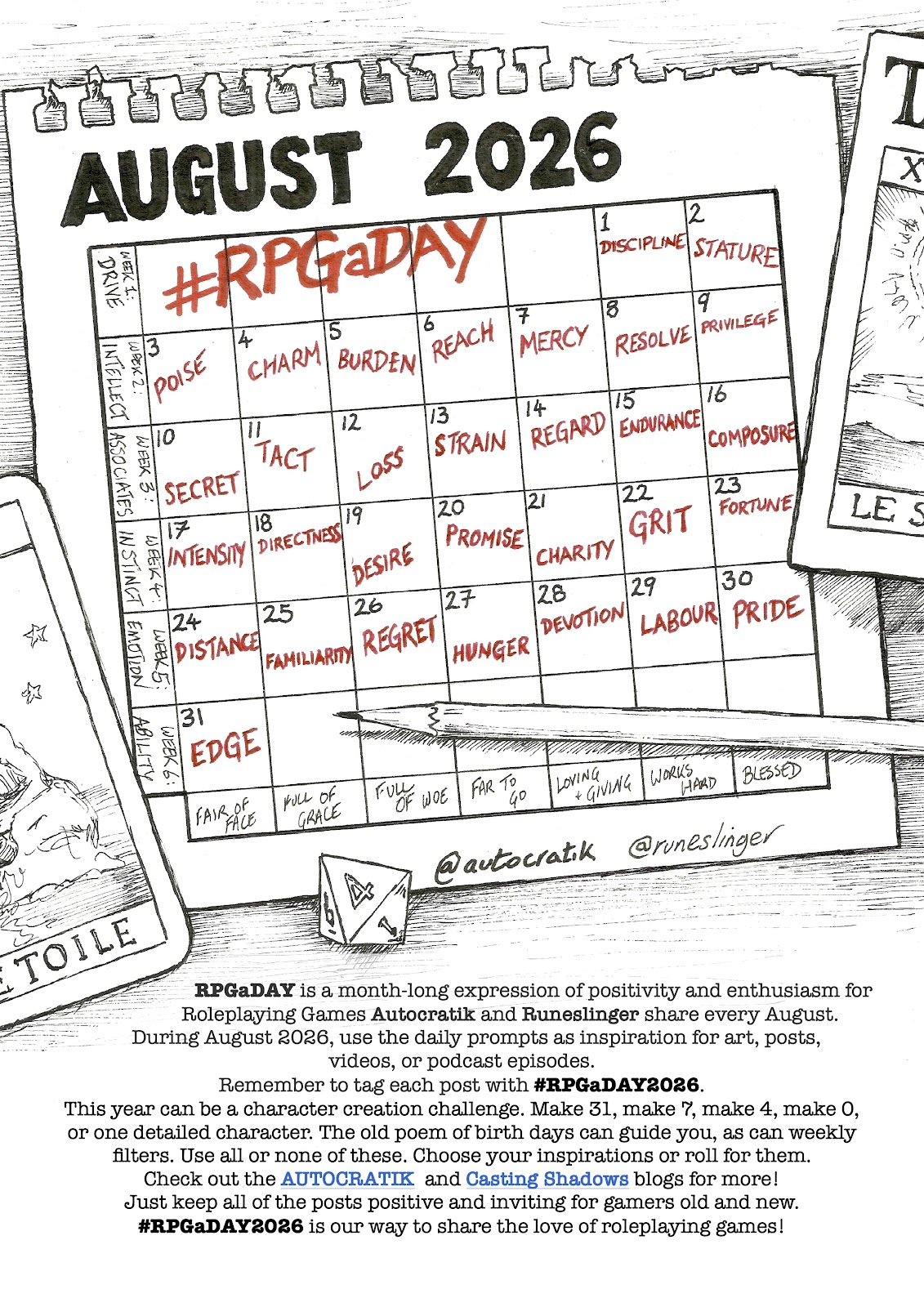
Today’s combination: Loss (Prompt) + Associates (Weekly Modifier) + Full of Woe (Weekly Modifier) + Horror (Genre)
Here is today’s NPC.
Wiktoria Nejman (Fantasy Name Generator used for the name: Polish name generator)
When people call Wiktoria “Madame Nejman,” she quickly corrects them, reminding them that the title belonged to her mother. After her mother’s death, she never turns on the neon Psychic sign in the front window. Still, every morning, she unlocks the parlor door, opens the little box on the entrance table, and receives her mother’s associates.
Her friends call often, asking when she’s going back to school. Even those who grew up in the neighborhood ask why she still wears black. They don’t understand that her mother’s death was a profound loss—one that left her full of woe and burdened with a gift she never asked for.
Her mother’s “associates” are all around her. That’s what her mother used to call them. They are the spirits of the departed, wandering into the parlor seeking to reach their loved ones, eager to share a secret they never meant to take to the grave, or simply wanting to gossip about the goings-on in the realms of the living and the dead. Wiktoria tries to fulfill their requests and deliver their messages to grieving families. Occasionally, the living come knocking, asking to contact someone specific. She explains that it doesn’t work that way, but when these associates do appear, she does her best to help both the living and the dead.
At the end of the day, she locks the parlor door and often pauses to stare at the contents of the little box. Her mother’s glass eye stares back at her. With her dying breath, her mother asked Wiktoria to pluck out her own eye and replace it with the glass one. Wiktoria is not yet ready to take that step.
Maybe tomorrow, she thinks. With that thought, she closes the lid of the little box.
Thanks for reading; I am looking forward to your RPG a Day 2026 post, comments, and conversation. If you want further information about #RPGaDay2026, be sure to check out Autocratik’s blog.
A Spanish version of this post is available at the Desde la Fosa Facebook page.
See you all tomorrow!
Categories: Tabletop Gaming Blogs
Adapting North West of Earth By C.L. Moore - Orbital Decay (MicroRed version) From The Red Room & The New Flesh Rpg - Shambleau (The Neural-Erotic Parasite)
In the Red Room and The New Flesh tabletop roleplaying game system (published by MicroRed / Red Room Publishing), "Adapting 'North West of Earth' by C.L. Moore" represents a specific module/framework that translates C.L. Moore’s classic 1930s pulp sci-fi and weird fiction—specifically the Northwest Smith space-western stories—into the gritty, transhumanist, bodyswap-heavy horror mechanics Needleshttp://www.blogger.com/profile/11243274667834930867noreply@blogger.com0
Categories: Tabletop Gaming Blogs
The Northern Marches is the Deal of the Day and 50% off!
One of the biggest challenges of publishing today is getting people to look at what you produced. This is why tools like DriveThruRPG's Promotion Points are crucial to publishers, especially those like myself who rely on online websites for the bulk of their sales.
Thanks to your support of the release of the Northern Marches back in May, I had enough points to submit the Northern Marches to the Deal of the Day queue. And that deal is today. For 50% off ($20.00), you can get the Northern Marches Guidebook and the complete set of digital maps and reference files.
Into the Majestic Fantasy Realms, the Northern Marches ($20.00).
The Northern Marches is a 320-by-400-mile fantasy sandbox covering the lands around the western end of the Grey Sea. It includes the Wild North, Blackmarsh, the Southlands, the conquered Viking realm of Vasa, the Duchy of Northport, and the strange Ring Islands.
The setting is spread across four 12" by 18" maps using 5-mile hexes. Throughout the guidebook are settlements, ruins, lairs, tribes, realms, factions, NPCs, and local history intended to give you enough detail to start running a campaign while still leaving enough room to make the setting your own.
While the digital version comes with all the maps and files you need to begin using the Northern Marches, you can get the poster maps or the map booklet separately as print products. Note that the digital files for both are included in the Guidebook product being offered, as you will see below.
Poster Maps, 12" by 18"Maps and Reference Book, letter-sized
The $20.00 Deal of the Day includes more than just the Guidebook PDF.
Guidebook PDFs
You get two versions of the Northern Marches Guidebook: one optimized for reading on a tablet or phone and a larger version suitable for printing at home.
Markdown Document
The complete text of the Guidebook is included in Markdown format and licensed under the Creative Commons Attribution license. You can use, modify, and build on the material for your own projects under the terms of the license.
Reference PDFs
Six reference PDFs summarize the rules, charts, travel information, encounters, and other material found throughout the Guidebook. This also includes the current version of the Merchant Adventure rules for the Majestic Fantasy RPG.
Rob's Note: All poster maps are designed to be printed at 12" by 18".
Player and Referee MapsHigh-resolution JPGs of the poster maps are included in both player and referee versions, along with the town maps used throughout the Northern Marches.
Layered Map PDFsThe complete Northern Marches map is also included as nearly 24" by 36" layered PDFs in both player and referee versions. By turning layers on and off, you can create customized map views for your own campaign.
Editable SVG Map
The Northern Marches map is included as an SVG file usable with Inkscape, CorelDraw, Affinity, Adobe Illustrator, and other programs that support SVG. This allows you to edit the map and create your own version of the Northern Marches.
High-Resolution Print MapsShipping poster maps can get expensive, especially outside the United States. So the package includes the high-resolution files used to print the four 12" by 18" maps. You can take them to a local print shop and have your own copies made.
Map BookletSometimes a letter-sized book of maps is easier to manage at the table than four large poster maps. The four maps have been divided into 25 overlapping letter-sized areas and assembled into a map booklet. The booklet also includes reference sheets, a visual index, terrain indices, and locale registers for the Northern Marches.
So if you were on the fence about giving the Northern Marches a try, today is a good opportunity. For $19.99 you get the complete setting along with the maps and reference material I use to support it at the table.
Welcome to the Majestic Fantasy Realms!
Thanks to your support of the release of the Northern Marches back in May, I had enough points to submit the Northern Marches to the Deal of the Day queue. And that deal is today. For 50% off ($20.00), you can get the Northern Marches Guidebook and the complete set of digital maps and reference files.
Into the Majestic Fantasy Realms, the Northern Marches ($20.00).
The Northern Marches is a 320-by-400-mile fantasy sandbox covering the lands around the western end of the Grey Sea. It includes the Wild North, Blackmarsh, the Southlands, the conquered Viking realm of Vasa, the Duchy of Northport, and the strange Ring Islands.
The setting is spread across four 12" by 18" maps using 5-mile hexes. Throughout the guidebook are settlements, ruins, lairs, tribes, realms, factions, NPCs, and local history intended to give you enough detail to start running a campaign while still leaving enough room to make the setting your own.
While the digital version comes with all the maps and files you need to begin using the Northern Marches, you can get the poster maps or the map booklet separately as print products. Note that the digital files for both are included in the Guidebook product being offered, as you will see below.
Poster Maps, 12" by 18"Maps and Reference Book, letter-sized
The $20.00 Deal of the Day includes more than just the Guidebook PDF.
Guidebook PDFs
You get two versions of the Northern Marches Guidebook: one optimized for reading on a tablet or phone and a larger version suitable for printing at home.
Markdown Document
The complete text of the Guidebook is included in Markdown format and licensed under the Creative Commons Attribution license. You can use, modify, and build on the material for your own projects under the terms of the license.
Reference PDFs
Six reference PDFs summarize the rules, charts, travel information, encounters, and other material found throughout the Guidebook. This also includes the current version of the Merchant Adventure rules for the Majestic Fantasy RPG.
Rob's Note: All poster maps are designed to be printed at 12" by 18".
Player and Referee MapsHigh-resolution JPGs of the poster maps are included in both player and referee versions, along with the town maps used throughout the Northern Marches.
Layered Map PDFsThe complete Northern Marches map is also included as nearly 24" by 36" layered PDFs in both player and referee versions. By turning layers on and off, you can create customized map views for your own campaign.
Editable SVG Map
The Northern Marches map is included as an SVG file usable with Inkscape, CorelDraw, Affinity, Adobe Illustrator, and other programs that support SVG. This allows you to edit the map and create your own version of the Northern Marches.
High-Resolution Print MapsShipping poster maps can get expensive, especially outside the United States. So the package includes the high-resolution files used to print the four 12" by 18" maps. You can take them to a local print shop and have your own copies made.
Map BookletSometimes a letter-sized book of maps is easier to manage at the table than four large poster maps. The four maps have been divided into 25 overlapping letter-sized areas and assembled into a map booklet. The booklet also includes reference sheets, a visual index, terrain indices, and locale registers for the Northern Marches.
So if you were on the fence about giving the Northern Marches a try, today is a good opportunity. For $19.99 you get the complete setting along with the maps and reference material I use to support it at the table.
Welcome to the Majestic Fantasy Realms!
Categories: Tabletop Gaming Blogs
RPG a Day 2026 – Day 11: Tact
Welcome to Day 11 of #RPGaDay2026. As I explained in my Day 0 post, I’ll be creating NPCs based on the day’s prompts and the week and day modifiers presented in the infographic below. Check out that post for further details.
Today’s combination: Tact (Prompt) + Associates (Weekly Modifier) + Full of Grace (Weekly Modifier) + Fantasy (Genre)
Here is today’s NPC.
Sylvar Ulawynn (Fantasy Name Generators used for the names: Elf name generator and Forest name generator)
The Wild Timberlands were once part of the vast Forest Holdings of the Elven Empire. Following the ancient wars, the arrival of humans, and the elven retreat beyond the Cloud Crags, all that remains in these woods are the ruins of a forgotten past. One of the most sought-after sites is the Shrine at the Pool of the Moon Goddess.
Deep within the trees, Sylvar Ulawynn—an elven priest of poetry, the woods, and the moon—keeps the shrine safe from wandering evils and ambitious raiders seeking to plunder its secrets and treasure.
Sylvar is a pale elf of ageless appearance with a wild mane of red hair, dressed in homespun robes and simple jewelry. Unarmed, he greets all who approach the silvery pool with openness and utmost tact, regardless of their hostility.
Those attuned to magic can easily perceive the blessings of the spirits he venerates; if asked, he simply states he is full of the grace of the goddess and her spirits. Sylvar is open and generous with his guidance for those who seek it. While he will never raise a hand against those who arrive with ill intent, he calmly reminds them that he has many allies and associates within the Wild Timberlands who are more than willing to defend him.
Thanks for reading; I am looking forward to your RPG a Day 2026 post, comments, and conversation. If you want further information about #RPGaDay2026, be sure to check out Autocratik’s blog.
A Spanish version of this post is available at the Desde la Fosa Facebook page.
See you all tomorrow!
Categories: Tabletop Gaming Blogs
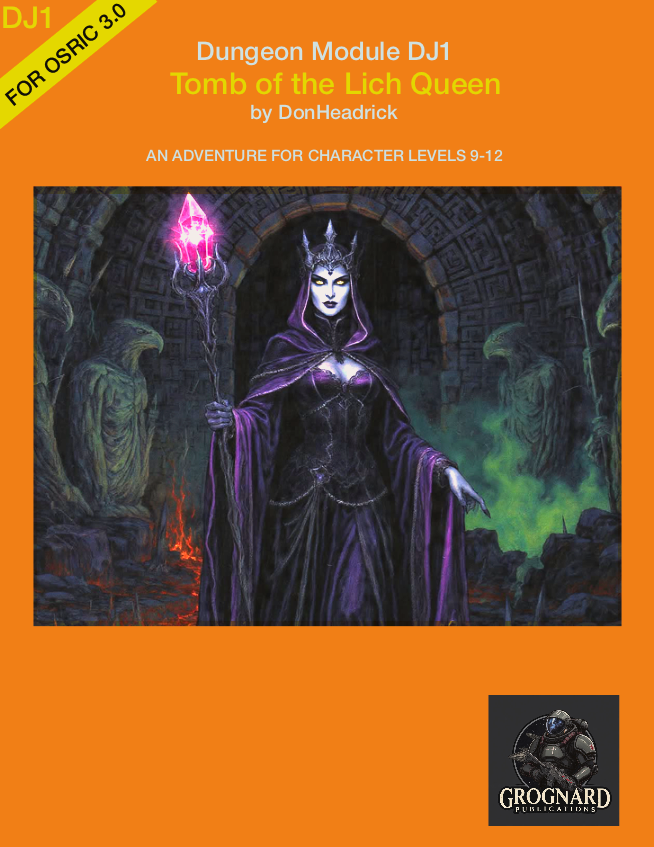
Tomb of the Lich Queen
By Don J Headrick
Grognard Games
OSRIC
Levels 9-12
Grognard Games
OSRIC
Levels 9-12
For centuries the Tomb of the Lich Queen has lain hidden within a vast wasteland of cliffs, canyons and chasms. Now it has been found, and its legendary lost treasures have drawn adventurers from across the realms. Can you navigate deadly traps, fearsome guardians, and age-old puzzles to claim the prize?
This twelve page “death-trap” dungeon features eight rooms with a lich at the end. It’s just the usual low-effort dungeon, not particularly challenging, over hyped, and undelivered on. There are Grimtooth overtones, if Grimtooth was a pussy.
It’s eight linear rooms. Do you want a dungeon with eight linear rooms? At level twelve? There’s a map, but I’m not sure why one was even included. You go the only way you can go. In through one door and out through another. Is that a level twelve adventure? Is that worth $6.50?
The marketing blurb says we have a legendary tomb and adventurers from across the realm. I love luv LUV Gone FIshin because of this! A steady stream of others fumbling about, royal currying favor and mud farmers full of pox and starving children desperate for coin. That’s fun! None of that happens here, of course. That would be fun. And imaginative.
After several pages of backstory that are meaningless to the adventure you’re dumped in medias res in front of a door. Or, as the adventure puts it “You have penetrated the pyramid and braved its outer defenses defeating ancient guardians and have finally found the sarcophagus of the Lich Queen “ Fortunately, you are still at full strength in every way. Anyway, “Suddenly gouts of green poisonous gas erupt behind you filling the passage, you have no choice but to hurry into the chamber.” We can see here several classic themes of bad adventure writing. There’s the use of second person writing throughout. This is the “you/your” phrasing. This is not appropriate. It is either a crutch for weak writing, which should be improved, or an attempt at immersive dramatic writing, which should not be done this way, if at all. Gouts of green poison gas! Oh no! The entire party is immune to poison, why would we flee? For some reason there’s this idea that you have to force the party. They are there to adventure. You don’t need to force them anywhere. Suddenly, being forced, doors slamming shut … you’re not writing a movie here. You’re providing a backdrop in which the players, through the party, along with DM are given a place to engage in play. They are, together, creating a narrative, in real time. DONT FUCKING FORCE IT! Shipwrecking the party may be ok for the first level one in a new campaign on an island. It’s not ok later on when the party has the means and desire to make decisions. That’s the fun. Making the decisions. “Beyond the moon door you see” I don’t have eyes you insensitive clod!
Rooms here average about a column or so each. This is for fairly basic rooms. Read-aloud over explains “Adorned with frescoes capturing the highlights of the Lich Queens depraved rule. There are scenes of her subjects bowing before her. Depictions of her pacts.” Frescoes, if we must, and then when the party examines them we can respond with detail from the DM an then the party will ask follow up questions and take actions and the DM will respond. This is the core RPG loop. Over-explaning in the read-aloud shows a basic lack of understanding for what an RPG game is.
Writing is padded out “There appears to be no exit from this room.” Uh huh. Appears is almost never a word to use in adventure writing. It is or it isn’t, from the parties perspective. And from the DMs perspective they have perfect knows. Everything the party has ever experienced in a game “appears to be …” Stating this is just padding. There is little to no theming here.
From the interactivity standpoint we have this fine gem “If the players are having an easy go of it, throw some more Salamanders/Mephits or the Dragon at them.” The height of adventure writing. Lazy adventure writing. What’s the point here? It’s the designers job to write interesting encounters. That’s what we’re paying for. Or, you know, I guess just don’t.
The adventure is marketed as a death-trap dungeon. “ Bring 3 characters. You’ll need them.” The first room is a 1d6 pit trap with 1d6 damage from spikes at the bottom. There’s a gel cube in the bottom. I’m not sure this is a death trap. Much is made of the room slightly sloping down toward the pit and maneuvering in the dark toward the pit because of the slope. This sounds oddly specific for an eventuality that is unlikely? Room two is the classic rolling bounder trap in a hallway, with a pit to jump in to avoid it, with a 1d6 damage spike in it also. Again, not sure this is a death trap. And so it goes. Eventually there’s an efreet and maybe a dragon, along with two stone golems and a lich at the end. No one has any treasure, just the staff of power/wizardry at the end. Also, one room is empty/a recovery room. This isn’t even grimtooth levels of traps. A level nine, not to mention a level twelve, is going to have extensive magics available. I’m not sure a level twelve party would even encounter ANY of these rooms.
There is a secret door in a pit, which I always love. This is the non-obvious/’of course that’s where it is’ thing that is always a delight to see executed in adventures..
It’s just another low-effort dungeon. You have to really work these things. Every adventure ever in the history of the world is now available for a DM to run. When you’re producing something one must ask if this is possibly the best thing ever? If it’s not then what’s the point? You gotta pour yourself in to these to make them stand out.
This is $6.50 at DriveThru. There is no preview. You need to offer a preview so a potential buyer can see a few rooms before they spend money on a purchase.
https://www.drivethrurpg.com/en/product/574184/tomb-of-the-lich-queen?1892600
Categories: Tabletop Gaming Blogs
Saving Throws and Implied Class Characteristics
Art by Jeff Easley
Savings throw in latter day editions of D&D are intrinsically tied to ability scores, which is pretty easy to understand. Old school saving throws, in contrast, are oddly specific and therefore difficult to generalize. Beyond that, given that they are tied to class, and only a few get ability score bonuses, it's not immediately clear what's going on in the fictional world.

Savings throw in latter day editions of D&D are intrinsically tied to ability scores, which is pretty easy to understand. Old school saving throws, in contrast, are oddly specific and therefore difficult to generalize. Beyond that, given that they are tied to class, and only a few get ability score bonuses, it's not immediately clear what's going on in the fictional world.
Of course, this can be seen as a feature not a bug. Proponents point out the abstraction allows the player and DM to interpret what happens in the fiction, making this an unexpectedly more narrative sort of mechanical feature.
That's all sort of interesting, but a problem (for me at least) is that their progression is uniform based on class, and every member of the same class has the same distribution of saving throw aptitudes. So, while you're free to interpret success (or failure) any way you like, whatever situational explanation you give doesn't really build or develop the fictional world. As written, every cleric's better saving throw than other classes against Death Magic is just a mechanic.
I think it's more interesting to view them as telling us something about the world, while leaving room for situational factors. The fact that every member of a class is more resistant to certain dangers than others can tell us something about the training, aptitudes, of characteristics of people in that class.
Compared to the normal individual (0 level Fighter in AD&D parlance), we could conclude that:
Clerics have divine favor bolstering their spiritual and mental fortitude. This particularly protects them from effects that would destroy or disrupt the body. Their biggest advantage is against Poison & Death Magic, but they have consistently good defense against all sorts of dangers.
Fighters have their martial spirit increasing their fortitude and perhaps giving them a "sixth sense" for danger. At first level, they are neophytes and haven't cultivated this to a great degree, but by the time they max out, they have the best saves on average.
Magic-Users possess an innate arcane aura that strengthens slowly as they develop their skills. It makes them particularly resilient in the face of spells and spell-like effects cast from common magical implements like wands and staves. Interestingly, they are also somewhat protected against the magical breath of dragons. Their aura adds little to protect them from poison, though.
Thieves rely on luck to get by. In the beginning it mostly protects them against things that would bind, hinder, or directly impair them being who they are. Unfortunately, they tend to wear their luck out and they max out their saves worse off than the other classes.
Certainly, these aren't the only implied class abilities you could take from these, but I wanted to come up with an explanation that didn't implicate ability scores, and I haven't really seen another approach that does that.
Categories: Comic Book Blogs, Tabletop Gaming Blogs
A d100 Abominations and Mutants Sword & Sorcery Random Encounter Table for Castles & Crusades rpg
d100 Abominations & Mutants: Sword & Sorcery Encounter Table This blog entry picks right up from the A d100 Abomination and Undead Sword & Sorcery Random Encounter Table for Castles & Crusades rpgd100Encounter Description & Details01The Obsidian-Gland Brute: A towering, hairless mutant whose veins glow with black, viscous fluid. Striking its chest causes Needleshttp://www.blogger.com/profile/11243274667834930867noreply@blogger.com0
Categories: Tabletop Gaming Blogs
RPG a Day 2026 – Day 10: Secret
Welcome to Day 10 of #RPGaDay2026. As I explained in my Day 0 post, I’ll be creating NPCs based on the day’s prompts and the week and day modifiers presented in the infographic below. Check out that post for further details.
Today’s combination: Secret (Prompt) + Associates (Weekly Modifier) + Fair of Face (Weekly Modifier) + Superhero (Genre)
Here is today’s NPC.
The Fantastic Enchanter (Fantasy Name Generator used for the name: Superhero name generator)
Whoever this individual is, they never call themselves the “Fantastic Enchanter”, that moniker was bestowed upon them by the heroes and villains of the city. Their true identity remains a closely guarded secret.
No one communicates with the Enchanter directly. All interactions are handled through their proxies, and these associates share one striking trait: they are always exceptionally beautiful. With chiseled features, impeccable physiques, and fair faces, it seems the Enchanter recruits, or controls, only the most physically attractive citizens.
Whether this control stems from magic, a superpower, or conventional blackmail, these associates carry out the Enchanter’s bidding without question. There is little they will not orchestrate. They can find a missing person, deliver illicit goods, negotiate a truce in an underworld feud, or conduct high-level espionage. Whenever you find yourself surrounded by beautiful people, you can never be entirely sure if the Fantastic Enchanter has their eyes on you.
Financial compensation is rarely requested for these services—instead, the Enchanter trades in favors, debts, and information. Superheroes remain highly suspicious of this shadow broker, yet they frequently rely on them for critical intel or to arrange neutral meetings. Villains and criminal syndicates distrust them just as much but cannot deny the results the Enchanter delivers. Ultimately, their vast network of connections and influence makes the Fantastic Enchanter an indispensable resource to both sides of the law.
Thanks for reading; I am looking forward to your RPG a Day 2026 post, comments, and conversation. If you want further information about #RPGaDay2026, be sure to check out Autocratik’s blog.
A Spanish version of this post is available at the Desde la Fosa Facebook page.
See you all tomorrow!
Categories: Tabletop Gaming Blogs
OSR Meditations - Using The classic TSR module C3: The Lost Island of Castanamir by Mike Breault for Adventurer, Conqueror, King II Rpg
C3: The Lost Island of Castanamir (originally published by TSR for AD&D in 1984) is a non-linear "funhouse" island crawl and planar maze designed by Mike Breault. The module drops player characters (PCs) into the mysterious, magically unstable island retreat of Castanamir the Mad, an archmage who vanished decades ago.Below is an adaptation of The Lost Island of Castanamir formatted for Needleshttp://www.blogger.com/profile/11243274667834930867noreply@blogger.com0
Categories: Tabletop Gaming Blogs
Further OSR Meditations - Using The classic TSR module B5: Horror on the Hill (originally written by Douglas Niles for Basic D&D) With The ACKS II Rpg
The classic TSR module B5: Horror on the Hill (originally written by Douglas Niles for Basic D&D) translates exceptionally well into Adventurer Conqueror King System II (ACKS II). ACKS II excels at wilderness survival, hex-clearing, and dynamic dungeon ecology, making "Guido’s Fort" and the deadly, monster-infested hill across the river an ideal sandbox for low-level ACKS II Play.Here is a Needleshttp://www.blogger.com/profile/11243274667834930867noreply@blogger.com0
Categories: Tabletop Gaming Blogs
RPG a Day 2026 – Day 9: Privilege
Welcome to Day 9 of #RPGaDay2026. As I explained in my Day 0 post, I’ll be creating NPCs based on the day’s prompts and the week and day modifiers presented in the infographic below. Check out that post for further details.
Today’s combination: Privilege (Prompt) + Intellect (Weekly Modifier) + Blessed (Weekly Modifier) + Post-Apocalyptic (Genre)
Here is today’s NPC.
Haellen, better known as Fortune (Fantasy Name Generator used for the names: Apocalypse/Mutant nickname generator, Futuristic name generator, and post-apocalyptic town name generator)
In the post-apocalyptic settlement of Kilead, there lives a young woman known as Fortune. Before her birth, the town was little more than a desperate huddle of survivors, fighting raiders and each other to scrape by. Born to a wanderer, the mutant infant was left to die in the dirt, until a kindly woman took her in and named her Haellen.
Haellen’s mutations initially seemed like a death sentence. Unable to walk and bearing an unnaturally large head, she was viewed with suspicion; on more than one occasion, her adoptive mother had to fight off neighbors to keep the child safe. But the girl’s fate shifted when, at barely two years old, she began to speak. Though physically dependent on others, her words had a soothing, often otherworldly effect. Soon, the toddler was mediating disputes and guiding the survivors toward cooperation, fundamentally changing the town’s destiny.
Under her immense intellect, Kilead slowly transformed into a thriving settlement, trading with other enclaves, fortifying its walls, and tilling the surrounding fields. The residents no longer saw her as a curse, but as a profound blessing, eventually renaming her Fortune. They now shower her with privileges and fiercely protect her.
Today, Fortune holds a widespread reputation as a seer and leader; rumors even claim her voice can pacify feral mutants and wild beasts. While she directs her people and they tend to her physical needs, her influence has drawn outside attention. As she has grown into a young woman, rival tribal chiefs and leaders have vied for her favor, with some attempting to arrange political marriages. Thus far, anyone who meets with her face-to-face is swiftly convinced to abandon such plans. However, a lingering dread hangs over Kilead: the fear that eventually, a ruthless warlord will decide to stop negotiating and try to take their Fortune by force.
Thanks for reading; I am looking forward to your RPG a Day 2026 post, comments, and conversation. If you want further information about #RPGaDay2026, be sure to check out Autocratik’s blog.
A Spanish version of this post is available at the Desde la Fosa Facebook page.
See you all tomorrow!
Categories: Tabletop Gaming Blogs
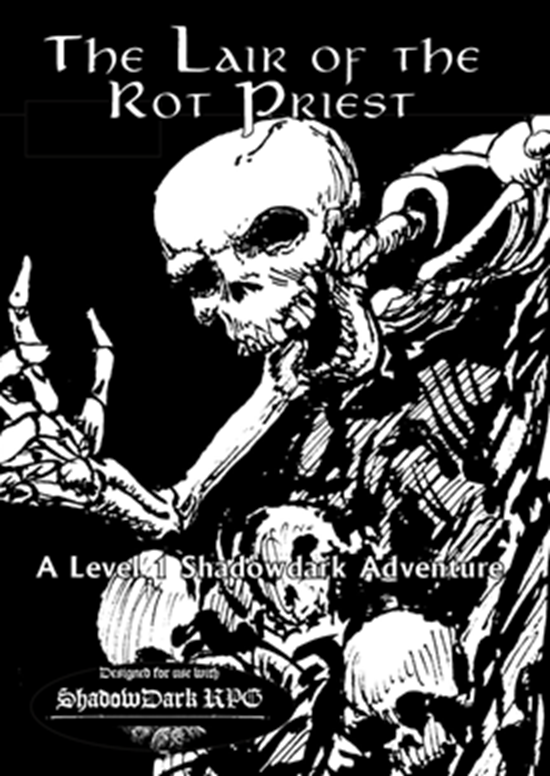
The Lair of the Rot Priest
By Devin MacKay
THorium 90 Prductions
OSR/Shadowdark
Level 1
THorium 90 Prductions
OSR/Shadowdark
Level 1
People in the poorer, more crowded neighbourhoods of the City of Copven are getting sick. Disease is spreading and swarms of biting and stinging insects have been reported frequently in the homes of the most afflicted. Sightings of these creatures emerging from the sewer grates and drains below have prompted the city to send workers down below to investigate. When these workers did not return, a group of city guards followed. As a last ditch effort to get to the bottom of this, the Commander of the City Watch and scraped the bottom of his jails and come up with you, all of who are here convicted of a criminal offense. The deal is simple, learn the truth stop the problem, and you leave the sewers free, if not, then you don’t leave at all. Can you win your freedom and survive the Lair of the Rot King?
This ten page adventure uses three pages to describe nine rooms in the sewers. It’s exactly what you think it is. Hubris got to me. Mea Culpa.
Hey man, the name of the publisher is Thorium 90. I’m not made of stone. I’ve been on a good run, and some of the Shadowdark stuff has been decent even as a crossover to OSE. What do you want from me, a studied and insightful knowledge of history that I learn from?
The town has a plague. Oh no! The party are prisoners. Oh no! You get your freedom is you Do The Thing. Yeah! There’s a little table to support this, giving reasons why you are a prisoner. You spit in a lord’s food. You dug up a grave to steal the silver fillings. You riffled the pockets of a passed out drunk. You forged the name of a guild leader to get access to a fancy party. This is some great petty crimes and I’m fully supportive of hyperrealism of the crimes and punishments. Mind your betters, eh?
The plague thing is interesting also. I love a good plague. Turns out there have been swarms of insects and vermin in the rooms with the people dying. Tracked back to … duh DUh DUH: THE SEWERS! Well, this isn’t exactly true. The party will not be involved in any of that. The plague, the suffering and misery of man. An investigation and tracking back of the issue to the sewers. Nah, you’re just shoved down the sewer hole so you can start hacking at shit. I know it’s a little hackneyed to have an investigation and then a lair crawl, but, man, it’s that way for a reason. If you are building an exploration dungeon with fifty rooms, several levels and so on then, sure, the dungeon is the adventure. But when your dungeon is nine rooms then it feels a little off to have that be the totality of the adventure, hence the investigation.
Yeah, ok, so, an essentially linear dungeon in a sewer. Kill some centipedes. Kill some swarms. You know the deal. Don’t worry, you can’t escape because there are grates in the main sewer pipe that you can’t get through because of [REASONS.] Just hack. In fact, come to think of it, there are a number of grates in the floor and a well and grates in the sewer line. None of which you can explore. It’s like putting in a waterfall with nothing behind it. Why? Why put in a well IN A SEWER if you’re not going to do something with it? They are MADE to go down. Grates are MADE to be pulled up. It’s almost like no one cared …
Did I mention that treasure is not placed? “Roll on the minor treasure table three times.” Fucking put in a god damn treasure. It’s your fucking job as designer. Put in the treasure, make it make some sense to the area its in and describe it in a few words. Fuck me man. What exactly is the point of a designer if its not that?
The adventure ends with Lareth. In the final room Lareth hides. He monologues and then attacks. How many times must Lareth appear in an adventure? Your baddie needs to be foreshadowed. There is no impact from the bing bad if he’s just another thing to hack down in the dungeon. Yes, I understand, you’ve got a monologue in there. That doesn’t help. By the time the party meets the evil high priest they should already know what the monogie is likely to be, so that the baddie need not give it. Did I mention that Rot Priest Angren Murrian has a whole backstory and history? Only to be cut down immediately and without hesitation …
I can be an ass. Surprise! I know, right. One day I’m going to be in a particularly petulant mood and not really give a shit that I’m ruining everyone else’s time at the table. I’m going to take one of these throw-away villains and really dive deep in to them. Explore, during the game as a player, their entire history. Track down people who knew them, their life experiences. Every place they went and everything that made them up. The full Rosebud treatment. I’ll never stop, always thinking that here must be MORE. There could be MORE! What conspiracies hide here?! I mean, there must be, give that named person appeared, with a monologue, and a half page of backstory. There MUST be more, right?!
Yeah, so, I’m an idiot. It’s just a throw-away adventure.
This is $3 at DriveThru. There is no preview. You need a preview so potential buyers can make an informed decision prior to an actual purchase.
https://www.drivethrurpg.com/en/product/574339/the-lair-of-the-rot-priest?1892600
Categories: Tabletop Gaming Blogs
OSR Campaign Setting - Leigh Brackett Solar System Campaign Framework & D100 artifacts and treasures table for the Leigh Brackett solar system
In Leigh Brackett’s "Old Solar System," science is indistinguishable from ancient magic, Mars is a dying desert of decaying stone cities and ancient secrets, Venus is a mist-choked swamp of matriarchal cults and sea-monsters, Mercury is a brutal rock of twilight nomads and penal camps, and Earth is a mercenary corporate force plundering the universe. We pick right up from OSR Campaign Needleshttp://www.blogger.com/profile/11243274667834930867noreply@blogger.com0
Categories: Tabletop Gaming Blogs
RPG a Day 2026 – Day 8: Resolve
Welcome to Day 8 of #RPGaDay2026. As I explained in my Day 0 post, I’ll be creating NPCs based on the day’s prompts and the week and day modifiers presented in the infographic below. Check out that post for further details.
Today’s combination: Resolve (Prompt) + Intellect (Weekly Modifier) + Works Hard (Weekly Modifier) + Cyberpunk (Genre)
Here is today’s NPC.
Kaelen “Aegis” Vance (Fantasy Name Generator used for the name: Cyberpunk (nick)name generator)
In the neon-drenched sprawl, where flash often substitutes for substance, Kaelen Vance is an anomaly. Known on the street as “Aegis,” he is not the chromed-out, hyper-aggressive mercenary often associated with the modern Ronin. Instead, Aegis is a meticulous professional whose reputation is built on unwavering resolve. It is said that once Aegis accepts a contract, only his death will prevent its completion. He does not take jobs to build a reputation; he takes them to execute them with extreme precision.
His presence reflects his methodical nature. Aegis has rejected flashy or bulky bionic enhancements for practical cybernetics that seamlessly integrate with his musculature. One eye is a well-disguised, natural-looking optical sensor that feeds data directly to his neural computer. Intellect, rather than brawn, is his primary weapon. While he is lethal in combat, he prefers to outthink his opponents, analyzing weak points and running probability simulations long before the first shot is fired.
His success is not accidental, nor is it solely dependent on his enhancements or hardware. Aegis works hard, and his strict discipline pays off. He despises laziness and blind improvisation, believing that in his line of work, if you don’t have a plan, you might as well be dead. He is willing to share his knowledge and methods with worthy allies, easily stepping in as a tactical advisor for complex heists or a formidable ally when overwhelming force is required.
However, he has little patience for those who do not share his work ethic or dedication. To earn Aegis’s respect, one must prove they have the intellect to formulate a plan and the resolve to see it through, no matter what the cost.
Thanks for reading; I am looking forward to your RPG a Day 2026 post, comments, and conversation. If you want further information about #RPGaDay2026, be sure to check out Autocratik’s blog.
A Spanish version of this post is available at the Desde la Fosa Facebook page.
See you all tomorrow!
Categories: Tabletop Gaming Blogs
Victor von Doom (Doctor Doom) adapted for the Superpowered! RPG & Cepheus Engine Rpg Games
Victor von Doom (Doctor Doom) adapted for the Superpowered! RPG (a streamlined 2d6 superhero system built on the Quantum/Cepheus Engine framework).In Superpowered!, characters are defined by 7 core Skills, Endurance (stamina), Lifeblood (health), a primary Power source, Abilities, and a Weakness. Doom is built as a top-tier Needleshttp://www.blogger.com/profile/11243274667834930867noreply@blogger.com0
Categories: Tabletop Gaming Blogs
Weird Revisited: Kung Fu Dark Sun
As when I wrote this post in 2019, I've been watching some wuxia film lately, and then there was the announcement of a new edition of Dark Sun, so it seemed a good time to revisit this idea...
art by Eric Belisle
Still on a wuxia kick and thinking about the arid lands of Northern China, it occurs to me that Dark Sun might be an interesting mashup with kung fu action. It is true that the default 80s barbarian film meets Mad Max aesthetic of Dark Sun doesn’t scream Crouching Tiger or Hidden Dragon, but that aside, I think it’s actually not a bad fit. Let me run the list:

Still on a wuxia kick and thinking about the arid lands of Northern China, it occurs to me that Dark Sun might be an interesting mashup with kung fu action. It is true that the default 80s barbarian film meets Mad Max aesthetic of Dark Sun doesn’t scream Crouching Tiger or Hidden Dragon, but that aside, I think it’s actually not a bad fit. Let me run the list:
- The downgrading of weaponry due to the scarcity of metal in the setting leaves space for bare-handed martial arts.
- The Elemental clerics thing can easily spun in a wuxia direction (as seen in Avatar: The Last Airbender).
- The "fighting oppression" angle of Dark Sun dovetails nicely with with the "fighting corrupt authority" aspect of some wuxia.

- There are Thri-Kreen who are praying mantis people, essentially, who would be natural practitioners of praying mantis kung fu.
- Athasian Dragons aren't common monsters but beings of immense power, like the Chinese conception of the creature (though Athas's is certainly not benevolent).

Categories: Comic Book Blogs, Tabletop Gaming Blogs
OSR Sword & Sorcery Adventure Fodder - d100 Random Serpent People & Treasure Table tailored for the Serpent Tower fully compatible with Castles & Crusades (and most classic OSR systems)
Here is a themed d100 treasure table for the Serpent Tower, blending ancient serpent-cult relics, ophidian oddities, venomous alchemy, and classic Castles & Crusades treasure. This entry picks from OSR Sword & Sorcery Adventure Fodder - d100 Treasure Table tailored for the Tower of the Serpent Horde, fully compatible with Castles & Crusades (and most classic OSR systems)TheNeedleshttp://www.blogger.com/profile/11243274667834930867noreply@blogger.com0
Categories: Tabletop Gaming Blogs
RPG a Day 2026 – Day 7: Mercy
Welcome to Day 7 of #RPGaDay2026. As I explained in my Day 0 post, I’ll be creating NPCs based on the day’s prompts and the week and day modifiers presented in the infographic below. Check out that post for further details.
Today’s combination: Mercy (Prompt) + Intellect (Weekly Modifier) + Loving and Giving (Weekly Modifier) + Western (Genre)
Here is today’s NPC.
Sister Laila Casad (Fantasy Name Generator used for the name: Old West name generator)
Sister Laila joined the Sisters of Sienna after her husband, Mad Dog Casad, was hanged for his crimes by a Marshal in the territories. Seeking penance for his eternal soul—and perhaps her own—she joined the nuns, dedicating herself to protecting the defenseless and educating the young.
While she lacked formal religious training, she possessed a sharp intellect and knew how to survive. These skills helped keep her and the other sisters safe during their mission to build an orphanage where children could be taught the mercy of the Lord. Laila took her vows not long after the Sienna Orphanage was finished.
She proved to be a fast learner, letting go of past anger and old grudges to fully embrace the Sisters of Sienna’s mission of loving and giving unto others. She has since grown into a position of leadership at the frontier orphanage: teaching the children, guiding her fellow sisters, and protecting her home against bandits or anyone else who means them harm.
The Sienna Orphanage always offers hospitality to weary travelers in exchange for a small donation. Sister Laila keeps an open ear for rumors regarding travelers and ne’er-do-wells in the nearby territories, and she is always willing to share what she knows with friendly visitors. However, she won’t hesitate to pull a gun from under her habit and remind anyone with ill intent that she is still the widow of Mad Dog Casad.
Thanks for reading; I am looking forward to your RPG a Day 2026 post, comments, and conversation. If you want further information about #RPGaDay2026, be sure to check out Autocratik’s blog.
A Spanish version of this post is available at the Desde la Fosa Facebook page.
Categories: Tabletop Gaming Blogs
Pages
